









A fast RC car is easy to find. A small 1/16 model that also combines 4WD, proportional controls, independent suspension and outdoor-oriented hardware is a more interesting proposition.
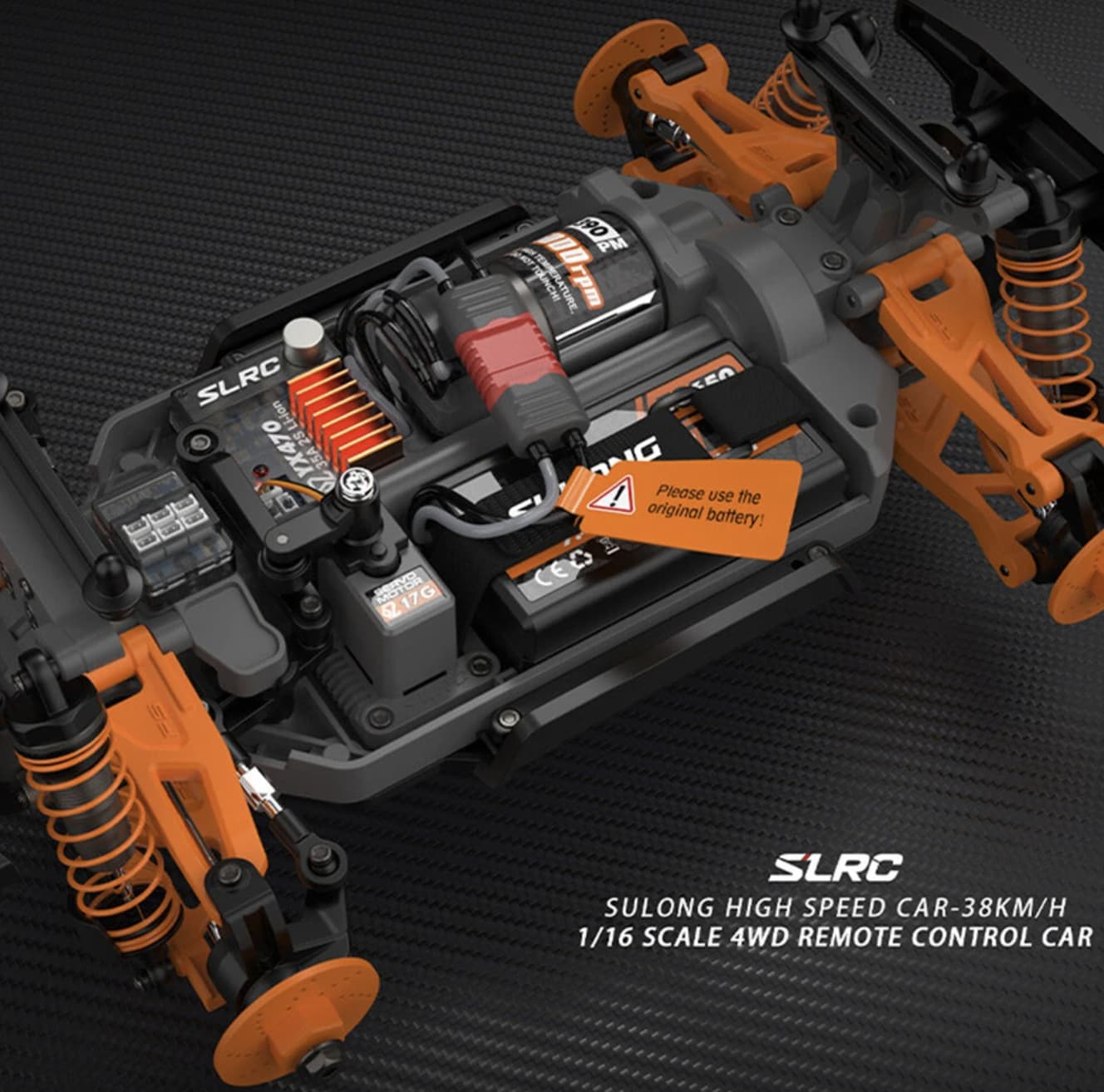
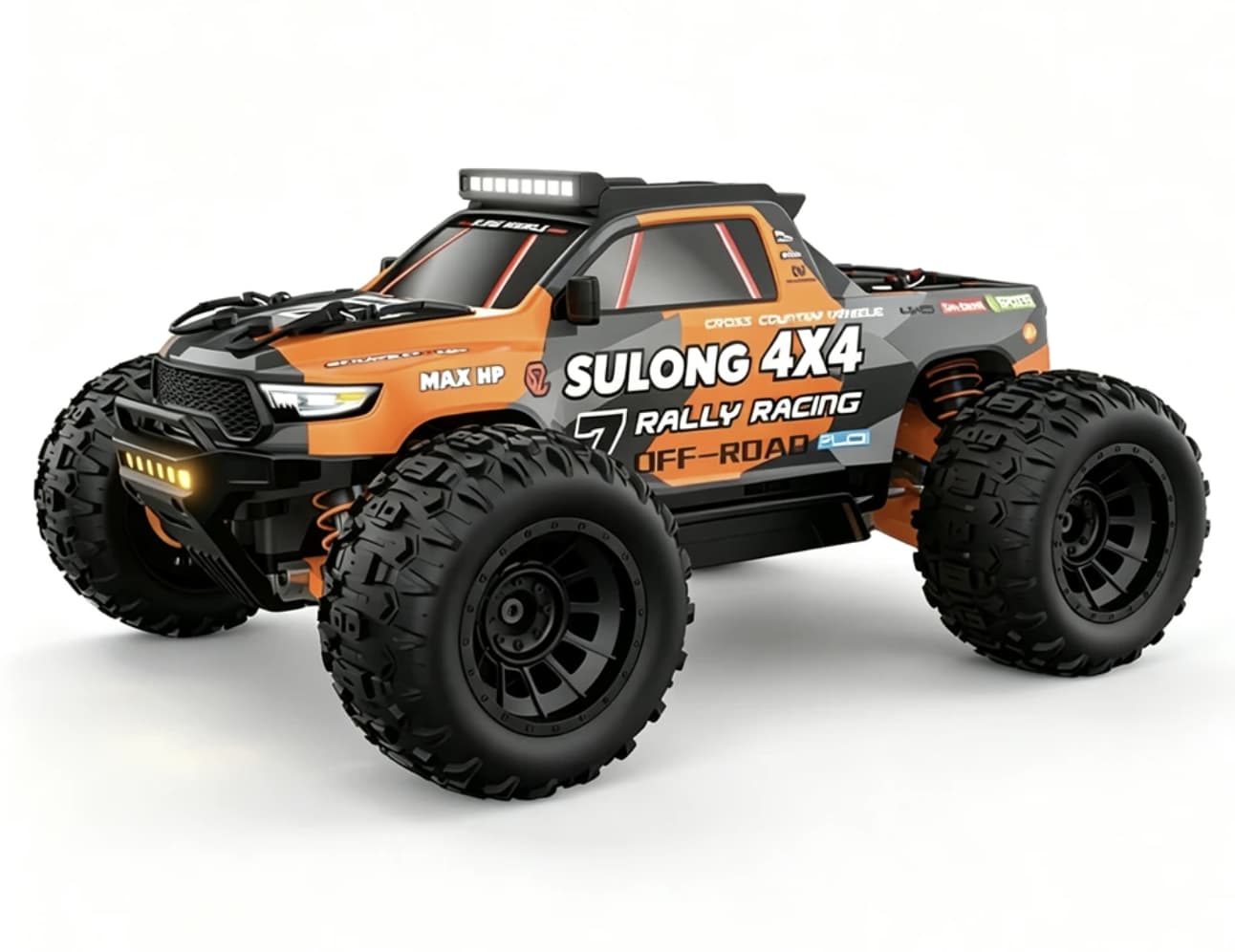
The SLRC C7 rc car is built around that combination. It is a 1/16-scale RTR RC car with a claimed top speed of 38km/h, an RS390 brushed motor, 4WD transmission, full proportional steering and throttle, independent suspension, metal drivetrain components and multiple LED lights.
But the 38km/h figure isn’t the only thing worth looking at.
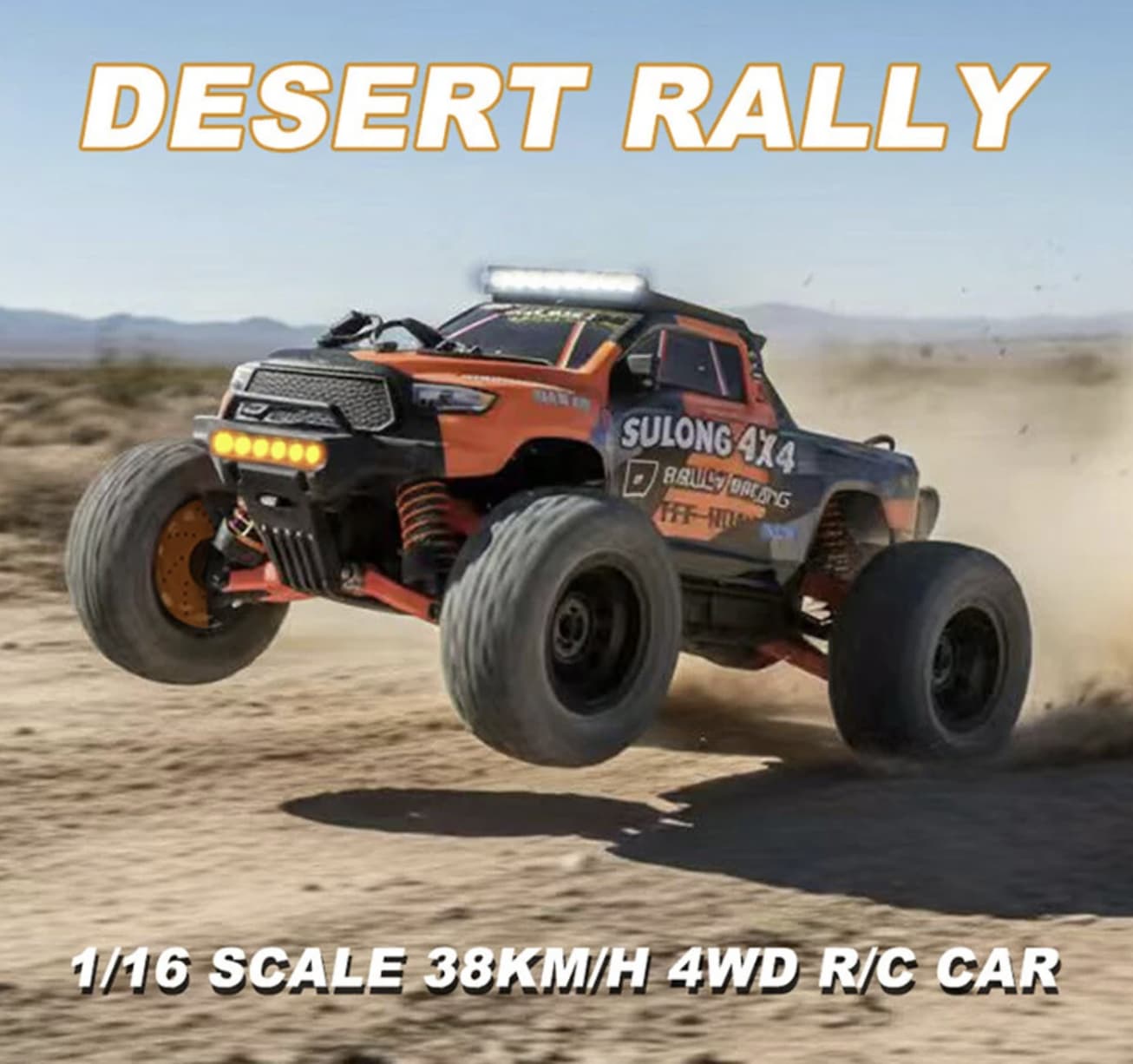
For someone shopping for a compact 1/16 RC car for grass, dirt, pavement and general outdoor driving, the more important questions are how the drivetrain, suspension and controls work together, whether the brushed motor is enough, and what type of driver the C7 is actually designed for.
SLRC C7 at a Glance
| Specification | SLRC C7 |
|---|---|
| Scale | 1/16 |
| Drive system | 4WD |
| Claimed top speed | Up to 38km/h |
| Motor | RS390 brushed motor |
| ESC | 35A integrated ESC/receiver |
| Control | Full proportional steering and throttle |
| Radio | 2.4GHz, 4-channel |
| Claimed range | At least 80m |
| Suspension | Independent double-wishbone |
| Battery | 7.4V Li-ion |
| Listed runtime | Approximately 20–25 minutes |
| Listed charging time | Approximately 3–4 hours |
| Tire diameter | Approximately 8cm |
| Vehicle dimensions | Approximately 29.5 × 22 × 14cm |
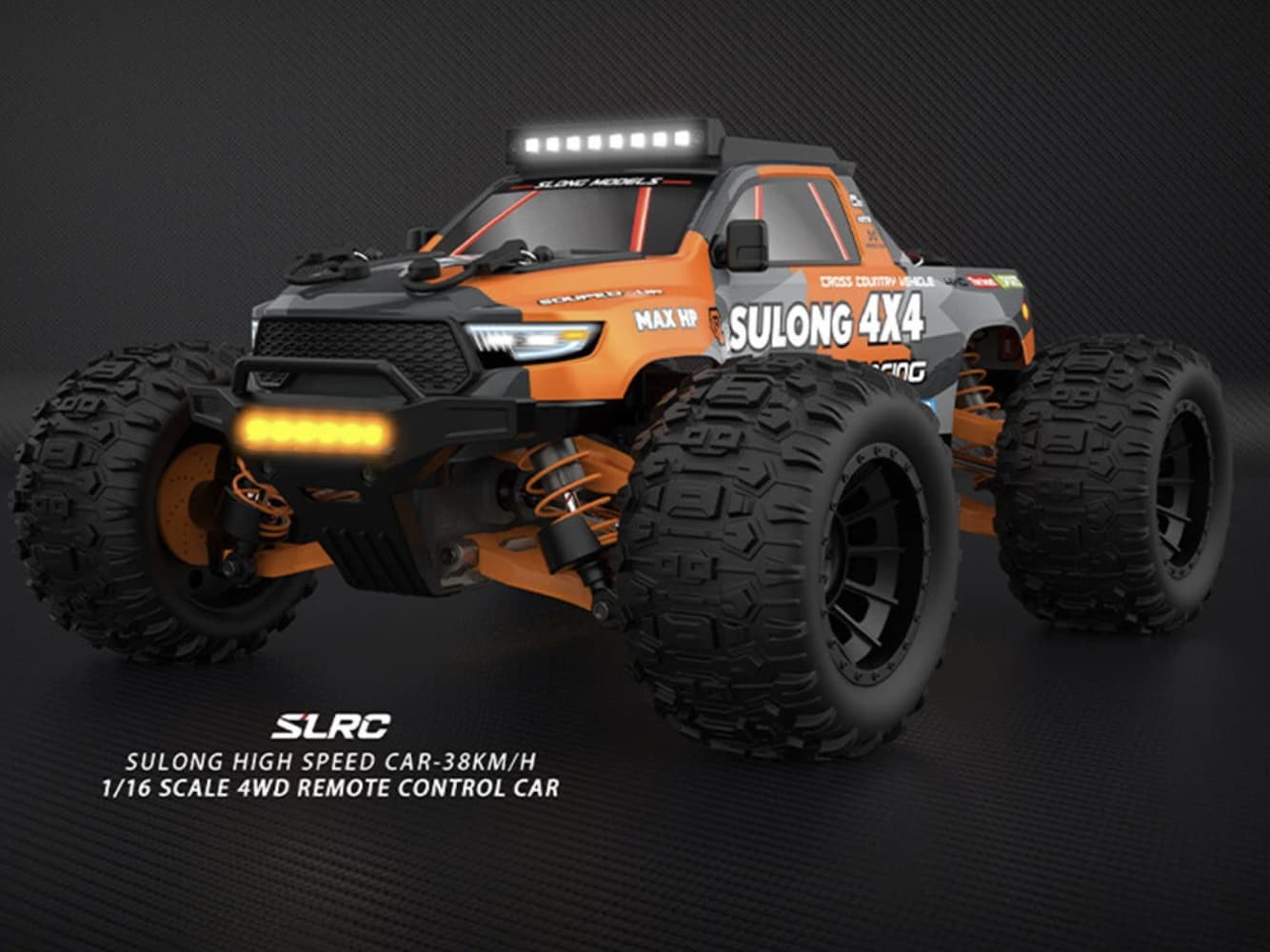
| Lighting | Front, roof, rear and chassis LEDs |
Specifications are based on the current product listing and can change. The 38km/h figure is a listed/claimed maximum rather than an independently measured result.
What Makes the SLRC C7 Interesting?
The C7 isn’t simply trying to win attention with a large speed number.
Its combination of 1/16 scale and 4WD gives it a different role from very small indoor RC cars. The chassis is large enough for outdoor driving, while the four-wheel-drive system is intended to provide traction when the surface becomes loose or uneven.
The vehicle is also equipped with proportional steering and throttle.
That matters more than it might initially sound.
A basic toy-grade RC car often responds to the controls with relatively simple inputs. The C7 allows the driver to apply throttle progressively and make smaller steering adjustments.
That makes it easier to control speed entering a corner, reduce wheelspin on loose ground and make corrections when the vehicle starts moving away from the intended line.
For an outdoor RC car, control can be more useful than another few kilometers per hour of theoretical top speed.
How Fast Is the SLRC C7?
The SLRC C7 is advertised with a maximum speed of 38km/h.
For a 1/16 RC vehicle, that’s a fairly lively speed for recreational driving. At that pace, the available space and surface become important. A car traveling quickly across smooth pavement behaves very differently from the same car driving across grass or loose dirt.
It’s also important not to treat 38km/h as a guaranteed real-world measurement.
Actual speed can vary according to battery condition, surface, temperature, tire condition, vehicle setup and other factors. Therefore, 38km/h should be viewed as the manufacturer’s/listing specification rather than an independent test result.
This distinction is worth making because it gives buyers a more realistic expectation of what they are getting.
Is 4WD More Important Than Top Speed?
For outdoor driving, it can be.
A 2WD RC car can be entertaining on smooth surfaces, but loose dirt and grass can make maintaining traction more difficult. With four driven wheels, the C7 has more opportunities to transfer motor power to the ground.
That doesn’t mean 4WD makes the vehicle unstoppable. Tires, surface conditions, weight distribution and suspension setup still matter.
What 4WD does provide is a drivetrain better suited to the type of mixed-surface driving for which the C7 is intended.
This makes the SLRC C7 particularly interesting for drivers who want to move between pavement, grass, dirt and other relatively open outdoor surfaces rather than staying indoors.
Independent Suspension Is Important for Off-Road Driving
Speed is only useful if the vehicle can remain controllable.
The C7 uses an independent double-wishbone suspension arrangement with coil springs at the front and rear. Each wheel can therefore respond more independently to changes in the surface.
Imagine driving over a patch of grass with small bumps. Instead of the entire chassis responding as one rigid unit, the suspension has room to absorb some of those changes.
That can help keep the tires in contact with the ground and make steering behavior more predictable.
The C7’s approximately 8cm tires also give the vehicle a more substantial footprint than tiny indoor RC cars.
This doesn’t turn the C7 into a dedicated rock crawler, however. Its design is better suited to fast recreational driving over relatively open terrain than slow technical crawling.
Brushed Motor vs Brushless: Where Does the C7 Fit?
The SLRC C7 uses an RS390 brushed motor rather than a brushless motor.
That’s one of the most important things to understand before buying.
Brushless systems are generally associated with higher-performance RC platforms, improved efficiency and greater upgrade potential. They are common in RC vehicles aimed at enthusiasts who want to push speed and performance further.
A brushed system, on the other hand, can make sense for a recreational vehicle where simplicity and cost are important.
The C7’s configuration suggests that it is positioned as an accessible fast outdoor RC car rather than a high-end performance platform.
So if your priority is:
“I want an affordable 4WD RC car that is fun to drive outdoors.”
The C7’s configuration makes sense.
If your priority is:
“I specifically want maximum performance and a brushless power system.”
You should look at brushless alternatives instead.
What Does Full Proportional Control Mean?
This is one of the C7’s most useful features for new RC drivers.
With proportional throttle control, the trigger doesn’t simply mean:
Full speed / Stop.
Instead, the driver can gradually increase power.
The same principle applies to steering. Small steering inputs can produce small corrections rather than forcing the vehicle immediately toward full left or right lock.
This becomes particularly useful at higher speeds.
For example, instead of entering a corner at full throttle and suddenly releasing the trigger, you can progressively reduce power and then apply steering input.
That gives the driver considerably more control over how the vehicle behaves.
The 2.4GHz Radio System
The SLRC C7 uses a 2.4GHz 4-channel radio system and the listing specifies a control distance of at least 80 meters.
For normal recreational driving, that provides plenty of operating space.
The 2.4GHz system is also a more convenient approach than older RC systems that relied on manually selecting different frequencies.
The important thing here isn’t simply the number of channels. For most C7 owners, the useful part is having a responsive radio system with proportional steering and throttle.
Can the SLRC C7 Handle Grass and Dirt?
That’s one of the areas where the C7 makes the most sense.
Its 4WD drivetrain, relatively large tires and independent suspension are better suited to outdoor surfaces than many compact indoor RC cars.
On pavement
This is where the C7 should have the easiest time reaching its advertised speed, assuming sufficient space and suitable conditions.
On grass
Grass introduces considerably more rolling resistance. Short, relatively firm grass should be easier than long or wet grass.
On dirt
Loose dirt can be entertaining because the tires can break traction under acceleration. The proportional throttle becomes particularly useful here.
On sand
Sand is much more demanding. Fine sand can place additional stress on motors, bearings and drivetrain components, so cleaning and maintenance become more important after driving.
The C7 is therefore best thought of as a multi-surface recreational RC car, not a vehicle designed for extreme terrain.
Metal Drive Components: Why Do They Matter?
The C7 uses metal drive components including metal drive dogbones and metal steering-related components.
This isn’t simply about making the specification sheet look impressive.
The drivetrain experiences repeated loads during acceleration, turning and driving over uneven surfaces. Reinforced components can therefore be useful for a vehicle intended to be driven outdoors.
However, metal components don’t make an RC car indestructible.
A 1/16 vehicle traveling close to 38km/h can accumulate considerable impact energy. Hitting a tree, curb or hard obstacle at speed can still damage suspension, wheels, gears or other parts.
The best approach is to treat the C7 as a recreational RC vehicle that still benefits from sensible driving and regular inspection.
LED Lighting Gives the C7 More Personality
The C7 includes several LED lighting elements, including front, roof, rear and chassis lighting.
These lights serve a practical purpose by making the vehicle easier to see in lower-light conditions, but they also change the appearance of the truck considerably.
For anyone who enjoys taking RC photos or videos, the lighting can make the C7 particularly recognizable in footage.
It is not a substitute for proper visibility or safe driving after dark, but it is a useful addition for evening recreational sessions.
How Long Does the SLRC C7 Battery Last?
The listing specifies a 7.4V Li-ion battery and approximately 20–25 minutes of runtime.
Actual runtime will depend heavily on how the vehicle is driven.
Constant full-throttle driving can consume power faster than moderate-speed cruising. Terrain also matters: grass and loose surfaces generally require more effort from the drivetrain than smooth pavement.
The listed charging time is approximately 3–4 hours, so anyone planning a long RC session should consider having a compatible spare battery rather than relying on one pack.
The transmitter requires three AA batteries, which are listed separately from the included vehicle battery.
Is the SLRC C7 Good for Beginners?
It depends on what kind of beginner you are.
For someone completely new to RC cars, the C7’s proportional controls are helpful because they allow the driver to reduce speed and practice gradually.
However, the advertised 38km/h top speed means this isn’t a toy that should be driven at maximum speed immediately in a small space.
A sensible learning approach would be:
- Start at reduced speed.
- Practice steering on a flat surface.
- Learn how quickly the vehicle brakes/coasts.
- Move to grass or dirt after becoming comfortable.
- Increase speed gradually.
- Leave maximum-speed runs for large, open areas.
This is one of the advantages of proportional control: the driver can learn the vehicle instead of having to operate it at full power from the beginning.
SLRC C7 vs a Basic Toy RC Car
The difference isn’t simply speed.
| Area | SLRC C7 | Basic Toy RC Car |
|---|---|---|
| Drive | 4WD | Often 2WD |
| Throttle | Proportional | Often basic |
| Steering | Proportional | Often basic |
| Suspension | Independent | Simpler |
| Outdoor driving | Designed for it | Depends on model |
| Motor | RS390 brushed | Usually simpler |
| Radio | 2.4GHz | Varies |
| Lighting | Multiple LEDs | Varies |
This is why the C7 sits somewhere between a simple toy and a more serious hobby-grade platform.
It provides several features that make the driving experience more controllable without requiring the owner to start with a highly specialized RC setup.
Who Is the SLRC C7 For?
The C7 makes the most sense for drivers who want:
- A compact 1/16 RC car
- 4WD traction
- A claimed speed of up to 38km/h
- Proportional throttle and steering
- Outdoor driving capability
- Independent suspension
- LED lighting
- An RTR setup that doesn’t require full assembly
It may be less suitable if your priority is:
- A brushless motor
- Competition-level racing
- Extreme rock crawling
- Maximum possible runtime
- A larger 1/10-scale platform
Understanding this difference is more useful than simply asking whether the C7 is “good” or “bad.”
The right RC car depends on what and where you want to drive.
What Comes With the SLRC C7?
The listed package includes the RC vehicle, battery, 2.4GHz transmitter, USB charging cable, manual, sticker set, Phillips screwdriver and L-shaped hex key.
The transmitter’s three AA batteries are not included.
Before ordering, check the current product page for the latest package contents because Banggood specifications and availability can change.
Final Verdict: Should You Consider the SLRC C7?
SLRC C7 is an interesting option for anyone looking for a relatively compact RC car that can move beyond indoor toy-style driving.
Its most meaningful combination is not simply the advertised 38km/h speed. The combination of 4WD, proportional controls, independent suspension, large off-road tires and reinforced drivetrain components gives it a more complete outdoor-driving setup.
The brushed RS390 motor also tells you where this vehicle sits in the market. It is designed more around accessible recreational performance than the upgrade potential of a brushless platform.
For a driver who wants to explore grass, dirt and pavement with a 1/16 RC car, those characteristics are arguably more important than chasing the biggest speed number on the box.
If you’re interested in the SLRC C7, check the current Banggood listing for the latest price, available shipping options, battery details and package contents before ordering.