









A good off-road RC car doesn’t need to be huge.
For many drivers, 1/16 scale is a sweet spot: small enough to use in a backyard or local open space, but large enough to carry a useful suspension system, four-wheel-drive drivetrain and tires capable of dealing with grass, dirt and gravel.
The challenge is that not every 1/16 4WD RC car is designed for the same kind of off-road driving.
Some are built for speed and jumps. Others prioritize crawling over rocks and uneven trails. Some use brushed motors to keep the price accessible, while brushless models focus more heavily on acceleration and upgrade potential.
So instead of choosing an RC car simply because the box says “4WD”, it is worth looking at the complete package: drivetrain, motor, suspension, tires, ground clearance, controls and the type of terrain you actually plan to drive on.
Quick Look: 1/16 4WD RC Cars for Different Driving Styles
| RC car type | Best suited to | What matters most |
|---|---|---|
| Fast 1/16 4WD basher | Grass, dirt, pavement and jumps | Speed, suspension, traction |
| 1/16 4WD truggy | Mixed surfaces and fast cornering | Handling and ground clearance |
| 1/16 4WD crawler | Rocks, trails and obstacles | Torque, gearing, articulation |
| 1/16 scale truck | General outdoor driving | Balance of control and durability |
| Brushless 1/16 4WD | High-speed driving | Motor, ESC, battery and drivetrain |
| Brushed 1/16 4WD | Casual/beginner driving | Simplicity, control and value |
This distinction is important because the fastest 1/16 RC car isn’t automatically the best off-road RC car.
A crawler geared for low-speed torque may be much better on rocks, while a fast basher will be more enjoyable on grass and open dirt.
Why Choose a 1/16 4WD RC Car?
The 1/16 scale sits between very small indoor RC models and larger 1/10 vehicles.
That makes it practical for people who don’t have access to a huge driving area.
A 1/16 model can usually be transported easily, stored without taking up much room and driven in relatively compact outdoor spaces.
The 4WD drivetrain adds another advantage.
When driving over grass, gravel or loose dirt, all four wheels can contribute to moving the vehicle forward. This can improve traction compared with a 2WD model, although tire design, motor power and weight distribution still have a major effect on actual performance.
The result is a compact RC platform that can be used for several types of recreational driving.
The Most Important Question: Fast Basher or Crawler?
Before choosing a model, decide what you mean by “off-road.”
If you want speed
Look for:
- Higher top speed
- Responsive proportional throttle
- Independent suspension
- Larger tires
- Good ground clearance
- Strong drivetrain components
- Effective heat management
This type of 1/16 RC car is designed for bashing — driving quickly over grass, dirt, gravel and relatively rough surfaces, with occasional jumps and slides.
If you want technical off-road driving
Look for:
- Low gearing
- High torque
- Flexible suspension
- Good approach and departure angles
- High ground clearance
- Grippy tires
- Drag-brake functionality
- Strong axle and drivetrain components
A crawler may move much more slowly than a high-speed basher, but it can be considerably more capable when the terrain includes rocks, roots and steep obstacles.
1. SLRC C7 — A Fast 1/16 4WD Option
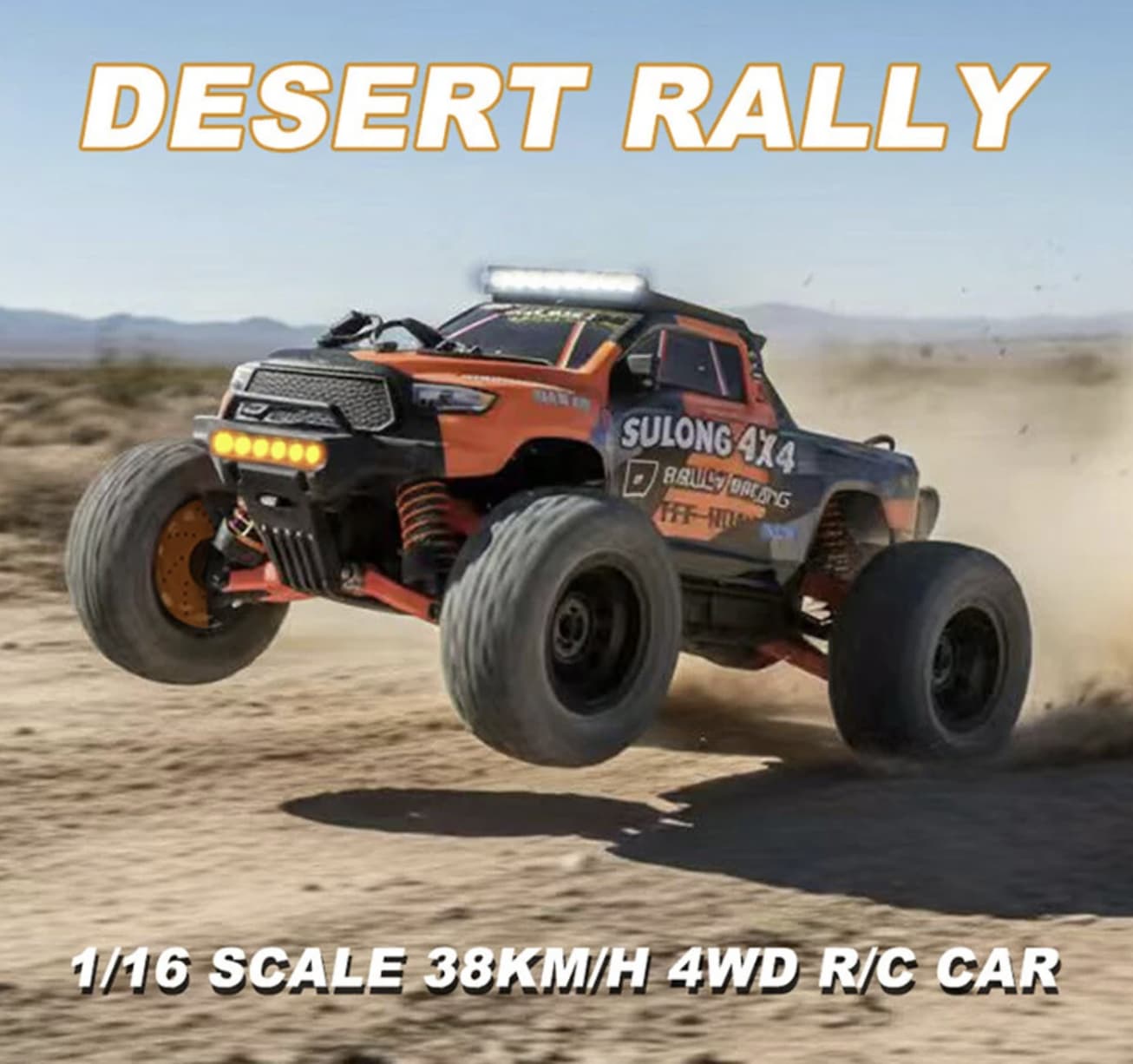
The SLRC C7 is particularly interesting for buyers who want a compact RC car with a focus on speed rather than slow technical crawling.
The model is listed as a 1/16 4WD RC car with a claimed maximum speed of 38km/h. It uses an RS390 brushed motor, a 35A integrated ESC/receiver and full proportional steering and throttle.
Its suspension uses an independent double-wishbone arrangement, while the vehicle also includes metal drive components and multiple LED lighting elements.
That combination makes the C7 better suited to fast recreational off-road driving than crawling.
Why consider the SLRC C7?
- 1/16 scale
- 4WD drivetrain
- Claimed 38km/h maximum speed
- RS390 brushed motor
- Full proportional throttle and steering
- Independent suspension
- Approximately 8cm tires
- Metal drivetrain components
- LED lighting
- 2.4GHz radio system
The important point is that the 38km/h number is a listed/claimed maximum, not an independently measured result.
Actual speed can vary depending on battery condition, terrain, temperature, surface and driving conditions.
For someone looking for an affordable 1/16 4WD vehicle for grass, dirt and pavement, however, the C7’s overall configuration is more important than the headline speed.
Best suited to: fast recreational outdoor driving.
2. Traxxas 1/16 Slash 4X4 — A Compact Short-Course Platform
The Traxxas 1/16 Slash 4X4 takes a different approach.
Rather than presenting itself as a basic toy-style RC car, the Slash 4X4 belongs to Traxxas’ established hobby platform. The current 70054-8 model is a 1/16-scale 4WD vehicle with a brushed motor. Traxxas also provides a large parts and accessory ecosystem for its 1/16 vehicles.
That matters if you plan to keep an RC car for a long time and gradually replace or upgrade components.
The parts documentation lists components including steel driveshafts, differentials, suspension parts and various optional upgrades.
The Slash format also makes it particularly interesting for drivers who enjoy:
- Grass
- Dirt
- Gravel
- Short-course-style driving
- Jumps
- Fast cornering
- RC modifications
Best suited to: hobbyists who want a compact 4WD platform with a substantial parts ecosystem.
3. WPL C54-1 — A Different Kind of 1/16 4WD
The WPL RC C54-1 demonstrates why you should not judge an RC car solely by its top speed.
The C54-1 RTR is a 1/16 model with 4WD, proportional steering and throttle, and a 2S 7.4V Li-ion battery. WPL lists a 260-size motor and revised gearbox and suspension components for the RTR version.
Its approximately 35cm body is noticeably longer than some compact 1/16 bashers.
The C54-1 is therefore better suited to a scale-style outdoor experience than a high-speed racing setup.
It makes sense for drivers who want to explore trails, uneven ground and outdoor environments at a more controlled pace.
Best suited to: scale-style trail driving and casual off-road exploration.
4. WPL C64-1 — 1/16 4WD for Crawling
If your definition of off-road includes rocks, steep inclines and technical obstacles, the WPL C64-1 is worth looking at.
WPL describes the C64-1 as a 1/16 4WD model with adjustable shocks, drag-brake functionality, an axle-mounted servo and revised chassis linkages designed to improve crawling capability. It uses a 370 brushed motor and gearing intended for low-speed crawling.
That immediately tells you how different it is from a fast 38km/h basher.
The C64-1 isn’t about maximum speed.
Instead, the low-speed gearing and drag brake are useful when negotiating inclines and obstacles where precise throttle control matters more than acceleration.
Best suited to: technical trails, rocks and slow-speed crawling.
5. Blackzon Slyder MT 1/16 4WD — Monster-Truck Style Driving
The Blackzon Slyder MT 1/16 4WD is another option for buyers who prefer the monster-truck format.
The larger-looking tires and truck-style stance make this type of vehicle particularly attractive for grass, dirt and recreational bashing.
Compared with a scale crawler, a monster truck puts more emphasis on:
- Tire size
- Suspension travel
- Stability over bumps
- Acceleration
- Jumps
- General backyard driving
This type of design is worth considering if your idea of off-road fun is more about speed and movement than carefully climbing individual obstacles.
Best suited to: backyard bashing, grass and general recreational driving.
What Makes a 1/16 RC Car Good for Off-Road Driving?
The scale itself isn’t enough.
Here are the specifications that deserve the most attention.
4WD Drivetrain
Four-wheel drive can improve traction on loose surfaces.
But don’t assume every 4WD system is equally capable.
The drivetrain design, differentials, tires, gearing and motor output all influence how effectively the available power reaches the ground.
For fast driving, a well-balanced 4WD system can make acceleration more controllable.
For crawling, low gearing and torque become more important.
Ground Clearance
Ground clearance determines how easily the chassis can pass over small rocks, roots and uneven sections without the underside getting caught.
More clearance isn’t always better.
A very tall vehicle can have a higher center of gravity, which may make it easier to tip during fast cornering.
The ideal setup depends on whether you’re prioritizing speed or obstacle clearance.
Suspension
A good off-road RC car needs suspension that can absorb bumps without becoming uncontrollable.
For a fast basher, look for suspension travel and damping that keep the tires connected to the surface.
For a crawler, suspension articulation becomes more important.
This is one reason a high-speed RC car and a rock crawler can have completely different suspension setups even though both are marketed as “off-road.”
Tires
Tires are one of the most overlooked components.
A high-speed RC car needs tires that can maintain stability while cornering.
A crawler needs rubber and tread that can grip rocks and irregular surfaces.
On grass, aggressive tread can help generate traction, while loose dirt may reward a different tire compound and pattern.
Proportional Controls
Full proportional throttle and steering are especially useful for off-road driving.
You don’t always want maximum power.
When approaching a rough section, you may want to reduce throttle.
When climbing, you may need a steady amount of power rather than an abrupt burst.
When cornering on loose dirt, small steering adjustments can help prevent the vehicle from becoming unstable.
That’s why proportional control can be more important than an impressive top-speed number.
Brushed vs Brushless for a 1/16 Off-Road RC Car
This is one of the biggest decisions when comparing models.
Brushed
Advantages:
- Generally simpler
- Often less expensive
- Easy to operate
- Suitable for casual driving
- Can provide enough performance for recreational use
Disadvantages:
- Less efficient than comparable brushless systems
- Brushes wear over time
- Usually less attractive to performance-focused hobbyists
Brushless
Advantages:
- Higher performance potential
- Better efficiency
- Strong acceleration
- Longer-term upgrade potential
- Popular for high-speed bashing
Disadvantages:
- Usually costs more
- Requires more attention to battery, gearing and heat
- More power can mean more stress on drivetrain components
A brushed 1/16 RC car isn’t automatically inferior.
For someone who wants to drive around the backyard for fun, a well-designed brushed model may be more than enough.
What Terrain Can a 1/16 4WD RC Car Handle?
Grass
One of the easiest outdoor surfaces for a suitable 4WD model.
Short grass is generally much easier than long, wet grass because long vegetation creates significantly more rolling resistance.
Dirt
Dirt is excellent for bashing.
It allows the vehicle to slide, accelerate and use the suspension without requiring the extreme clearance needed for rock crawling.
Gravel
Small gravel can be fun, but loose stones can also be thrown into moving parts.
Cleaning the vehicle afterward is important.
Sand
Sand places extra load on the motor and drivetrain.
Fine particles can also enter bearings and gears, so maintenance is particularly important after driving on beaches or sandy trails.
Rocks
This is where crawler-oriented models have an advantage.
A fast basher can cross small rocks, but a dedicated crawler is designed around slow-speed control, clearance and traction.
1/16 4WD Basher vs Crawler: Which Type Should You Choose?
| Your priority | Look for |
|---|---|
| Maximum speed | Fast basher |
| Grass | 4WD basher |
| Dirt | Basher or truggy |
| Gravel | 4WD basher |
| Jumps | Monster truck/basher |
| Rocks | Crawler |
| Steep climbs | Crawler |
| Scale realism | Scale crawler |
| Easy learning | Brushed proportional model |
| Performance upgrades | Brushless hobby platform |
This is a much better way to choose than searching for one universally “best” 1/16 RC car.
What About Waterproofing?
Be careful with the word waterproof.
A listing that says an RC car can handle water does not mean it should be submerged, driven through deep water or left wet after a run.
Before buying, check exactly what level of water resistance the manufacturer specifies for the motor, ESC, receiver and other electronics.
If the manufacturer does not clearly specify waterproofing, don’t assume it.
After wet driving:
- Remove the battery.
- Dry the vehicle.
- Clean dirt and debris.
- Inspect the drivetrain.
- Check bearings and moving parts.
- Allow electronics and chassis components to dry before storage.
This matters even more for off-road vehicles because dirt and moisture tend to accumulate around the drivetrain.
What Should You Check Before Buying a 1/16 4WD RC Car?
Don’t buy based on the speed number alone.
Check the drivetrain
Is it actually 4WD?
Check the motor
Is it brushed or brushless?
Check the controls
Does it have proportional steering and throttle?
Check the battery
Look at voltage, chemistry, capacity and charging method.
Check spare parts
Can you buy replacement suspension arms, gears, tires and driveshafts?
Check the terrain
Is the model designed for bashing, trail driving or crawling?
Check the size
A 1/16 label does not mean every model has exactly the same physical dimensions.
Check the actual package
Some RTR models include a battery and charger; others may require additional equipment.
1/16 4WD RC Car Buying Guide: What Matters Most?
If you are buying your first model, I would prioritize these characteristics:
For fast outdoor driving:
- 4WD
- Proportional controls
- Good suspension
- Suitable tires
- Strong drivetrain
- Adequate motor cooling
- Replaceable parts
For crawling:
- Low-speed gearing
- Torque
- Ground clearance
- Suspension articulation
- Grippy tires
- Drag brake
- Durable axles and drivetrain
Notice that top speed isn’t at the top of either list.
That’s because off-road performance is about how the entire vehicle works together.
Final Thoughts
The best 1/16 4WD RC car for off-road driving depends heavily on what you want to do with it.
A model such as the SLRC C7 is aimed at drivers who want a relatively fast 1/16 vehicle for grass, dirt and general outdoor bashing, with a claimed 38km/h top speed and proportional controls.
The Traxxas 1/16 Slash 4X4 is more interesting for buyers who want an established hobby platform with a broad parts and upgrade ecosystem.
The WPL C54-1 takes a more scale-oriented approach to 1/16 outdoor driving, while the WPL C64-1 focuses more heavily on low-speed crawling and obstacle work.
That is the key takeaway:
Don’t ask only which 1/16 RC car is the best. Ask which 1/16 4WD RC car is best suited to the terrain and driving style you actually enjoy.
For fast grass and dirt runs, look toward a basher.
For rocks and steep trails, look toward a crawler.
And if you want something in between, prioritize a 4WD platform with proportional controls, useful ground clearance, capable suspension and readily available replacement parts.
FAQ
Is 1/16 a good size for an off-road RC car?
Yes. The 1/16 scale offers a useful balance between portability and outdoor capability. It is considerably easier to transport and store than many 1/10 models while still allowing manufacturers to fit meaningful suspension, tires and 4WD hardware.
Is 4WD better than 2WD for off-road RC driving?
4WD can provide more traction on loose surfaces such as grass, dirt and gravel. However, drivetrain design, tires, gearing and vehicle setup also affect performance.
Is a 1/16 RC car suitable for grass?
Many 1/16 4WD models are well suited to grass, especially short grass. Long or wet grass can put considerably more load on the motor and drivetrain.
Is a 38km/h RC car fast?
For a compact 1/16 RC car, a claimed 38km/h maximum speed represents relatively fast recreational performance. Actual speed depends on the vehicle, battery, surface and conditions.
Should I buy a brushed or brushless 1/16 RC car?
Choose brushed if you prioritize simplicity and casual driving. Consider brushless if higher performance, efficiency and upgrade potential are more important.
Can a 1/16 RC car drive on rocks?
Yes, but the type of model matters. A crawler-oriented 1/16 4WD vehicle is generally better suited to rocks and technical obstacles than a high-speed basher.
What is more important than top speed?
For off-road driving, traction, suspension, ground clearance, tires, proportional controls and drivetrain durability can matter more than the maximum advertised speed.