










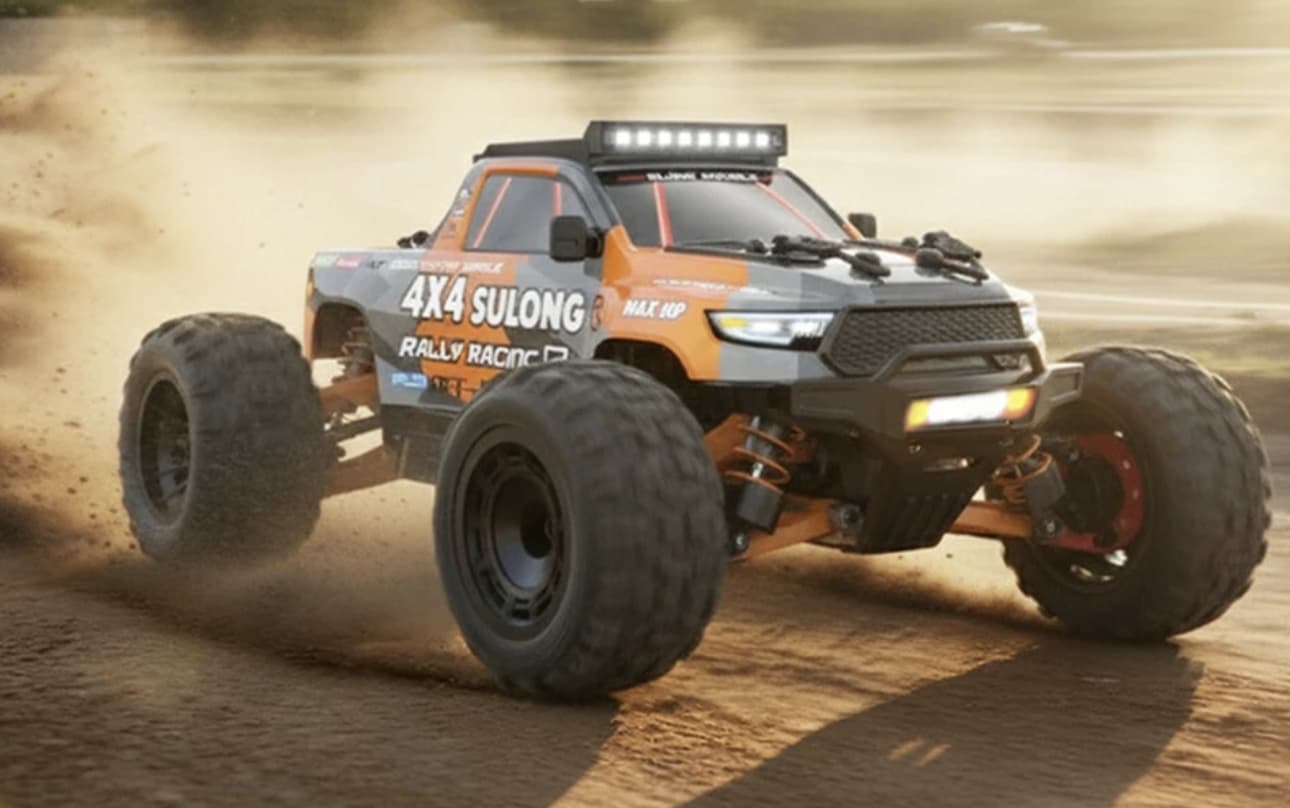
Making an RC car faster is not simply a matter of installing the biggest motor you can find. Speed is the result of several parts working together, including the motor, battery, ESC, gearing, tires, drivetrain, and vehicle weight.
That is why an RC car can sometimes become faster after a relatively small upgrade, while another car may gain little from an expensive motor swap.
If you want more speed without turning your RC car into an unreliable project, the key is to understand how each component affects the entire system.
What Actually Makes an RC Car Faster?
An RC car’s top speed is influenced by several factors:
- Motor type and KV rating
- Battery voltage and current capability
- Pinion and spur gear sizes
- Tire diameter and traction
- ESC capability
- Vehicle weight
- Drivetrain efficiency
- Aerodynamics
- Driving surface
A useful way to think about it is:
Motor provides the potential → battery supplies the energy → ESC controls it → gearing converts it → tires put it onto the ground.
Changing only one component may therefore produce a smaller improvement than expected.
For example, fitting a powerful motor to a car with a weak battery or unsuitable ESC can simply create more heat rather than meaningful additional speed.
1. Start With the Motor
The motor is one of the most obvious places to look when you want a faster RC car, but motor choice depends heavily on the existing electronics.
Brushed vs. Brushless
Most entry-level RC cars use brushed motors because they are inexpensive and relatively simple. They can provide enjoyable performance, but they generally have lower efficiency and less performance headroom than comparable modern brushless systems.
A brushless motor uses electronic commutation instead of physical brushes. In an appropriately matched system, this can provide higher efficiency, stronger acceleration, and considerably more speed potential.
However, brushless does not automatically mean faster.
The motor must be compatible with the ESC and battery, while gearing and vehicle weight also determine the final result.
If you are deciding between the two motor types, our guide to brushed vs brushless RC cars is a useful next step.
What Does KV Mean?
KV is commonly used to describe the approximate RPM a brushless motor produces per volt under specified conditions.
For example, a 3000KV motor theoretically has a higher unloaded RPM per volt than a 2000KV motor.
But choosing the highest KV rating available is not a reliable shortcut to maximum speed.
A higher-KV motor can draw more current, generate more heat, and place greater demands on the battery and ESC. It may also require different gearing.
Instead of asking:
“What is the highest KV motor I can install?”
ask:
“What motor KV, battery voltage, gearing, and ESC combination is appropriate for my RC car?”
That is a much safer way to approach a speed upgrade.
2. Upgrade the Battery Carefully
The battery is another major factor in RC performance.
For many electric RC cars, increasing battery voltage can increase motor RPM and therefore increase potential top speed. But the vehicle must be designed to handle that voltage.
Voltage Matters
A simplified relationship is:
Motor RPM ≈ KV × battery voltage
This is not the actual loaded wheel speed, but it explains why battery voltage matters.
For example, the theoretical unloaded RPM of a 3000KV motor would be approximately:
- 7.4V × 3000KV = 22,200 RPM
- 11.1V × 3000KV = 33,300 RPM
The second setup has substantially greater RPM potential.
But that does not mean you can simply replace a 2S battery with a 3S battery.
The ESC, motor, connectors, wiring, drivetrain, and battery compartment all need to support the new setup.
What About Battery Capacity?
Battery capacity is usually expressed in mAh.
A larger-capacity battery can potentially provide longer runtime, but more mAh does not automatically mean higher top speed.
For speed, the more important considerations can include:
- Voltage
- Discharge capability
- Battery condition
- Weight
- Compatibility with the ESC and motor
A very large battery may even make an RC car slower if its additional weight outweighs any electrical advantage.
Don’t Ignore Battery Weight
This is particularly important on small 1/16 and 1/18 RC cars.
A heavier battery can increase total vehicle mass. The motor then has more weight to accelerate, and the suspension and drivetrain also have to handle the additional load.
For a lightweight RC car, the best battery for speed may not necessarily be the battery with the largest capacity.
3. Change the Gearing
Gearing is one of the most effective ways to change how an RC car behaves.
Most electric RC cars use a combination of gears, commonly including a pinion gear attached to the motor and a spur gear connected to the drivetrain.
Changing their sizes changes the balance between acceleration and top speed.
Smaller Pinion Gear
A smaller pinion generally provides:
- More acceleration
- More torque at the wheels
- Lower potential top speed
- Reduced load on the motor
This can be useful for heavy vehicles or off-road driving.
Larger Pinion Gear
A larger pinion generally provides:
- Higher potential top speed
- Lower mechanical advantage
- More load on the motor
- Potentially more heat
This is why simply installing a much larger pinion is not always a good idea.
If the motor becomes excessively hot, the gearing may be too aggressive for the current setup.
What About the Spur Gear?
The same principle works in the opposite direction with the spur gear.
A smaller spur gear can increase the gearing toward higher speed, while a larger spur gear generally favors acceleration and reduces the load on the motor.
The exact effect depends on the vehicle’s transmission design.
Final Drive Ratio
The important number is the overall gear ratio, not just the size of one gear.
A simplified relationship is:
Gear ratio = spur gear teeth ÷ pinion gear teeth
For example:
- 60T spur / 20T pinion = 3.0:1
- 60T spur / 15T pinion = 4.0:1
The lower numerical ratio generally favors speed, while the higher numerical ratio generally favors torque and acceleration.
Always check the manufacturer’s recommended gearing range before making a change.
4. Don’t Forget the Tires
Tires are often overlooked when people discuss RC car speed.
Yet tire diameter has a direct relationship with gearing.
Larger Tires Can Increase Speed Potential
A larger tire travels farther with each revolution.
That means installing larger-diameter tires can increase the theoretical speed of an RC car.
However, there is a trade-off.
Larger tires also:
- Increase rotational mass
- Put additional load on the motor
- Increase drivetrain stress
- Require more torque
- Can make acceleration slower
So larger tires do not automatically make an RC car better.
Tire Grip Matters Too
A powerful motor is useless if the tires constantly spin.
On pavement, tires with appropriate grip can help transfer power efficiently.
On grass, dirt, or loose gravel, aggressive tread can be more useful because the surface itself limits traction.
For an off-road RC car, choosing a tire that matches the terrain can sometimes improve real-world performance more than chasing a higher theoretical top speed.
5. Check the ESC Before Increasing Power
The ESC, or electronic speed controller, is the component responsible for controlling power between the battery and motor.
It is one of the most important parts of a speed upgrade.
Before increasing voltage or installing a more powerful motor, check:
- Maximum battery voltage
- Continuous current rating
- Motor compatibility
- Connector type
- Cooling
- Whether the ESC is integrated with the receiver
A motor upgrade that exceeds the ESC’s capabilities can lead to overheating or failure.
This is especially important with inexpensive RTR models where the ESC and receiver may be combined into a single electronic unit.
6. Reduce Unnecessary Weight
Weight has a major effect on acceleration.
A lighter RC car generally needs less force to accelerate, brake, and change direction.
Before buying expensive performance parts, look for unnecessary weight.
Potential areas include:
- Oversized accessories
- Heavy body components
- Unnecessary metal parts
- Excessively large batteries
- Damaged or contaminated drivetrain components
However, removing weight blindly is not always beneficial.
Some weight contributes to durability, traction, and stability. A very light vehicle can become difficult to control at high speed.
The goal is not simply to make the car as light as possible. It is to achieve a sensible balance between weight, strength, traction, and speed.
7. Make Sure the Drivetrain Is Running Efficiently
Sometimes an RC car feels slow because the motor is working harder than it should.
Before upgrading anything, inspect the drivetrain.
Check for:
- Binding gears
- Dirty bearings
- Damaged gears
- Bent axles
- Over-tightened components
- Debris around the drivetrain
- Excessive friction
A poorly maintained RC car wastes some of the motor’s available power as heat and friction.
This is one of the cheapest performance improvements because it may require nothing more than cleaning, inspection, and replacing worn components.
8. Improve Cooling Before Chasing More Speed
More speed usually means more energy moving through the system.
More energy can also mean more heat.
Heat is particularly important when changing:
- Battery voltage
- Motor KV
- Pinion size
- Tire diameter
If the motor, ESC, or battery becomes excessively hot, continuing to push the setup can shorten component life.
Useful cooling measures can include:
- Better airflow
- Appropriate heat sinks
- A suitable motor fan
- ESC cooling
- Avoiding excessively tall gearing
Cooling does not directly make an RC car faster, but it can allow a properly designed performance setup to operate more consistently.
9. Consider the Driving Surface
The fastest setup on pavement is not necessarily the fastest setup on grass.
Pavement
Smooth pavement generally allows:
- Higher speeds
- More consistent traction
- Lower rolling resistance
This is where a speed-oriented gear ratio and suitable tires can make a noticeable difference.
Grass
Grass creates more resistance and can put a greater load on the drivetrain.
A setup designed for pavement may struggle when used on thick grass.
Dirt and Gravel
Loose surfaces reduce available traction.
In this situation, acceleration can become more important than theoretical top speed.
Sand
Sand can place a particularly heavy load on the motor and drivetrain. It can also enter bearings and gears.
If you regularly drive in sand, maintenance becomes just as important as the speed upgrade itself.
10. Brushed-to-Brushless Conversion: Is It Worth It?
Converting a brushed RC car to brushless can produce a major performance increase, but it is more complicated than replacing the motor.
A typical conversion may require:
- Brushless motor
- Compatible ESC
- Appropriate battery
- Correct connectors
- Suitable pinion gear
- Potential drivetrain upgrades
You should also consider whether the existing transmission, driveshafts, differential, and suspension can handle the additional power.
For a very inexpensive RC car, a complete brushless conversion can sometimes cost enough that buying a purpose-built brushless model makes more sense.
For a good-quality chassis that you already enjoy driving, however, upgrading the electronics can be an interesting way to extend its life.
11. Why a Faster Motor Can Actually Make Your RC Car Slower
This sounds strange, but it happens.
Imagine replacing the original motor with a much more powerful motor while keeping the same small battery and unsuitable gearing.
The new motor may demand more current than the battery can comfortably provide.
The result could be:
- Voltage sag
- Excessive heat
- Poor throttle performance
- Shorter runtime
- ESC overheating
- Reduced reliability
The same problem can occur with oversized tires.
A larger tire effectively increases the gearing and adds rotational mass. If the motor cannot comfortably turn it, acceleration can become worse.
This is why system matching is more important than individual component specifications.
12. The Best Upgrade Order for Most RC Cars
If your goal is to make an RC car faster, I would not start by buying the most expensive motor.
A more sensible process is:
Step 1: Check the Current Setup
Identify:
- Motor type
- Motor KV, if brushless
- Battery voltage
- ESC rating
- Pinion and spur sizes
- Tire diameter
- Vehicle weight
Step 2: Fix Mechanical Problems
Clean the drivetrain and make sure the wheels, bearings, gears, and axles operate freely.
Step 3: Improve Gearing
If the existing motor has sufficient power and temperatures remain reasonable, a modest gearing adjustment may provide a noticeable speed increase.
Step 4: Consider Better Tires
Choose tires according to the surface you actually drive on.
Step 5: Upgrade Electronics
If you need substantially more performance, consider a properly matched motor, ESC, and battery combination.
Step 6: Monitor Temperature
After every significant performance change, check the motor and ESC temperatures rather than assuming the upgrade is safe.
This approach is usually more useful than changing several components simultaneously.
How Fast Can an RC Car Realistically Become?
There is no universal speed limit for an RC car because different vehicles are designed for very different purposes.
A small 1/16 4WD RC cars may be designed around moderate speed and durability, while a dedicated racing or speed-run model can be engineered for much higher performance.
The following factors all matter:
| Factor | Effect on Speed |
|---|---|
| Higher battery voltage | Can increase motor RPM |
| Higher motor KV | Can increase RPM potential |
| Larger pinion | Can increase top-speed potential |
| Smaller spur | Can increase top-speed potential |
| Larger tires | Can increase speed potential but add load |
| Lower vehicle weight | Can improve acceleration |
| Better traction | Helps transfer power |
| Brushless system | Usually offers greater performance potential |
| Better aerodynamics | Can improve high-speed stability |
| Efficient drivetrain | Reduces power losses |
The important point is that a headline speed number does not tell the whole story.
An RC car that accelerates strongly, stays cool, handles well, and remains reliable can be more enjoyable than one with a higher claimed top speed but poor control.
Common Mistakes When Trying to Make an RC Car Faster
Installing a battery with higher voltage without checking the ESC
This is one of the easiest ways to damage electronics.
Choosing the highest-KV motor available
A high KV rating can increase RPM potential but also increase electrical and thermal demands.
Installing oversized tires
Larger tires can increase theoretical speed but also increase motor load and drivetrain stress.
Increasing gearing too aggressively
A taller gear ratio can produce more speed but may cause excessive heat.
Ignoring traction
Wheelspin wastes power. More motor output does not help if the tires cannot transfer it to the ground.
Changing everything at once
If you install a new motor, battery, ESC, gearing, and tires simultaneously, it becomes difficult to determine what caused a problem.
A step-by-step approach makes troubleshooting much easier.
Should You Make Your RC Car Faster?
That depends on what you want from the vehicle.
If you enjoy straight-line speed, motor output, battery voltage, gearing, and tires deserve the most attention.
If you mainly drive off-road, traction, suspension, ground clearance, and gearing may matter more than maximum speed.
If you are a beginner, a moderate upgrade that keeps the original electronics within their intended limits is usually easier to manage than a complete power-system conversion.
And if your current RC car already performs well, improving its drivetrain efficiency and gearing may be enough—you do not necessarily need a completely new motor.
FAQ: Making an RC Car Faster
Can I make a brushed RC car faster?
Yes. Depending on the vehicle, you can experiment with gearing, battery selection within the manufacturer’s limits, tires, drivetrain maintenance, and eventually a brushless conversion.
Does a higher-voltage battery make an RC car faster?
It can, because higher voltage can increase motor RPM. However, the motor and ESC must be rated for that voltage. Never assume that a higher-voltage battery is automatically compatible.
Does a higher KV motor mean a faster RC car?
Not necessarily. KV indicates RPM per volt under specified conditions, but final speed also depends on battery voltage, gearing, tire size, load, traction, and aerodynamics.
Do bigger RC tires make the car faster?
Larger tires can increase theoretical speed because the vehicle travels farther per wheel revolution. However, they also increase rotational mass and motor load, so acceleration and efficiency can suffer.
Is brushless always better for speed?
A properly matched brushless system generally provides more performance potential than a comparable brushed system, but the complete powertrain determines the result.
What is the easiest way to make an RC car faster?
Start with maintenance and gearing. If the existing setup is healthy and operating within safe temperatures, a modest gearing change may increase speed without requiring a complete electronics upgrade.
Can I make any RC car extremely fast?
No. The chassis, drivetrain, suspension, tires, electronics, and structural components place practical limits on how much power a vehicle can handle. Some platforms are better suited to high-speed upgrades than others.
Final Thoughts
Making an RC car faster is really an exercise in balancing the power system.
A stronger motor alone does not guarantee higher speed. The battery needs to supply the required power, the ESC must handle it, the gearing needs to match the motor, and the tires need enough grip to transfer that power to the ground.
For a sensible upgrade path, start with the basics: inspect the drivetrain, choose appropriate gearing, use suitable tires, check battery and ESC compatibility, and monitor temperatures. Only then consider a more substantial motor or brushless conversion.
That approach can produce a faster RC car without turning every speed upgrade into a reliability problem. You can also read SLRC C7 review here.