










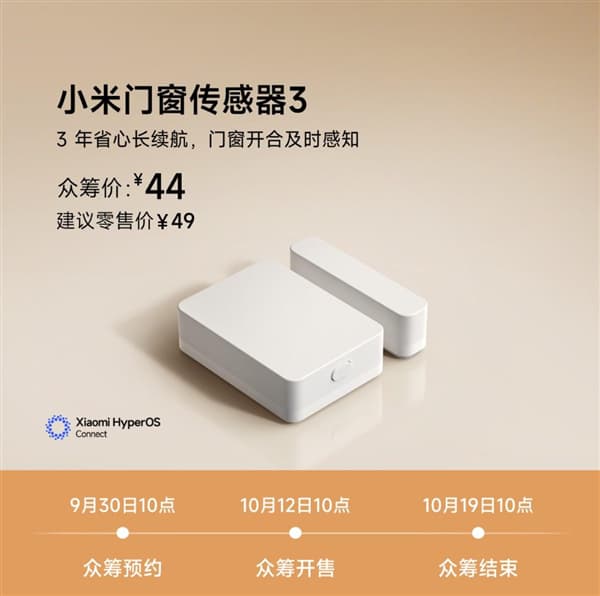
Xiaomi has introduced the Xiaomi Door and Window Sensor 3, a compact smart-home accessory designed to monitor whether doors, windows, drawers, and cabinets are open or closed.
The new sensor will begin crowdfunding in China at 10:00 a.m. on October 12. Its crowdfunding price is set at 44 yuan, while the suggested retail price is 49 yuan.
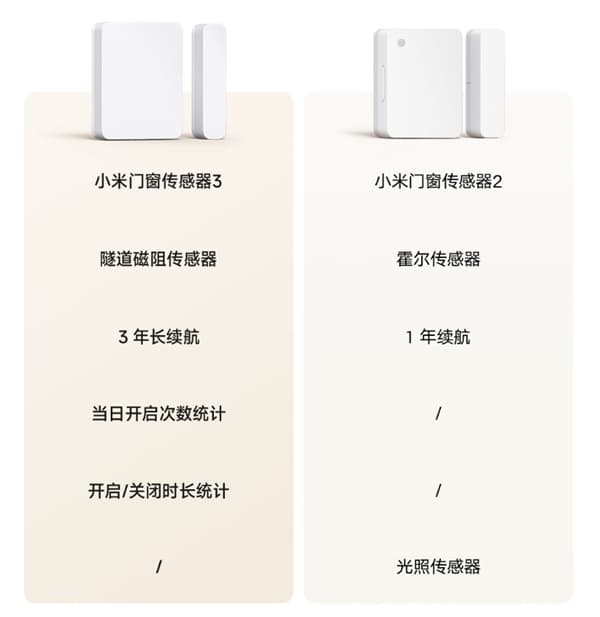
Compared with the previous generation, the Xiaomi Door and Window Sensor 3 brings a new sensing technology, longer battery life, and additional activity statistics that can provide a clearer picture of how often and how long a door or window is being used.
New Tunnel Magnetoresistance Sensor
The biggest hardware change is the move from a traditional Hall-effect sensor to a tunnel magnetoresistance (TMR) sensor.
Xiaomi says the new high-sensitivity TMR sensor offers faster response and lower power consumption than a conventional Hall sensor. When a door or window is opened or closed, the sensor can quickly detect the magnetic-field change and report the event.
This upgrade is particularly useful for a small battery-powered device because the sensor needs to remain responsive while consuming very little power.
Up to 3 Years of Battery Life
Battery life is another major improvement.
The Xiaomi Door and Window Sensor 3 uses a CR2032 coin-cell battery together with a low-power design. Xiaomi estimates up to three years of battery life based on a test scenario involving approximately 30 opening and 30 closing operations per day.
When the battery level becomes low, the Mijia app can send a notification reminding users to replace the battery.
The actual battery life will naturally vary depending on usage frequency, wireless communication, temperature, and other environmental conditions.

More Detailed Door and Window Activity Tracking
The new model does more than simply report whether a door or window is open.
If you are building a connected home around Xiaomi devices, our Xiaomi smart home devices guide covers other sensors and accessories that can be combined with the Mi Home ecosystem.
Through the Mi Home app, users can reportedly view the number of opening events during the day, as well as the amount of time a door, window, drawer, or cabinet remains open or closed.
This gives the sensor a more useful role in everyday monitoring. For example, users could check how frequently a particular door is opened or identify whether a cabinet or window has remained open for an unusually long period.
To access remote monitoring features, the sensor needs to work with a compatible device that provides Bluetooth Mesh gateway functionality.
Remote Notifications for Abnormal States
The Xiaomi Door and Window Sensor 3 can also be used to create alerts for unusual situations.
The Mi Home app supports notifications for events such as unexpected opening, unexpected closing, and a door or window being left open for too long.
The timeout reminder is enabled by default, with the leaked product information indicating that the sensor can send an alert when a door or window remains open for one minute.
This could be useful for situations where a user wants to avoid accidentally leaving a window, cabinet, or storage area open.
Compact Design for Narrow Spaces
The sensor retains a small and lightweight design with a simple white exterior.
Its compact body is intended for installation on narrow surfaces, including doors, windows, drawers, cabinet doors, and storage boxes.
A clearly marked “magnetic sensing side” on the housing helps users identify the correct installation direction. The main sensor and accompanying magnet can therefore be aligned more easily during setup.
Because the sensor occupies little space, it can be installed in locations where a larger smart-home accessory would be impractical.
HyperOS Connect Expands Smart-Home Automation
The Xiaomi Door and Window Sensor 3 also supports Xiaomi HyperOS Connect, allowing it to participate in connected smart-home scenarios through the Mi Home ecosystem.
The sensor is part of Xiaomi’s broader smart-home ecosystem, and our Xiaomi smart home guide explains how different connected devices can work together through automated scenes.
For example, users can create automations that turn on a light when a door is opened or automatically turn off an air conditioner when a window is detected as open.
The sensor can also work with other Xiaomi smart-home products. In a suitable setup, a water-leak detector or temperature and humidity sensor could be used alongside the door and window sensor to create reminders related to rain or high humidity, such as prompting users to close a window.
These automation options make the sensor more than a basic open/close detector. Its usefulness largely depends on which compatible Xiaomi devices are already installed in the home.
One Feature Has Been Removed
There is one notable downgrade compared with the previous generation.
The Xiaomi Door and Window Sensor 3 reportedly removes the ambient light sensor found on the earlier model.
In exchange, Xiaomi has focused the new version on lower power consumption, a smaller physical design, more detailed activity statistics, and broader smart-home automation scenarios.
Xiaomi Door and Window Sensor 3 Price and Availability
The Xiaomi Door and Window Sensor 3 will start crowdfunding in China at 10:00 a.m. on October 12.
The crowdfunding price is 44 yuan, while its suggested retail price is 49 yuan.
For users already invested in the Xiaomi smart-home ecosystem, the combination of a TMR sensor, three-year claimed battery life, Mi Home monitoring, activity statistics, and HyperOS Connect integration makes the new sensor a practical upgrade over the previous generation.
However, users who specifically need an ambient light sensor should note that this feature has been removed from the new model.