









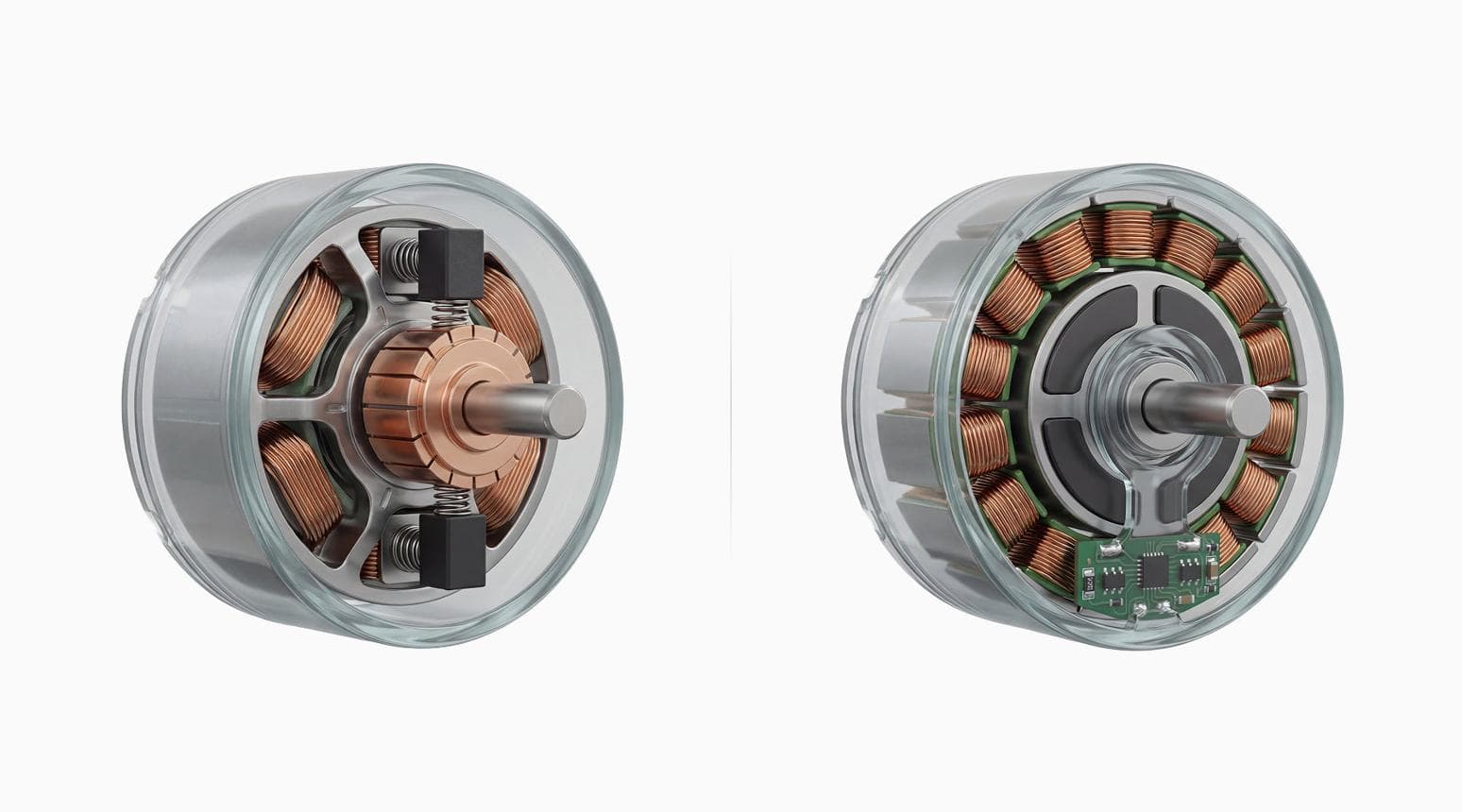
Choosing an RC quadcopter involves more than comparing camera quality, flight time, or maximum speed. The type of motor powering the aircraft has a direct impact on how it accelerates, responds to control inputs, handles wear, and performs during repeated flights.
Before choosing a motor type, read our guide to how to choose an RC quadcopter to compare motor systems, flight performance, and other important buying factors.
Most small RC quadcopters use either brushed or brushless motors. Brushed motors are common in affordable beginner drones and lightweight indoor models, while brushless motors are widely used in performance-oriented quadcopters that need stronger thrust and greater durability.
Neither design is automatically the right choice for every pilot. A small drone used for learning basic controls has different requirements from a quadcopter built for outdoor flying, freestyle maneuvers, or carrying a camera. Understanding how these two motor types work makes it easier to choose an aircraft that matches your experience, budget, and flying environment.
If you’re new to flying, our review of this beginner-friendly RC quadcopter explains the features that can make early practice easier.
What Is the Difference Between Brushed and Brushless RC Quadcopter Motors?
The main difference lies in how electrical current produces rotation inside the motor.
A brushed motor uses physical brushes that maintain electrical contact with a rotating commutator. This relatively simple design keeps manufacturing costs low, making brushed motors suitable for inexpensive, lightweight RC quadcopters. However, the brushes gradually wear down, and friction generates additional heat during operation.
A brushless motor uses electronic switching rather than physical brushes to control the magnetic field that rotates the motor. This eliminates brush-related friction and wear, allowing the motor to deliver efficient power and support demanding flight conditions when paired with suitable electronics.
The distinction affects more than motor construction. It also influences the drone’s electronic speed controller (ESC), maintenance requirements, battery consumption, and overall purchase price.
Brushed vs Brushless RC Quadcopters: Side-by-Side Comparison
| Feature | Brushed quadcopter | Brushless quadcopter |
|---|---|---|
| Initial cost | Usually lower | Usually higher |
| Motor construction | Uses physical brushes | Uses electronic commutation |
| Friction and wear | More brush-related wear | No brush wear |
| Power potential | Generally suited to lighter-duty flying | Often supports higher performance |
| Throttle response | Suitable for basic flight | Often faster and more precise |
| Efficiency | Generally lower under comparable demanding conditions | Often higher, depending on the setup |
| Maintenance | Motors may need replacement sooner | Less routine motor maintenance |
| Electronics | Often simpler | Requires compatible brushless control electronics |
| Typical applications | Toy drones, beginner models, micro quadcopters | FPV, freestyle, racing, and performance drones |
| Best suited to | Budget-conscious beginners | Pilots seeking performance and upgrade potential |
These are general tendencies rather than universal rules. Motor size, propeller design, aircraft weight, battery voltage, and flight-controller tuning can significantly change the performance of an individual quadcopter.
1. Motor Design: Simple Construction vs Electronic Control
How brushed motors work
Inside a brushed DC motor, electrical current passes through physical brushes and a commutator to energize the motor’s windings. The resulting magnetic interaction creates rotation.
This arrangement is relatively inexpensive to manufacture and straightforward to operate. It also makes brushed motors practical for very small aircraft, where low weight and a limited component budget matter more than maximum thrust.
The trade-off is mechanical contact. Brushes gradually deteriorate during use, while friction and electrical arcing can contribute to heat and wear. As the motor ages, performance may become less consistent, and eventual replacement may be necessary.
How brushless motors work
A brushless motor relies on electronic circuitry to switch current through its windings in a controlled sequence. Permanent magnets on the rotor respond to the changing magnetic field, producing rotation without physical brushes rubbing against a commutator.
Most brushless RC quadcopters use an ESC to regulate motor speed. The flight controller sends control signals, and the ESC adjusts the electrical power supplied to the motor.
Removing the brushes reduces one important source of mechanical wear. However, brushless systems still contain components that can fail, including bearings, ESCs, wiring, and connectors. Their long-term reliability depends on motor quality, operating temperatures, maintenance, and how the aircraft is flown.
2. Flight Performance: Why Brushless Quadcopters Often Feel More Powerful
Motor performance becomes especially noticeable when a quadcopter needs to accelerate quickly, recover from a sudden movement, or maintain control in demanding conditions.
Brushless motors generally offer greater performance potential for their size and weight when appropriately designed. A well-matched brushless quadcopter can produce strong thrust, respond rapidly to throttle changes, and maintain better control authority during aggressive maneuvers.
These characteristics make brushless systems popular among FPV pilots and freestyle enthusiasts. When a drone drops through a gap, changes direction sharply, or recovers from a dive, responsive motor control can make a meaningful difference.
Brushed quadcopters are usually designed around more modest power requirements. They can still provide stable, enjoyable flights, particularly indoors or in calm conditions, but many models have less thrust available for rapid acceleration and recovery.
It is important not to judge flight performance by motor type alone. A lightweight brushed quadcopter may handle better than a poorly tuned brushless model. Propeller pitch, frame design, flight-controller settings, and total aircraft weight all influence how a drone feels in the air.
For a real-world example of a brushless design, see our YCRC A22 RC quadcopter review, which covers its design and flight features
3. Battery Life and Efficiency: Which Motor Type Lasts Longer?
Battery performance is one of the most frequently misunderstood aspects of the brushed-versus-brushless comparison.
Brushless motors can operate efficiently because they avoid brush friction and can be matched closely to the aircraft’s power requirements. This can help reduce energy losses, particularly in demanding applications.
However, a brushless quadcopter does not automatically deliver longer flight times. High-performance models often use larger motors, more aggressive propellers, higher-voltage batteries, and heavier frames. Pilots who frequently accelerate or perform freestyle maneuvers can consume considerable energy regardless of motor type.
A small brushed quadcopter may achieve respectable flight time because its overall weight and power requirements are low. Conversely, a heavy brushless quadcopter running at high throttle may exhaust its battery quickly.
When comparing two models, check the following details:
- Battery capacity: Compare watt-hours when possible, rather than relying only on milliamp-hours. Batteries with different voltages cannot be compared accurately using mAh alone.
- Aircraft weight: Additional weight requires more thrust and generally increases energy consumption.
- Motor and propeller combination: The right combination can improve efficiency, while a poorly matched setup wastes power.
- Flight style: Gentle cruising and hovering usually consume less energy than repeated full-throttle acceleration.
- Actual flight tests: Manufacturer estimates may use ideal conditions that differ from everyday flying.
For buyers, a quadcopter’s tested flight time under a realistic flying style is more useful than assuming that either motor technology always wins.
4. Durability and Maintenance: What Happens After Repeated Flights?
A brushed motor’s physical brushes are consumable components. As they wear, electrical contact can deteriorate, reducing performance and eventually making replacement necessary. On many inexpensive toy drones, replacing the complete motor is more practical than repairing it.
Brushless motors do not have this particular wear mechanism. They can therefore be a better choice for pilots who fly frequently or place greater demands on their aircraft.
Nevertheless, brushless does not mean maintenance-free. Motor bearings can wear, dirt can enter moving components, and hard impacts can damage shafts or propellers. Crashes may also damage the ESC or motor wiring.
For either motor type, good maintenance includes checking propellers for cracks, inspecting the motor mounts, removing debris, and avoiding continued operation when a motor becomes unusually hot or noisy.
The cost of repairs also depends on the aircraft. A brushless motor may last a long time, but replacement parts for an advanced FPV quadcopter can be more expensive than parts for a basic brushed model. Beginners should consider the availability and price of spare motors, propellers, batteries, and electronic components before buying.
5. Price and Long-Term Value
Brushed quadcopters usually have the advantage when the purchase budget is the main concern. Their simpler motors and electronics help manufacturers produce affordable aircraft, often sold as complete beginner kits with a controller and battery.
This lower entry price is attractive for children old enough to operate an appropriate RC aircraft, first-time pilots, and anyone who wants to learn basic flight control without investing heavily in equipment.
Brushless quadcopters generally cost more because they need compatible motors, ESCs, and supporting electronics. Higher-performance models may also include stronger frames, better flight controllers, more advanced radio systems, and FPV equipment.
However, the initial price does not tell the whole story. Frequent flyers may find that a brushless model offers better long-term value through reduced brush-related motor replacement and stronger performance. Someone who flies occasionally in a living room may never benefit enough from those advantages to justify the extra cost.
A useful way to evaluate value is to consider the expected cost of the aircraft, spare parts, batteries, and likely repairs over the period you plan to use it.
6. Which Motor Type Is Better for Beginners?
For a first-time pilot, the best quadcopter is usually the one that makes learning affordable, convenient, and safe.
Choose a brushed quadcopter if you want:
- An inexpensive introduction to RC flight.
- A lightweight drone for indoor practice in a suitable open space.
- Simple controls and modest performance.
- An aircraft that you can use to learn throttle management, turning, and orientation.
- A lower initial investment while deciding whether to pursue the hobby seriously.
A brushed micro quadcopter can be a sensible training aircraft, especially when replacement motors and propellers are inexpensive and easy to obtain.
Choose a brushless quadcopter if you want:
- More thrust for outdoor flying and demanding maneuvers.
- Responsive control for FPV freestyle or racing.
- An aircraft with greater performance and tuning potential.
- A platform that can support future upgrades, provided its components are compatible.
- A motor system without brushes that gradually wear through physical contact.
Brushless is not necessarily the easiest starting point. Faster aircraft may require more practice, careful setup, and a larger budget for repairs. A beginner who chooses brushless should consider a manageable model with appropriate flight modes and readily available spare parts.
7. Indoor Flying, Outdoor Flying, and FPV: Matching the Motor to the Job
The flying environment often provides a clearer answer than the motor specifications alone.
Indoor flying: Small brushed quadcopters can work well in rooms with sufficient open space. Their modest power and lightweight construction make them suitable for basic practice, although propeller guards are helpful around furniture and other obstacles. Some brushless micro quadcopters are also designed specifically for indoor use.
Outdoor cruising: Both motor types can fly outdoors in suitable conditions. A lightweight brushed drone is generally better suited to calm weather, while a properly designed brushless model may provide more thrust for handling changing conditions. Neither should be assumed to fly safely in strong winds simply because of its motor type.
FPV freestyle and racing: Brushless motors are the common choice because these activities often demand rapid throttle changes, substantial thrust, and repeated acceleration. The full setup matters, including the frame, ESC, flight controller, battery, and propellers.
Aerial photography: The right choice depends on the camera system and aircraft design. A camera-equipped quadcopter needs enough thrust to carry its payload while maintaining stable flight. Brushless motors are common in capable camera drones, but smooth footage also depends on stabilization, vibration control, and flight tuning.
8. Can You Upgrade a Brushed RC Quadcopter to Brushless?
It is technically possible on some platforms, but a motor swap is rarely as simple as removing one motor and installing another.
Brushless motors require compatible ESCs and suitable electrical connections. The frame must support the motor dimensions and mounting pattern, while the battery must provide an appropriate voltage and current capability. The flight controller must also support the relevant motor-control system.
A brushless conversion can change the aircraft’s weight, power consumption, and handling. The original frame may not tolerate the increased thrust, and the existing propellers may not be suitable for the new motors.
For inexpensive toy drones, buying a purpose-built brushless model is often more practical than attempting a conversion. Upgrades make more sense on modular RC platforms with documented compatibility, available parts, and room for the necessary electronics.
Before modifying any quadcopter, check the manufacturer’s specifications and confirm that all components are electrically and mechanically compatible.
Final Verdict: Brushed or Brushless RC Quadcopter?
The choice between brushed and brushless RC quadcopters comes down to what you expect from your aircraft.
Brushed motors remain a practical option for affordable beginner drones, indoor practice, and lightweight models that do not require high performance. Their low initial cost makes it easier to learn the fundamentals of flight without committing to an expensive setup.
Brushless motors are generally the stronger choice for pilots who prioritize thrust, responsive control, frequent flying, and performance-oriented applications. They eliminate brush wear and provide a flexible foundation for many FPV, freestyle, and racing builds, although the complete system still determines actual flight performance and reliability.
Before buying, compare the aircraft’s weight, battery specifications, expected flight time, spare-part availability, and intended use. A well-designed quadcopter with the right motor for its job will usually provide a better experience than a more expensive model selected on specifications alone.
For most casual beginners, a brushed quadcopter is a reasonable starting point. For pilots who already know they want to explore FPV, freestyle, or higher-performance outdoor flying, a brushless model is often the more suitable long-term investment.