









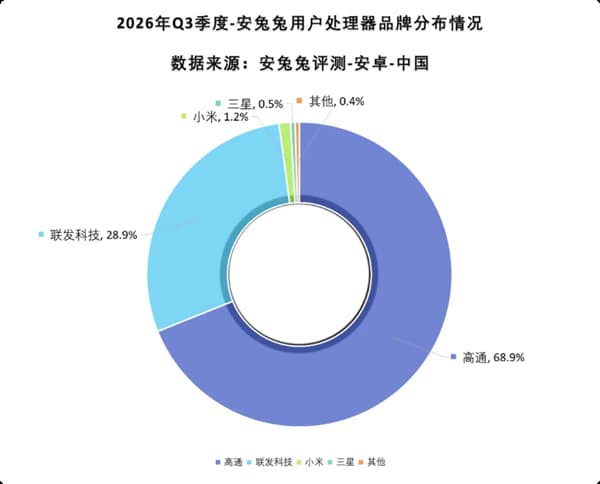
AnTuTu has released its third-quarter 2026 statistics on processor brand distribution among Android smartphone users in mainland China. Qualcomm continues to dominate the rankings, with MediaTek holding second place. Xiaomi’s self-developed XRing chipset family ranks third, marking a notable milestone for the company’s efforts to build its own mobile processors.
According to the report, Qualcomm accounts for 68.9% of the processor distribution, followed by MediaTek at 28.9%. Xiaomi’s XRing chips take a 1.2% share, while Samsung accounts for 0.5%. All other processor brands combined make up the remaining 0.4%.
Qualcomm and MediaTek Control More Than 97% of the Distribution
Qualcomm remains the clear leader in China’s Android ecosystem, accounting for more than two-thirds of the processors represented in AnTuTu’s statistics. Its chips are widely used in flagship and upper-midrange smartphones, where performance, gaming capabilities, and camera processing are major selling points.
MediaTek follows with a 28.9% share. Beyond competing in the flagship segment, the company has a strong presence in entry-level and midrange devices, helping smartphone manufacturers balance performance with affordability.
Together, Qualcomm and MediaTek represent 97.8% of the reported processor distribution. Their extensive product portfolios and adoption across multiple price categories give them a substantial advantage over smaller competitors.
Xiaomi XRing Takes Third Place With a 1.2% Share
Xiaomi’s XRing processors account for 1.2% of the distribution, placing the company ahead of Samsung’s 0.5% share in the report.
Although the percentage remains small compared with the two leading suppliers, the result is noteworthy because Xiaomi primarily uses its own processors in its own smartphones. Unlike Qualcomm and MediaTek, which supply chips to numerous manufacturers, Xiaomi has a more limited selection of devices equipped with its in-house silicon.
This restricted deployment means XRing has fewer opportunities to gain market presence across different smartphone brands and price ranges. Its third-place ranking therefore highlights the growing visibility of Xiaomi’s chip development efforts, even though it does not indicate that the company has challenged the industry’s leading suppliers.
Developing proprietary processors also gives Xiaomi greater control over how hardware and software work together. By coordinating its chip architecture with its operating system and device features, the company can pursue more tailored optimization for performance, power efficiency, imaging, and everyday responsiveness.
Xiaomi’s custom-chip strategy began attracting wider attention with the Xiaomi 15S Pro and its XRing O1 processor, an earlier step toward tighter integration between the company’s smartphone hardware and software.
Different Strategies Shape the Android Chip Market
The three main players follow different approaches to the smartphone processor business.
Qualcomm focuses heavily on flagship performance, gaming, and advanced imaging capabilities. Its broad adoption among premium Android manufacturers makes it a major supplier in the high-end market.
MediaTek competes across a wider range of price segments. Its processors are particularly important in affordable and midrange smartphones, while its flagship platforms also compete for performance-focused buyers.
Xiaomi takes a more vertically integrated approach with XRing. Rather than supplying a broad range of competing smartphone brands, the company uses its in-house chips to support its own hardware ecosystem. This strategy may help it fine-tune the relationship between the processor, system software, and device-specific features.
However, the current distribution figures show that Xiaomi still has a long way to go before its processors approach the scale of Qualcomm or MediaTek. Expanding the number of compatible devices and improving the appeal of its in-house chips will be important if Xiaomi wants to increase its share over time.
Why AnTuTu’s Numbers Need Context
AnTuTu’s statistics are based on users who run its benchmarking software, rather than a comprehensive count of every Android smartphone sold or actively used in China.
This distinction matters because people who run performance benchmarks may be more interested in technology, gaming, or comparing hardware than the average smartphone owner. As a result, the sample can differ from the overall market in terms of device selection and user behavior.
The reported percentages should therefore be understood as the processor distribution within AnTuTu’s sampled user base, not as official smartphone sales market shares. Even so, the figures offer a useful snapshot of the processors appearing in the participating Android devices.
Xiaomi 18 Fold Tops AnTuTu’s Latest Performance Ranking
Xiaomi’s processor ambitions have also drawn attention following AnTuTu’s release of its first Android performance rankings after the major Android V12 update in September.
According to the report, the Xiaomi 18 Fold, powered by the XRing O3 processor, secured first place with an average benchmark score of 4,620,886 points. The source says it outperformed devices powered by the sixth-generation Snapdragon 8 Supreme Edition and the Dimensity 9600 Pro.
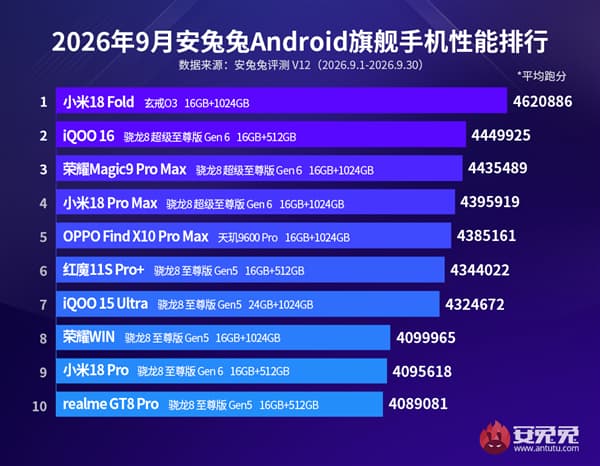
The result suggests that Xiaomi’s in-house silicon could be competitive in benchmark performance, although rankings alone do not establish how a phone will perform in every real-world situation. Sustained workloads, thermal management, battery consumption, software optimization, and application compatibility also influence the user experience.
For a closer look at Xiaomi’s latest in-house processor, our Xiaomi 18 Fold review covering the XRing O3 chipset examines its architecture, benchmark results, and performance-focused hardware.
What Xiaomi’s Third-Place Ranking Means
AnTuTu’s Q3 2026 figures underline how concentrated China’s Android processor landscape remains. Qualcomm and MediaTek account for nearly all of the reported distribution, while Xiaomi’s XRing chips occupy a much smaller but noteworthy third position.
For Xiaomi, the longer-term challenge is not simply producing a high-scoring processor. It is building a reliable chip platform that can deliver consistent performance, efficient power consumption, strong imaging support, and dependable software compatibility across more devices.
If Xiaomi continues improving its in-house processors and expands their use in future smartphones, XRing could become a more significant part of the company’s hardware strategy. For now, the latest figures offer an early indication of its position within AnTuTu’s user sample rather than proof of a major shift in the wider Android chipset market.