









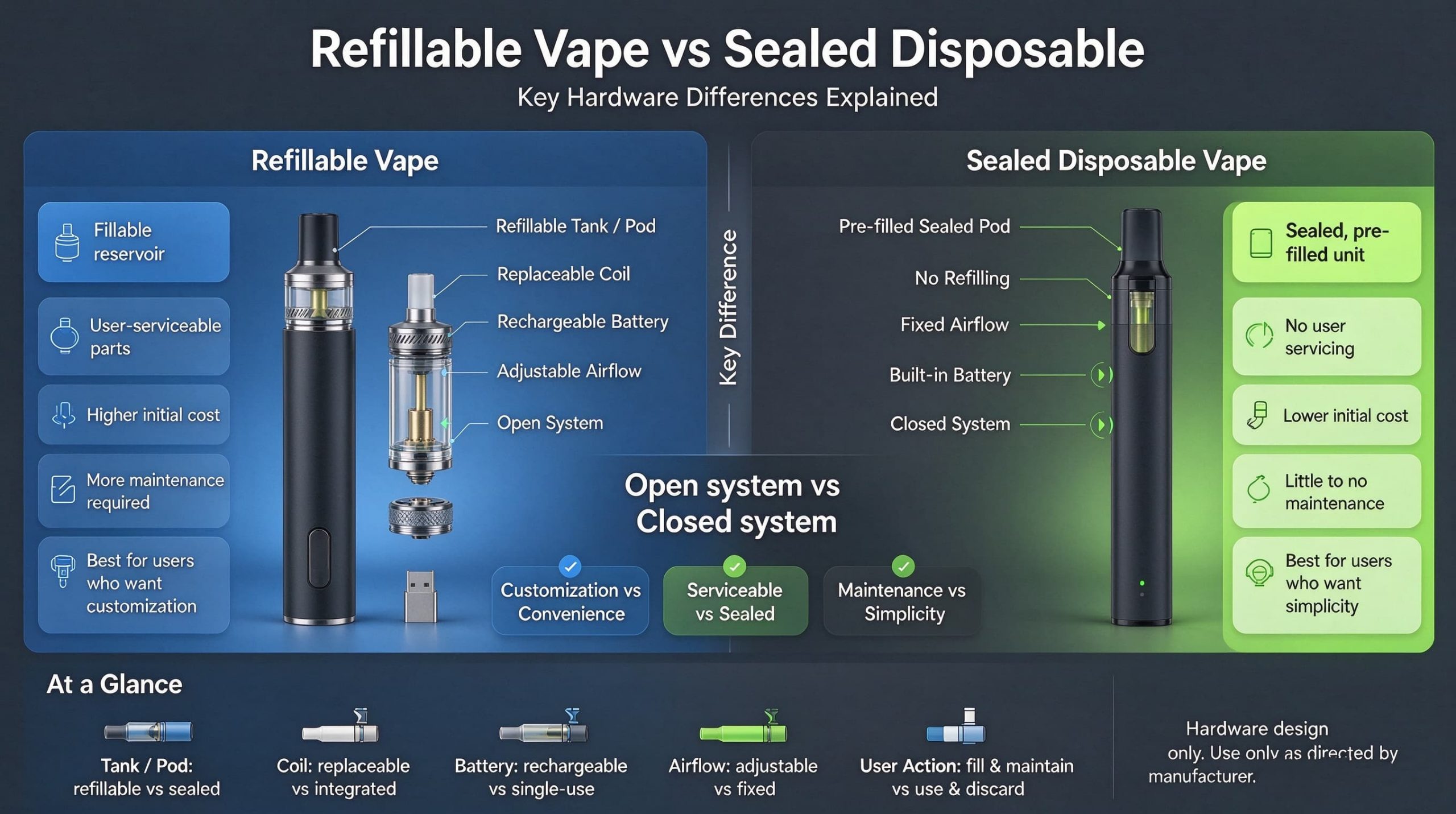
Choosing between a refillable vape and a sealed disposable is not just a question of convenience. The two formats are built around different hardware priorities, from how e-liquid reaches the coil to whether the battery, pod, and heating element can be serviced or replaced. Understanding these differences makes it easier to compare device design, maintenance requirements, and long-term resource use.
Although both formats use a battery-powered heating element to turn e-liquid into an aerosol, their internal layouts and user interactions can vary considerably. Here is a closer look at the hardware that separates refillable systems from sealed disposable devices.
1. E-Liquid Storage: Refillable Reservoir vs Factory-Filled Chamber
The most visible difference is the way each device stores its e-liquid.
A refillable vape uses a tank or refillable pod with an opening that allows the user to add compatible e-liquid. Depending on the design, the reservoir may feature a silicone stopper, a side-fill port, a top-fill mechanism, or another sealing arrangement. These components need to prevent leakage while allowing convenient refilling.
The refillable structure also gives manufacturers more flexibility in reservoir capacity, pod shape, and coil configuration. Some devices use replaceable pods with integrated coils, while others allow users to change the coil separately.
A sealed disposable vape, by contrast, arrives with e-liquid already inside. Its reservoir is generally not designed for routine user access. The filling port is closed during manufacturing, and the casing may be difficult to open without damaging the device.
This sealed approach reduces the number of steps required before use, but it limits user access to the liquid-storage hardware. When the device reaches the end of its intended service life, it is generally replaced rather than refilled.
2. Coil Architecture: Replaceable Components or Integrated Heating Hardware
The coil is the component that heats the e-liquid. Its construction affects heat distribution, vapor production, flavor delivery, and resistance to leakage or flooding.
Refillable devices offer several coil arrangements. A traditional tank may use a replaceable coil head containing heating wire or mesh and a surrounding wicking material. Other systems integrate the coil into a replaceable pod, meaning the user replaces the entire pod when the coil reaches the end of its useful life.
Mesh coils are common in modern designs because their broad heating surface can distribute heat across the wick. However, performance depends on more than coil shape: power settings, airflow, liquid formulation, and wick design all play a role.
Sealed disposables typically use a factory-installed coil or heating assembly. The manufacturer selects the coil resistance, wick material, airflow path, and operating power as part of a single device design. Users generally cannot replace the heating element independently.
This integrated structure helps standardize the experience within a particular model, but it also means a failed coil can make the entire device unusable, even if the battery still holds a charge and some e-liquid remains.
Coil resistance also affects the power a device needs, so our guide to Vaporesso GTX coil resistance, wattage, and compatibility explains why coil specifications matter when comparing vaping hardware.
3. Battery Design: Rechargeability and Service Life
Battery architecture is another important distinction.
Many refillable vape systems use rechargeable lithium-ion batteries. Depending on the product, the battery may be built into the device or housed in a removable battery compartment. Built-in designs can support a compact body, while removable configurations provide a different approach to battery replacement and maintenance.
Rechargeable devices also need a charging circuit and suitable electrical protection. Depending on the model, these systems may monitor charging conditions, manage output power, and help prevent certain electrical faults.
Sealed disposable vapes use a battery selected to suit the device’s intended operating life. Some models are designed for one-time use without charging, while others include a charging port. The presence of a charging port does not make a disposable refillable, nor does it mean the device is intended for repeated long-term service.
In both categories, battery capacity alone does not determine usable life. Coil resistance, power consumption, activation frequency, battery condition, and the amount of liquid in the reservoir all influence how long a device lasts.
A key design distinction is what happens when one component reaches its limit. A refillable device may continue to be used after replacing a compatible pod or coil, whereas a sealed disposable is generally treated as a complete unit.
For a closer look at battery configurations, read our guide to 18650 vs built-in battery vape mods and how they differ in replacement options, charging, and everyday use.
4. Airflow and Power Control
Airflow determines how air moves through the device and across the heating area. It influences draw resistance, aerosol cooling, and the overall inhalation experience.
Refillable systems may provide adjustable airflow, allowing users to change the opening through which air enters. Some also offer adjustable wattage or selectable output modes. These controls create more opportunities to customize the experience, although not every refillable device includes them.
Sealed disposables usually have a more fixed airflow path and a factory-defined power configuration. Many use automatic draw activation, which triggers the heating element when the user inhales. Other models may include a button or limited adjustment features.
More controls do not automatically mean better hardware. A fixed configuration can simplify operation, while adjustable settings add flexibility but may require users to understand compatibility, power limits, and device instructions.
The relevant comparison is whether the hardware provides the level of control a user needs, not simply how many settings appear on the packaging.
5. Sensors, Circuit Boards, and Electronic Protection
Both device types may contain electronic control circuitry, but the complexity varies by model.
A refillable vape may include a control board that regulates power output, reads coil resistance, manages button or draw activation, and displays battery status. More advanced devices can offer screens, operating modes, puff counters, or other monitoring features.
Disposable devices can also contain sensors and electronic controls. Draw-activated models typically need a sensor capable of detecting airflow or pressure changes. The control circuit then activates the heating element according to the manufacturer’s design.
Neither category should be assumed to have superior safety features based on its format alone. Protection against short circuits, overheating, overcharging, or other faults depends on the specific electronics, component quality, and product compliance. Buyers should consult the manufacturer’s documentation rather than infer protection levels from appearance.
Users should stop using a device that becomes unusually hot, leaks significantly, or shows signs of battery damage. Batteries and electronic vaping products should not be opened or modified to investigate an internal fault.
6. Seals, Connections, and Leakage Control
Leakage prevention requires different engineering solutions in refillable and sealed systems.
Refillable pods and tanks rely on seals, filling-port closures, and carefully designed liquid channels. These components must tolerate repeated handling and refilling. Worn seals, damaged pods, incompatible e-liquid, overfilling, or incorrect assembly can contribute to leakage.
Sealed disposables avoid routine refilling, so they do not need a user-accessible filling mechanism. Their liquid chamber is assembled and closed during manufacturing. However, sealed construction does not guarantee that leakage is impossible. Manufacturing defects, physical damage, temperature changes, and storage conditions can still affect performance.
For refillable hardware, useful design considerations include how easily the fill port opens, whether the seals are replaceable, and how clearly the pod fits into the device. For sealed hardware, consistent assembly and reliable factory sealing are particularly important.
7. Maintenance and Component Replacement
Maintenance is where the two hardware approaches lead to very different ownership experiences.
A refillable system may require users to refill the reservoir, keep the device clean according to the manufacturer’s instructions, replace worn pods or coils, and monitor battery condition. Coil life varies with use, power settings, and e-liquid composition, so a fixed replacement interval does not apply to every device.
The ability to replace a single component can extend the useful life of the rest of the hardware. If a compatible pod or coil wears out, the user may not need to discard the battery and control electronics.
A sealed disposable generally requires less routine maintenance because its liquid chamber and heating components are not intended for user servicing. That simplicity comes with a trade-off: when the device reaches the end of its intended life or develops a fault, replacing the whole unit is usually the manufacturer’s intended approach.
Opening, refilling, or modifying a sealed disposable can damage its seals, electrical connections, or battery protection. It should not be treated as a refillable device simply because its casing can be opened.
8. Material Use and End-of-Life Disposal
The hardware structure also affects how each format is handled at the end of its service life.
A refillable device can potentially remain in use while individual consumable parts are replaced. The actual environmental benefit depends on how long the device lasts, which components are discarded, and whether replacement parts are available. Refillable pods and coils still generate waste, and a rechargeable device still contains a battery and electronic components.
A sealed disposable combines the battery, heating assembly, liquid reservoir, and outer casing into a single product. Discarding the complete unit can mean that usable components are thrown away alongside exhausted or faulty ones.
Neither format should be placed in ordinary household waste without checking local requirements. Vaping devices contain batteries and electronic parts that may require specialist collection. Do not burn, crush, or dismantle a device to separate its materials. Follow local e-waste and battery-disposal guidance.
9. Quick Comparison: Refillable Vape vs Sealed Disposable
| Hardware feature | Refillable vape | Sealed disposable |
|---|---|---|
| E-liquid storage | User-refillable tank or pod | Factory-filled chamber |
| Coil access | Replaceable coil or integrated pod coil, depending on design | Usually factory-installed and not user-replaceable |
| Battery | Often rechargeable; built-in or removable depending on model | Sized for the device’s intended life; some models are rechargeable |
| Airflow | May be adjustable | Usually fixed, although designs vary |
| Power settings | May offer adjustable output | Commonly factory-configured |
| Routine maintenance | Refilling and possible pod or coil replacement | Usually minimal routine maintenance |
| Component replacement | Some parts can be replaced independently | Generally replaced as a complete device |
| End-of-life handling | Battery, electronics, pods, and coils need appropriate disposal | Whole device needs appropriate battery or e-waste handling |
Which Hardware Design Makes More Sense?
The practical difference comes down to serviceability and the level of user involvement.
Refillable devices are built around continued use of a main device with recurring maintenance and, where supported, replaceable consumables. Their advantages depend on access to compatible e-liquid, pods or coils, and replacement parts. They can also offer more control over airflow and power, depending on the model.
Sealed disposables prioritize an integrated, factory-configured design. They typically require fewer user decisions, but provide less access to internal components and usually generate a complete-device replacement when their intended service life ends.
For a fair comparison, look beyond advertised puff counts, battery capacity, or the number of features on the box. Check whether the battery is rechargeable, whether the coil can be replaced, how the liquid chamber is sealed, what protections the manufacturer documents, and how the product must be disposed of.
The bottom line: refillable vapes emphasize ongoing use and potential component replacement, while sealed disposables emphasize an integrated, ready-to-use format. Understanding the hardware behind each design provides a more meaningful comparison than appearance or marketing claims alone.