











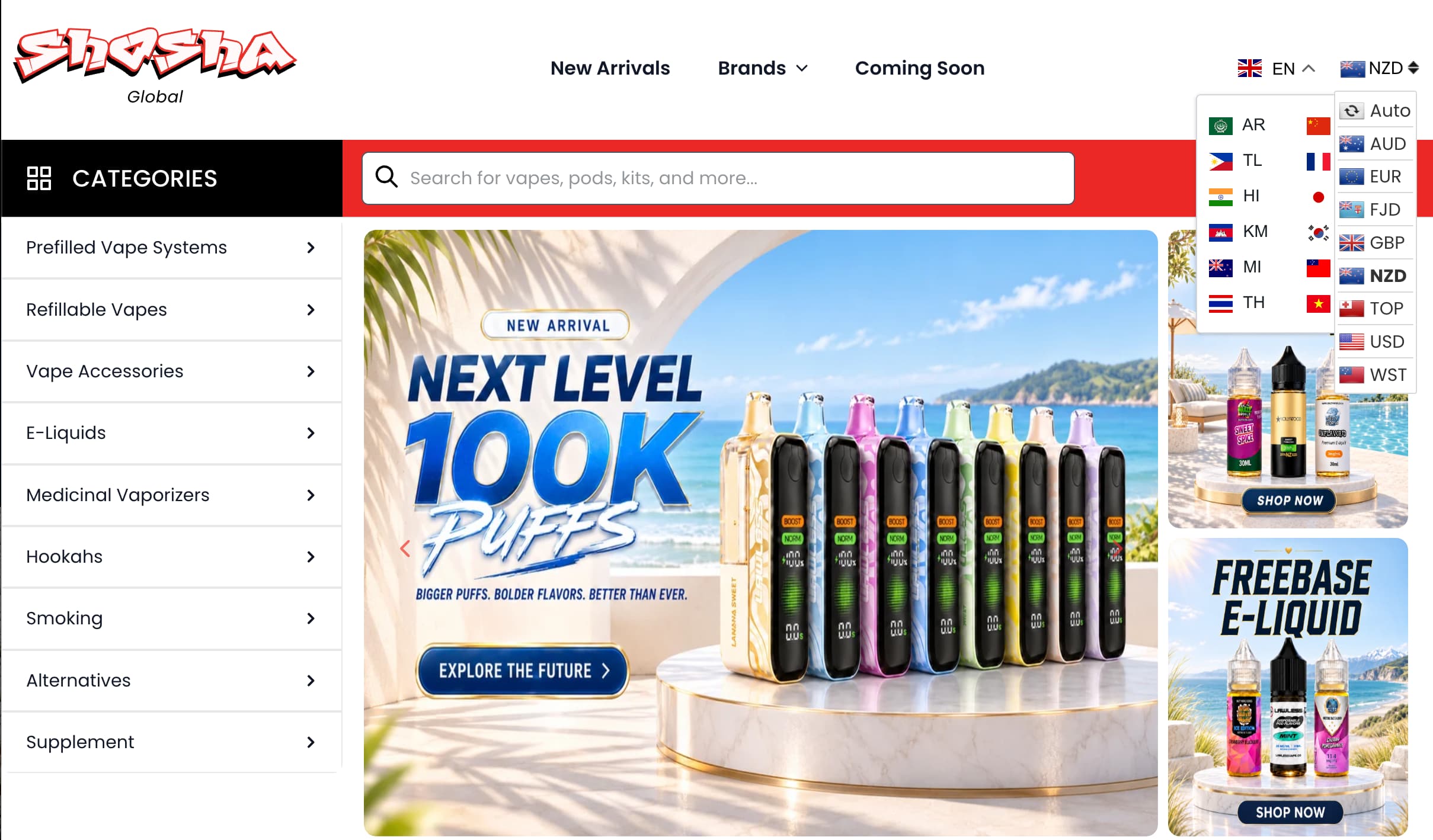
New Zealand health authorities are reviewing the international website operated by major vape retailer Shosha after researchers raised concerns that it may be allowing the company to bypass domestic vaping advertising restrictions.
The website, Shosha Global, displays images of vaping products and appears to accept orders from customers in New Zealand. More importantly, test purchases conducted by researchers at the University of Auckland reportedly arrived at local addresses within three days, with shipping documents showing that the goods had been dispatched from Auckland.
The findings have renewed questions about whether an overseas-facing e-commerce platform can legally promote vaping products to New Zealand consumers while operating within the country’s jurisdiction.
According to Radio New Zealand (RNZ), which reported the investigation on November 13, researchers also discovered that Shosha Global’s store availability tool listed physical retail locations exclusively in New Zealand.
Shosha operates more than 125 physical stores across the country. The company describes Shosha Global as an international e-commerce operation established through a commercial partnership with an undisclosed overseas entity in July 2025.
New Zealand’s Ministry of Health has confirmed that officials are reconsidering their previous assessment of the website. However, no final determination has been made that Shosha Global has breached the country’s vaping advertising laws.
Shosha Global Still Displays Vape Products While Serving New Zealand Customers
The controversy began ahead of New Zealand’s tighter vaping advertising and retail display rules, which took effect on June 17, 2025.
Before the restrictions were introduced, Shosha reportedly informed its domestic customers that images of vaping products would be removed from its New Zealand website, shosha.co.nz, to comply with the new requirements.
Emails obtained by RNZ indicate that customers were directed to shosha.com, an international website where product images and promotional displays remained available.
Casey Costello, who was then Associate Minister of Health, referred the international website to the Ministry of Health for investigation.
At the time, the ministry reportedly concluded that shosha.com was registered and hosted in the United States and did not deliver regulated products to New Zealand. On that basis, officials did not consider the website to be operating in breach of local rules.
However, researchers from the University of Auckland subsequently examined the platform more closely.
Public health researcher Lucy Hardie and her colleagues found that the website continued to display vaping products and included a store availability feature showing New Zealand retail outlets.
The research team then placed several test orders. According to the findings reported by RNZ, the products reached New Zealand delivery addresses within three days. Shipping documentation indicated that the parcels had originated in Auckland.
This evidence has prompted the Ministry of Health to revisit its earlier position.
A ministry spokesperson told RNZ that officials were examining whether the new information justified changing their previous assessment. The ministry also acknowledged that New Zealand’s laws can apply to websites accessible within the country, although investigating and enforcing rules against businesses registered overseas can create practical and jurisdictional difficulties.
Researchers Identify New Zealand-Specific Marketing on Shosha Global’s Instagram Account
The investigation extended beyond the international shopping website to an associated Instagram account, shosha.global.
Researchers examined 67 posts published between June 17, 2025, and May 2026. Their analysis identified several features suggesting that the account’s marketing was closely connected to the New Zealand market.
The findings included:
- 46.3% of posts: Product images contained warning information presented in both English and Māori.
- 40.3% of posts: Images included labelling associated with New Zealand’s specific nicotine concentration limits.
- 5.9% of posts: Content referenced Matariki, the Māori New Year.
Researchers also noted that the Instagram account’s public profile information identified New Zealand as its location.
Hardie argued that these details suggested the account’s marketing activities had a strong connection to domestic consumers, despite its association with an international website.
RNZ attempted to access the Instagram account on November 6 but found that it was no longer available.
The Ministry of Health reportedly said it had not been aware of the associated Instagram account during its earlier investigation of Shosha Global.
Shosha did not respond to RNZ’s request for comment on the latest findings.
Shosha’s International Business Structure Raises Further Questions
Shosha is one of New Zealand’s largest specialist vape retailers. The company says it began operating in 2010 and now has more than 125 physical stores.
Its product range includes vaping devices, e-liquids, heated tobacco products and related accessories.
A September 2025 New Zealand High Court judgment identified Mason Corporation Limited as the business operating under the trading name Shosha Vape and Hookah, with activities covering the importation, distribution and retail sale of vaping products.
In a statement on its website, Shosha said its headquarters and research and development operations remain in New Zealand. The company also described product development activities involving markets including Australia, the United Kingdom, the United States and China.
Shosha said it established a commercial partnership with an overseas entity in July 2025 to support international sales through Shosha Global. Its international order fulfilment arrangements involve partners in New Zealand, the United States and China.
However, the company has not publicly identified the overseas partner in the statement or disclosed its ownership structure and financial contribution to the international business. The publicly available sales terms on shosha.com also do not clearly identify the legal entity responsible for all transactions.
The retailer distributes products from established vaping brands such as SMOK, Vaporesso, Geekvape and UWELL. It also operates product lines including Lawless, SaltyVape and Smoka.
The Lawless website provides separate shopping directions for different markets, directing New Zealand consumers to shosha.co.nz and customers in the United States and other international markets to shosha.com.
Shosha Global publicly lists a range of prefilled pod devices, replacement pods and e-liquids. However, the available reporting does not provide a complete list of brands or individual product SKUs involved in the researchers’ test purchases or the 67 Instagram posts.
Consequently, it remains unclear which specific products were included in the transactions examined by the research team.
New Zealand’s Vape Advertising Restrictions Put Overseas Websites Under Scrutiny
New Zealand introduced tighter vaping advertising restrictions on June 17, 2025, as part of its broader regulatory framework for vaping products.
Under the updated requirements, retailers cannot display images of vaping products on their websites. Specialist vape retailers are also restricted from sending promotional messages about vaping products to existing customers.
Similar regulatory changes are also taking place in other markets, as explained in our guide to UK vape advertising and promotion restrictions, which examines how governments are tightening controls on nicotine-product marketing.
Domestic online retailers are further restricted from linking customers to overseas websites where the product displays would be inconsistent with New Zealand’s advertising rules.
These requirements form part of the regulatory framework under the Smokefree Environments and Regulated Products Act 1990 and its associated regulations.
The Ministry of Health has indicated that enforcement activity has continued since the restrictions came into force.
Between June 2025 and July 2026, authorities issued 71 infringement notices relating to vaping advertising violations on websites. This figure represents nationwide enforcement activity and does not mean that Shosha received 71 notices.
Businesses found in breach of applicable vaping advertising requirements may face an infringement fee of NZ$2,000. More serious cases resulting in prosecution and conviction can carry higher penalties, depending on the type of offender and the relevant legal provision.
The Shosha investigation therefore raises a broader regulatory question: can a retailer avoid domestic advertising restrictions by operating a website through an overseas-registered business when its products are still promoted and delivered within New Zealand?
The answer may depend on the website’s actual operations, the parties responsible for sales and fulfilment, and the extent to which its activities are directed at New Zealand consumers.
Previous Shosha Legal Dispute Was Separate From the Current Advertising Investigation
Shosha has previously been involved in legal proceedings concerning New Zealand’s vaping regulations.
In November 2024, Mason Corporation sought judicial review of government requirements relating to removable batteries in reusable vaping devices.
The New Zealand government announced in July 2025 that it would withdraw the relevant requirement, with the regulatory change taking effect in September.
High Court documents also show that British American Tobacco’s New Zealand business had sought access to certain court records connected with the proceedings.
That battery-related judicial review is separate from the current investigation into Shosha Global’s advertising and online sales activities. The two matters should not be treated as evidence of the same alleged regulatory breach.
What Happens Next in the Shosha Global Investigation?
The Ministry of Health has not yet published the outcome of its latest review of Shosha Global. It has also not announced whether enforcement action will be taken against the website, its associated social media account or the businesses responsible for its operations.
The investigation could become an important test of how New Zealand applies its vaping advertising rules to international e-commerce platforms that continue to serve domestic customers.
The central issue is no longer simply where a website is registered or hosted. Researchers’ test purchases suggest that local delivery arrangements, domestic retail connections and market-specific promotional content may also be relevant when assessing whether an overseas-facing platform is effectively operating in New Zealand.
For the country’s vaping industry, the outcome could provide greater clarity about the responsibilities of retailers using international websites, overseas commercial partnerships and cross-border fulfilment arrangements.
For now, Shosha has not been found to have breached the advertising rules in this case, and the Ministry of Health’s review remains ongoing.