









July 7 – Igeekphone
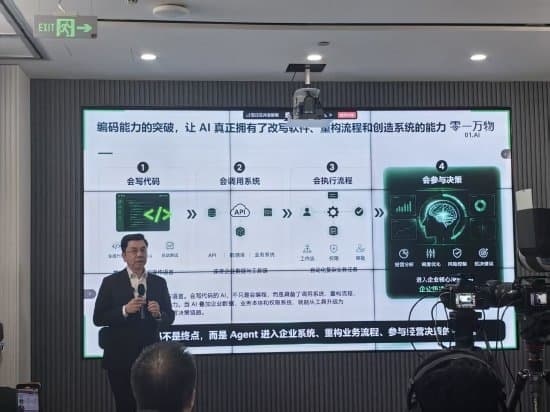
At the “WanCe AI Media” launch event held today, Li Kaifu, founder and CEO of 01.AI (Zero-One World), shared his views on the rapid advancement of AI programming, arguing that programmers have less to fear from AI than many people believe.
According to Li, AI coding capabilities have already surpassed those of humans in many real-world applications.
“Over the past two years, AI programming has exceeded human capabilities. At many companies, around 90% of the code is now generated by AI, while humans write only the remaining 10%,” Li said.
He added that breakthroughs in AI coding have enabled AI systems to go far beyond code generation.
“AI can now rewrite software, redesign workflows, and build entire systems.”
AI Is Becoming More Than a Coding Tool
Li argued that many people mistakenly assume programmers are among the professions most at risk of being replaced by AI. In reality, he believes this concern misses the bigger picture.
“When AI can program, it also gains the ability to perform countless other tasks,” he said. “It is no longer just a tool for answering questions—it can orchestrate systems, execute complex tasks, and even participate in decision-making.”
According to Li, the real transformation lies not in AI replacing software developers, but in its ability to dramatically expand human productivity.
“When AI becomes better than most people at performing tasks, the most important issue is not whether it replaces programmers. The real value is that it can help us accomplish work on an almost unlimited scale.”
Great Programmers Will Lead AI, Not Be Replaced by It
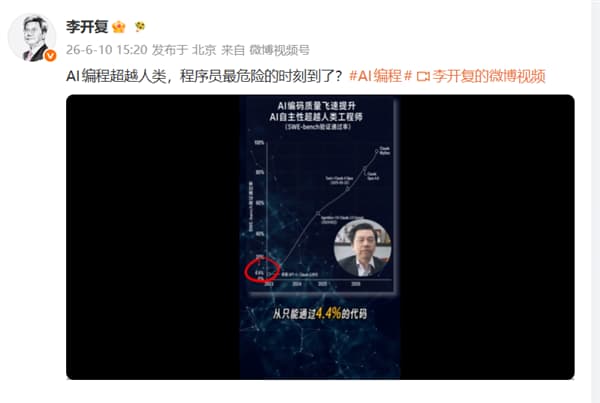
Li’s remarks are consistent with comments he made in June, when he shared a video on his personal social media explaining why experienced software engineers remain essential in the AI era.
He argued that outstanding programmers contribute far more than writing code. They understand user requirements, business models, and competitive strategies, while also designing software architecture, planning module interactions, and coordinating complex development projects.
As long as developers possess these high-level planning and coordination skills, Li believes they will be able to direct AI rather than be replaced by it.
Instead of eliminating programmers, AI is expected to become a powerful collaborator—handling repetitive coding tasks while allowing engineers to focus on system design, strategic thinking, and innovation.