










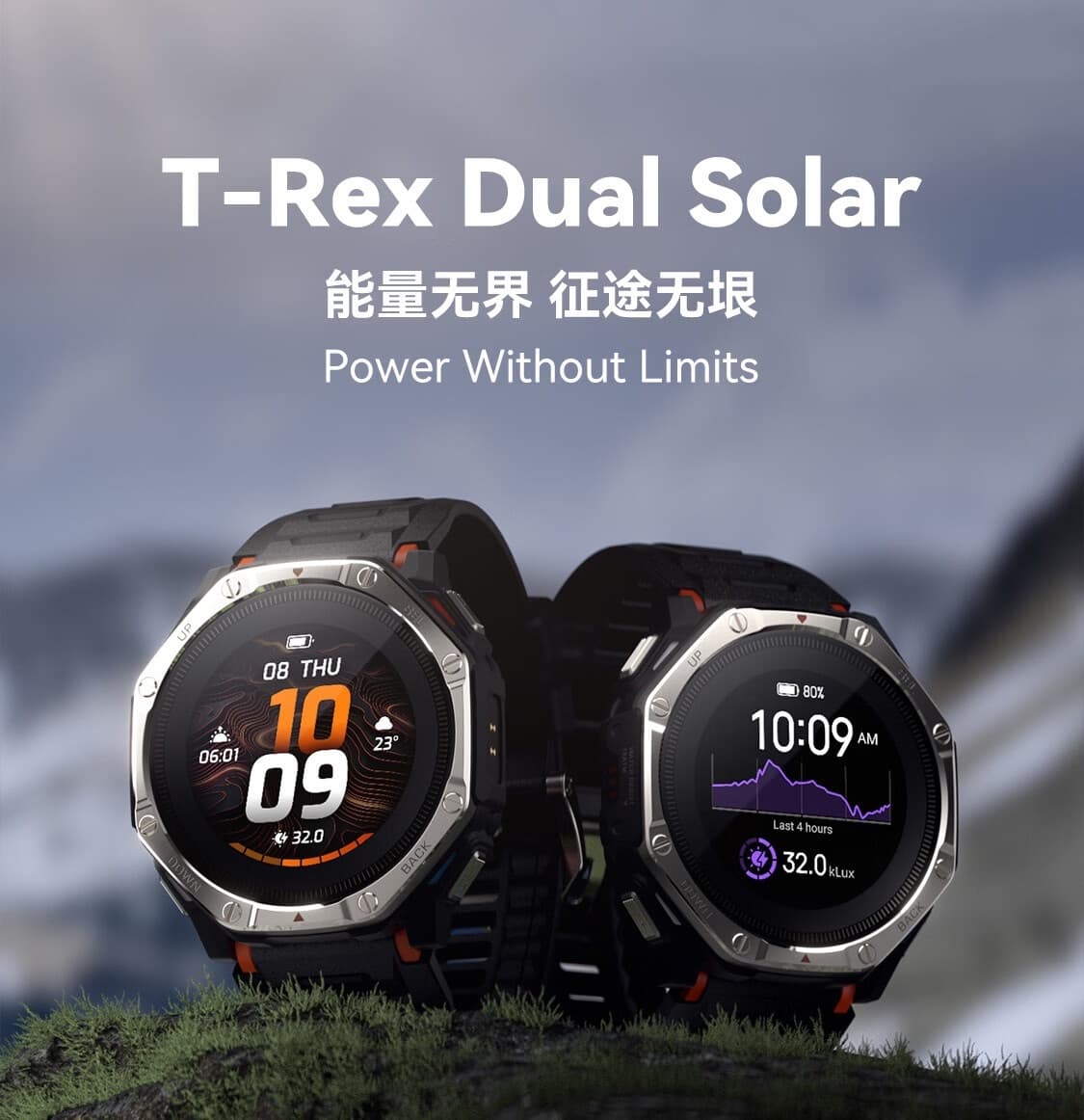
Amazfit has launched the T-Rex Dual Solar in China, introducing an unusual approach to smartwatch battery life: solar charging from both the front and rear of the watch. Listed at 4,499 yuan, the rugged smartwatch combines a 1.32-inch AMOLED display, sapphire glass, Grade 5 titanium components, offline maps and 10 ATM water resistance with a dual-sided solar system designed for extended outdoor use.
The headline battery figures are particularly interesting. Amazfit rates the T-Rex Dual Solar for up to 25 days of typical use, while its specified solar test conditions can extend that figure to 34 days with front solar charging or 51 days with rear solar charging. These figures are based on three hours of 50,000-lux light exposure per day, so they should not be interpreted as guaranteed everyday battery life.
What Makes the T-Rex Dual Solar Different?
Solar-powered smartwatches are not new, but the T-Rex Dual Solar takes the concept further by putting solar collection on both sides of the watch.
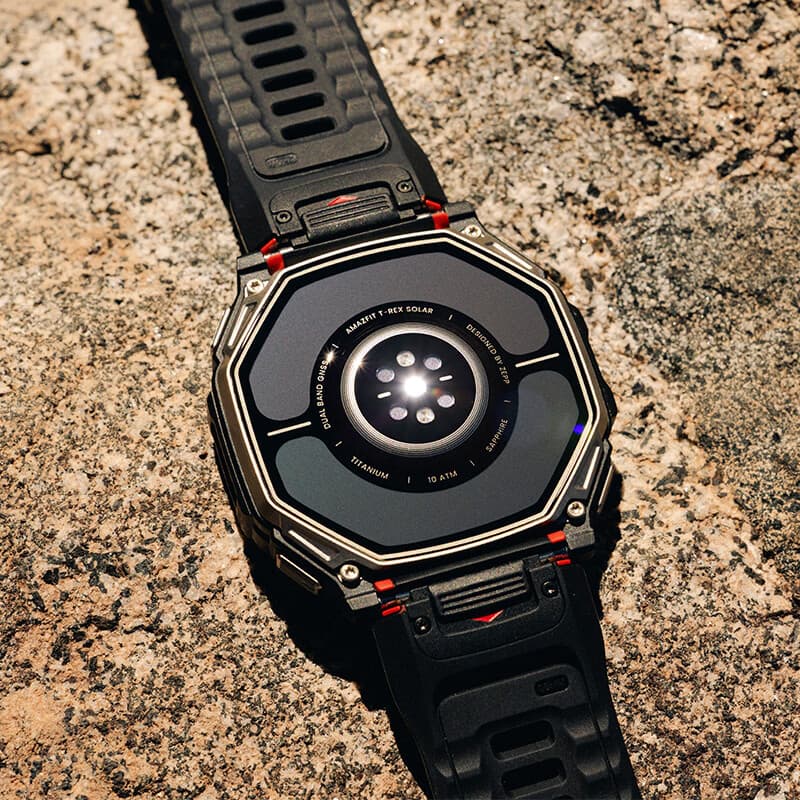
The front of the watch combines its AMOLED display with solar charging hardware, while the rear uses a glass-ceramic panel incorporating a larger solar collector. That gives Amazfit more surface area for harvesting light than a conventional smartwatch that relies on a small solar element around the display.
The difference matters most for people who spend long periods outdoors. A smartwatch used for hiking, camping or trail running may be far from a power outlet, making every additional day of battery endurance useful.
Rather than treating solar charging as a replacement for conventional charging, the T-Rex Dual Solar is better understood as a watch designed to reduce how often its battery needs external power.
How Does Dual-Sided Solar Charging Work?
The T-Rex Dual Solar uses its front and rear surfaces differently.
When the watch face is exposed to strong light, the front solar system can contribute energy while the watch is being worn. The rear solar panel provides another collection surface and can be particularly useful when the back of the watch is deliberately exposed to sunlight.
Amazfit’s official specifications list the following battery figures:
- Up to 25 days of typical battery life
- Up to 34 days with three hours of front solar exposure per day
- Up to 51 days with three hours of rear solar exposure per day
The 34-day and 51-day figures are based on specific lighting conditions rather than normal indoor use. Actual endurance will depend on sunlight intensity, weather, screen brightness, GPS use, workouts, notifications and other settings.
That distinction is important because solar charging is primarily about extending endurance, not making the watch independent of its battery.
Why Is the Rear Solar Panel Important?
The rear solar collector is arguably the most interesting part of the T-Rex Dual Solar.
A watch worn normally has its display facing outward, so a conventional front-facing solar surface has the best chance of receiving direct light. Amazfit’s rear collector provides another option: the watch can be positioned so that the larger rear solar surface receives more direct sunlight when it is not being worn normally.
This makes particular sense during outdoor trips. A user could leave the watch exposed to sunlight while taking a break, attaching it to outdoor equipment, or otherwise positioning it for better light exposure.
The design therefore addresses one of the main limitations of solar smartwatches: the watch is not always oriented toward the strongest available light.
25 Days, 34 Days or 51 Days: What Do the Numbers Mean?
The battery figures can easily be misunderstood.
The baseline figure is up to 25 days of typical use. Under Amazfit’s specified test scenario, three hours of 50,000-lux exposure per day can increase the claimed endurance to 34 days with front solar charging.
The rear solar system can push the figure to up to 51 days under the same specified lighting condition.
In other words, the 51-day figure should not be read as “the watch lasts 51 days for every user.” It represents a manufacturer-defined test condition.
For someone who spends most of the day indoors, the benefit could be much smaller. For hikers and outdoor athletes who regularly encounter strong sunlight, the solar system has considerably more practical value.
Rugged Design for Outdoor Use
The T-Rex Dual Solar is built around the rugged design philosophy of the T-Rex family.
Amazfit lists a Grade 5 titanium bezel and buttons, while the rear shell combines titanium and glass-ceramic materials. The display is protected by sapphire glass, giving it better scratch resistance than ordinary smartwatch glass.
The watch has a 10 ATM water-resistance rating, which reinforces its focus on outdoor activities and water-related use.
This combination of materials is important because long battery life alone does not make a smartwatch suitable for demanding trips. A watch designed for hiking and adventure also needs to survive exposure to water, dust, impacts and rough handling.
If battery endurance is your main priority, our guide to smartwatches with long battery life compares other models designed to reduce frequent charging.
1.32-Inch AMOLED Display Reaches 3,000 Nits
The T-Rex Dual Solar features a 1.32-inch AMOLED display with a peak brightness of up to 3,000 nits.
High brightness is particularly useful on an outdoor smartwatch. A screen that looks excellent indoors can become difficult to read when sunlight hits it directly, especially when users are checking maps or workout information while moving.
The display also uses sapphire glass, giving the watch a combination of high brightness and stronger scratch resistance.
For hikers and runners, this is more important than simply having an impressive specification. A readable screen can make it easier to check navigation information without stopping to use a smartphone.
Offline Maps and Outdoor Navigation
Battery endurance is only one part of an adventure smartwatch.
The T-Rex Dual Solar supports offline topographic maps and route planning, allowing users to access navigation information without depending entirely on a continuous internet connection.
That makes the solar system more meaningful. A smartwatch that can continue operating for many days and provide offline navigation is better suited to environments where carrying a charger or maintaining a mobile connection may be inconvenient.
The combination is particularly relevant to hiking, backpacking and trail running.
For readers comparing wearable navigation features, our smartwatch reviews cover more models with GPS, fitness tracking and outdoor-focused features.
Health and Fitness Tracking
The T-Rex Dual Solar also includes an optical heart-rate sensor for continuous health and activity monitoring.
The watch is designed as a broader outdoor fitness device rather than simply a battery-focused smartwatch. Users can combine activity tracking, navigation and health measurements while spending extended periods away from home.
As with other consumer wearables, its health measurements should be treated as wellness and fitness information rather than a substitute for professional medical equipment.
Amazfit T-Rex Dual Solar Specifications
| Feature | Amazfit T-Rex Dual Solar |
|---|---|
| China price | 4,499 yuan |
| Solar charging | Dual-sided |
| Typical battery life | Up to 25 days |
| Front solar endurance | Up to 34 days under specified conditions |
| Rear solar endurance | Up to 51 days under specified conditions |
| Display | 1.32-inch AMOLED |
| Peak brightness | Up to 3,000 nits |
| Cover glass | Sapphire glass |
| Bezel | Grade 5 titanium |
| Rear shell | Titanium and glass-ceramic |
| Water resistance | 10 ATM |
| Navigation | Offline maps and route planning |
| Battery capacity | 660mAh |
| GPS battery life | Up to 41 hours in accurate GPS mode |
Amazfit’s official specifications also list more demanding battery modes, including up to 13 days under heavy use and up to 41 hours in accurate GPS mode.
Who Is the T-Rex Dual Solar For?
The T-Rex Dual Solar is not necessarily the best choice for someone who spends most of the day at a desk and charges a smartwatch regularly.
Its advantages become clearer for users who spend significant time outdoors.
It makes the most sense for:
- Long-distance hikers
- Backpackers
- Trail runners
- Campers
- Outdoor travelers
- Adventure sports enthusiasts
- Users who prioritize long battery life
- People who regularly use GPS and offline navigation
For these users, reducing dependence on a wall charger can be more valuable than having the thinnest possible smartwatch.
T-Rex Dual Solar vs a Conventional Long-Battery Smartwatch
The main difference is not simply battery capacity.
Many long-lasting smartwatches rely on a larger battery, lower-power hardware or aggressive power-saving modes. Amazfit instead adds another energy source to the equation.
The T-Rex Dual Solar still has a 660mAh battery, but its dual-sided solar system can continuously contribute energy when suitable light is available.
That makes it particularly interesting for outdoor users who may have access to sunlight but not a conventional charger.
The trade-off is obvious: solar performance depends heavily on the environment. Someone who spends most of the day indoors will not receive the same benefit as someone hiking under strong sunlight.
Price and Availability
The Amazfit T-Rex Dual Solar is listed in China at 4,499 yuan. The Chinese listing information reported at launch also highlights the dual-sided solar charging system and the 25-, 34- and 51-day battery figures.
Amazfit’s international product page lists the T-Rex Dual Solar with a 660mAh battery, dual-sided solar charging, a 1.32-inch AMOLED display and 10 ATM water resistance.
International pricing and availability can differ by market, so buyers outside China should check Amazfit’s local store rather than assuming the Chinese launch price will apply globally.
Is the Amazfit T-Rex Dual Solar Worth Watching?
The T-Rex Dual Solar stands out because it tries to solve a very specific smartwatch problem.
Instead of simply increasing battery capacity, Amazfit has designed the watch to collect solar energy from both the front and rear surfaces. The result is a claimed 25-day typical endurance that can reach 34 days with front solar exposure or 51 days with rear solar exposure under specified test conditions.
The rest of the hardware supports the same outdoor-first philosophy: a bright 1.32-inch AMOLED display, sapphire glass, Grade 5 titanium construction, 10 ATM water resistance and offline mapping.
For everyday smartwatch users, the dual-sided solar system may be unnecessary. For hikers, campers and other outdoor users who value battery independence, however, it could be the T-Rex Dual Solar’s most compelling feature.
The biggest question is therefore not whether the watch can last 51 days in a controlled test. It is how much additional battery life real outdoor users can gain from the two-sided solar system in their own environment.
That is what makes the Amazfit T-Rex Dual Solar one of the more interesting rugged smartwatches to watch in 2026.
Frequently Asked Questions
How long does the Amazfit T-Rex Dual Solar last?
Amazfit rates it for up to 25 days of typical use. Under specified solar conditions, the figure can reach 34 days with front solar charging or 51 days with rear solar charging.
Does the T-Rex Dual Solar charge from both sides?
Yes. Amazfit lists the watch as supporting dual-sided solar charging, with solar collection integrated into the front and rear design.
Does the T-Rex Dual Solar have a 660mAh battery?
Yes. The official specifications list a 660mAh rated battery capacity.
Is the T-Rex Dual Solar waterproof?
It has a 10 ATM water-resistance rating. Users should still follow Amazfit’s specific water-use guidance rather than treating an ATM rating as protection against every type of water exposure.
Is the 51-day battery life guaranteed?
No. The 51-day figure comes from Amazfit’s specified solar-use conditions. Actual battery life will vary depending on light exposure, GPS usage, screen settings, workouts and other features.
What makes the T-Rex Dual Solar different from other solar smartwatches?
Its defining feature is the dual-sided solar charging system. Instead of relying only on a solar surface around the display, the watch also uses a rear solar collector integrated into its glass-ceramic back.