









AMD is demonstrating a new approach to making large AI models run more efficiently on consumer hardware. Its experimental software project, HRX Loom, uses agent-based AI coding workflows to accelerate model adaptation for AMD graphics hardware. In a recent experiment, AMD engineers reportedly migrated 50 popular Hugging Face models across 18 different architectures in just three to four days.
The achievement highlights how AI coding agents could reduce the time and engineering effort required to bring open-source models to different hardware platforms, potentially making local AI deployment more accessible to PC users.
AMD Engineers Use AI Agents to Adapt 50 Models
The experiment was led by AMD engineers Jeremy Fowers and Ben Vanik. Instead of manually adapting each model for AMD hardware, the team introduced an agent-based AI workflow that could independently write, modify, and optimize model code for the company’s GPU platform.
Using this approach, the engineers completed the migration of 50 popular models from Hugging Face within approximately three to four days. These models cover 18 different architectures, demonstrating the potential of automated development tools to simplify hardware compatibility work.
Hugging Face is one of the world’s largest platforms for sharing open-source AI models. Traditionally, adapting a large collection of models to a particular hardware ecosystem can require months of engineering work. AMD’s experiment suggests that AI-powered programming agents could significantly shorten this process.
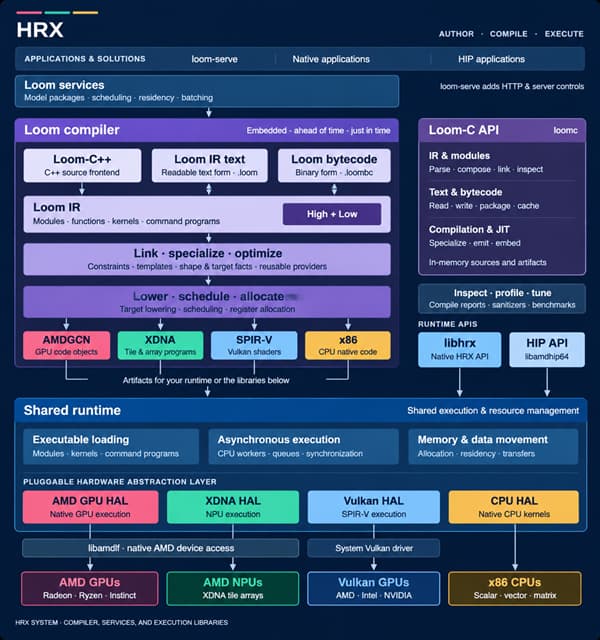
HRX Loom Delivers Up to 2.1x Faster Performance
Beyond model compatibility, AMD also tested HRX Loom’s performance on its Strix Halo platform, which is powered by Ryzen AI Max hardware.
According to the experimental results, HRX Loom delivered a speed improvement of approximately 1.5 to 2.1 times over the commonly used Llama.cpp ROCm backend when processing long prompts containing 32K tokens.
The comparison with the Vulkan backend was also notable, with AMD reporting performance gains of up to 1.9 times.
These results suggest that HRX Loom could offer meaningful performance improvements for local AI workloads, particularly when handling longer input sequences. However, actual performance will depend on the model, hardware configuration, and workload.
HRX Loom Supports GPU, CPU and NPU Processing
One notable aspect of HRX Loom is that its development is not limited to GPU acceleration. The experimental project also supports execution through CPUs and NPUs, giving developers more flexibility when deploying AI models across different hardware resources.
This broader hardware support could be useful for consumer devices equipped with integrated AI processors, especially as local AI capabilities become increasingly important in laptops and desktop computers.
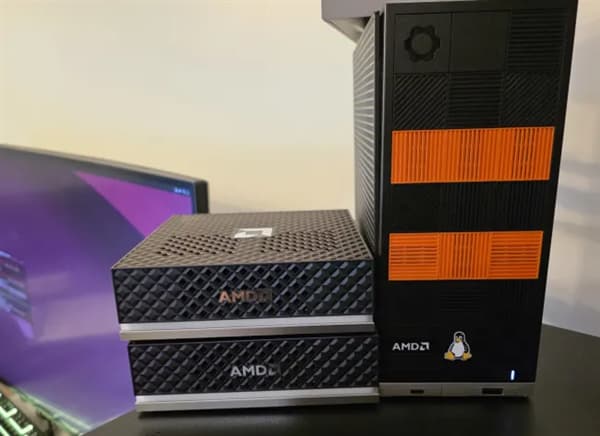
AMD’s current testing has focused primarily on Strix Halo-based systems. Potentially relevant devices include the Ryzen AI Halo platform and Framework Desktop, both of which are designed around AMD’s high-performance computing hardware.
AMD’s Strix Halo platform is also attracting attention in compact AI workstations, including the iBUYPOWER AI Halo Mini PC, which features the AMD Ryzen AI Max+ PRO 495 processor.
AMD Releases Loom-Fun and loom-skills on GitHub
AMD has also made the experimental work publicly accessible through its GitHub Loom-Fun project.
Alongside the project, the company provides a package called loom-skills, which supplies the components needed to integrate the workflow with AI programming agents such as Claude Code, Codex, and Pi.
With these components, supported coding agents can generate model implementations and help deploy optimized programs on AMD client GPUs. This approach is intended to make model adaptation more accessible to developers without requiring them to manually handle every hardware-specific optimization.
What HRX Loom Means for Local AI on PCs
HRX Loom represents an interesting development in AMD’s efforts to expand its local AI ecosystem. Rather than relying entirely on manual optimization, the project explores how AI agents can assist with model porting, code generation, and hardware-specific deployment.
HRX Loom could make it easier for developers to bring more open-source AI models to consumer hardware, similar to the approach behind the CHUWI UniBox AI495 Pro and its support for running large language models locally.
If the approach continues to develop, it could help developers bring more open-source AI models to consumer PCs in less time. It may also reduce some of the compatibility challenges that currently exist across different GPU software platforms.
However, HRX Loom remains an experimental project, and the reported performance figures should not be interpreted as universal improvements across all models and AMD graphics products. More testing will be needed to understand its performance and compatibility in everyday applications.
For now, AMD’s ability to adapt 50 models across 18 architectures in just a few days offers an encouraging example of how agent-based development could accelerate the adoption of locally running AI.