








Introduction: The Cable Dilemma
For years, content creators and business professionals have faced the same frustrating choice: reliable but restrictive HDMI cables, or convenient but unreliable wireless solutions. HDMI delivers quality but tethers you to your display; wireless offers freedom but brings lag, dropouts, and compromised image quality. The market has long sought a wireless hdmi transmitter that combines the best of both worlds, and recent advances in dual-band technology are finally making that possible. This article explores how modern dual-band 4K wireless systems actually work.
The Core Challenge: Why Wireless Has Been Difficult
Wireless video transmission faces three major challenges. Bandwidth limitations—uncompressed 4K/30fps video requires approximately 6–12 Gbps, far exceeding consumer wireless standards. Interference—the 2.4GHz band is overcrowded, while 5GHz offers more room but suffers from poorer wall penetration. Latency—the traditional process of compression, transmission, and decompression introduces 100–300 milliseconds of delay, impacting real-time operations. A truly reliable wireless hdmi transmitter and receiver system must overcome all three hurdles simultaneously.
How Dual-Band 4K Transmission Works
Modern dual-band systems solve these problems through intelligent engineering. True dual-band transmission uses both 2.4GHz and 5.8GHz simultaneously. The transmitter continuously monitors signal quality on both bands and routes critical video packets through the cleaner channel without renegotiation. On the compression front, H.264 encoding achieves a compression ratio of roughly 20:1 to 50:1, bringing 4K bandwidth requirements down to approximately 50–100 Mbps—well within the reliable range of dual-band wireless. Optimized encoding pipelines and minimal buffering ensure low-latency transmission.
Real-World Performance
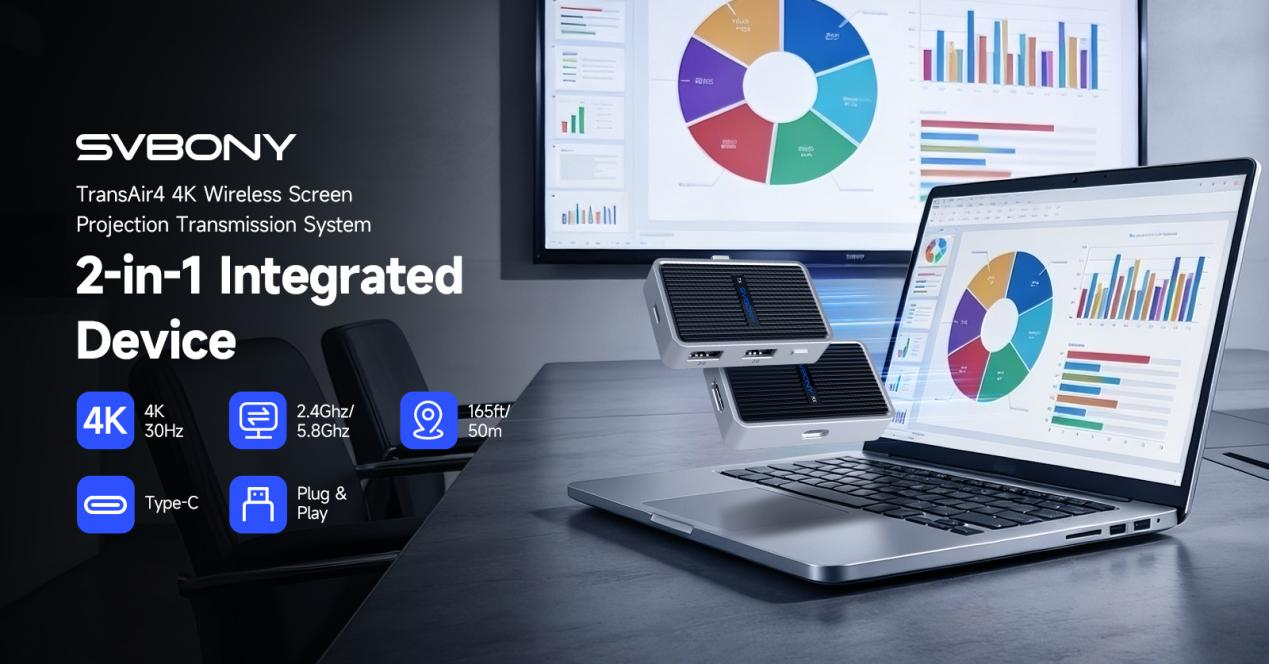
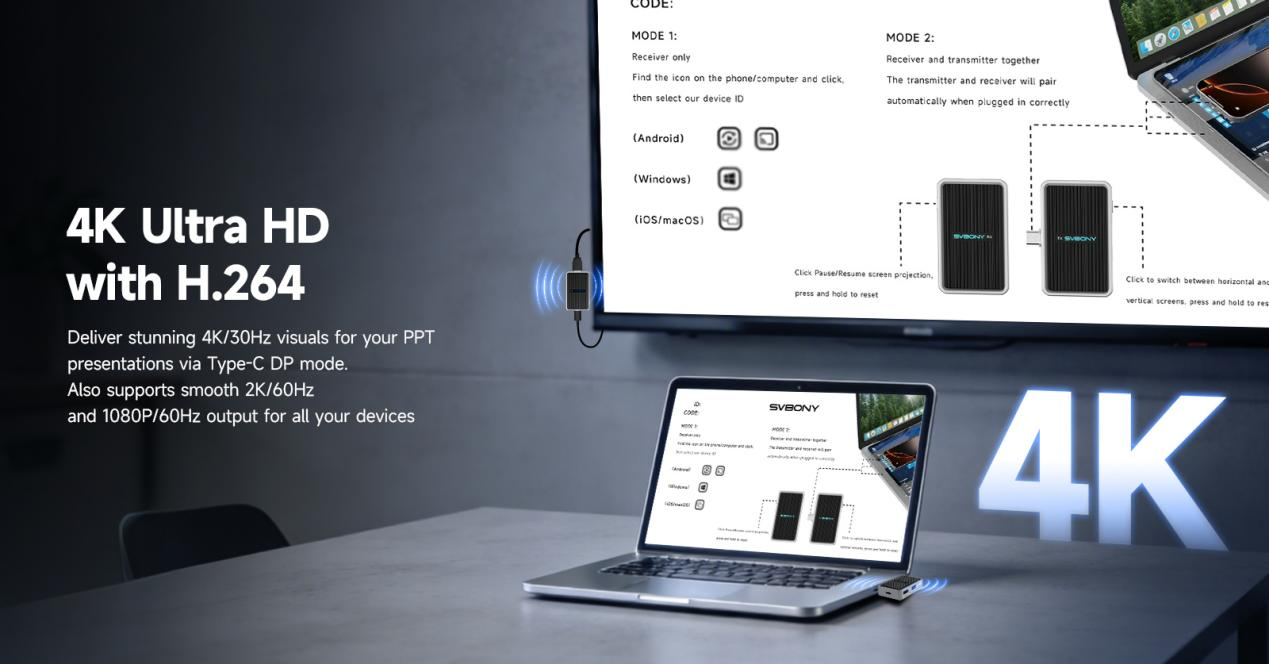
Take the SVBONY TransAir4 4K Wireless Screen Projection Transmission System as an example. It supports up to 4K at 30Hz output, with options for 2K at 60Hz or 1080p at 60Hz for smoother motion when needed. With a 50-meter (approximately 164 feet) transmission range, camera operators and presenters can move freely. Dual-band operation ensures stable transmission even in environments with moderate wireless interference. This is what sets a premium wireless hdmi transmitter apart from entry-level alternatives.
Two Operating Modes
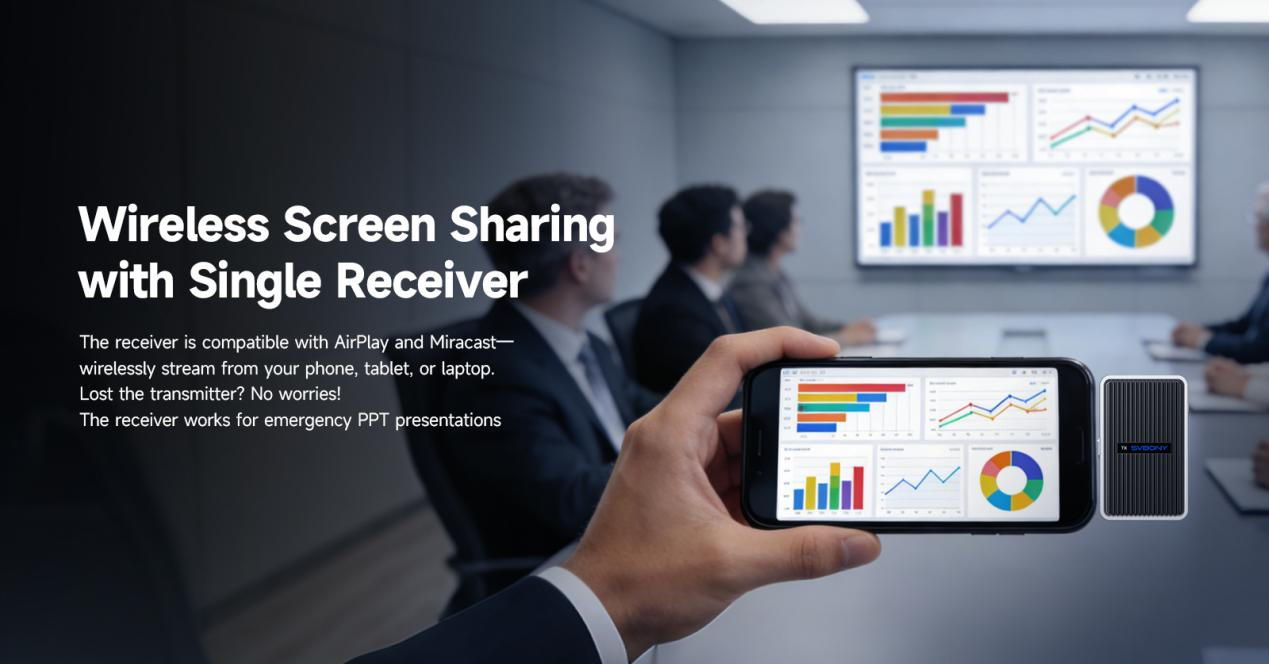
Mode 1 is Transmitter + Receiver (one-to-one). Using USB-C to connect the source device to the hdmi transmitter, the system pairs automatically—plug and play. This mode is ideal for professional video monitoring, live production, and conference presentations. Mode 2 is Receiver-Only Wireless Casting. Without needing the transmitter, the receiver connects directly to a display, allowing wireless casting via AirPlay (for Apple devices) or Miracast (for Windows and Android). This mode suits impromptu presentations, multi-person collaboration, and classroom environments. Together, these modes make the SVBONY TransAir4 4K Wireless Screen Projection Transmission System a versatile solution for both dedicated and ad-hoc use cases.
Key Hardware Features
The transmitter features a USB-C port with DisplayPort Alt Mode support, delivering 4K signals while simultaneously powering the source device—eliminating battery anxiety. The receiver includes a USB expansion port for external keyboards and mice, enabling remote control of the source device. A dedicated button allows quick switching between landscape and portrait orientation, accommodating vertical video and digital signage needs.
Use Cases
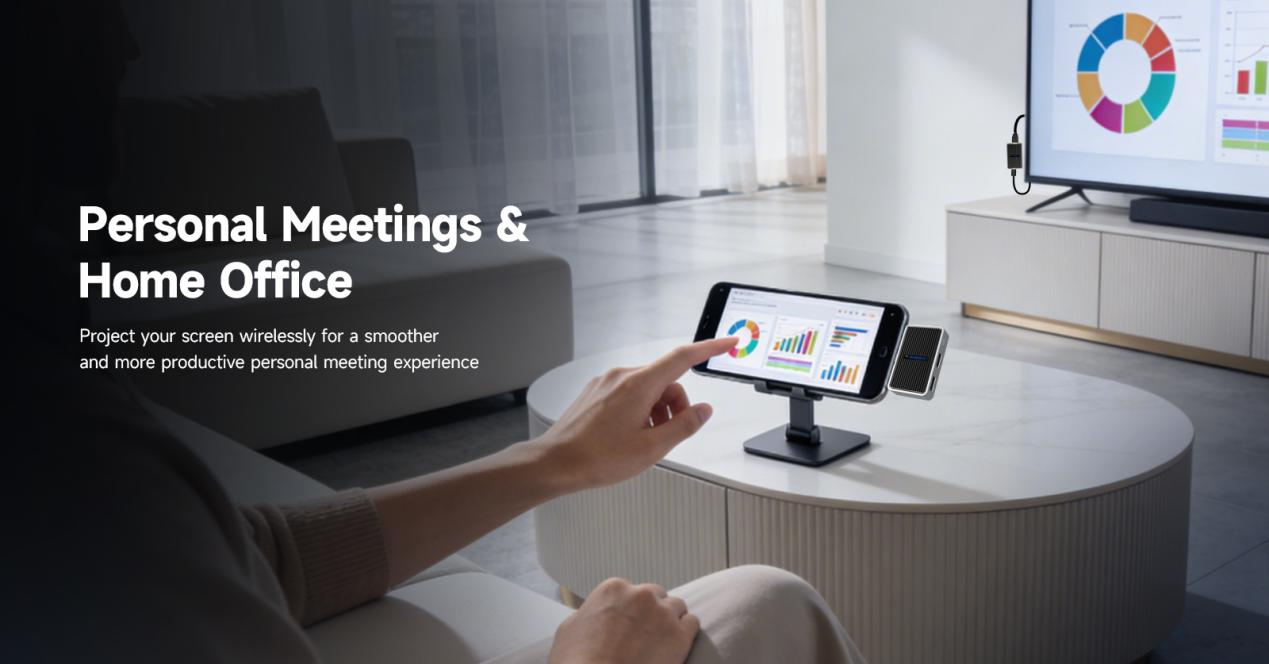
In professional video production, a reliable wireless hdmi transmitter and receiver setup allows camera operators to move freely while directors monitor footage on a large screen in real time. In conference rooms, the receiver remains connected to the display; participants can either cast directly or connect via the transmitter, with wireless keyboard and mouse enabling remote control. In mixed-device collaboration scenarios, users across different operating systems can seamlessly switch casting without repeatedly plugging and unplugging cables.
Conclusion
If you work in professional filmmaking and require uncompressed 4:4:4 color sampling with frame-perfect accuracy, wireless solutions are not yet there. But for the vast majority of applications—corporate presentations, event videography, education, home entertainment—a high-performance wireless hdmi transmitter like the SVBONY TransAir4 4K Wireless Screen Projection Transmission System has matured enough that its convenience far outweighs the minor compromises. Here is the official site to check.
The technical truth is this: perfect wireless video hasn’t arrived yet. But for most real-world applications, dual-band 4K wireless hdmi transmitter and receiver systems have become genuinely good enough—and that’s a milestone worth celebrating.