









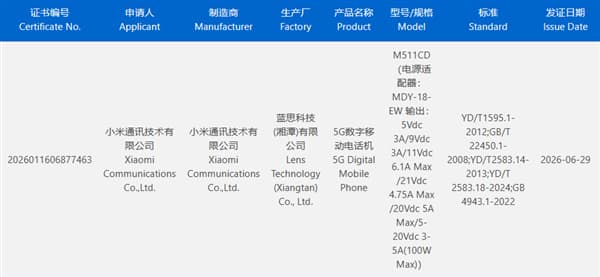
Igeekphone July 1st: Recently, a mysterious new model of Xiaomi has obtained the domestic 3C certification. The information indicates that it supports 100W fast charging and is currently the mainstream flagship specification of Xiaomi.
According to blogger Smart Pikachu, this device is expected to be the long-awaited large-screen foldable phone from Xiaomi. It is expected to be released as early as July.
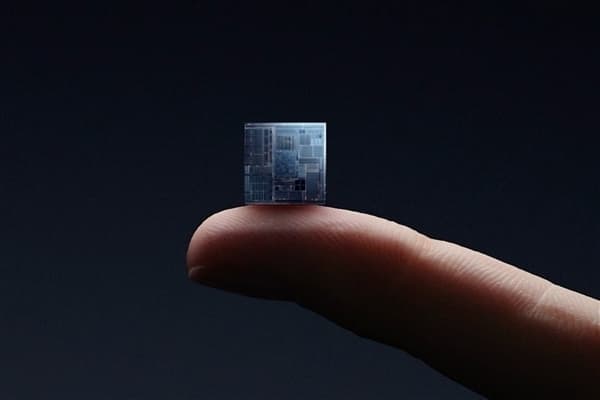
Previously, it was revealed that this device will be named MIX Fold 5. It is a product that Xiaomi has put a lot of effort into. It features the debut of Xianji O3 + Hyper OS 4, and it is also the product announced by Lei Jun at the conference earlier this year, which was about self-developed chips + self-developed OS + self-developed large models.
It is reported that Xuanji O3 is manufactured using TSMC’s 3nm process. The engineering version features a design with an ultra-large core, a performance core, and small cores. The ultra-large core operates at 4.05 GHz, the performance core at 3.42 GHz, and the small core at 3.02 GHz. The GPU also operates at 1.49 GHz, with a bandwidth of 9600 MT/s.
In terms of software experience, Hyper OS has made a major overhaul by thoroughly removing the redundant legacy code that had accumulated over the years within the system, and has carried out a complete reconfiguration of the system’s underlying structure.
The Xiaomi team is currently working on re-structuring the core system modules using the Rust language. Once implemented, this will significantly enhance the application’s cold start speed and system stability, reduce power consumption and the probability of application crashes, and also provide more comprehensive security protection capabilities. Ultimately, it will create a purer, more lightweight, and fully interconnected operating system for all scenarios.
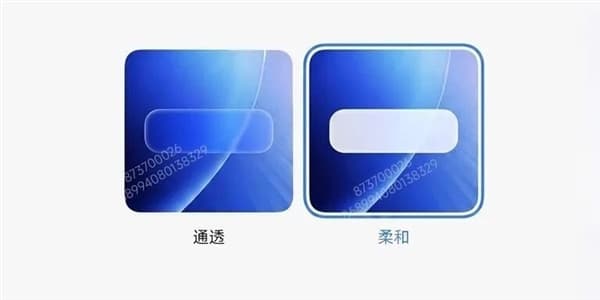
The appearance design incorporates a liquid glass element. The system offers two display styles for the overall display – transparent and soft.
The AI intelligent agent achieves full-chain integration, directly embedding AI capabilities into the underlying operation logic of the system, seamlessly integrating into every aspect of daily operations. Users can perform cross-application operations at the bottom layer with just one sentence.