










Gallup has added nicotine pouches to its long-term tracking of U.S. nicotine consumption for the first time. Its latest Consumption Habits survey found that 11% of American adults had smoked cigarettes in the previous week, while 9% reported vaping and 4% said they had used nicotine pouches during the same period.
The survey was conducted from July 1 through July 19, 2026, and included roughly 1,200 adults aged 18 and older across the United States, including Washington, D.C.
The new data provides another snapshot of how nicotine consumption is evolving. Cigarette smoking remains close to its historical low, vaping has stayed within a relatively narrow range since Gallup began tracking it, and nicotine pouches now have an established baseline in Gallup’s annual consumer research.
Gallup Measures Nicotine Pouch Use for the First Time
Gallup has monitored cigarette smoking among American adults for many decades and added vaping to its Consumption Habits research in 2019. Its 2026 survey introduced nicotine pouches as a separate category.
Respondents were asked whether they had used nicotine pouches during the previous week, with products such as ZYN referenced in the survey question.
Overall, 4% of U.S. adults reported past-week nicotine pouch use. For readers who want to understand the product category in more detail, our nicotine pouch guide explains what nicotine pouches are and how they differ from other nicotine products.
The results varied considerably by age. Reported use reached 5% among adults aged 18-29 and 7% among those aged 30-49, compared with 2% for adults aged 50-64 and just 1% among people aged 65 and older.
Gallup also reported a substantial difference between men and women, with 7% of men reporting recent nicotine pouch use compared with 1% of women.
U.S. Adult Past-Week Use of Tobacco and Nicotine Products, July 2026. Source: Gallup Consumption Habits Survey.
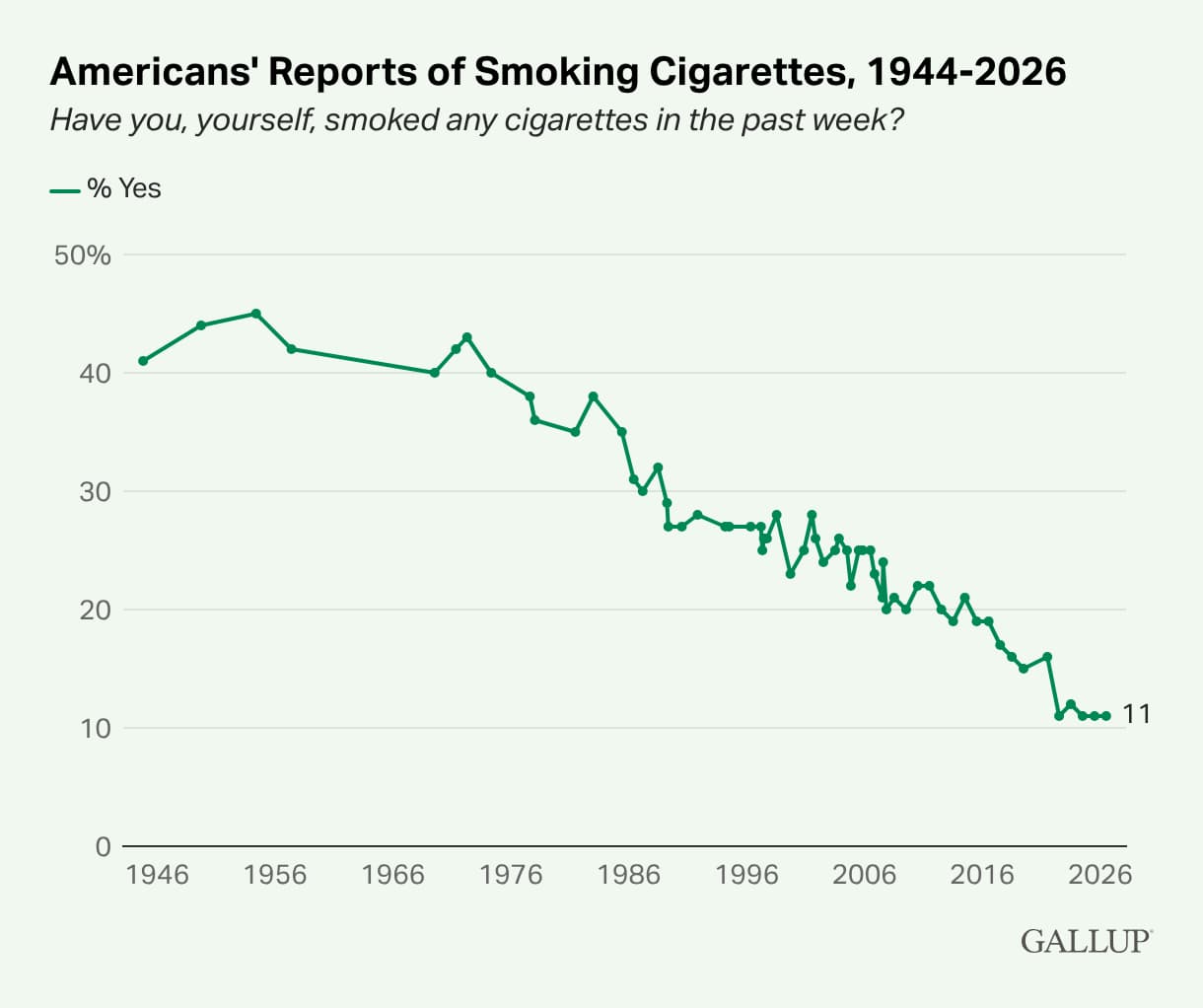
Cigarette Smoking Remains Near Its Historic Low
Cigarette use continues to sit at a historically low level in Gallup’s long-term data.
In July 2026, 11% of U.S. adults said they had smoked cigarettes during the previous week. That result is broadly consistent with the recent trend, with the adult smoking rate staying between 11% and 12% over the past five years.
The longer historical picture is considerably different.
When Gallup first asked Americans about cigarette smoking in 1944, 41% of adults reported smoking. The rate climbed to 45% in 1954 before beginning a prolonged decline.
Smoking eventually dropped below 30% in 1989 and has remained below 20% since 2015.
At 11%, the 2026 result is therefore close to the lowest level recorded in Gallup’s extensive history of measuring adult cigarette use.
U.S. Adult Cigarette Smoking Rate, 1944-2026. Source: Gallup Consumption Habits Survey.
Adult Vaping Remains Within a Narrow Range
The trend for vaping looks different from the long-term decline in cigarette smoking.
Gallup reported that 9% of U.S. adults had vaped during the week covered by the 2026 survey. Since the organization began asking about vaping in 2019, reported adult use has generally remained within a 6% to 9% range. For more background on the U.S. vaping market, see our vaping guide covering vaping products, usage trends, and related industry developments.
Age continues to be an important factor.
Among adults aged 18-29, 17% reported vaping during the previous week. The figure fell to 11% among those aged 30-49, 6% among adults aged 50-64 and 1% among those aged 65 and older.
The age distribution indicates that vaping remains considerably more prevalent among younger adults than older age groups.
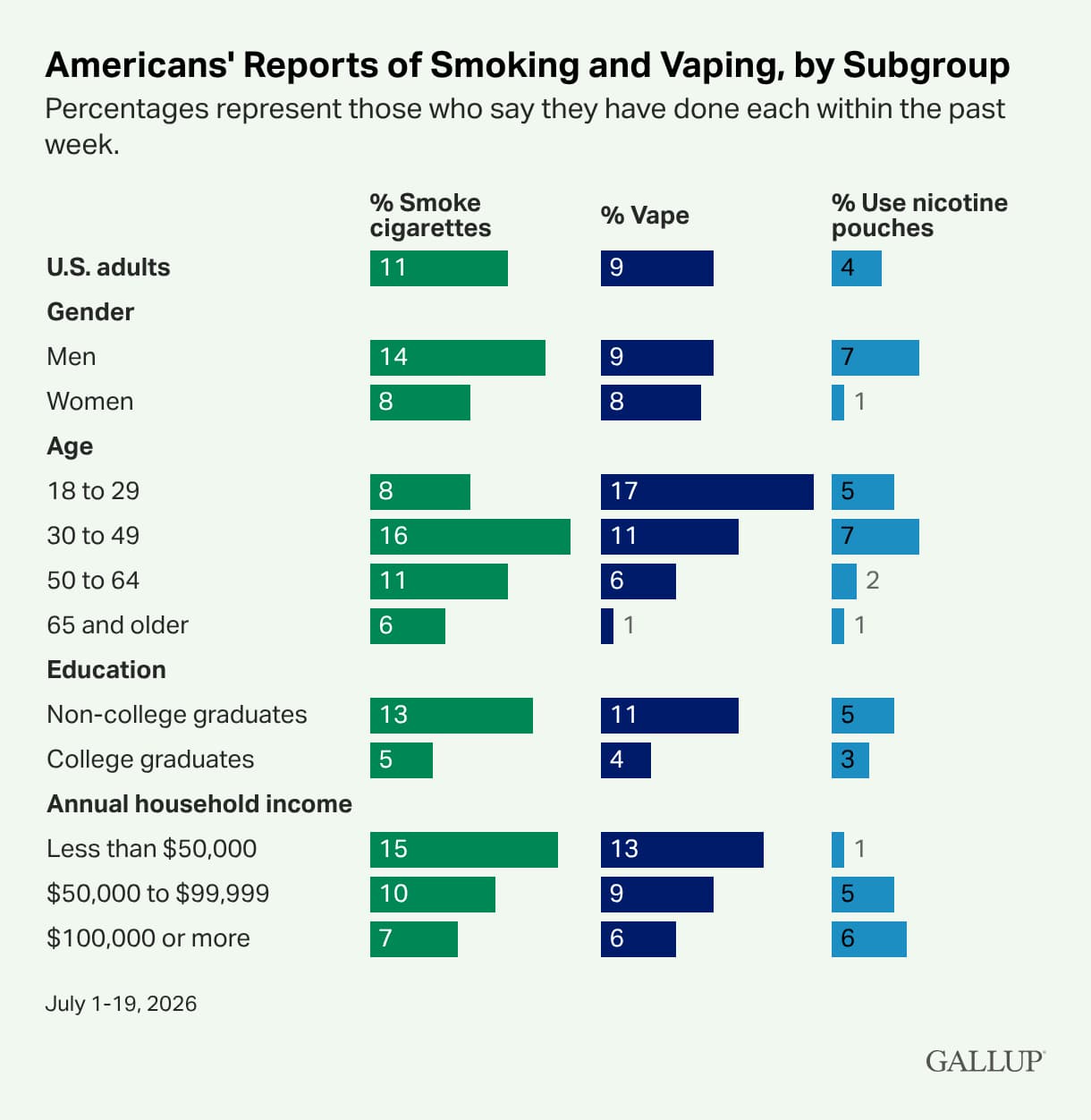
Nicotine Products Have Distinct User Profiles
Putting the three categories side by side highlights substantial differences in reported usage.
Cigarette smoking was most prevalent among adults aged 30-49, reaching 16%, followed by 11% among those aged 50-64.
Vaping had its highest reported rate among 18-29-year-olds, at 17%.
Nicotine pouch use was also concentrated among younger adults, although at lower overall levels. Reported use was 5% among 18-29-year-olds and reached 7% among adults aged 30-49.
Gallup also identified differences related to income and education. Cigarette smoking and vaping were reported more frequently among lower-income and non-college-educated adults, while nicotine pouch use displayed a different demographic pattern.
These differences suggest that nicotine consumption isn’t distributed evenly across the adult population and that individual product categories can attract different groups of users.
What the New Nicotine Pouch Data Actually Tells Us
The 4% figure is useful as a new baseline, but it shouldn’t be interpreted as evidence that nicotine pouches are replacing cigarettes or vaping.
Gallup’s survey measures reported product use during the previous week. It does not establish why someone uses a particular nicotine product, whether they use multiple products, or whether they switched from one category to another.
For example, someone reporting nicotine pouch use could also have reported vaping or smoking. The survey result therefore shouldn’t be treated as a direct measure of product substitution.
This distinction is particularly important when comparing the 11% smoking figure, the 9% vaping figure and the 4% nicotine pouch figure.
A New Benchmark for Tracking Nicotine Pouches
The most significant development may be that nicotine pouches have now entered Gallup’s established consumer-tracking framework.
Future surveys can potentially provide a clearer picture of whether reported use remains around the current level, increases, or declines over time.
That will also make it easier to examine how usage patterns differ by age, gender, income and other demographic characteristics.
At this stage, however, the 2026 result should primarily be viewed as a starting point for longer-term measurement rather than evidence of a major shift in consumer behavior.
U.S. Nicotine Use Is Becoming More Diverse
Gallup’s latest survey illustrates a nicotine market that can no longer be described through cigarette smoking alone.
In July 2026:
- 11% of U.S. adults reported smoking cigarettes.
- 9% reported vaping.
- 4% reported using nicotine pouches.
Each category also shows a different demographic pattern. These changes are part of a broader shift in the nicotine market, which we track in our nicotine industry news section.
Gallup’s latest figures show that cigarette use remains near its historic low, while adult vaping has stayed comparatively steady. At the same time, nicotine pouches have been added to the survey’s tracking for the first time, recording a 4% past-week usage rate.
The findings cannot determine whether consumers are switching between cigarettes, vapes, and nicotine pouches. However, they establish a useful starting benchmark for monitoring how nicotine pouch consumption changes over time.