










Igeekphone News August 4, 2026 – Huawei is reportedly preparing its next-generation flagship smartphone, the Mate 90 Pro Max, with significant upgrades in display technology, processing performance, battery capacity, and imaging capabilities. According to recent leaks, the device is expected to launch in September 2026, positioning it as a direct competitor to Apple’s upcoming iPhone 18 Pro Max.
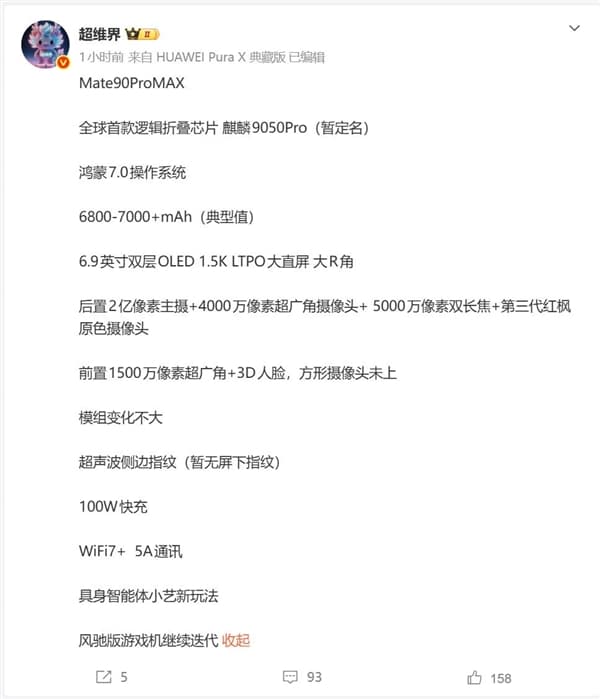
A report from technology source Super Dimension has revealed key specifications of the Huawei Mate 90 Pro Max, suggesting that the smartphone will introduce Huawei’s latest flagship chipset and continue the company’s push toward advanced display technology.

6.9-inch Dual-Layer OLED Display with 1.5K Resolution
One of the biggest highlights of the Huawei Mate 90 Pro Max is its display.
The device is expected to feature a 6.9-inch dual-layer OLED panel with a 1.5K resolution. This would make it one of the few smartphones on the market to adopt advanced Tandem OLED technology, which is currently reserved primarily for premium flagship devices.
The screen is also expected to retain Huawei’s three-hole camera cutout design, supporting advanced biometric features including 3D face recognition.
First Smartphone with Kirin 9050 Pro Chip
The Mate 90 Pro Max is rumored to be the first device powered by Huawei’s new Kirin 9050 Pro processor.
The chipset is reportedly based on Huawei’s next-generation “Tau Law” architecture, which introduces a new approach to chip design through advanced three-dimensional stacking technology.
Unlike traditional semiconductor improvements that rely heavily on smaller manufacturing processes, the new architecture reportedly focuses on “logic folding” technology, transforming conventional flat circuit layouts into a more compact stacked structure.
According to leaked information, compared with the previous-generation Kirin 9030 Pro, the new Kirin chip could achieve:
- 53.5% higher transistor density
- 37.5% smaller chip area
- 41% lower power consumption at the same performance level
If these figures prove accurate, the Kirin 9050 Pro could represent a major step forward for Huawei’s self-developed mobile processors.
Large 6800–7000mAh Battery with HarmonyOS 7
Battery life is expected to be another major strength of the Mate 90 Pro Max.
The smartphone is rumored to include a battery capacity between 6800mAh and 7000mAh, significantly larger than many current flagship phones.
The device is also expected to ship with HarmonyOS 7, Huawei’s latest operating system platform, bringing improvements in performance optimization, cross-device connectivity, and AI-based features.
Flagship Camera System with Third-Generation Red Maple Color Imaging
The Huawei Mate 90 Pro Max is expected to continue Huawei’s focus on mobile photography with a powerful rear camera system.
The rumored camera setup includes:
- 200MP main camera
- 40MP ultra-wide-angle camera
- 50MP dual telephoto camera
- Third-generation Red Maple Color camera
- 15MP front-facing camera
The upgraded Red Maple Color imaging system is expected to further improve color accuracy, especially in challenging lighting environments.
With a combination of high-resolution sensors and multiple focal lengths, the Mate 90 Pro Max could remain one of the most capable camera smartphones available.
Dual-Layer OLED Technology Explained
The continued use of dual-layer OLED, also known as Tandem OLED, is expected to be one of the defining features of the Mate 90 Pro Max.
Traditional OLED displays use a single layer of RGB light-emitting materials. Tandem OLED technology adds a second light-emitting layer, creating a vertically stacked structure that allows both layers to work together.
This design brings several advantages:
Higher Brightness
Because two OLED layers share the workload, the display can theoretically achieve significantly higher brightness levels compared with conventional OLED panels.
Longer Display Lifespan
With two layers distributing the electrical load, each OLED layer experiences less stress. This helps slow material degradation and improves long-term durability.
Improved Power Efficiency
For the same brightness level, dual-layer OLED requires less driving current, potentially reducing power consumption.
Reduced Burn-In and Light Leakage
The technology can also help reduce common OLED issues such as image retention, uneven aging, and light leakage.
However, due to its higher manufacturing cost and more complex production process, Tandem OLED remains limited to premium flagship devices.
Huawei Mate 90 Pro Max vs Future Flagship Competition
With a large battery, advanced OLED technology, a new Kirin flagship processor, and a powerful camera system, the Huawei Mate 90 Pro Max appears designed to compete directly with the highest-end smartphones expected in late 2026.
The rumored September launch would place it alongside Apple’s iPhone 18 Pro Max, creating another major flagship rivalry between Huawei and Apple.
While Huawei has not officially confirmed the Mate 90 Pro Max specifications, the leaked information suggests the company is preparing one of its most ambitious flagship smartphones yet.
More details, including official pricing, global availability, and final hardware specifications, are expected closer to the launch event.