









On December 11th, Igeekphone reported that Huawei held the “HarmonyOS Office Industry Summit” today and officially launched the new generation of HarmonyOS computers – Huawei CloudCloud HM740 at the summit.
According to the official introduction, this product focuses on the mobile office needs of government and enterprises, achieving full-chain independent control from the system to the ecosystem, and creating a new generation of productivity for key industries such as finance, energy, and government affairs.
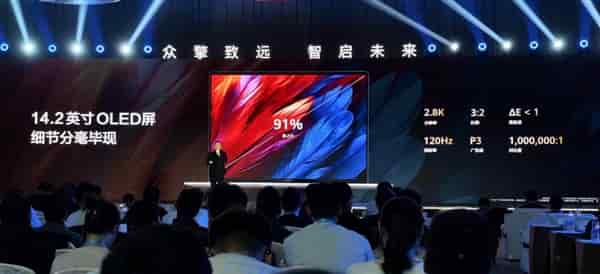
In terms of hardware, the Qingyun HM740 is equipped with a 2.8K OLED touch screen, supporting a 120Hz high refresh rate, featuring an ultra-high contrast ratio of 1,000,000:1 and a peak brightness of 450 nits. It supports 100%sRGB and P3 dual-color gamut switching, meeting the needs of professional scenarios such as design and video. And it has passed the Eye Comfort eye-protection certification of TUV Rheinland in Germany. The low-frequency flicker is more eye-protecting.
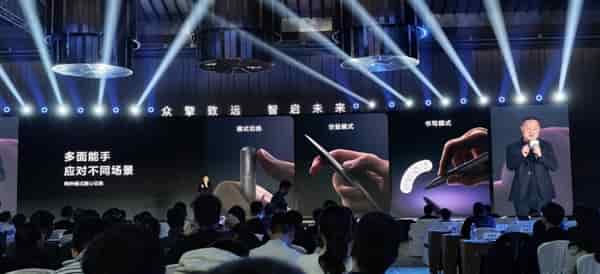
In addition, there is another major feature. The Qingyun HM740 also supports the HUAWEI M-Pen 3 multi-functional pen. It not only supports writing but also can be switched to the mouse mode with one click, making the solution demonstration very convenient.
Equipped with a 70Wh large-capacity battery, it is the longest-lasting computer launched by Huawei to date, capable of supporting 21 hours of 1080P local video playback or 15 hours of voice conferences. The actual test experience even far exceeds that of the Apple M4 version of the MacBook.
The performance experience also has a huge advantage over other products. It only takes 2.7 seconds to decompress 2.5GB and 9.8 seconds to compress 2.5GB.
Under the premise of excellent screen, performance and battery life experience, the Huawei CloudRock HM740 also achieves a slim and light body of 14.5mm and 1.32kg.
In terms of wireless connection, the Qingyun HM740 is the first to adopt a three-antenna Wi-Fi 7+. It innovatively designs a “combined ring film dual-frequency antenna” to form a three-antenna complementary system, effectively eliminating signal dead zones. In open environments, it can achieve a stable connection over an ultra-long distance of up to 420 meters.
Supporting Starflash peripherals, it can achieve a high-bandwidth and battery-powered experience, enabling faster response of peripherals and smoother collaboration, providing a solid foundation for integrated office work across multiple devices.
The Qingyun HM740 also supports the Star flash search function. Even when the device is turned off, it can still continuously broadcast signals through the low-power chip. Combined with the HADM high-precision positioning algorithm, enterprises can remotely achieve precise device search, screen lock, message leaving, and even data erasging, effectively preventing asset loss and information leakage.
Equipped with USB 3.2, RJ45 network port, HDMI, 3.5mm headphone jack, full-function Type-C and physical super privacy switch, it can cut off the camera/microphone permission with one click.
In terms of system experience, relying on the HarmonyOS Enterprise Edition operating system, the Qingyun HM740 can achieve a deeply intelligent office experience.
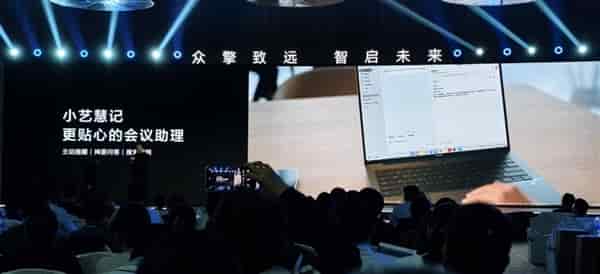
The upgraded version of Xiaoyi Assistant it is equipped with supports “in-depth research” and can generate a paper-level report within 20 minutes. “Smart File Management” enables automatic classification and associated recommendation of local files. “Xiaoyi Huiji” has connected the entire meeting chain and automatically generated structured minutes.
The system pioneered the “Enterprise Digital Dual Space”, supporting four-finger sliding to switch between personal and enterprise environments, balancing security and efficiency. The enterprise space forces the encryption of classified data, while the personal space supports social and entertainment activities, eliminating the risk of cross-leakage.
It also supports “zero-sensing deployment”. After the device is unboxed and connected to the network, it can automatically complete policy configuration, software installation and permission allocation, significantly reducing operation and maintenance costs.
Support enterprises in deploying dedicated AI models (such as financial risk control and document analysis), and local data processing ensures that sensitive information “does not leave the end”.