











Choosing wireless earbuds usually means deciding between an open-ear design and a conventional in-ear fit. Open-ear earbuds can feel less intrusive and are useful when you want to remain aware of your surroundings, while semi-in-ear models provide a more familiar listening experience with a closer fit.
The Lenovo ERAZER EX216 2-in-1 Wireless Headset takes an unusual approach to this choice. Instead of asking users to pick one style, it includes two separate pairs of earbuds in a single charging case: an open-ear clip-on pair and a semi-in-ear pair.
The package also brings Bluetooth 6.0, 13mm dynamic drivers, AI-assisted ENC call noise reduction, DT9.0 directional audio transmission and up to 24 hours of advertised total playback. Its digital battery display adds another practical touch.
Rather than focusing only on headline specifications, this review looks at what the EX216’s two-pair design means in everyday use, who might benefit from it and which limitations buyers should understand.
If you prefer this less intrusive wearing style, our MONSTER MQT69 open-ear earclip headphones review explores another Bluetooth 6.0 audio option designed around open-ear comfort.

Lenovo ERAZER EX216 Specifications
| Feature | Specification |
|---|---|
| Product name | Lenovo ERAZER EX216 |
| Design | 2-in-1 wireless earbuds |
| Earbud styles | Open-ear clip-on and semi-in-ear |
| Bluetooth | Version 6.0 |
| Driver size | 13mm dynamic drivers |
| Frequency response | 20Hz–20kHz |
| Sensitivity | 97dB |
| Impedance | 32Ω |
| Call noise reduction | AI + ENC |
| Audio technology | DT9.0 directional audio transmission |
| Wireless range | Up to 10m (advertised) |
| Earbud battery | 24mAh per earbud |
| Charging case | 300mAh |
| Playback time | Approximately 4 hours per pair; up to 24 hours with the case |
| Charging time | Approximately 1.5 hours |
| Charging interface | USB Type-C |
| Display | Digital battery indicator |
| Additional features | Game Mode, app-based battery monitoring |
Specifications are based on the available product listing. Actual battery life and wireless performance can vary with volume, connection conditions and usage.
Two Earbud Designs in One Package: The EX216’s Main Advantage
The most interesting aspect of the EX216 is its dual-style configuration.
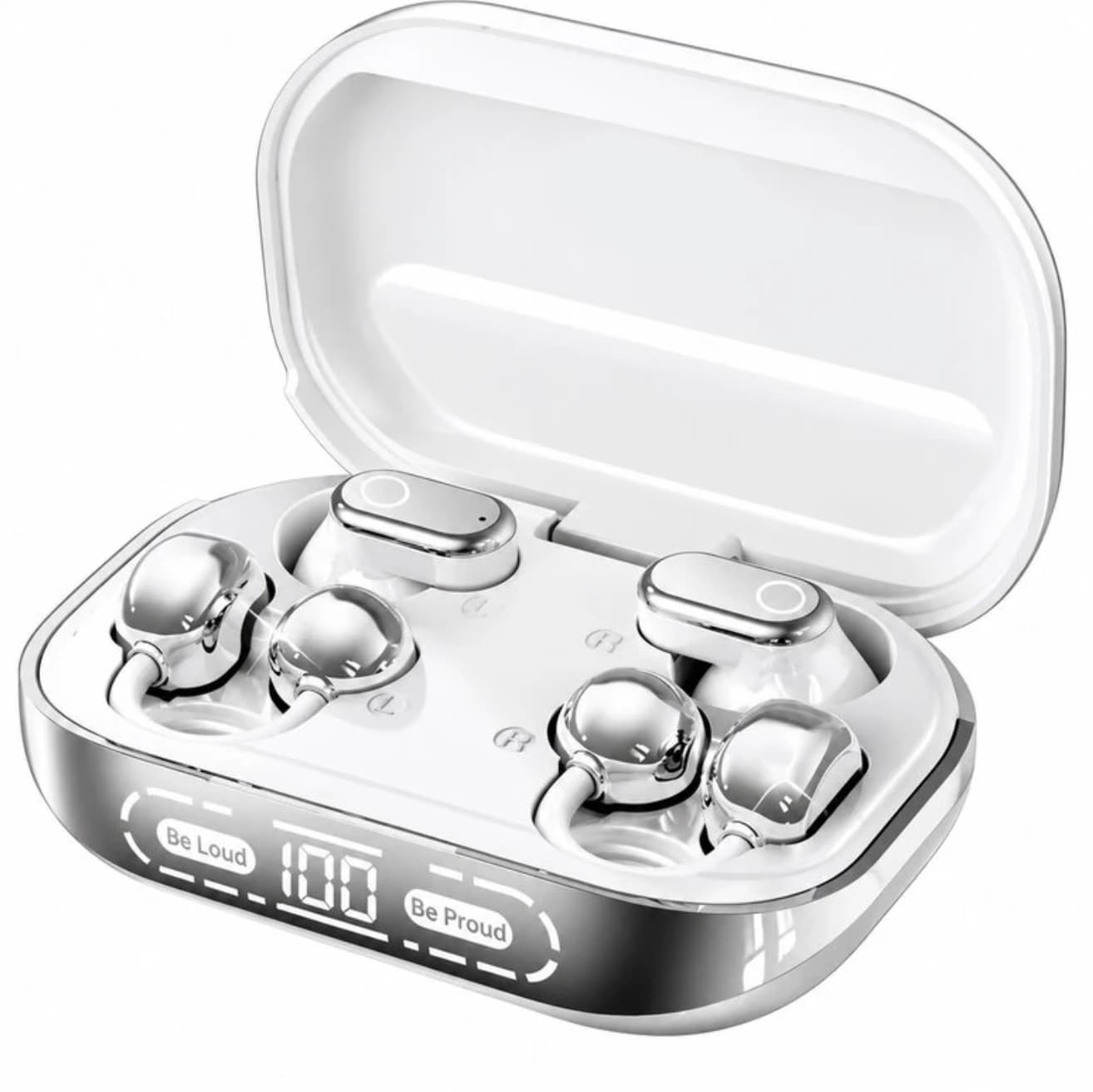
Inside the charging case are two pairs of wireless earbuds. One uses an open-ear clip-on design, while the other follows a semi-in-ear structure. This is more than a cosmetic difference because the way earbuds sit on the ear affects comfort, awareness of surrounding sounds and the overall listening experience.
Open-Ear Clip-On Earbuds for Everyday Awareness
The clip-on pair is intended for people who prefer not to insert traditional earbuds deeply into their ears.
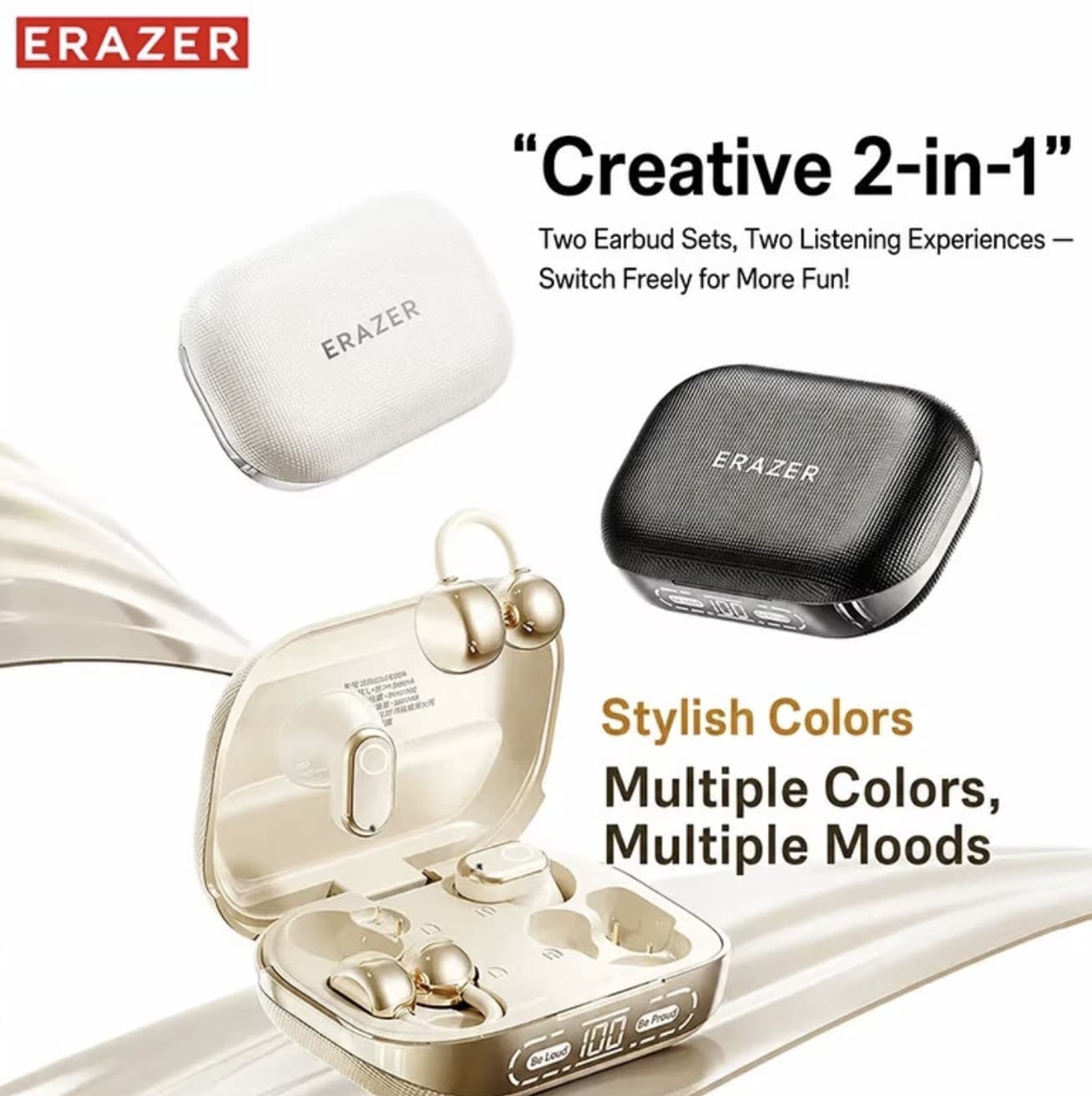
This design can be useful when walking around the house, working at a desk or listening to music while remaining aware of nearby conversations. It may also appeal to users who find conventional in-ear tips uncomfortable during longer listening sessions.
The open-ear approach has a trade-off: it generally provides less passive isolation from surrounding noise than a more enclosed earbud design. In a busy environment, outside sounds may compete with the audio.
For that reason, the clip-on pair is better suited to situations where awareness and a less enclosed wearing style matter more than blocking external noise.
For another Lenovo ERAZER wireless audio option, read our Lenovo ERAZER EP210 Pro review, which examines Bluetooth 6.0, 13mm drivers and the combination of ANC and ENC technologies.
Semi-In-Ear Earbuds for a More Familiar Fit
The second pair offers a semi-in-ear wearing style.
This design sits closer to the ear canal than an open-ear clip-on model, making it a more familiar option for people accustomed to conventional wireless earbuds. It can be a better choice when listening to music, watching videos or taking calls in relatively quiet surroundings.
The two designs give users some flexibility without requiring another charging case or a separate purchase.
However, comfort is personal. Ear shape varies considerably, so neither design should automatically be considered suitable for everyone. Buyers should also follow the manufacturer’s guidance for wearing and charging both pairs.

Bluetooth 6.0 for Modern Wireless Connectivity
The EX216 uses Bluetooth 6.0, giving it a current wireless connectivity specification for compatible smartphones, tablets and computers.
Its listed supported Bluetooth profiles include HSP, HFP, A2DP and AVRCP. These cover common functions such as hands-free calling, audio streaming and media control.
The advertised wireless transmission distance is up to 10 meters under suitable conditions. In everyday use, walls, interference and the connected device can affect the actual range.
The product information also highlights dual-device connection capabilities. This can be useful for people who regularly switch between a phone and another compatible device, although the exact connection behavior should be checked in the supplied instructions and companion app.
Bluetooth 6.0 is a connectivity feature rather than a guarantee of better sound by itself. The listening experience still depends on the drivers, audio processing, source material and fit.
13mm Dynamic Drivers: What to Expect From the Audio
Each pair uses 13mm dynamic drivers, with a listed frequency response of 20Hz to 20kHz and sensitivity of 97dB.
The driver size gives the EX216 a substantial speaker unit for a compact wireless earbud system. It is intended to reproduce a broad range of everyday audio, from lower-frequency music content to vocals and higher-frequency details.
The two wearing styles may also influence how users perceive the sound. A semi-in-ear fit can create a different listening impression from an open-ear clip-on design, particularly in terms of bass perception and how much surrounding noise reaches the listener.
It is important not to judge sound quality from driver diameter alone. A larger driver does not automatically guarantee deeper bass, clearer vocals or more accurate audio. Tuning, acoustic design and fit remain important.
For casual music, podcasts, online videos and calls, the EX216 offers a feature set aimed at general everyday listening rather than specialist audiophile use.
DT9.0 Directional Audio Transmission: A Focus on Sound Placement
Lenovo ERAZER promotes DT9.0 directional audio transmission as one of the EX216’s distinguishing technologies.
The idea behind directional audio is to guide more of the sound toward the listener’s ear instead of allowing it to spread widely into the surrounding environment.
This is particularly relevant to open-ear and clip-on earbuds, where the speaker does not form the same enclosed listening space as a traditional in-ear design.
The EX216’s product description presents DT9.0 as a way to improve listening privacy and reduce sound leakage. These are useful goals, especially for people who listen to audio in shared spaces.
However, directional transmission should not be interpreted as complete sound isolation. Open-ear designs can still leak audio, particularly at higher volume levels. The actual result will depend on fit, volume and the surrounding environment.
Users who need privacy in quiet offices, libraries or public transport should keep the volume moderate and consider the listening environment.
AI + ENC Call Noise Reduction: Designed for Voice Communication
The EX216 includes AI-assisted Environmental Noise Cancellation (ENC) for calls.
According to the product description, its microphone system uses AI processing to help distinguish the speaker’s voice from background noise. This is intended to make conversations easier to understand when calling from streets, offices or other everyday environments.
ENC is particularly useful because microphone noise reduction and music noise cancellation solve different problems.
The EX216’s AI + ENC feature is designed to improve the outgoing voice captured by the microphones. It should not be confused with Active Noise Cancellation (ANC), which reduces external sounds reaching the listener’s ears.
In other words, the EX216 advertises call-noise processing, not a full ANC listening system.
For people who frequently answer calls while commuting or working away from a quiet room, this distinction is worth understanding before buying.
Up to 24 Hours of Playback With the Charging Case
Battery life is another important part of the EX216 package.
Each earbud is listed with a 24mAh battery, while the charging case has a combined capacity of 300mAh. The manufacturer advertises approximately four hours of playback from an earbud pair and up to 24 hours of total playback with the charging case.
This arrangement makes the EX216 suitable for users who listen intermittently throughout the day rather than continuously for many hours.
For example, someone might use the clip-on pair during work, return both earbuds to the case and later switch to the semi-in-ear pair for music or video playback.
The two-pair configuration is especially interesting here because it gives users another set of earbuds to switch to while managing their listening time.
The charging case also includes a digital battery display. Instead of relying entirely on a small indicator light, users can check the remaining battery information directly on the case.
USB Type-C charging is another practical inclusion, and the listed charging time is approximately 1.5 hours.
Actual runtime will depend on listening volume, call frequency, wireless conditions and other usage factors. The advertised 24-hour figure should be understood as total playback with charging support, not 24 hours from a single earbud charge.
Game Mode and Companion App Features
The EX216 also advertises a low-latency Game Mode.
This feature is intended to reduce the delay between on-screen action and the corresponding audio. The listing claims latency can be reduced by up to 75% in Game Mode, although the exact result depends on the connected device, application and wireless conditions.
For casual mobile gaming and video playback, reduced latency can help make audio and visuals feel more synchronized. Competitive gamers should still consider a dedicated low-latency gaming headset if precise audio timing is essential.
The product information also references companion-app support, including battery monitoring for the earbuds. The available manual identifies the SayMi app.
App compatibility and the availability of individual functions can depend on the phone’s operating system and software version, so buyers should verify the application before relying on a particular feature.
Who Should Consider the Lenovo ERAZER EX216?
The EX216 is most interesting for people who want different wearing styles without buying two separate wireless earbud products.
It may suit:
- Users who dislike a single fixed earbud style: The open-ear clip-on and semi-in-ear pairs offer two ways to listen.
- Office and home users: The clip-on pair can be useful for casual listening while staying aware of nearby activity.
- People who take frequent calls: AI + ENC is designed to help reduce background noise picked up by the microphones.
- Everyday music and video listeners: The 13mm drivers and Bluetooth 6.0 cover the basic requirements of wireless entertainment.
- Users who want a visible battery indicator: The digital display makes it easier to check the charging case’s remaining power.
- People who alternate between listening situations: Having two pairs in one case offers additional flexibility throughout the day.
It may be less suitable for people who specifically need strong active noise cancellation, verified water resistance or long uninterrupted playback from a single earbud charge.
Things to Check Before Buying
Despite its unusual configuration, the EX216 is not necessarily the right choice for every listener.
There are several details worth checking:
1. ENC is not ANC. The advertised AI + ENC system focuses on microphone noise reduction during calls. It does not mean the earbuds provide active cancellation of outside sounds during music playback.
2. Four hours per pair is the stated single-use runtime. The 24-hour figure includes the charging case. People who listen continuously for long periods should consider this distinction.
3. Open-ear designs do not provide complete sound isolation. The clip-on pair may be more comfortable for some users, but surrounding noise can remain audible and music may leak outward.
4. Water resistance is not clearly confirmed. If you plan to use the earbuds during workouts or in rainy conditions, check the seller’s current specifications for an official IP rating rather than assuming they are waterproof.
5. Sound quality needs real-world testing. Driver size and frequency response do not establish how the earbuds actually sound. Look for independent listening tests if audio fidelity is your top priority.
Final Verdict: A More Flexible Earbud Package Than a Standard TWS Set
Lenovo ERAZER EX216 stands out because it approaches wireless listening as a choice between two wearing styles rather than offering just one pair of earbuds.
Its open-ear clip-on pair is aimed at people who prefer a less enclosed fit, while the semi-in-ear pair provides a more familiar alternative. Bluetooth 6.0, 13mm drivers, AI + ENC call noise reduction, DT9.0 directional transmission and the digital battery display round out the feature set.
The 24-hour advertised total playback is useful for users who listen in shorter sessions and recharge between them, although each pair is rated for approximately four hours of standalone use.
The biggest buying consideration is understanding what the EX216 does not promise. ENC is not ANC, directional audio does not eliminate sound leakage, and the available specifications do not establish water resistance or professional-grade sound quality.
For users who value flexibility and want two different earbud styles in one package, the Lenovo ERAZER EX216 is an interesting alternative to conventional single-style TWS earbuds.