









Vape tricks have become a recognizable part of vaping culture, combining vapor movement, timing, and visual creativity. From circular vapor patterns to floating-looking clouds and complex visual combinations, these demonstrations can look surprisingly artistic.
However, impressive vapor effects are not simply a matter of producing larger clouds. They depend on how vapor behaves in moving air, how visual patterns form, and how lighting and camera angles influence what an audience sees.
This guide explores the science behind common vape-trick effects, explains the visual differences between beginner and advanced demonstrations, and discusses the practical limitations and health considerations associated with vaping.
Important: Vape tricks require inhaling or exhaling aerosol from an electronic cigarette. Vaping is not risk-free, including when using nicotine-free products. This article is intended as an explanation of vaping culture and visual effects, not an encouragement for non-users to begin vaping.
The same physical factors also influence larger cloud effects, as explained in our guide to how vapor density and cloud volume are affected.
Why Do Vape Tricks Create Different Shapes?
The visual effects commonly called vape tricks are produced by aerosol suspended in moving air.
Unlike ordinary smoke from combustion, e-cigarette aerosol consists of small liquid droplets generated by heating an e-liquid formulation. These droplets scatter light, making the cloud visible.
Several physical factors influence how the aerosol appears:
- Air movement: Changes in surrounding airflow can distort or disperse visible patterns.
- Temperature: Temperature differences between the aerosol and surrounding air can affect how long visible clouds remain apparent.
- Humidity: Environmental moisture can influence aerosol behavior and visibility.
- Lighting: Side lighting and darker backgrounds can make cloud shapes easier to see.
- Camera settings: Exposure, shutter speed, and background contrast can change how an effect appears in photographs and videos.
This explains why the same visual demonstration can look very different in two environments. A cloud that appears sharply defined in a still room may quickly become indistinct outdoors.
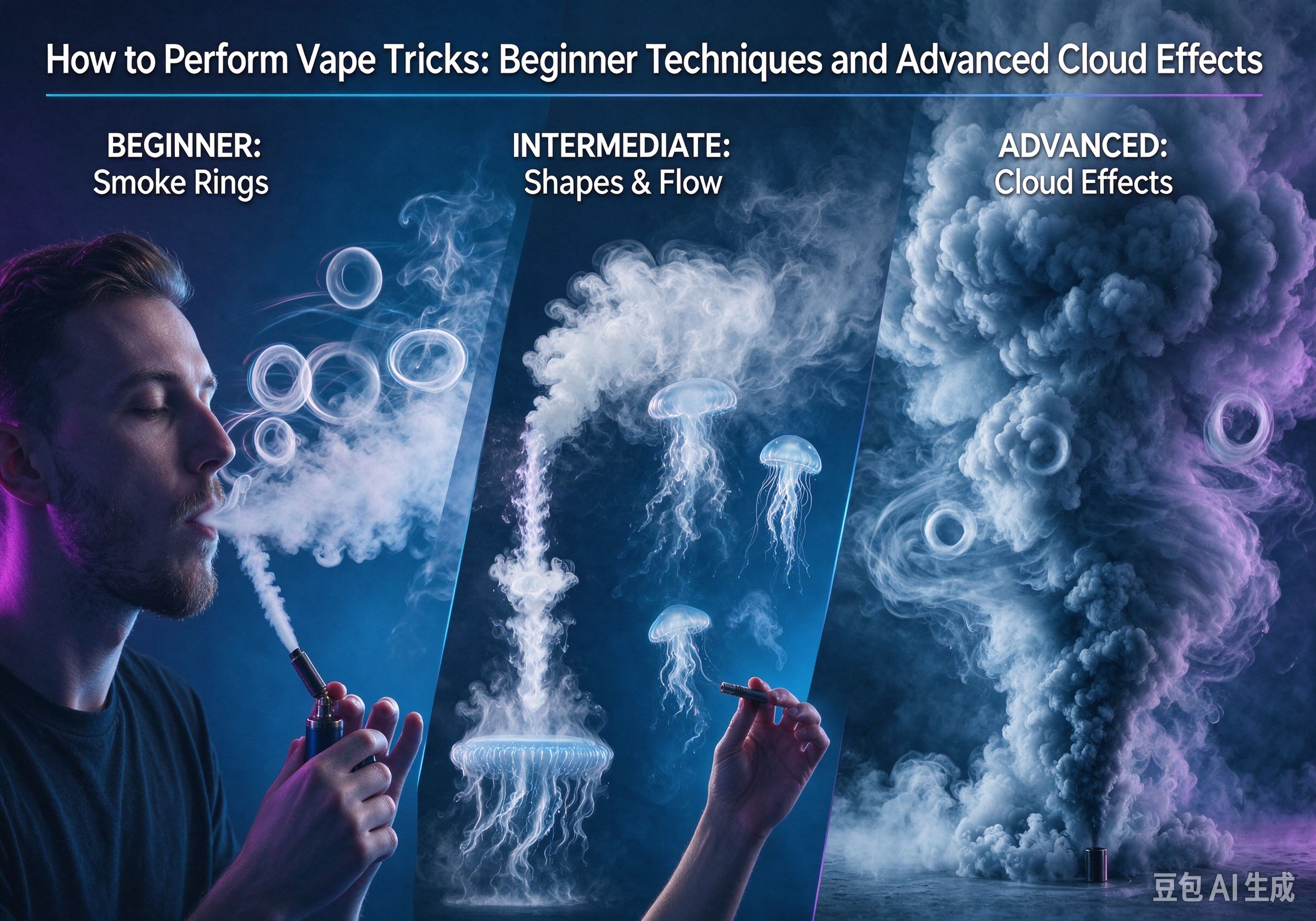
Beginner Vape Tricks: Understanding the Most Recognizable Visual Effects
Beginner-level vape tricks are usually discussed because their shapes are relatively easy to recognize. The following descriptions explain their visual characteristics rather than providing instructions to inhale or exhale aerosol.
1. Vapor Rings
Vapor rings are among the most recognizable effects in vaping culture. They appear as circular loops that travel through the air before gradually losing their shape.
Their appearance is related to vortex motion. A vortex is a rotating flow of fluid or gas that can maintain a recognizable structure for a short period.
The outer edge of a vapor ring is usually more visible than its center because the aerosol droplets scatter light differently across the structure.
What makes the effect visually interesting?
- A clearly defined circular outline.
- A recognizable center opening.
- Gradual expansion or deformation.
- Interaction with surrounding air currents.
Vapor rings are also common in demonstrations of fluid dynamics because they provide a visible example of vortex behavior.
2. The Ghost-Like Cloud Effect
The ghost effect is a visual style in which a compact-looking cloud appears briefly before becoming diffuse.
The effect is associated with changes in cloud density and surrounding airflow. Its appearance can be influenced by lighting and camera exposure, which sometimes make the aerosol seem to appear and disappear.
The important visual feature is contrast: a relatively defined cloud against a background where the aerosol is otherwise difficult to distinguish.
For a closer look at the relationship between airflow and visible vapor, read our guide to how airflow changes vapor density and movement.
3. The Waterfall Effect
The waterfall effect describes a cloud that appears to flow downward rather than disperse evenly in every direction.
This appearance is strongly influenced by temperature differences and air movement. Cooler surrounding air can make certain aerosol patterns appear more concentrated, while gravity and local air currents influence how the visible cloud moves.
It is a useful example of how environmental conditions can change the appearance of aerosol.
4. The Dragon-Style Cloud Effect
The dragon effect is a familiar visual concept in vape-trick videos. It is characterized by several visible streams of aerosol appearing around the mouth and nose area.
Its appeal comes from symmetry and the impression of a coordinated visual pattern.
From a photography perspective, the effect depends heavily on contrast, framing, and lighting. A dark background can make the individual streams easier to distinguish.
Advanced Cloud Effects: What Makes Them More Complex?
Advanced vape-trick demonstrations are often combinations of smaller visual effects. Their complexity comes from timing, spatial arrangement, and the interaction of multiple moving aerosol patterns.
5. Multi-Ring Patterns
A multi-ring demonstration involves several visible circular structures appearing within the same scene.
The visual challenge is maintaining separation between the patterns. When nearby vortices interact, they can distort one another or merge into a larger cloud.
This is one reason multi-ring demonstrations often look different from one recording to another.
6. Ring Interaction Effects
Some advanced demonstrations focus on what happens when one visible ring encounters another.
The resulting patterns can include:
- Changes in ring shape.
- Distorted circular outlines.
- Merging aerosol structures.
- Temporary turbulence.
- Rapid loss of definition.
These effects provide a useful illustration of how interacting vortices behave in a fluid environment.
7. Cloud Illusions and Optical Effects
Not every impressive vape-trick video depends on a particularly complex aerosol pattern.
Some demonstrations use camera positioning, lighting, reflections, or editing to create unusual visual impressions.
For example, backlighting can emphasize the outer boundary of a cloud, while a carefully chosen background can make a relatively small amount of aerosol appear more prominent.
Slow-motion footage can also reveal movements that are difficult to see at normal playback speed.
For viewers evaluating viral vape-trick videos, it is worth distinguishing a physical aerosol effect from a camera or editing effect.
Beginner vs. Advanced Vape Tricks: What’s the Difference?
The difference is not necessarily the amount of aerosol produced. It is more closely related to the complexity of the visible pattern.
| Visual category | Typical appearance | Main visual characteristic |
|---|---|---|
| Vapor rings | Circular clouds | Vortex structure |
| Ghost effect | Compact cloud appearance | Changes in cloud density |
| Waterfall effect | Downward-moving cloud | Airflow and temperature differences |
| Dragon effect | Multiple visible streams | Symmetry and composition |
| Multi-ring patterns | Several circular structures | Pattern separation |
| Ring interaction | Distorted or merging rings | Vortex interaction |
| Cloud illusions | Unusual visual compositions | Lighting and camera techniques |
This distinction is useful because it shows that advanced demonstrations are often about visual coordination rather than simply producing more aerosol.
How Lighting and Photography Make Vapor Tricks Look Better
Photography plays a major role in how vape tricks are presented online.
A visually interesting effect can become difficult to recognize when the background is too bright or the lighting is poorly positioned.
Several photography concepts explain why certain videos are more visually effective:
Background contrast: A darker background can help distinguish aerosol from the surrounding environment.
Side lighting: Light entering from the side can reveal the structure of suspended droplets.
Backlighting: Light behind the subject can emphasize the outline of a cloud.
Frame composition: Leaving sufficient space around the subject makes it easier to see the full shape of a moving pattern.
Video playback: Slow-motion footage can make fast changes in cloud structure easier to observe.
These principles apply to photography of many airborne materials, including theatrical fog and stage effects.
For anyone interested in visual demonstrations without inhaling aerosol, theatrical fog machines and digital visual effects provide alternatives.
Common Reasons Vape Tricks Look Different on Camera
Two recordings of the same type of visual effect may look completely different. This is not necessarily evidence that one demonstration is better than another.
Several variables can explain the difference.
Room Ventilation
Moving air disperses aerosol and changes the shape of visible clouds. A room with strong ventilation may produce a very different visual result from a relatively still environment.
Temperature and Humidity
Environmental conditions influence aerosol visibility and how quickly clouds become difficult to distinguish.
Lighting Position
Direct frontal lighting can sometimes make the aerosol appear less defined. Side or rear lighting may reveal more of its structure.
Camera Exposure
Automatic exposure adjustments can change how bright the cloud appears. This is particularly noticeable when the background contains both dark and bright areas.
Video Editing
Some online demonstrations use cuts, slow motion, or digital enhancement. Viewers should not assume that every unusual effect represents an uninterrupted physical demonstration.
Vape Tricks and Health: What Viewers Should Understand
Although vape tricks are often presented as entertainment, producing these effects involves inhaling and exhaling e-cigarette aerosol.
That aerosol is not simply harmless water vapor. Depending on the product, it may contain nicotine, propylene glycol, vegetable glycerin, flavoring substances, and other chemicals.
Important considerations include:
- Nicotine is addictive.
- Nicotine-free e-cigarettes are not automatically risk-free.
- Inhaling aerosol can expose the respiratory system to potentially harmful substances.
- Repeated exposure is not necessary to appreciate the visual science behind vapor patterns.
- E-cigarettes should not be used by children, teenagers, or people who do not currently use tobacco or nicotine products.
People who already vape should also follow product warnings and applicable local laws rather than treating cloud production as a reason to increase consumption.
For a purely visual demonstration, theatrical fog equipment, computer-generated effects, and controlled photography can recreate many similar appearances without requiring someone to inhale e-cigarette aerosol.
Frequently Asked Questions
What is the most recognizable vape trick?
Vapor rings are among the best-known examples because their circular shape is easy to recognize and illustrates vortex motion.
Why do vapor rings have a circular shape?
Their appearance is associated with vortex structures in moving air. The rotating flow helps maintain a recognizable ring shape for a limited period.
Why do some vape clouds disappear quickly?
Air currents, temperature, humidity, aerosol droplet behavior, and lighting all affect how long a cloud remains visible.
Are advanced vape tricks simply bigger clouds?
No. Advanced visual demonstrations often involve more complicated patterns, interactions, timing, and composition. Cloud size alone does not determine complexity.
Does a zero-nicotine vape make cloud tricks safe?
No. A zero-nicotine label does not mean that the aerosol is harmless. Other ingredients and inhalation-related risks remain relevant.
Can similar visual effects be created without vaping?
Yes. Theatrical fog machines, computer-generated imagery, and video effects can reproduce many cloud-like visual patterns without requiring e-cigarette aerosol inhalation.
Final Thoughts: Vape Tricks Are About More Than Cloud Size
Vape tricks are a combination of aerosol behavior, airflow, visual perception, and presentation. Familiar effects such as rings, ghost-like clouds, and waterfall patterns demonstrate how suspended droplets interact with their surroundings.
More complex demonstrations build on these visual principles through pattern interaction, symmetry, and carefully composed video footage.
Understanding the science behind these effects offers a more useful perspective than judging demonstrations solely by cloud size. It also provides an opportunity to appreciate the underlying physics without assuming that inhaling aerosol is harmless.
For anyone interested in the visual side of cloud effects, theatrical fog and digital production tools offer ways to explore similar ideas without taking up vaping.