










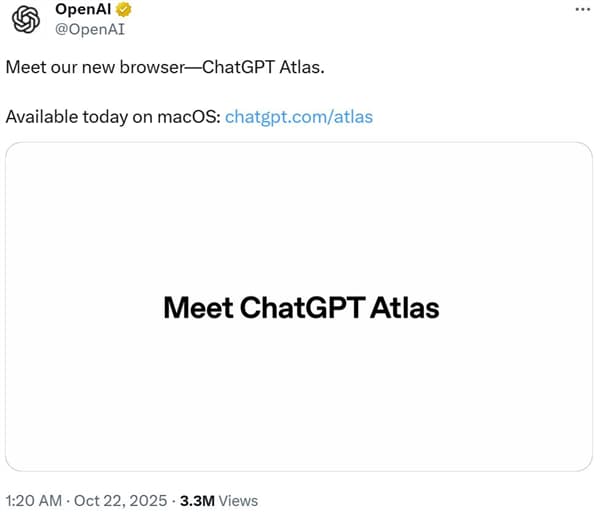
Igeekphone News August 9, 2026 — When OpenAI launched its AI-native browser ChatGPT Atlas on October 21, 2025, the global technology industry quickly gave it a dramatic nickname: the “Chrome killer.”
It was an understandable description. OpenAI was entering one of the oldest and most entrenched layers of the internet with a browser built around AI agents rather than conventional tabs, bookmarks, and search. At the time, many observers believed the browser was finally ready for a major transformation.
The launch also triggered a rush among AI-browser startups. Several companies accelerated their own product releases, concerned that OpenAI’s enormous user base and brand recognition would otherwise overwhelm them.
But less than a year later, the story has taken a very different turn.
On August 9, 2026, just 292 days after Atlas launched, OpenAI discontinued the browser. Users were instructed to export their bookmarks before the shutdown, effectively marking the end of an experiment that was supposed to redefine how people interacted with the web.
The irony is difficult to miss: A company that set out to reinvent the browser ultimately had to teach its users how to migrate back to Chrome.
01. Chrome Never Really Had to Fight
The most striking part of the AI-browser story is that Chrome did not need a major counterattack.
Despite the arrival of numerous AI-powered browsers over the past year, Chrome’s global market share remained remarkably stable at roughly two-thirds. Depending on the measurement source, there were fluctuations, but the overall change remained relatively small.
Meanwhile, the combined market share of AI browsers remained below 1% in many browser statistics.
That gap is especially revealing when comparing the distribution of the underlying products.
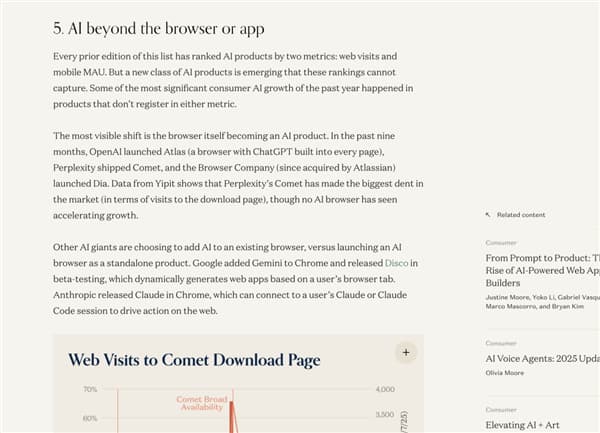
ChatGPT had already reached a weekly active user base of hundreds of millions, giving OpenAI one of the world’s largest consumer software audiences. Yet Atlas struggled to convert that enormous audience into browser users at anything close to the same scale.
The problem was not necessarily that Atlas was technologically weak.
The problem was that the browser is one of the hardest consumer software categories to replace.
Switching browsers means moving bookmarks, saved passwords, extensions, payment information, browsing habits and countless small interactions that users have accumulated over years.
By comparison, adding an AI capability to an existing browser can be almost effortless.
The challenger asks users to move their digital lives.
The incumbent only needs to add a new feature.
That is an extremely uneven starting position.
The Cost of Breaking User Habits
Browser competition has never been purely about technical specifications.
For most people, a browser is infrastructure. Once a user becomes comfortable with a particular browser, there is little motivation to switch unless the alternative provides a dramatic improvement.
This is also why distribution has historically been more important than browser innovation itself.
Google’s long-running payments to secure default search placement on Apple devices illustrate how valuable the default entry point can be. The browser is not simply a piece of software; it is a gateway to the internet and a powerful distribution channel.
AI-browser startups therefore faced a fundamental problem.
They were attempting to replace a deeply embedded gateway rather than simply introduce a better AI assistant.
And the rise of mobile computing made that challenge even harder.
02. AI Browsers Arrived Without the Mobile Advantage
Another weakness of the AI-browser movement was its heavy focus on desktop computing.
Many of the products that attracted attention were initially designed around desktop workflows. Atlas itself remained a macOS-only product throughout its short life.
That created a significant strategic limitation.
The modern internet is no longer primarily a desktop experience. Smartphones account for a huge portion of global browsing activity, and mobile users have their own established browser ecosystems.
Trying to replace Chrome while failing to establish a meaningful presence across mobile platforms meant that AI browsers were effectively fighting over only part of the market.
In other words, they were trying to capture the browser category without controlling the places where much of the world’s browsing actually happens.
03. Big Tech Learned Faster Than Startups Could Innovate
Perhaps the most important lesson from the past year is that AI dramatically shortened the advantage normally enjoyed by innovative startups.
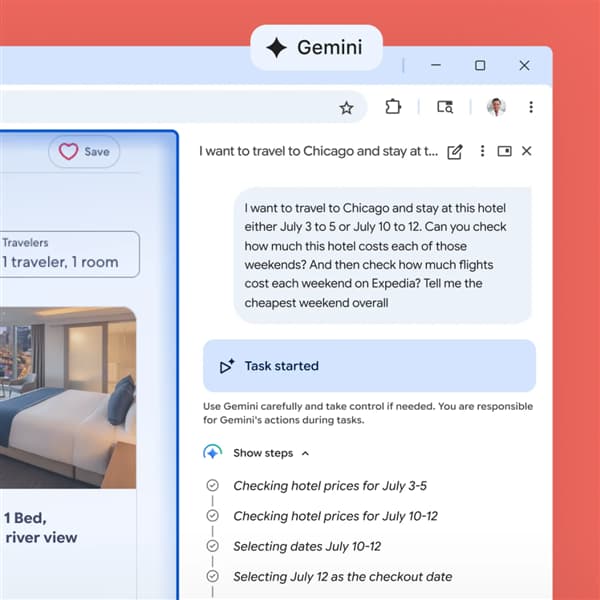
AI browsers introduced features such as:
- Sidebar AI assistants
- Web-page summaries
- Contextual question answering
- Automated browsing
- Agent-based task execution
- AI-powered research and navigation
These features initially looked like compelling reasons to switch browsers.
But the major browser companies quickly began incorporating similar capabilities into their existing products.
Google brought Gemini deeper into Chrome, while Microsoft expanded Copilot capabilities within Edge.
That fundamentally changed the competitive landscape.
A startup might spend months building an AI-powered browser experience. A platform company with an existing browser could potentially introduce a similar capability through a software update.
This undermined one of the traditional advantages of startups: the window of time between invention and imitation.
The classic “innovator’s dilemma” assumes that established companies may be reluctant to disrupt their existing businesses.
But AI browsers presented a different situation.
AI features did not necessarily threaten the core browser businesses of Google or Microsoft. As a result, incumbents had little reason to ignore the trend.
They could simply absorb the innovation.
And once the most attractive AI features became available inside existing browsers, the incentive to switch largely disappeared.
Chrome did not need to defeat the challengers.
It simply absorbed their best ideas.
04. The Browser Became a Feature, Not a Destination
That brings us to perhaps the most important conclusion from the collapse of the independent AI-browser boom.
The surviving products are generally not trying to make money from the browser alone.
Consider the different business models emerging around the category.
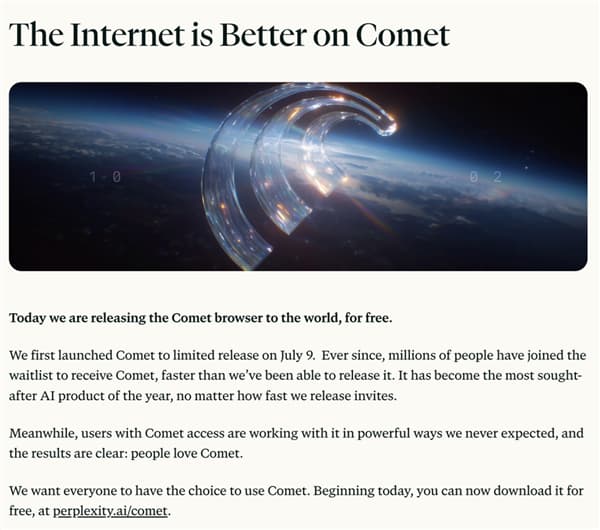
Perplexity’s Comet can function as an extension of its AI subscription ecosystem and a way to acquire users.
Dia, developed by The Browser Company and later acquired by Atlassian, can become part of a broader productivity and workplace software strategy.
Opera Neon has positioned itself as a premium AI browser with a subscription model, while smaller products can depend heavily on venture capital to finance development.
The common denominator is clear:
The browser is rarely the business itself.
Instead, it is becoming a distribution mechanism for another business.
It can acquire customers, provide access to AI services, extend a productivity platform, or serve as another interface for an existing ecosystem.
This represents a fundamental challenge to the idea of the independent AI-browser company.
The browser category will survive.
But the idea that dozens of standalone companies can build businesses simply by creating “a better AI browser” looks increasingly difficult to sustain.
05. The Chinese Market Offers a Similar Lesson
There is also a precedent for this development in China.
Rather than creating entirely new browsers specifically for the AI era, major technology companies have generally taken existing products and gradually integrated AI capabilities into them.
Alibaba has continued evolving its existing consumer software toward AI-powered work and productivity experiences. Tencent has integrated AI into established products such as QQ Browser, while 360 has incorporated AI capabilities into its security-focused browser ecosystem.
The pattern is consistent:
Existing products become AI products.
The browser remains the shell, while AI becomes the capability inside it.
That is almost the opposite of the strategy pursued by many independent AI-browser startups in 2025.
06. OpenAI Didn’t Abandon the Browser’s Most Important Idea
Atlas’s shutdown does not necessarily mean OpenAI has abandoned browser-based AI.
In fact, the company’s next strategy may be more important than Atlas itself.
Rather than maintaining a separate browser, OpenAI can take the most valuable capabilities developed for Atlas and distribute them through other products.
Some of Atlas’s functionality has reportedly moved into the desktop ChatGPT experience, including browser automation capabilities that allow AI agents to interact with websites on a user’s behalf.
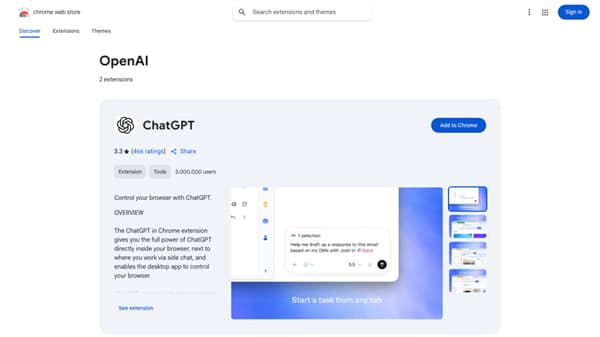
Other capabilities can be delivered through a Chrome extension.
This represents a fundamental change in strategy.
OpenAI no longer needs to convince hundreds of millions of people to abandon their existing browser.
It can simply bring its agent into the browser they already use.
And that could be a much more powerful approach.
07. The Real Browser War Is Becoming an Agent War
The first generation of AI browsers asked a relatively simple question:
What if we built a browser around AI from the beginning?
The next generation is asking something much more consequential:
What if AI could operate the browser for you?
That distinction matters.
The future competition may not be about which browser has the smartest sidebar or the most attractive new-tab page.
Instead, it may be about which AI agent can successfully perform tasks across the web.
Imagine asking an agent to research several products, compare prices, complete a form, organize information, book an appointment, monitor a website, or perform a series of repetitive online tasks.
In that world, the browser itself becomes infrastructure.
The user does not necessarily care which browser is underneath the agent.
They care whether the agent can get the job done.
That puts OpenAI and Google back into direct competition—but on a very different battlefield.
The weapon is no longer the browser.
It is the AI agent.
08. What Happened to the Other AI Browsers?
Atlas was not the only casualty of the AI-browser boom.
Over roughly the same period, several other major developments reshaped the category.
Arc, developed by The Browser Company, stopped receiving active development as the company shifted its attention toward its AI-focused successor, Dia.
Sidekick was absorbed by Perplexity, with the product subsequently discontinued.
The Browser Company itself was acquired by Atlassian in a deal reportedly valued at around $610 million, turning what began as an independent browser company into part of a much larger enterprise software organization.
These outcomes are different on the surface—shutdown, acquisition, absorption and strategic repositioning—but they point toward the same underlying trend.
The independent AI browser is becoming increasingly difficult to justify as a standalone business.
The technology itself may survive.
The standalone category may not.
09. 292 Days That Changed the Strategy
Atlas existed for only 292 days.
That is an extraordinarily short lifespan for a product positioned as a fundamental reinvention of the web browser.
Yet those 292 days may ultimately prove useful for OpenAI.
The company learned that its enormous ChatGPT audience does not automatically translate into willingness to change a fundamental piece of personal computing infrastructure.
It also demonstrated that users are willing to adopt AI capabilities without necessarily adopting a new browser.
That distinction could shape the next phase of AI development.
The battle for the internet’s entry point is not over.
It has simply moved above the browser.
The Real Lesson: Don’t Make Users Move
The biggest lesson from the rise and fall of Atlas is surprisingly simple.
Users don’t necessarily want a new place to browse the web. They want their existing tools to become more capable.
For years, technology companies have competed by trying to persuade users to move from one platform to another.
AI changes that equation.
The most powerful AI products may not be the ones that force users to adopt a completely new environment. They may be the ones that quietly integrate themselves into environments users already understand.
That is why a Chrome extension can ultimately be more strategically valuable than a new browser.
And it explains the irony of Atlas’s short life.
OpenAI spent almost a year building a browser intended to replace the existing internet gateway.
In the end, its most valuable technology may live inside the gateway it was originally trying to replace.
The “Chrome killer” did not kill Chrome.
Instead, it helped demonstrate why the future of AI may not require killing the browser at all.
The next battle is not about replacing the browser. It is about making the browser intelligent enough that users no longer have to think about it.