









A handheld fan usually doesn’t need a complicated feature list. You turn it on, choose a speed, point it toward yourself, and expect some relief from the heat.
The TEVOREX JF163 handheld fan takes a more precise approach. Instead of offering only a handful of preset speeds, it provides 199 adjustable airflow levels, together with a 4000mAh rechargeable battery, USB-C charging, a digital display, a brushless motor, and a foldable body that can be used by hand or placed on a desk. These specifications give it a more flexible design than a basic portable fan.
But there’s a more useful question than simply listing those features:
Does having 199 speed levels actually make a noticeable difference when you’re trying to stay cool?
That’s what makes the JF163 worth examining.
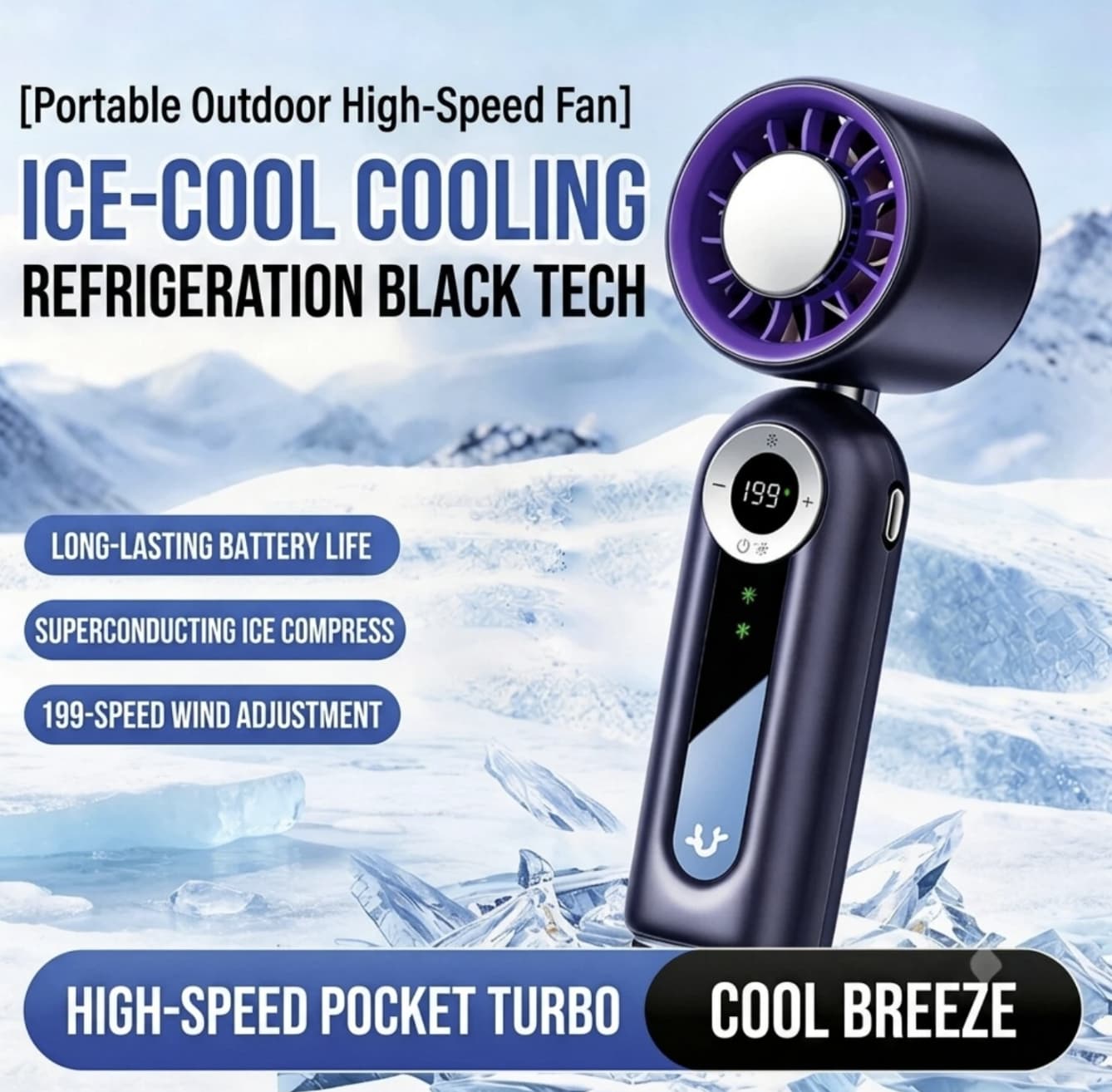
The Real Advantage Is Control, Not the Number 199
“199 speeds” sounds impressive, but the number itself isn’t necessarily what makes the fan useful.
The practical benefit is having more control between low and high airflow.
With a simple three-speed fan, you might find that level one is too weak while level two is already stronger than necessary. A large number of adjustment steps gives you more opportunities to find a comfortable middle point.
That can be useful in different situations.
Sitting at a desk doesn’t require the same airflow as walking outside in summer. A gentle breeze may be enough while reading, while outdoor use can justify considerably stronger airflow.
The JF163’s 199-level system is therefore best understood as a fine-adjustment feature, rather than 199 dramatically different cooling modes. If you’re comparing other personal cooling options, our portable fan reviews cover different designs for home, office, travel, and outdoor use.

Why a Handheld Fan Needs Different Priorities
A desktop fan can move a relatively large amount of air because it doesn’t have to be carried around.
A handheld fan has a different job.
It needs to balance airflow with:
- weight
- battery capacity
- grip comfort
- noise
- portability
- operating time
The JF163 addresses this by combining a portable form factor with a 4000mAh battery and foldable construction.
That combination makes it more suitable for personal cooling than trying to replace a room fan.
This distinction is important.
The JF163 can help cool the person sitting in front of it, but it isn’t designed to rapidly lower the temperature of an entire room.
The Foldable Design Changes How You Can Use It
The JF163 isn’t restricted to handheld operation.
Its body can be positioned for desktop use, allowing the fan to stand on a surface while directing airflow toward the user. The design also makes it easier to pack for travel than a conventional desktop fan.
That gives the product three practical identities:
Handheld fan:
Useful when walking, waiting outdoors, shopping, or attending an event.
Desktop fan:
Useful when working, studying, or sitting at a desk.
Travel fan:
Useful when carrying a personal cooling device in a bag.
This versatility may actually be more valuable than the headline 199-speed specification.
A fan that can change position without requiring you to hold it continuously is simply easier to live with. If portability isn’t your main priority, our desktop fan reviews cover larger cooling solutions designed primarily for desks and workspaces.
The Digital Display Solves a Small but Real Problem
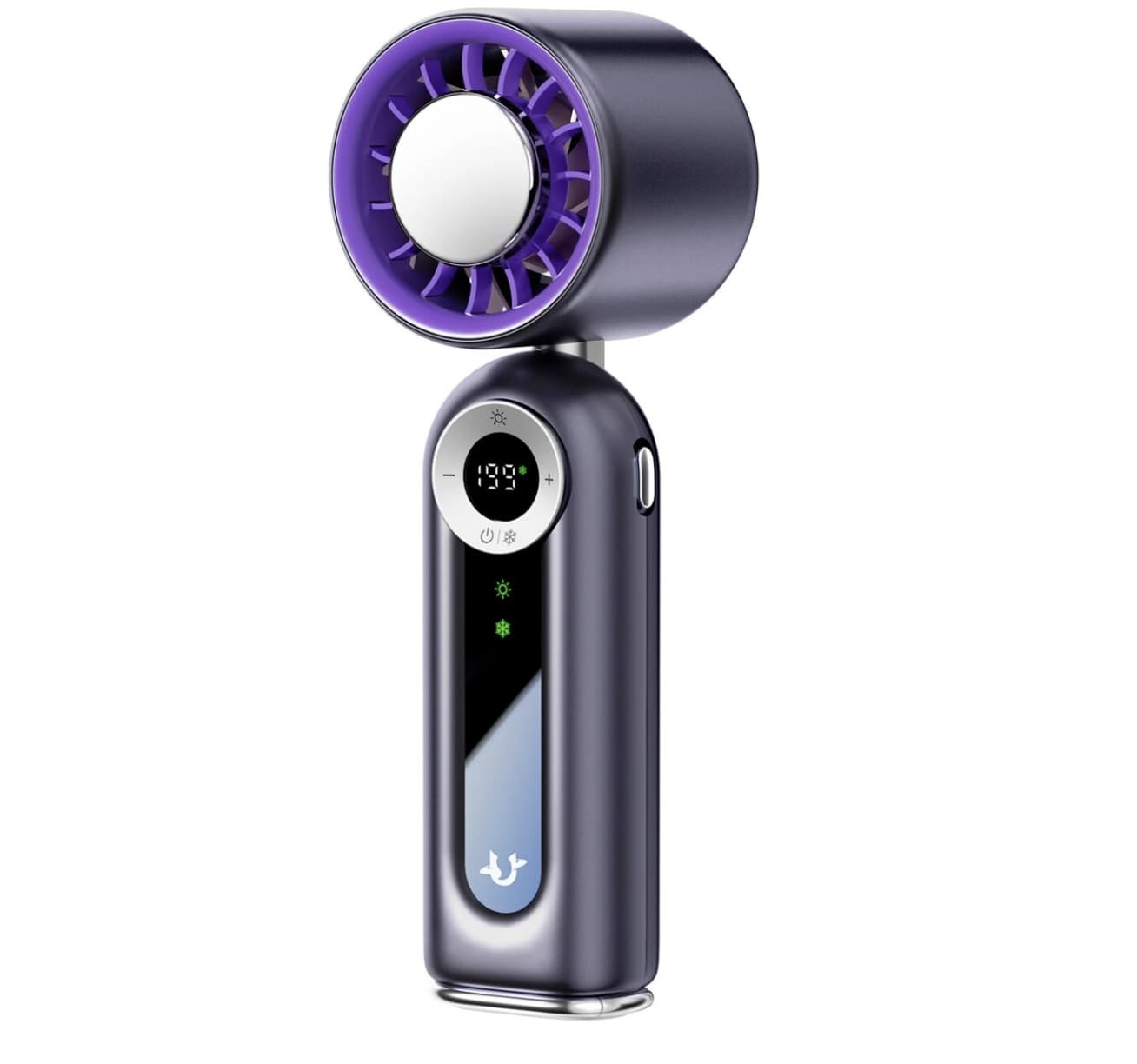
The built-in display shows information such as the selected wind-speed level and battery status.
At first, this may sound like a cosmetic feature.
It isn’t entirely.
Traditional portable fans often use a few indicator lights, which tell you that the battery is somewhere between “probably okay” and “probably needs charging.”
A numerical display gives you much more useful information.
If you’re leaving home for several hours, knowing the remaining battery level can help you decide whether the fan needs charging first.
The display also makes the 199-level system easier to understand because you can see which setting you’re actually using.
The 4000mAh Battery Is More Important Than 199 Speeds
For a portable cooling device, battery capacity may have a bigger impact on everyday usefulness than the number of speed levels.
The JF163 uses a 4000mAh rechargeable battery and supports USB-C charging.
The important point is that actual runtime will depend heavily on the selected airflow level.
At lower speeds, the motor doesn’t need to work as aggressively.
At maximum airflow, power consumption will naturally increase.
So I wouldn’t describe the JF163 as having one fixed “battery life” figure without standardized testing.
Instead, the 4000mAh capacity gives the fan enough battery headroom to make the device practical for extended personal use, while USB-C makes it easier to recharge from equipment many people already carry.
USB-C Makes More Sense for Travel
USB-C is hardly an unusual feature in 2026, but it remains useful.
A portable fan shouldn’t require a proprietary charging cable if it is supposed to travel with you.
The JF163 can be charged through common USB-C power sources such as power banks, laptop ports, and wall chargers.
That means the same charging equipment used for a phone or other accessories can potentially be used for the fan.
For people who spend time outdoors, this is a practical advantage rather than a headline specification.
Brushless Motor: Useful Hardware, But Don’t Overpromise
The JF163 uses a brushless motor.
Brushless motors are commonly used in modern portable devices because they can provide efficient operation without the mechanical brushes found in traditional brushed motor designs.
However, I wouldn’t automatically translate “brushless” into:
quieter + stronger + longer-lasting in every situation.
Actual performance depends on the motor implementation, fan blade design, airflow path, electronics, and operating speed.
For the JF163, the more reasonable conclusion is that the brushless motor is an appropriate choice for a device that needs to balance airflow, efficiency, and portability.
Noise Becomes More Important at Higher Speeds
This is where the 199-level adjustment becomes useful.
Maximum airflow isn’t necessarily the best setting.
A high-speed fan will generally produce more audible airflow and motor noise than a lower-speed setting.
The advantage of having many intermediate settings is that you don’t have to jump directly from a gentle breeze to maximum output.
You can gradually increase airflow until you find a comfortable compromise between cooling and noise.
That’s particularly useful in environments such as:
- offices
- classrooms
- libraries
- bedrooms
- study areas
The JF163 is therefore better viewed as a fan that lets the user choose the balance between airflow and noise, rather than one that is simply “quiet.”
Where the JF163 Makes the Most Sense
The product is particularly suited to situations where the person needs cooling rather than the entire room.
Commuting
A handheld fan can provide direct airflow while waiting for public transport or walking outdoors.
Outdoor Events
Concerts, festivals, theme parks, and sporting events can expose people to heat for long periods without access to strong personal airflow.
Office Work
The foldable stand allows the JF163 to function as a small personal desk fan.
Studying
A lower airflow setting can provide continuous personal cooling without requiring the user to hold the fan.
Travel
Its foldable design and USB-C charging make it easier to incorporate into a travel setup.
Photography and Outdoor Work
People working outdoors can direct airflow toward themselves without needing a larger fan or fixed power source.
Where It Isn’t the Right Tool
The JF163 has clear limitations.
It isn’t designed to replace an air conditioner.
It also isn’t a substitute for a large room fan when you need to circulate air throughout an entire space.
And at maximum speed, the fan will naturally be more noticeable acoustically than when running at a low setting.
The product is best used as personal cooling equipment.
That sounds obvious, but it’s an important distinction when evaluating portable fans.
199 Speeds vs. Three Speeds: Who Benefits?
This is probably the most interesting question surrounding the JF163.
If you’re the type of user who turns a fan on and simply chooses low, medium, or high, you may not care about 199 levels.
But if you’re sensitive to airflow strength, noise, or temperature, fine adjustment can be genuinely useful.
Imagine two settings:
Level 40:
Comfortable but slightly weak.
Level 50:
Better airflow but slightly too strong.
A conventional three-speed fan gives you no way to find the middle.
A continuously adjustable design gives you much more control.
That’s the real reason the 199-step system matters.
Not because 199 is a magic number, but because it reduces the gap between “too weak” and “too strong.”
For more alternatives, our portable cooling device guide compares different approaches to staying comfortable in hot weather.
The JF163 Is More Interesting as a Personal Cooling Tool
The combination of handheld and desktop operation gives the JF163 a broader role than a basic mini fan.
At home, it can sit beside a laptop.
At work, it can provide localized airflow without occupying much desk space.
Outside, it can become a handheld cooling device.
That flexibility is one of the strongest arguments for the product.
The fan doesn’t need to be the most powerful cooling solution available.
It needs to be available exactly where the user needs airflow.
What I Like About the JF163
The best part of the JF163 is the relationship between its features.
The 199-level adjustment gives airflow control.
The 4000mAh battery supports portable use.
The foldable body allows both handheld and desktop operation.
The digital display makes the settings easier to understand.
USB-C makes charging convenient.
None of these features is revolutionary on its own.
Together, however, they create a fairly coherent personal-cooling product.
What Could Be Better
The biggest limitation is that the headline 199 speeds could easily be mistaken for 199 genuinely different performance modes.
That’s not really how such adjustment systems should be understood.
The value comes from fine control.
I’d also avoid choosing the JF163 purely because it has a 4000mAh battery. Battery capacity alone doesn’t determine runtime; airflow level and motor efficiency matter too.
Finally, anyone expecting semiconductor cooling, misting, or genuine temperature reduction rather than airflow should look at a different type of cooling product.
Final Verdict
TEVOREX JF163 is more interesting when you stop looking at “199 speeds” as a marketing number and start thinking about what fine airflow adjustment actually does.
Its biggest advantage is control.
You can choose a gentle breeze for quiet desk use, increase the airflow when you’re outside, or find a middle setting that balances cooling and noise.
The 4000mAh battery, USB-C charging, digital display, and foldable body then make that control practical in everyday situations.
It isn’t a room-cooling replacement, and its maximum airflow will naturally be more noticeable than its lower settings.
But that’s not really the point.
The JF163 is designed to put adjustable personal cooling in your hand—or on your desk—without forcing you to choose between only a few preset speeds.
If you value precise airflow control and portability, that’s a much stronger reason to consider the JF163 than simply saying it has 199 speeds.