









When people think of RC vehicles, they often imagine fast buggies racing over dirt, drift cars sliding around corners, or monster trucks climbing rough terrain. Most traditional RC models focus on speed, handling, suspension, and off-road performance. The basic experience is simple: control the vehicle, accelerate, steer, and navigate different surfaces.
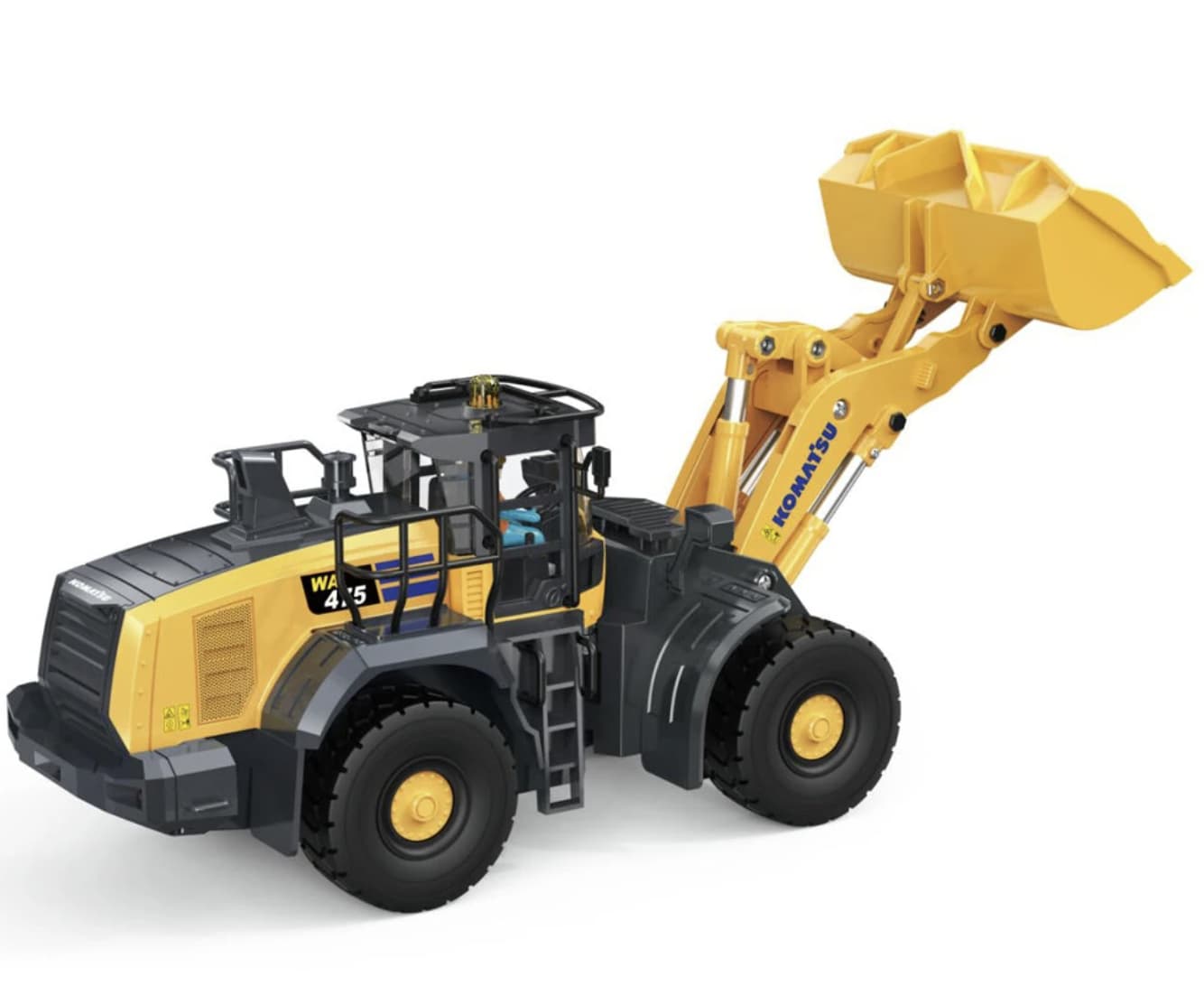
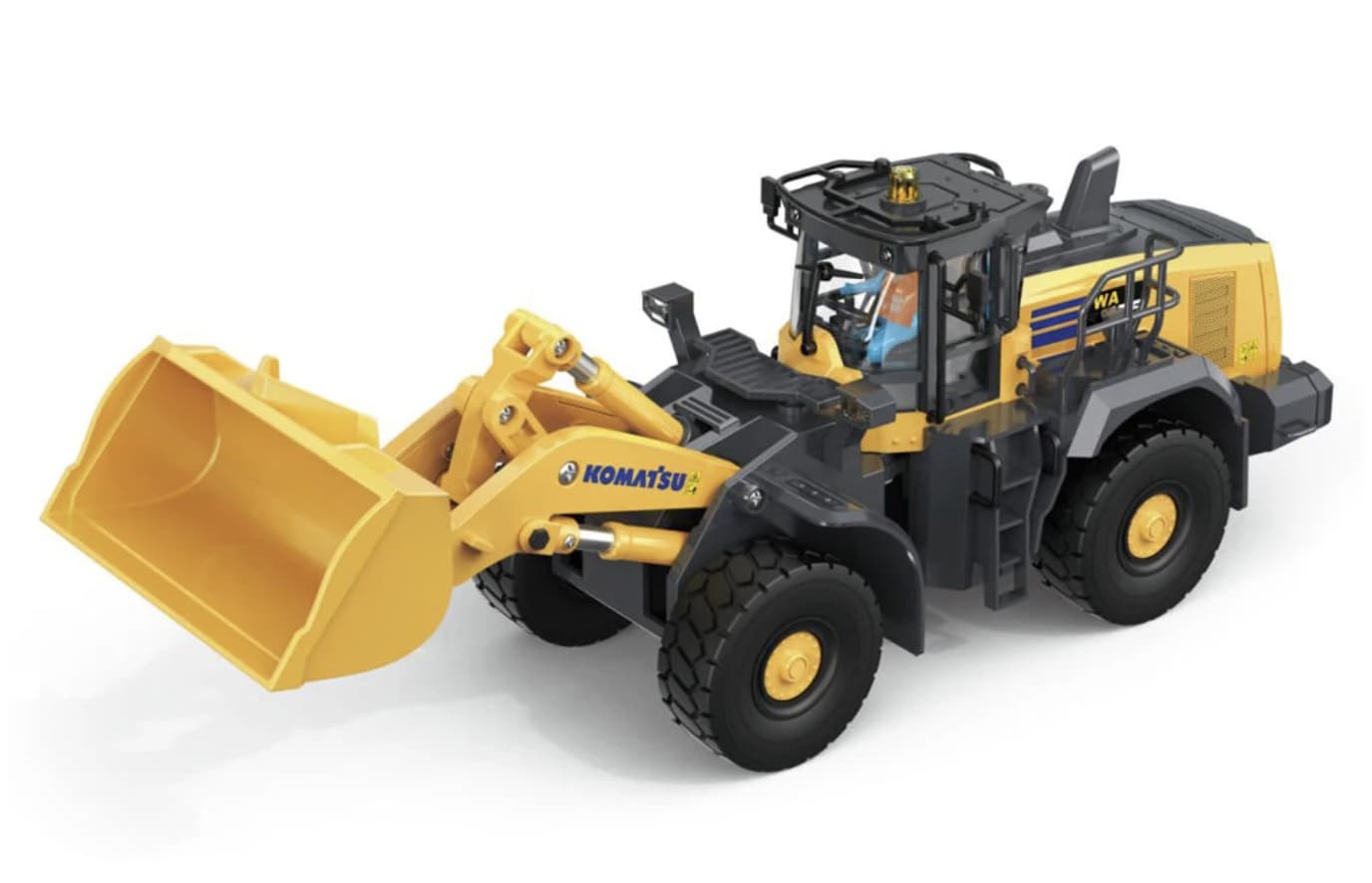
The YIGONG YG475 RTR 1/50 2.4G RC Car Loader defies that convention entirely. Instead of mimicking a scaled-down sports car or off-road racer, this model faithfully reproduces the look, feel, and function of a real construction loader. Its appeal doesn’t come from raw speed or lap times—it comes from scale realism, functional mechanical movements, precision maneuvering, and interactive play with miniature environments.
For collectors, diorama builders, and RC enthusiasts looking for something beyond the ordinary, the YG475 offers a refreshing change of pace. It’s not about how fast you can go—it’s about how accurately you can scoop, lift, and dump. That alone makes it worth a closer look, even for those who already own a garage full of conventional RC cars.
Traditional RC Cars Are About Driving; Construction RC Models Are About Operating
The biggest difference is the type of interaction.
A conventional RC car generally has a small number of primary inputs: throttle and steering. Depending on the model, you may also have additional controls for lights, winches, differentials, or other functions. But the core experience remains driving.
A construction vehicle adds another layer. The operator is not only deciding where the vehicle goes, but also what the machine is doing.
With a loader-style RC model, the bucket becomes part of the experience. You can approach an object, position the machine, operate the working mechanism, and then move away. That creates a simple but surprisingly engaging sequence of actions.
This is one reason mini construction vehicles can feel less like conventional RC cars and more like interactive scale models.
The YIGONG YG475 Has a Different Idea of “Fun”
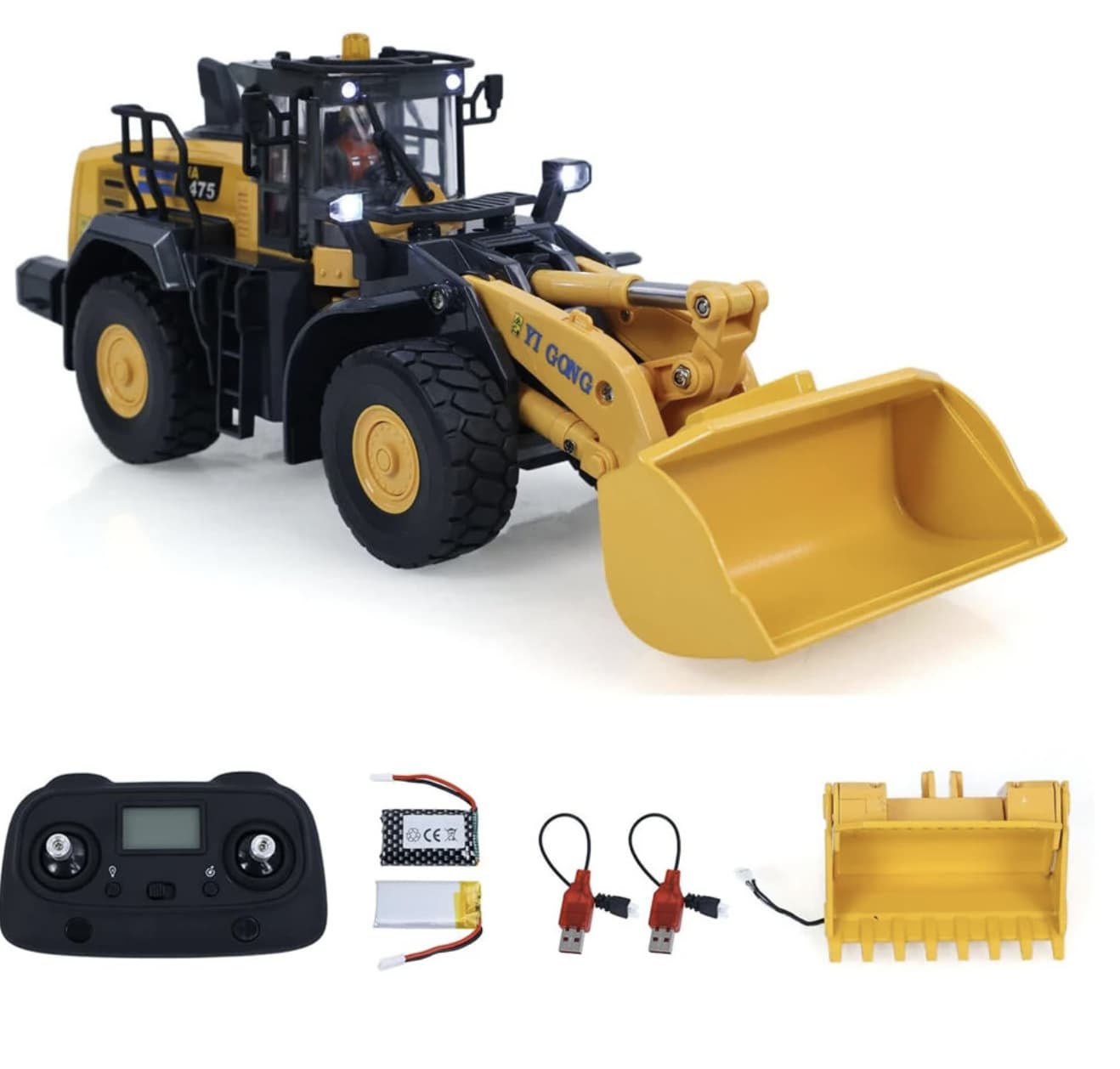
The YG475 is designed around a 1/50-scale construction-vehicle concept, with an alloy bucket, simulated LED lighting, sound, and 2.4G remote control. The product is positioned as an RTR model, meaning the basic vehicle and control system are supplied as a ready-to-run package.
The result is not a machine intended to compete with a hobby-grade 1/10 crawler on speed or extreme off-road capability.
Instead, the YG475 makes sense when you create a small environment around it.
A tabletop can become a miniature work site. Small blocks can become construction materials. Loose, lightweight material can become a simulated pile of earth. Even an ordinary desk can become a temporary operating area.
That changes the question from:
“How fast can this RC vehicle go?”
to:
“What can I make this little machine do?”
That is a much more interesting proposition for some users.
Size Is Actually One of Its Advantages
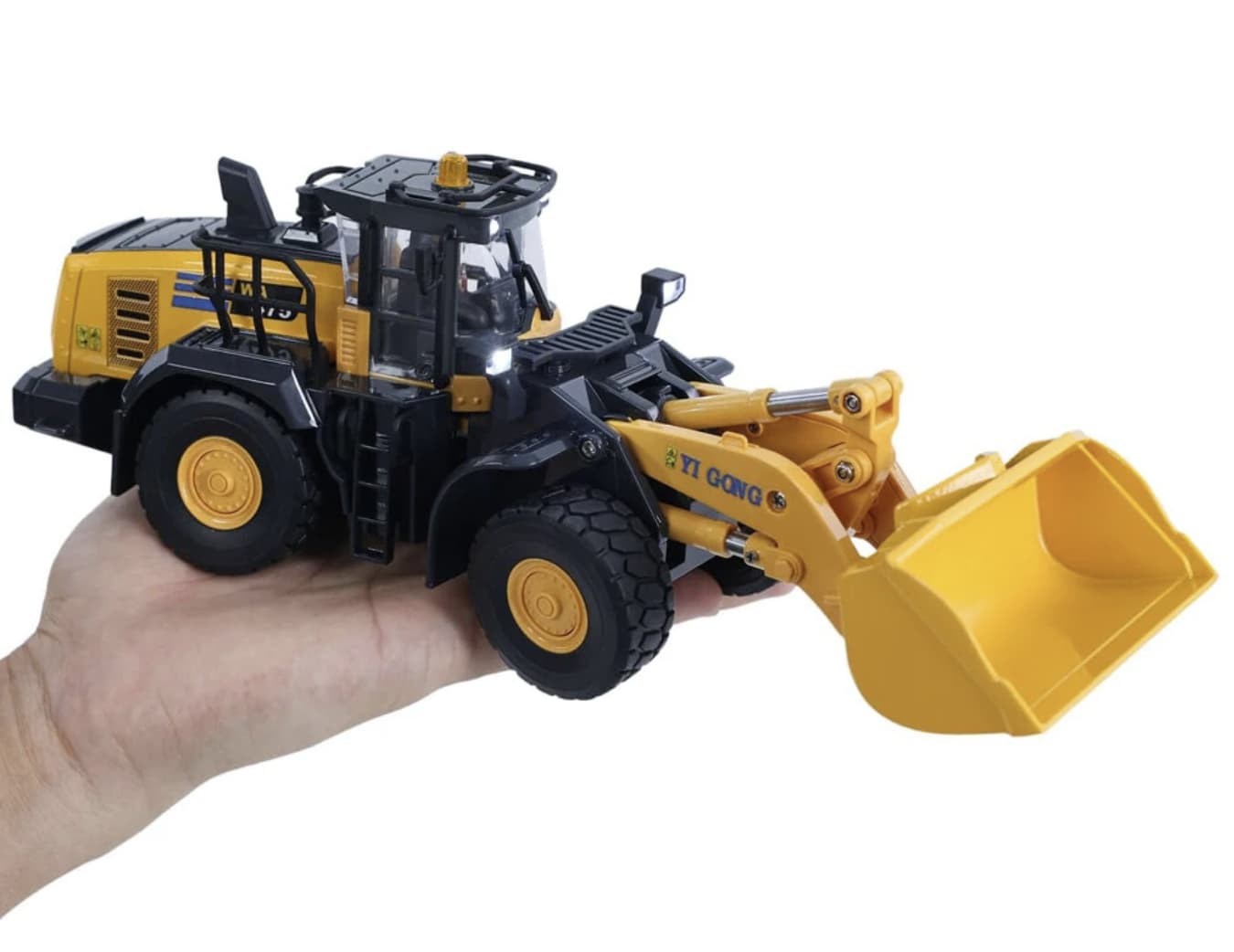
The 1/50 scale is important because miniaturization changes where you can use the vehicle.
Large RC construction machines can be impressive, but they require considerable operating space. A large model may need an outdoor area, a sandbox, or a dedicated RC construction site to demonstrate its capabilities properly.
A small construction model has a different advantage: accessibility.
Community discussions around YIGONG’s 1/50 construction models repeatedly highlight their suitability for indoor or tabletop use. One recent RC Construction discussion described a YIGONG 1/50 model as particularly enjoyable indoors and suitable for loose dry material, while another user said the smaller scale was preferable because it required much less operating space.
This is where the YG475 can outperform a much larger RC construction vehicle in practical terms. You may not need a backyard construction pit simply to enjoy it.
Construction Models Turn Movement Into a Task
A traditional RC car can be entertaining even when it has no specific objective. Driving around obstacles, jumping ramps, climbing slopes, or racing against another vehicle can provide the challenge.
A construction model introduces task-based play.
For example, a miniature operating session could involve:
- Driving toward a pile of lightweight material.
- Positioning the loader correctly.
- Lowering the working mechanism.
- Collecting material with the bucket.
- Reversing away from the pile.
- Moving toward a designated unloading area.
- Repeating the process.
The vehicle is therefore not simply moving from Point A to Point B. The operator is trying to complete a small job.
That difference can make a construction RC model particularly appealing to people who enjoy simulation and problem-solving.
It Is Closer to a Miniature Machine Than a Toy RC Car
Another major distinction is visual philosophy.
Many traditional RC cars prioritize aggressive styling, oversized tires, suspension travel, aerodynamic shapes, or racing-inspired proportions. Even when they are scale models, their design is usually optimized around driving performance.
Construction models have a different visual vocabulary.
Cabin proportions, bucket geometry, tracks, working arms, warning lights, and other details contribute to the impression that you are controlling a miniature machine rather than an ordinary toy car.
YIGONG’s broader 1/50 construction range illustrates this approach. Other YIGONG models in the same general category are sold with features such as metal working components, simulated lights and sounds, and articulated construction functions.
This emphasis on mechanical appearance is one reason miniature construction vehicles can attract collectors as well as RC enthusiasts.
2.4GHz Control Matters More Than It Sounds
The YG475 uses 2.4GHz radio control, a technology now common across modern RC vehicles.
For a small construction model, the benefit is not necessarily about achieving extreme range. Instead, reliable radio control helps make multiple inputs feel predictable during close-range operation.
That matters when you’re trying to position a loader precisely.
A conventional RC car can often tolerate a little steering error. If you’re racing around an open area, being several centimeters away from your intended line may not matter.
With a loader, positioning is part of the task.
You may need to approach an object at a particular angle or line up the bucket with a small pile. Consequently, controllability can be more important than outright speed.
Don’t Expect It to Behave Like a Full-Size Hobby-Grade Construction Machine
This is an important distinction for buyers.
The YIGONG 1/50 construction platform should be viewed as a compact electric simulation model, not as a miniature hydraulic construction machine.
Comparable YIGONG 1/50 loaders are explicitly described by sellers as electric simulation models rather than hydraulic hobby loaders. Their specifications also illustrate the priorities of this class: compact dimensions, modest speed, integrated lighting and sound, and relatively long operating time rather than heavy-duty digging performance.
That means the YG475 should not be judged by the same criteria as a large professional RC construction model.
The smaller machine sacrifices raw power in exchange for:
- Much less required operating space
- Easier indoor use
- Lower physical scale
- Simpler setup
- More accessible tabletop operation
- Strong visual appeal as a miniature model
In other words, small is not necessarily a weakness when the goal is simulation rather than heavy-duty work.
Where a Traditional RC Car Still Wins
The YG475 is different, but that does not mean it is better for every RC enthusiast.
A conventional RC car is usually the better choice if your priorities are:
- High speed
- Racing
- Jumping
- Rock crawling
- Long-distance driving
- Suspension performance
- Aggressive off-road driving
- Competitive handling
A 1/10 crawler, for example, is designed to deal with obstacles that would be completely inappropriate for a tiny construction model.
Likewise, a performance-oriented RC car can deliver an adrenaline rush that a slow-moving loader simply cannot reproduce.
The YG475 is appealing for a different reason: control becomes the entertainment rather than merely the means of reaching a high speed.
Where the YG475 Has the Advantage
The balance changes when the priorities become scale realism and interactive operation.
The YG475 makes more sense if you want:
- A compact RC model
- A construction-themed vehicle
- Working-machine aesthetics
- A tabletop RC experience
- A collectible model that can also move
- A vehicle for miniature scenes and dioramas
- A slower, more deliberate operating experience
- Something different from another RC truck or crawler
This distinction is also reflected in community discussions. Owners of YIGONG’s small construction models have described them as good-value ways to explore RC construction without committing to much larger and more expensive machines. At the same time, experienced users point out that the smaller models naturally cannot match the durability of larger-scale equipment.
That is arguably the most useful way to understand the YG475: it lowers the barrier to entering the RC construction hobby.
The “Tabletop Construction Site” Is the Real Selling Point
One of the most interesting possibilities is creating an operating environment specifically for the YG475.
Traditional RC cars normally need a track, driveway, garden, or off-road course.
A mini construction vehicle can turn a tabletop into a miniature worksite.
You could create different zones for loading, transportation, parking, and unloading. Small wooden blocks could represent construction materials. Lightweight granular material can create a more realistic scene, provided it is appropriate for the model and kept away from sensitive electronics.
This transforms an ordinary RC session into something closer to miniature simulation.
It also gives the model a second life when it is not being operated. A traditional RC car may sit on a shelf between driving sessions. A detailed construction model can function as a display piece and an interactive vehicle.
A Better Comparison: Driving vs. Operating
The easiest way to understand the difference is to compare the two experiences directly.
| Category | Traditional RC Car | YIGONG YG475-Type Construction Model |
|---|---|---|
| Main purpose | Driving | Operating a miniature machine |
| Typical excitement | Speed and handling | Movement and mechanical interaction |
| Environment | Track, road, trail | Tabletop, miniature site, loose material |
| Controls | Primarily steering/throttle | Driving plus working functions |
| Scale appeal | Varies | Strong construction-model focus |
| Space requirement | Depends on model | Relatively small |
| Best for | Racing, crawling, off-road driving | Simulation, collecting, miniature play |
| Operating style | Fast and dynamic | Slow and deliberate |
| Display value | Moderate to high | High for construction enthusiasts |
The table also reveals why comparing the YG475 with an ordinary RC car purely on speed or terrain performance misses the point.
They are designed around different definitions of fun.
Is the YIGONG YG475 Better for Beginners?
For someone completely new to RC, the answer depends on what they find interesting.
If they are fascinated by cars, racing, drifting, or off-road driving, a conventional RC car is probably the more natural starting point.
If they are fascinated by excavators, loaders, trucks, construction sites, or machinery, a mini construction vehicle could be much more engaging.
The RTR format also reduces the barrier to entry because users don’t need to build a complete vehicle before their first operating session.
YIGONG YG475 Durability: What Owners Say
Before purchasing the YIGONG YG475 RTR 1/50 RC loader, it’s important to understand its durability limitations. While the model is marketed as a toy and ready-to-run vehicle, owner reviews consistently note that it is not as rugged as larger-scale RC construction equipment. The YG475 performs best in indoor environments or controlled display settings. Outdoor use on rough or uneven terrain may strain its mechanical components. For collectors and diorama enthusiasts seeking scale realism over heavy-duty performance, the YG475 offers excellent value—provided it’s used within its intended scope.
The Verdict: Different Rather Than Simply Better
The most useful comparison between the YIGONG YG475 and a traditional RC car is not “which one is faster?” or “which one has more power?”
It is:
Which type of RC experience do you want?
A traditional RC car is fundamentally a vehicle designed to be driven.
The YG475 represents a different philosophy. It turns the RC hobby into a miniature machinery experience where positioning, working movements, scale details, lights, sound, and interaction with a small environment become part of the fun.
That makes the YG475 particularly interesting for people who have already experienced conventional RC cars and want something different.
You don’t buy the YIGONG YG475 because you want another racing car. You buy it because operating a tiny construction site can be more entertaining than simply driving another car around the track. For collectors, families, miniature-model fans, and RC users who value realism over speed, the YG475 is a refreshing and worthwhile addition to any collection.