










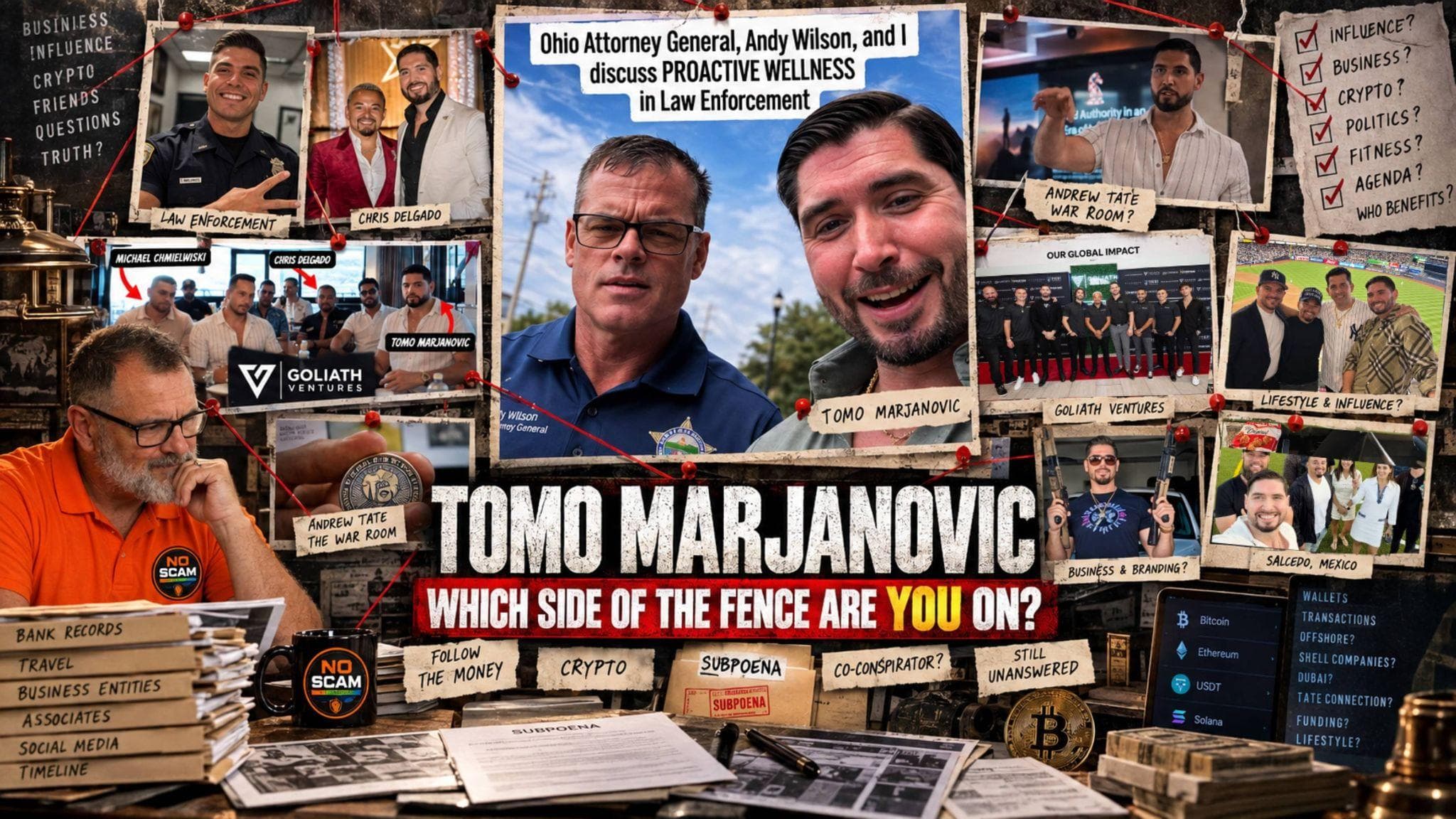
Today at the Armor Within Expo I got to sit down with Ohio Attorney General Andy Wilson, the state’s top cop.”
Those are Tomo Marjanovic’s own words, published alongside a video of him standing with Ohio Attorney General Andy Wilson after speaking at a wellness event aimed at the law-enforcement community.
I first contacted Tomo on September 16, 2025, while I was actively investigating Christopher Delgado and Goliath Ventures Inc. I asked him directly whether he had invested with Goliath, whether he had received payouts, whether he had promoted the operation or introduced other people to it, and whether he had ever been shown independent audits, custodian records or verifiable on-chain evidence supporting what investors were being told.
Those questions weren’t random. I had already documented Tomo publicly associating with Goliath and Delgado. He had also moved within Andrew Tate’s War Room, publicly describing himself as one of its 33 mentors, and appeared aboard the yacht where Christopher Delgado and Mike Chmielewski were among those speaking.
Since then, the Goliath story has exploded.
Christopher Delgado has pleaded guilty to conspiracy to commit wire fraud, wire fraud and money laundering, while regulators have alleged that Goliath Ventures raised hundreds of millions of dollars from investors. The CFTC’s case describes at least $397 million, while the SEC alleges Goliath raised at least $425 million.
But Tomo didn’t disappear from public view.
Instead, in 2026, he emerged as a speaker at Armor Within, placing himself back inside the world of law enforcement and eventually publishing footage alongside Ohio’s Attorney General.
There is something Armor Within’s audience probably didn’t know.
Before Tomo took that stage, I warned the organisers.
On June 27, 2026, I wrote directly to the Armor Within team. I explained the Goliath investigation, told them about Delgado’s guilty plea and specifically warned them that I had documented Tomo’s involvement in promoting and associating himself with Goliath Ventures. I encouraged them to conduct their own due diligence and offered to provide the supporting evidence.
They went ahead with him anyway.
Meanwhile, federal bankruptcy court records show that the Goliath Ventures estate has repeatedly sought records from Tomislav “Tomo” Marjanovic under Rule 2004. The first notice was filed in May, an amended notice followed in June, and another amended notice was filed on August 20, 2026.
And they aren’t asking for his résumé.
They are seeking communications between Tomo and Christopher Delgado, communications concerning Goliath Ventures, cryptocurrency account records and transaction histories, bank and brokerage records, and records reflecting transfers between Tomo and Delgado, Goliath, or Goliath officers, principals and affiliates.
On its own, there is nothing unusual about that encounter. Tomo is a former police officer who has reinvented himself as an entrepreneur, speaker and wellness advocate. But I have been investigating another side of Tomo Marjanovic for almost a year, including his documented association with Christopher Delgado and Goliath Ventures. Against that background, his appearance alongside Ohio’s Attorney General raises questions that deserve closer examination.
My own investigation has now uncovered financial records that make those requests even more significant.
I have reviewed an analysis of transaction data from Tomo Marjanovic’s Coinbase account. Those records document approximately $460,649 in USDC sent from Tomo’s Coinbase account to an address identified as belonging to Goliath Ventures. One transaction, for approximately $16,992 on September 13, 2024, carries a particularly interesting notation:
“GV EXEC PARTNER CONTRIBUTION.”
The same analysis identified approximately $4.45 million in cryptocurrency entering Tomo’s Coinbase account from two principal external addresses during the period examined. I do not know who controlled those addresses, and I am not claiming those incoming funds belonged to Goliath. That is one of the questions this investigation is now attempting to answer.
Alongside this Tomo-specific evidence, the Avengers Anti-Fraud Alliance has identified nearly $10 million in cryptocurrency currently sitting in wallets that were part of the network used to issue distributions to Goliath investors while the scheme was operating. That is not the total amount that moved through those wallets — the transaction volume is considerably larger.
I have also received confidential financial intelligence concerning Tomo. I will not publish that material or reveal anything capable of identifying its source. Where that intelligence provides investigative leads, my approach is to establish them independently through blockchain records, court filings and other evidence before publishing any conclusions.
This investigation is not an allegation that Ohio Attorney General Andy Wilson knew anything about Tomo’s relationship with Goliath. I have seen no evidence establishing that. Nor does appearing beside an Attorney General establish wrongdoing by Tomo.
The question is what happened before that video was recorded.
Because while Tomo Marjanovic was publicly presenting himself alongside the state’s highest law-enforcement official, the financial evidence was beginning to tell another story — one involving hundreds of thousands of dollars moving from his Coinbase account to an identified Goliath address, millions entering his account from addresses whose owners remain unidentified, and federal bankruptcy proceedings seeking his communications, cryptocurrency histories, bank accounts and transfers involving Christopher Delgado and Goliath.
So I went back to the beginning.
From Andrew Tate’s War Room To Goliath Ventures
Long before Tomo Marjanovic appeared at a law-enforcement wellness event, he was publicly operating in a very different circle.
Tomo has described himself as one of 33 mentors inside Andrew Tate’s War Room, a private network built around Tate and promoted as an exclusive brotherhood of successful businessmen. In Tomo’s own promotional material, his role was not presented as that of a casual member. He was a mentor, sharing lessons on business, health optimisation and what he described as brotherhood.
That connection became particularly relevant to my Goliath investigation because Christopher Delgado was moving within the same circle.
I obtained and reviewed footage from a gathering aboard a yacht associated with the War Room where Tomo appeared alongside Delgado and Mike Chmielewski. Delgado wasn’t some distant name Tomo happened to encounter at a conference. Their association was visible elsewhere as well.
On October 30, 2024, Tomo posted from Yankee Stadium during Game 5 of the World Series. The photographs included Christopher Delgado, Patrick Bet-David and others. Tomo’s caption described the men around him as his “brothers”, tagging Delgado’s account directly.
None of that, by itself, establishes financial wrongdoing. People attend events together, take photographs together and move within the same business networks all the time. What made the relationship important was what I subsequently documented around Goliath Ventures.
Tomo was publicly associated with Goliath during the period when Delgado’s operation was attracting investors. That placed him within a network where reputation mattered enormously. Goliath wasn’t selling investors a conventional product they could inspect on a shelf. People were being asked to trust claims about investment performance, returns, security and the people standing behind the operation.
Credibility was part of the product.
That is why promoters, speakers, successful entrepreneurs and people with impressive backgrounds matter in schemes like this. An investor may know nothing about cryptocurrency trading, liquidity strategies or how an investment operation actually generates its returns, but they understand social proof. They see successful people around the founder. They see expensive lifestyles, exclusive events and influential connections. Every additional layer of apparent legitimacy makes the underlying proposition easier to believe.
Tomo brought another powerful piece of credibility with him: he was a former police officer.
By his own public account, Tomo entered the police academy in 2007 and remained in law enforcement until 2018. He has continued to make that history part of his public story as he transitioned from policing into entrepreneurship and the wellness industry.
There is nothing improper about a former police officer becoming an entrepreneur, associating with wealthy businessmen or even joining Andrew Tate’s War Room. The significance lies in what happened when these different worlds began overlapping.
By September 2025, I was no longer interested simply in who Tomo knew.
I wanted to know what his actual relationship with Christopher Delgado and Goliath Ventures had been — and whether money had moved with it.
I Started Asking Questions In September 2025
I contacted him while Goliath Ventures was still operating and explained that I was investigating Christopher Delgado and Goliath Ventures Inc. I wasn’t asking Tomo whether he happened to know Delgado. Their association was already apparent. I wanted to establish what Tomo’s involvement with the investment operation actually looked like.
My questions were specific.
I asked whether Tomo had personally invested with Goliath Ventures or any affiliated operation, how much he had invested, when he invested and what terms he had been offered. I asked whether those terms included the kind of 3–4% monthly returns, principal guarantees or insurance representations that had become relevant to my wider investigation.
I also wanted to know about the money coming back.
Had Tomo received distributions? How much had he received? How frequently were those payments made? What explanation had he been given about where the returns were coming from, and had he seen anything independently verifying that explanation?
Then I asked the question that matters whenever someone with an established public profile becomes associated with an investment operation: Did he promote Goliath to other people?
I asked whether Tomo had promoted Goliath through events, social-media posts or private introductions, and what disclosures or supporting information he had been provided before doing so. I also asked whether he had ever seen independent audits, custodian letters or verifiable on-chain evidence demonstrating that the investment activity investors were being told about was actually taking place.
These were not questions constructed with the benefit of hindsight after Goliath collapsed. I was asking them in September 2025, while the operation was still running.
I gave Tomo a right of reply and made it clear that I was prepared to consider his answers on the record or, where appropriate, off the record. The purpose was simple: if there was a legitimate explanation for his relationship with Goliath and Delgado, I wanted to hear it directly from him.
What happened over the following months transformed those questions from due diligence into something much more significant.
Goliath stopped paying investors. Federal authorities moved in. Christopher Delgado was criminally charged and later pleaded guilty to conspiracy to commit wire fraud, wire fraud and money laundering. Separate civil enforcement actions followed, with the SEC alleging at least $425 million had been raised from more than 1,300 investors and the CFTC alleging at least $397 million had been obtained from approximately 1,600 customers.
Suddenly, questions about who promoted Goliath, who received money from it and where that money ultimately went were no longer merely questions being asked by an investigative journalist.
They were becoming questions being asked in federal court.
Following Tomo’s Money
Once Goliath collapsed, my attention shifted from photographs, presentations and public associations to something far more useful: the financial records.
I obtained and reviewed an Analysis of Transaction Data relating to Tomo Marjanovic’s Coinbase account. The records cover several years of cryptocurrency activity and document substantial transactions between the account attributed to Tomo and numerous external blockchain addresses.
According to the analysis, approximately $4.45 million worth of cryptocurrency was received into Tomo’s Coinbase account from external wallet addresses during the period examined. Two addresses accounted for the overwhelming majority: approximately $298,140 came from one address, while approximately $4.137 million came from another. The report notes that the second address appeared to replace the first, but it does not identify the owners of those two addresses.
That distinction matters.
I do not have a personal self-custody wallet address that I can independently identify as belonging to Tomo Marjanovic. What I have is something different: transaction records from an account attributed to Tomo showing cryptocurrency moving between that Coinbase account and numerous external addresses.
One of those external addresses can be connected directly to Goliath Ventures.
This address was already known to my investigation and can also be independently examined on the blockchain. The same address appears in Christopher Delgado’s June 23, 2026 plea agreement in truncated form among cryptocurrency assets subject to forfeiture.
The result is significant.
The records show multiple USDC transfers from Tomo’s Coinbase account directly to that Goliath address. According to the transaction summary, those transfers total approximately $460,649.
One transaction particularly caught my attention.
On September 13, 2024, the records show approximately $16,992.48 USDC being sent from Tomo’s Coinbase account to the Goliath address. Sitting beside that transaction is a note containing four words:
That is far more useful to this investigation than trying to label an unidentified blockchain address as “Tomo’s wallet.” I don’t need to make that leap. The records document an account attributed to Tomo sending cryptocurrency directly to an address identified as belonging to Goliath Ventures, including a transaction specifically labelled as an executive partner contribution.
The records also provide another glimpse into what was happening inside Tomo’s Coinbase account. The analysis states that USDC was frequently sold for cash and that the cash was subsequently withdrawn and transferred to Tomo’s personal bank accounts. It also records cryptocurrency being sent from the Coinbase account to numerous other wallet addresses whose owners remain unidentified.
None of this, standing alone, establishes criminal conduct. Someone investing in, contributing to or receiving money from a company does not become responsible for crimes subsequently committed by that company or its founder. The purpose of examining these records is not to manufacture guilt from transactions.
It is to establish the financial relationship that actually existed.
Why Is The Bankruptcy Estate Chasing Tomo’s Records?
The Coinbase records gave me documented transactions between an account attributed to Tomo Marjanovic and an address identified as belonging to Goliath Ventures. Then I looked at what was happening in the Goliath bankruptcy proceedings.
The overlap was difficult to miss.
On May 14, 2026, Goliath Ventures, through its bankruptcy counsel, filed a Rule 2004 notice seeking records from Tomo. An amended notice followed on June 17, and on August 20, 2026, a Second Amended Notice was filed setting a new document-production date of September 18.
I want to be precise about who is behind these demands. This is not the Department of Justice subpoenaing Tomo. The subpoena was issued at the request of Meland Budwick, P.A., counsel for the Goliath Ventures debtors, as part of the Chapter 11 bankruptcy proceedings. Federal officials and agencies appear on the electronic notice list, but that is not the same thing as saying they issued the subpoena.
What matters is what Goliath’s bankruptcy counsel wants Tomo to produce.
The August subpoena seeks all documents concerning Goliath, including agreements, contracts, correspondence, financial records and corporate records. It seeks all communications between Tomo and Goliath, and separately, all communications between Tomo and Christopher Alexander Delgado.
Then it turns directly to cryptocurrency.
The subpoena demands records relating to any cryptocurrency or digital-asset account held by Tomo, individually or jointly, including account-opening documents, statements and transaction histories. Its definition of digital assets is broad, encompassing cryptocurrencies, virtual currencies, digital tokens, stablecoins and wrapped, synthetic or derivative versions.
That request immediately stood out because I had already reviewed the Coinbase analysis documenting approximately $460,649 in USDC sent from Tomo’s Coinbase account to the Goliath address, including the September 2024 transaction carrying the notation “GV EXEC PARTNER CONTRIBUTION.”
The bankruptcy subpoena goes further still.
It seeks all bank statements, brokerage statements and other financial-account records for accounts Tomo held individually or jointly. Most significantly, Request No. 6 demands documents reflecting any transfer of funds or digital assets between Tomo and Delgado, Goliath, or any officer, principal or affiliate of Goliath, specifically including wire records, blockchain transaction records and receipts. The relevant period begins on January 1, 2019 and continues through full compliance.
That is remarkably close to the financial trail I had already begun examining independently.
There have now been three notices: May, June and August. I cannot establish from those filings why the dates changed, and I will not claim Tomo ignored or refused to comply unless a court record proves that. The latest filing itself says the amendment was made solely as to the witness address and production date.
Nor does a Rule 2004 subpoena establish that Tomo committed a crime. It is a broad bankruptcy discovery mechanism designed to obtain information relevant to the debtor’s financial affairs.
But the scope of these particular requests is significant.
I started asking Tomo in September 2025 about his investment in Goliath, the money he received, his relationship with Delgado and the evidence supporting the operation. I now have records documenting cryptocurrency sent from his Coinbase account to an identified Goliath address.
And the bankruptcy estate is seeking the records capable of showing the complete picture — Tomo’s communications, cryptocurrency histories, bank accounts and transfers involving Delgado and Goliath.
The blockchain gave me part of the financial trail. The bankruptcy estate is asking for the rest.
Armor Within Was Warned — Then Tomo Appeared Beside Ohio’s Attorney General
By the time Armor Within 2026 was approaching, the circumstances surrounding Tomo Marjanovic had changed dramatically. Christopher Delgado had pleaded guilty in federal court, Goliath Ventures had collapsed, and Tomo’s financial relationship with Delgado and Goliath was becoming increasingly relevant to the bankruptcy proceedings.
I explained who I was, outlined my investigation into Goliath Ventures and told the organisers that I had documented Tomo’s involvement in promoting and associating himself with Goliath Ventures. I made them aware of Delgado’s guilty plea, encouraged them to conduct their own due diligence before continuing to feature Tomo and offered to provide the underlying court documents and evidence supporting what I was telling them.
This wasn’t an attempt to dictate who Armor Within could or could not invite to speak.
It was a warning.
Tomo Marjanovic During His Career as a Police Officer
The organisation was presenting an event connected to law enforcement, first responders, leadership and wellness. Tomo’s own history as a former police officer was part of his public identity, and he was being given a platform that inevitably carried a degree of credibility with the people attending.
Armor Within now had information that I believed warranted investigation.
They put him on stage anyway.
And I have since discovered that Tomo’s appearance was considerably more prominent than simply being another speaker at the event.
On August 17, 2026, a press release supplied by Florida public-relations agency Moon Media Affairs LLC was distributed through EIN Presswire under the headline:
The release describes Tomo as having “headlined” the Armor Within Expo alongside Ohio Attorney General Andy Wilson. According to the release, Tomo delivered the 12:30 p.m. keynote, with Wilson following at 1 p.m. It also states that the event was held with the Ohio Department of Public Safety and two local police departments as partners.
That distinction matters.
This wasn’t simply Tomo walking through an expo and managing to get a photograph with the Attorney General. According to publicity distributed on Tomo’s behalf, he was a keynote speaker immediately before Ohio’s Attorney General at an event specifically built around the law-enforcement community.
The press release also quoted Tomo directly linking himself to Wilson’s law-enforcement wellness agenda:
“Attorney General Wilson has made first responder wellness a real priority, and I wanted these officers walking away with something they could actually use.”
I want to be equally clear about what this document is.
This was not an independently reported news investigation by EIN Presswire. The release identifies Moon Media Affairs LLC as the source. Moon Media describes itself in the same release as a public-relations agency specialising in “strategic communications, brand positioning, media relations, and reputation management.”
That makes the timing particularly interesting.
I warned Armor Within on June 27.
The event went ahead.
Tomo Marjanovic on Independence Day 2022 — “The only reason you are celebrating Independence Day is because citizens were armed.”
Then, on August 17, this press release was distributed publicly positioning Tomo as a former police officer and wellness entrepreneur who had headlined a police wellness expo alongside Ohio Attorney General Andy Wilson.
Tomo also promoted the encounter himself.
“Today at the Armor Within Expo I got to sit down with @ohioattorneygeneral Andy Wilson, the states top cop,” Tomo wrote, before describing their discussion about “proactive wellness” within law enforcement. He connected the conversation directly to his own experiences as a police officer and to the business he later built.
It is powerful personal branding: the former police officer turned entrepreneur returning to the law-enforcement community as a keynote speaker and sponsor, immediately preceding the Ohio Attorney General and subsequently promoting that association publicly.
But there is another side to Tomo’s public history.
On October 30, 2024, Tomo was at Yankee Stadium for Game 5 of the World Series with Christopher Delgado and others. Tomo didn’t describe Delgado as somebody he happened to meet at a baseball game. His caption referred to the men around him as his “brothers.”
Then there is Andrew Tate’s War Room.
Tomo has publicly described himself as one of 33 War Room mentors, and I have reviewed material showing him operating within that network alongside people who later became central to my Goliath investigation. Christopher Delgado appeared in that world. So did Mike Chmielewski. These weren’t connections I manufactured by joining distant social-media dots. Much of the association was documented publicly by the people themselves.
None of this establishes that Tomo participated in Christopher Delgado’s crimes.
And there is no evidence before me that Attorney General Wilson knew about Tomo’s relationship with Delgado or Goliath Ventures. There is no evidence Wilson had seen my warning to Armor Within, and his appearance with Tomo should not be misrepresented as an endorsement of Tomo’s financial activities.
Aspire Rejuvenation Founder Tomo Marjanovic Headlines Ohio Police Wellness Expo Alongside Attorney General Andy Wilson
That is why my questions are primarily directed at Armor Within.
What did the organisers do with the information I sent them on June 27? Did they investigate Tomo’s relationship with Goliath? Did they ask him about Christopher Delgado? Did they request the evidence I offered? Did they examine the federal proceedings themselves? And did anyone consider whether participating law-enforcement officials should know about the unresolved questions surrounding one of the event’s keynote speakers and sponsors?
Those questions become more significant when placed beside what I now know about the money.
I have reviewed records documenting approximately $460,649 in USDC sent from Tomo’s Coinbase account to an address identified as belonging to Goliath Ventures, including a transaction carrying the notation “GV EXEC PARTNER CONTRIBUTION.” At the same time, the Goliath bankruptcy proceedings are seeking Tomo’s communications with Delgado, cryptocurrency histories, banking records and evidence of transfers involving Goliath and its principals.
Yet the public image being presented told a very different story: Tomo Marjanovic, former police officer, entrepreneur and wellness advocate, headlining a law-enforcement wellness event alongside Ohio’s Attorney General.
A photograph with an Attorney General is not an endorsement.
Neither is speaking at the same event.
But proximity to law enforcement creates powerful optics, particularly when that proximity is subsequently incorporated into professionally distributed publicity and somebody’s public branding.
That is why this matters. Not because of who Tomo Marjanovic managed to stand beside in 2026, but because Armor Within had already been warned about who he had stood beside while Goliath Ventures was operating — and the unresolved financial questions surrounding that relationship.
What Tomo Still Has To Explain
The financial evidence changes the questions I now have for Tomo Marjanovic.
I no longer need to speculate about whether there was a financial relationship between Tomo and Goliath Ventures. The records I have reviewed document approximately $460,649 in USDC sent from Tomo’s Coinbase account to an address identified as belonging to Goliath Ventures. One of those transactions, for approximately $16,992 on September 13, 2024, carries the notation “GV EXEC PARTNER CONTRIBUTION.”
What I still do not know is the complete explanation for those transactions.
Was the approximately $460,649 an investment in Goliath? Were some of those payments contributions connected with an executive-partner arrangement? What did “GV EXEC PARTNER CONTRIBUTION” actually mean inside Goliath? What position or relationship, if any, did that description represent? What agreements existed between Tomo, Delgado and Goliath?
There is another side of the ledger that needs explaining.
The Coinbase analysis identified approximately $4.45 million in cryptocurrency received into Tomo’s account from external addresses during the period examined. Approximately $4.137 million came from one address between April 2024 and July 2025, while approximately $298,140 came from another during the preceding period. The analysis does not establish who controlled those addresses.
That means I am not going to call those incoming funds “Goliath money” without evidence establishing that connection.
But I do want to know who controlled those addresses, why millions of dollars in cryptocurrency were being transferred into Tomo’s Coinbase account, and whether any of that activity was connected to Goliath, Delgado or businesses operating around them.
The bankruptcy subpoena could potentially answer some of these questions. It seeks Tomo’s cryptocurrency account histories, banking and brokerage records, communications with Christopher Delgado and records of transfers between Tomo and Goliath, Delgado or Goliath officers, principals and affiliates.
Then there is the wider Goliath network.
The Avengers Anti-Fraud Alliance has identified nearly $10 million in cryptocurrency currently sitting in wallets that were part of the network used to issue distributions to Goliath investors while the scheme was operating. We are continuing to map those addresses and their transaction histories. That $10 million represents cryptocurrency presently identified in those wallets — not the considerably greater transaction volume that passed through the distribution network.
The evidence therefore leaves me with questions that Tomo himself is in the best position to answer.
When I first contacted him in September 2025, I asked whether he had invested with Goliath, whether he had received distributions, whether he had introduced other people to the operation, what representations he had made about it and what independent evidence he had seen supporting Delgado’s claims.
Those questions have not become less important with time.
They have become more important because I now have financial records to put beside them.
Tomo should also be given the opportunity to explain what the bankruptcy estate is seeking and, if he has complied with the Rule 2004 subpoena, to say so. Three notices appear on the bankruptcy docket, but those filings alone do not establish that he refused to cooperate, and I will not claim otherwise.
Armor Within also deserves an opportunity to explain what happened after my warning. I want to know what due diligence was conducted, whether Tomo was questioned about his Goliath relationship and why the organisation continued with him as a speaker and sponsor after receiving the information I provided.
Ohio Attorney General Andy Wilson
Ohio Attorney General Andy Wilson’s office deserves a much narrower question. There is presently no evidence that Wilson knew about Tomo’s Goliath connections or the bankruptcy proceedings, so I simply want to establish whether the Attorney General or his staff were aware of that background when Wilson appeared with Tomo at Armor Within.
And my questions for Tomo are now very specific.
What was your complete financial relationship with Christopher Delgado and Goliath Ventures? What did “GV EXEC PARTNER CONTRIBUTION” represent? Why did approximately $460,649 leave your Coinbase account for the identified Goliath address? Who controlled the addresses responsible for approximately $4.45 million entering your Coinbase account? What did you tell other people about Goliath, and what evidence did you have to support those representations?
Tomo may have legitimate explanations for every one of those questions.
I am giving him the opportunity to provide them.
Because after everything that has happened with Goliath Ventures, this investigation should not be decided by photographs with Andrew Tate, Christopher Delgado or an Attorney General. Nor should it be decided by assumptions about what a cryptocurrency transaction means.
It should be decided by the evidence.
Those questions should be answered with records, not reputations.
Disclaimer: How This Investigation Was Conducted
This investigation relies entirely on OSINT — Open Source Intelligence — meaning every claim made here is based on publicly available records, archived web pages, corporate filings, domain data, social media activity, and open blockchain transactions. No private data, hacking, or unlawful access methods were used. OSINT is a powerful and ethical tool for exposing scams without violating privacy laws or overstepping legal boundaries.