









TWOFISH TW4 PRO is easy to describe from a specification sheet: it has a 60V 23Ah battery, two 1000W motors, 11-inch tires, front and rear suspension, dual disc brakes, and a claimed maximum speed of 72 km/h. TWOFISH also lists a maximum range of 60 km and a maximum rider load of 120 kg.
But those numbers don’t tell the whole story.
The more useful question is what those specifications mean when they’re put together.
A 60V electrical system, a 23Ah battery, dual motors, large tires, and a 37kg chassis place the TW4 PRO firmly in the performance-oriented electric scooter category rather than the lightweight commuter class.
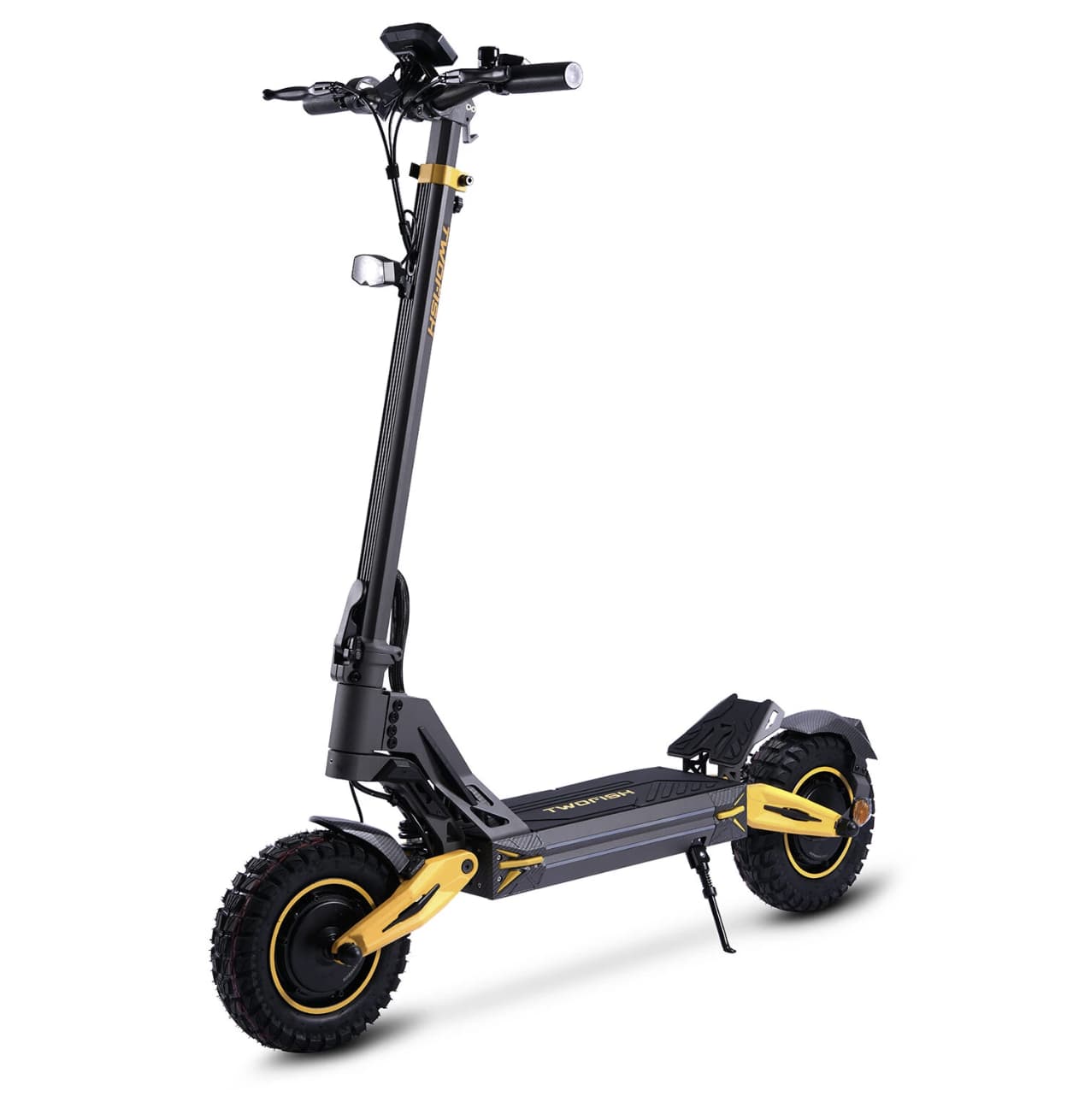
Here is what stands out—and what prospective buyers should understand before focusing on the headline 72km/h and 60km figures.
The 60V 23Ah Battery Is the Key to the TW4 PRO’s Size
The battery is one of the most important specifications on this scooter.
The TW4 PRO uses a 60V 23Ah battery. That works out to approximately:
60V × 23Ah = 1,380Wh
In simple terms, the scooter has around 1.38kWh of nominal battery energy.
That’s a substantial amount for an folding electric scooter, but it should not be interpreted as 1,380Wh of guaranteed usable energy under every riding condition.
Speed, rider weight, acceleration, terrain, temperature, tire pressure, and motor configuration all influence consumption.
This is why the advertised 60km range should be treated as a maximum claim rather than a promise of 60km in every ride.
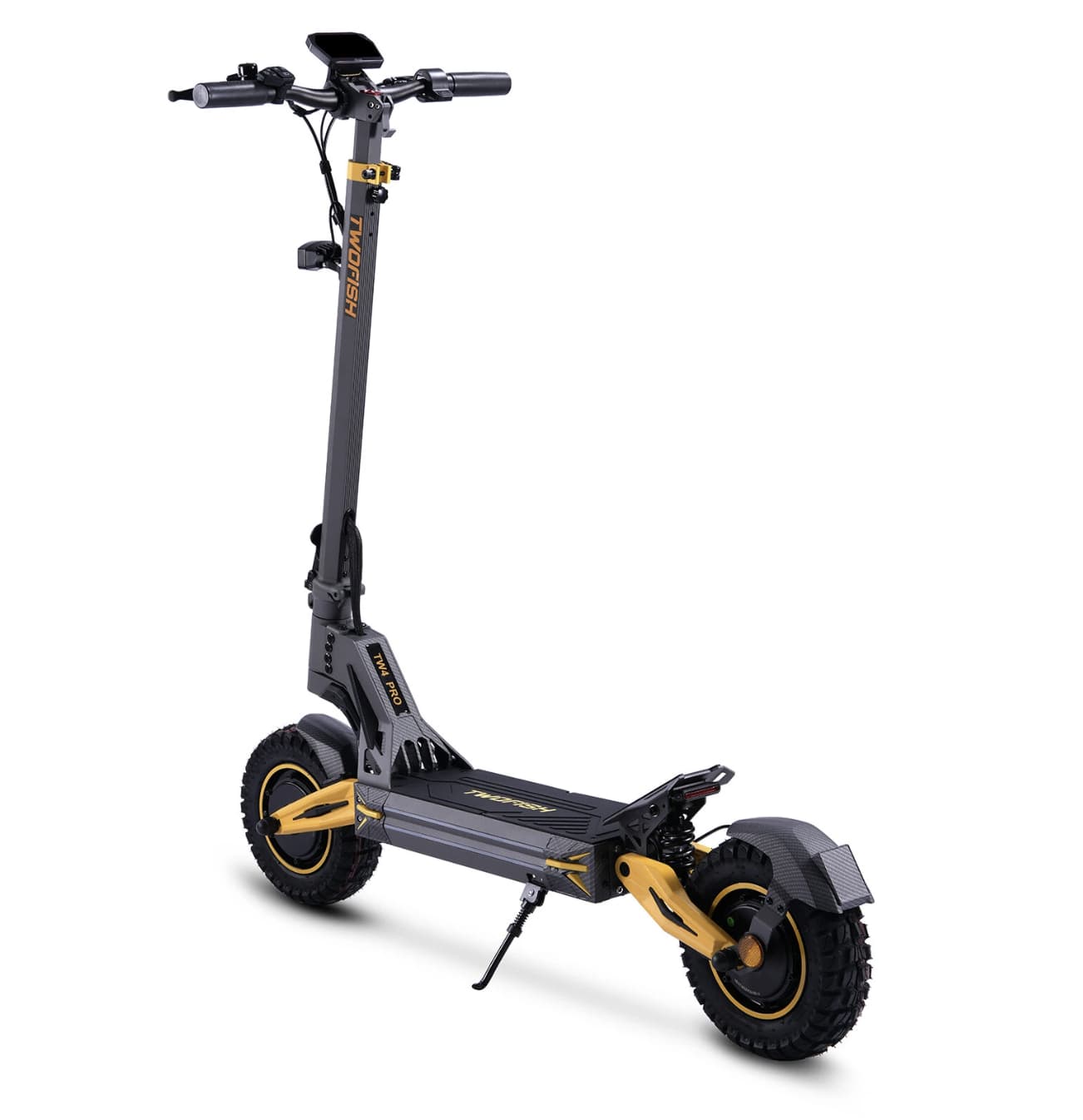
The Most Important Range Detail: Single Motor vs Dual Motor
This is where the TW4 PRO becomes more interesting than its basic specification table suggests.
Current product information indicates that the scooter can operate in single-motor and dual-motor modes. One current listing states that single-motor operation can reach up to 60km, while dual-motor operation is approximately 40km.
That makes sense from an energy-consumption perspective.
Single-motor mode
Using one motor can reduce power consumption and is potentially better suited to:
- flatter roads
- ordinary commuting
- longer rides
- situations where maximum acceleration isn’t necessary
Dual-motor mode
Activating both motors makes more sense when the priority is:
- stronger acceleration
- hill climbing
- additional traction
- higher-performance riding
The trade-off is increased energy consumption.
So the 60km and 40km figures should not be viewed as contradictory. They illustrate why riding mode matters when discussing electric-scooter range.
What Does 72km/h Actually Mean?
TWOFISH lists a maximum speed of 72km/h for the TW4 PRO.
However, a maximum specification is not the same thing as a normal recommended riding speed.
Other listings for the same scooter show multiple speed configurations, including lower settings.
That means buyers should not assume that every version is configured to operate at 72km/h.
More importantly, actual achievable speed depends on:
- rider weight
- battery charge
- terrain
- wind
- temperature
- riding mode
- road surface
- regional configuration
Local regulations are equally important. A scooter capable of 72km/h may be subject to substantially lower legal speed limits—or may not be legal to use on public roads in some jurisdictions.
Therefore, 72km/h should be treated as a performance specification, not a recommended everyday commuting speed.
Why Two 1000W Motors Matter
The TW4 PRO uses two 1000W motors, one at each end of the scooter. TWOFISH lists 2,000W of combined rated motor power and a peak power figure of 3,280W.
The advantage isn’t simply a bigger number.
Dual motors can provide power to both wheels, which can improve traction and acceleration compared with a single-motor setup.
That becomes particularly useful when the scooter encounters:
- steep inclines
- loose surfaces
- frequent stops
- heavier loads
- uneven terrain
The downside is equally important: using two motors generally consumes more energy.
This explains why the scooter’s range can be significantly different between single- and dual-motor operation.
11-Inch Tires Change the Character of the Scooter
The TW4 PRO uses 11-inch vacuum tires.
Large tires aren’t just a visual upgrade.
Compared with smaller commuter-scooter wheels, larger tires can help the scooter roll over cracks, rough pavement, and small surface imperfections with less abrupt impact.
The TW4 PRO also uses front and rear suspension, giving the chassis another mechanism for dealing with uneven surfaces.
That combination makes sense for a scooter designed around longer rides and higher performance.
However, suspension and large tires don’t eliminate the need for careful riding. Tire pressure, tire condition, road surface, and braking technique still have a major effect on stability.
The 37kg Weight Is Both a Strength and a Weakness
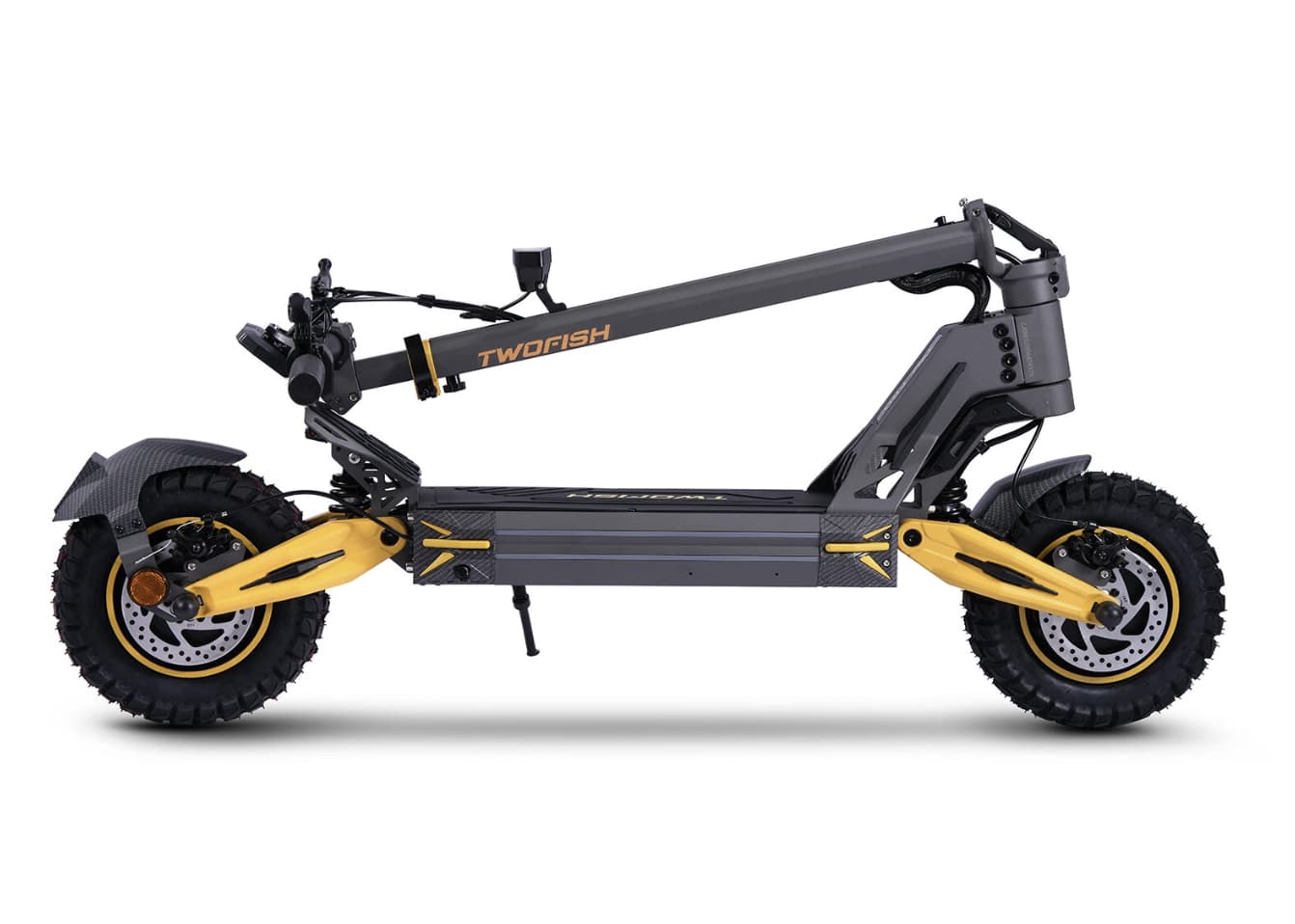
The TW4 PRO weighs approximately 37kg.
That’s important because the word folding can create the wrong impression.
Yes, the scooter folds.
But 37kg is still substantial.
The folding mechanism is therefore more useful for:
- storage
- fitting the scooter into a vehicle
- reducing its footprint
than for carrying the scooter through a train station or up several flights of stairs.
This is one of the biggest differences between a performance scooter and a lightweight urban commuter.
The TW4 PRO prioritizes power, battery capacity and stability over portability.
60km Range Doesn’t Mean 60km of High-Speed Riding
This deserves its own explanation.
A rider might look at:
60V + 23Ah + 60km range
and assume that 60km is available while riding at maximum speed.
That’s not a reasonable interpretation.
The energy required to move an electric scooter increases substantially as speed rises, while acceleration, hills, rider weight and wind can further increase consumption.
The product information itself gives us an important clue: one listing describes up to 60km in single-motor mode but around 40km in dual-motor mode.
So the more realistic way to understand the specification is:
60km is a best-case or optimized range figure, not a universal real-world range.
That’s a much more useful takeaway for a potential buyer.
Dual Disc Brakes Are Especially Important on This Scooter
The TW4 PRO uses front and rear disc brakes.
That hardware makes sense considering the scooter’s performance potential.
A scooter capable of substantially higher speeds requires more than just powerful motors. It also needs appropriate braking hardware and a chassis capable of handling the forces involved.
But brake hardware alone doesn’t determine stopping distance.
Stopping performance is influenced by:
- speed
- rider weight
- tire condition
- road surface
- wet or dry conditions
- brake adjustment
- reaction time
For that reason, the TW4 PRO’s braking system should be viewed as part of the overall performance package rather than a guarantee of short stopping distances.
IPX4 Does Not Mean Waterproof
The TW4 PRO is listed with an IPX4 rating.
IPX4 indicates protection against water splashes from different directions.
It does not mean the scooter is designed to be submerged or ridden through deep standing water.
This distinction matters for a high-capacity electric scooter because water exposure can affect electrical components, connectors, displays, and battery-related hardware.
A splash-resistant rating should therefore not be interpreted as permission to ride through heavy rain or flooded roads.
Is the TWOFISH TW4 PRO Actually Portable?
This is probably one of the most important questions that the specification sheet doesn’t answer directly.
It folds, but it isn’t lightweight.
At approximately 37kg, the TW4 PRO is better described as a foldable performance scooter than a portable commuter scooter.
That’s not necessarily a disadvantage.
For someone storing the scooter in a garage, the folding system can be useful.
For someone carrying it up stairs every day, the weight could become a serious inconvenience.
So buyers should distinguish:
foldable ≠ lightweight
That is an important practical difference.
Who Is the TWOFISH TW4 PRO Best Suited For?
The TW4 PRO makes the most sense for someone who prioritizes:
- battery capacity
- dual-motor performance
- larger tires
- suspension
- longer-distance riding
- higher performance
- a higher maximum load
- folding storage
It is less attractive for someone whose priorities are:
- low weight
- carrying the scooter frequently
- public-transport portability
- compact storage
- conservative commuter performance
The scooter’s 37kg weight is the clearest indication of where TWOFISH has placed its priorities.
TWOFISH TW4 PRO: The Specifications That Matter Most
If you ignore the marketing language, five specifications tell you most of what you need to know:
1. 60V 23Ah battery
Approximately 1,380Wh nominal energy.
2. Dual 1000W motors
Designed for stronger acceleration and traction.
3. 11-inch tires
Better suited to rougher surfaces than many small-wheel commuter scooters.
4. Front and rear suspension
Adds another layer of impact absorption.
5. 37kg weight
A clear reminder that this is a performance-focused scooter rather than an ultra-portable commuter.
Together, these specifications tell a more useful story than the headline 72km/h number alone.
Final Verdict
The TWOFISH TW4 PRO is best understood as a heavy, high-capacity folding electric scooter designed around performance rather than portability.
Its 60V 23Ah battery provides approximately 1,380Wh of nominal energy, while the dual 1000W motors provide the hardware for stronger acceleration and traction. TWOFISH lists up to 60km of range and 72km/h maximum speed, but current product information also indicates that range can fall to around 40km when dual-motor operation is used.
The 11-inch tires, front/rear suspension and dual disc brakes further reinforce the scooter’s performance-oriented design.
The biggest compromise is its 37kg weight.
So the TW4 PRO isn’t the obvious choice for someone who wants a scooter that can be carried everywhere. It makes considerably more sense for riders who want a large battery, dual 600W motors capability, bigger wheels and suspension, and who mainly need the folding mechanism for storage or vehicle transport.
Before purchasing, buyers should also verify the exact regional configuration and local regulations. A listed maximum speed of 72km/h does not mean that speed is legal or appropriate on public roads everywhere.