









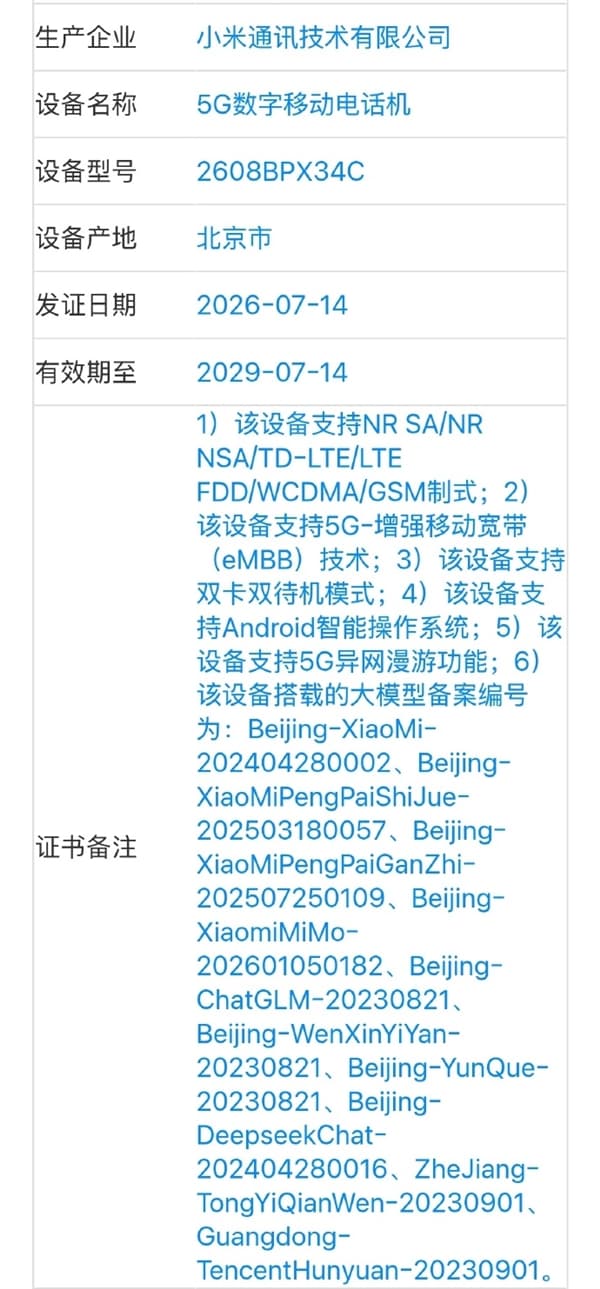
Xiaomi is reportedly preparing to unveil a new flagship device that could represent a major milestone in the company’s long-term technology strategy. According to information shared by well-known tipster Digital Chat Station, a Xiaomi smartphone bearing the model number 2608BPX34C has completed all required regulatory certifications and is now awaiting its official launch, which is expected as early as next month.
The upcoming device is widely believed to be the first Xiaomi smartphone to fully integrate the company’s self-developed processor, operating system, and AI large language models into a single product.

Certified With UWB, 5G, and AI Capabilities
Certification documents reportedly reveal several key hardware features, including:
- 67W wired fast charging
- UWB (Ultra-Wideband) support
- 5G compatibility, including the n79 frequency band
- Certification for Xiaomi’s proprietary AI large model platform
Although Xiaomi has yet to officially identify the device, the combination of these features suggests it will be positioned as a premium flagship.
Xiaomi’s Vision of a Fully Self-Developed Ecosystem
Earlier this year, Xiaomi founder and CEO Lei Jun stated that the company aims to achieve the convergence of three core technologies on a single device in 2026:
- Self-developed silicon
- Self-developed operating system
- Self-developed AI large models
The newly certified flagship is widely expected to become the first commercial product to realize that vision, highlighting Xiaomi’s growing emphasis on vertical integration across hardware and software.
Expected to Be the Next MIX Fold
Despite earlier speculation surrounding the Xiaomi 17S Pro, recent reports indicate that this new flagship will instead belong to Xiaomi’s MIX series.
Industry sources suggest it could debut as the next-generation MIX Fold, possibly under the name MIX Fold 5, featuring a redesigned large foldable form factor with a new wide-fold architecture.
While Xiaomi has not confirmed the product name, the device is expected to serve as the company’s next premium foldable flagship.
Powered by the New Xuanjie O3 Chip
The upcoming device is rumored to feature Xiaomi’s next-generation Xuanjie O3 flagship system-on-chip (SoC), succeeding the Xuanjie O1 while reportedly skipping an O2 generation.
According to previous leaks, the chipset is manufactured using TSMC’s 3nm process and features a high-performance CPU architecture that includes:
- One ultra-large core clocked at 4.05GHz
- Performance cores operating at 3.42GHz
- Efficiency cores running at 3.02GHz
The integrated GPU is reportedly clocked at 1.49GHz and paired with memory supporting bandwidths of up to 9,600MT/s, promising significant gains in graphics performance, AI processing, and overall system responsiveness.

HyperOS 4 Brings a Rebuilt Foundation
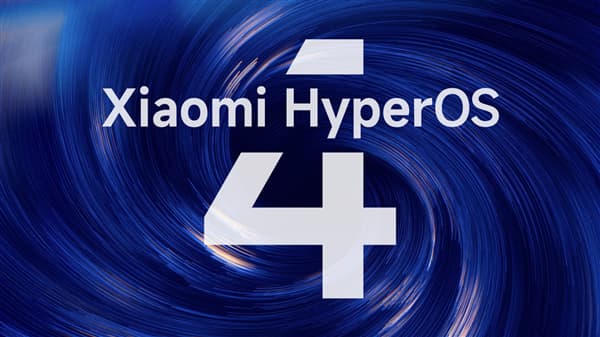
On the software side, the flagship is expected to debut with HyperOS 4, Xiaomi’s next-generation operating system.
According to previous reports, HyperOS 4 has undergone a comprehensive redesign at the system level. Xiaomi is said to have removed years of accumulated legacy code and rebuilt major portions of the underlying architecture, with the goal of delivering:
- Improved system responsiveness
- Better power efficiency
- Enhanced multitasking
- Deeper AI integration throughout the operating system
Broad AI Model Support
The certification information also references an extensive range of AI models that may be supported on the device, including:
- Xiaomi Large Model
- Xiaomi Leaps Vision Model
- Xiaomi Leaps Perception Model
- Xiaomi MiMo Model
- Zhipu AI
- ERNIE (Wenxin Yiyan)
- Doubao
- DeepSeek
- Tongyi Qianwen
- Hengyuan
The broad compatibility suggests Xiaomi is building a more open AI ecosystem capable of leveraging both proprietary and third-party large language models for different applications and user scenarios.
67W Charging Raises Questions
One specification that has surprised industry observers is the reported 67W wired fast charging support.
In recent years, Xiaomi’s premium flagship smartphones have commonly offered 90W, 100W, or even higher charging speeds. If the certification information proves accurate, the reduced charging wattage may reflect engineering trade-offs associated with the device’s foldable design, battery longevity, thermal management, or internal space constraints.
Outlook
Although Xiaomi has not officially confirmed the device, multiple leaks point to an ambitious flagship designed to showcase the company’s expanding technological independence. By combining an in-house Xuanjie processor, HyperOS 4, and Xiaomi’s growing portfolio of AI models, the upcoming smartphone could become the clearest demonstration yet of Xiaomi’s vertically integrated ecosystem.
More details—including the official product name, pricing, complete specifications, and launch date—are expected to be revealed when Xiaomi announces the device in the coming weeks.