









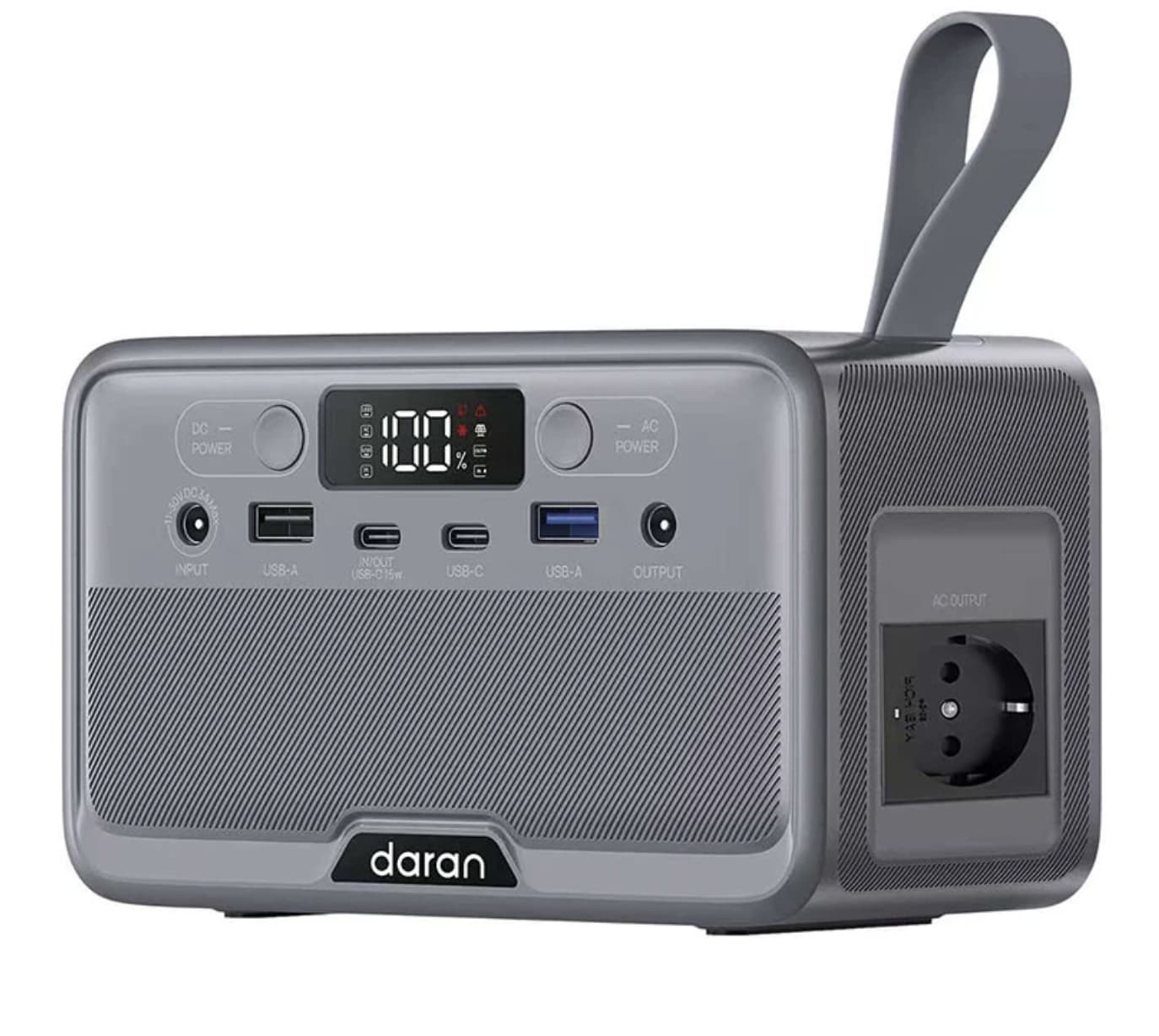
Small power stations are often marketed with big output numbers, but the headline wattage doesn’t tell the whole story. The YOUYO R100 is a good example.
It combines an 89.6Wh LiFePO4 battery with a 100W AC output, multiple USB ports, DC output, and solar charging in a body weighing roughly 1.1kg.
That specification puts the R100 in an interesting position. It isn’t designed to replace a large home backup battery, but it offers considerably more flexibility than a conventional power bank.
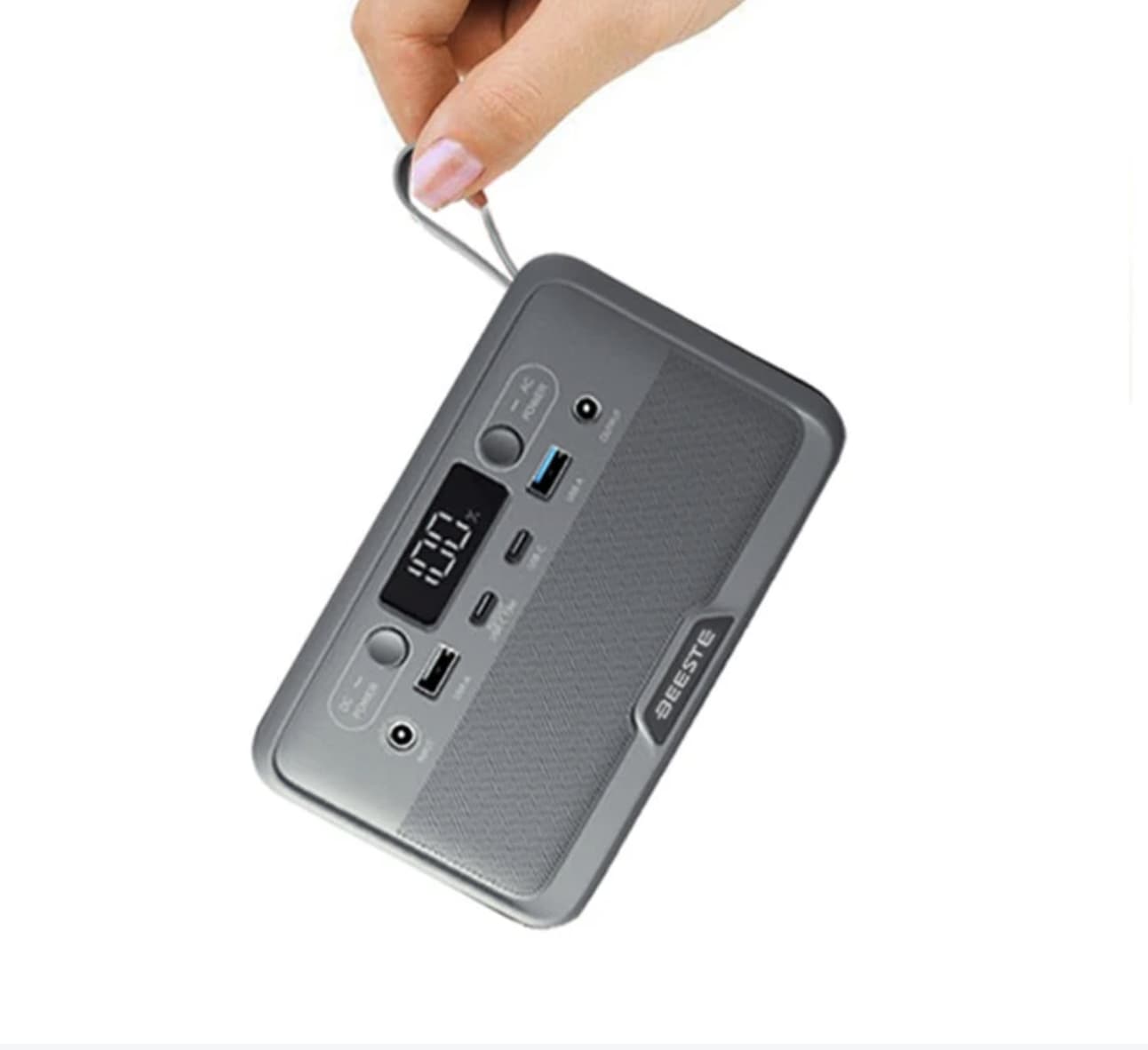
The more useful question, therefore, isn’t simply “How powerful is the YOUYO R100?”
It’s:
What can an 89.6Wh, 100W power station realistically do, and where are its limits?
YOUYO R100 at a Glance
The basic hardware is straightforward:
| Specification | YOUYO R100 |
|---|---|
| Battery | LiFePO4 |
| Capacity | 89.6Wh |
| AC Output | 100W |
| AC Surge | 200W |
| USB-C Output | Up to 45W |
| USB-A | Up to 18W / 15W |
| DC Output | Up to 60W |
| Solar Input | Up to 40W |
| Weight | About 1.15kg |
| Dimensions | 165 × 85 × 100mm |
The specifications are also documented in the R100 user manual, including the 100W AC output, 200W surge rating, 45W USB-C port, 60W DC output and 40W solar input.
89.6Wh Is the Number You Should Pay Attention To
The 100W figure tells you how much power the AC inverter can deliver.
The 89.6Wh figure tells you how much stored energy the battery contains.
Those are two different measurements.
A simple way to think about it is:
Watts = how much power a device needs
Watt-hours = how much stored energy the power station has
So a device drawing 50W will consume energy considerably faster than one drawing 10W.
The R100’s 89.6Wh capacity therefore makes more sense for phones, cameras, networking equipment, lighting, tablets and other relatively low-power electronics than for appliances designed to generate heat.
How Long Can the R100 Run a 100W Device?
This is where the 100W headline can be misleading.
If a connected device continuously consumed exactly 100W, the theoretical calculation would be:
89.6Wh ÷ 100W = 0.896 hours
That’s about 54 minutes under ideal conditions.
Real-world AC runtime would be shorter because the inverter and other electronics consume some energy.
So you shouldn’t expect the R100 to deliver 100W continuously for almost an hour in practical use.
This calculation is much more useful than simply saying “the R100 supports 100W.”
It shows exactly where the power station sits in the market.
What About a 50W Device?
At a theoretical 50W load:
89.6Wh ÷ 50W = 1.792 hours
That’s roughly 1 hour 48 minutes before accounting for conversion losses.
Again, actual runtime will vary.
But the example demonstrates why the R100 is better suited to small electronics and moderate loads than high-power appliances.
What Can You Actually Power?
The 100W AC output and USB/DC ports give the R100 several practical use cases.
Laptop
A laptop with a USB-C charging input may be a good match for the R100’s 45W USB-C PD output, provided the laptop supports that charging level.
For larger laptops requiring substantially more than 45W through USB-C, charging speed may be limited.
Wi-Fi Router
A router typically consumes much less power than the R100’s 100W AC limit.
That makes the R100 potentially useful during short power interruptions, although actual backup time depends on the router’s specific power requirement and whether an AC adapter or DC connection is being used.
Camera Equipment
Photographers and content creators can use a compact power station like this to recharge cameras, batteries, phones, and other accessories while away from a wall outlet.
The 1.1kg-class weight is particularly relevant here because portability matters more when the power station itself needs to be carried with camera equipment.
LED Lighting
Low-power LED lighting is another logical use case.
A small LED lamp consumes far less energy than a kettle, heater, or hair dryer, so the R100’s limited capacity is less of a problem.
Drone Batteries
The R100 can also be useful as a portable source for compatible drone charging equipment, although the actual charging time depends on the charger and drone battery.
What Should You NOT Plug Into It?
This is arguably more important than the list of compatible devices.
The R100 has a 100W continuous AC output, with 200W surge capability.
That makes it unsuitable for typical high-wattage appliances such as:
- electric kettles
- hair dryers
- heaters
- cooking appliances
- high-powered coffee machines
- larger refrigerators
- power tools that exceed the output rating
A device exceeding the rated output can trigger the R100’s protection system rather than simply running at reduced power. The user manual specifically identifies AC overload as a condition that can shut down the AC output.
So the R100 should be viewed as a small-electronics power station, not a miniature generator for household appliances.
Why LiFePO4 Matters Here
The R100 uses a LiFePO4 battery, rather than a conventional lithium-ion chemistry.
That’s significant for a product intended to be repeatedly charged and discharged.
LiFePO4 batteries are generally valued for their cycle life and thermal characteristics, although actual battery longevity depends on operating conditions, temperature, charging habits, and the battery-management system.
The R100 manual recommends avoiding frequent complete discharges and provides storage guidance for longer periods of inactivity.
For a portable backup device, that makes more sense than treating the battery as a disposable component.
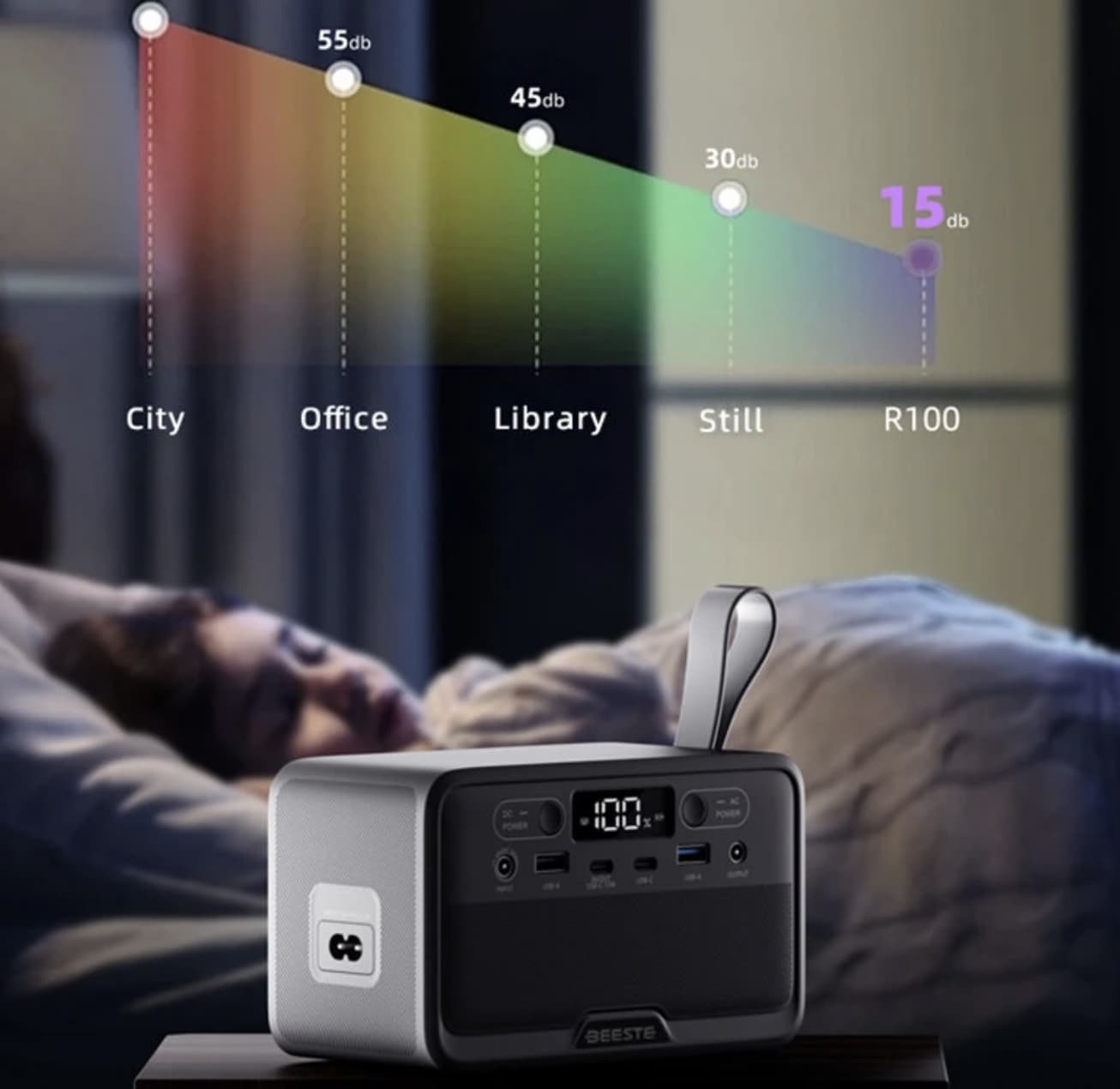
The 45W USB-C Port May Be More Important Than the AC Outlet
One of the most useful specifications is arguably the 45W USB-C output.
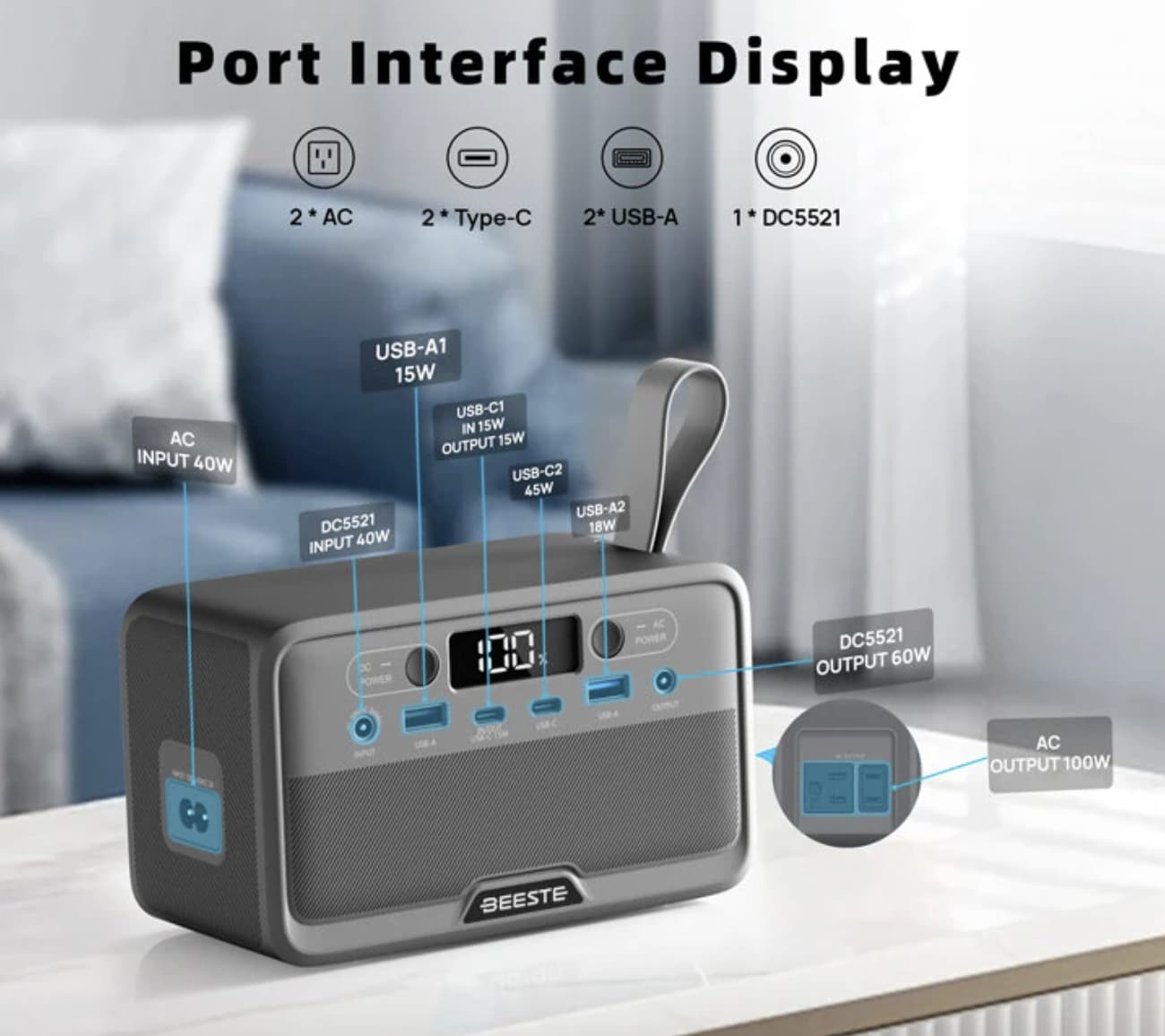
The R100 also has a second USB-C port rated at 15W, two USB-A outputs, and a 60W DC5521 output.
This means you don’t always need to use the AC inverter.
For compatible electronics, direct USB-C power can be more convenient and avoids the additional conversion involved in using an AC adapter.
For example, if a laptop accepts USB-C PD charging at 45W or below, connecting it directly to the R100 can be a cleaner setup than:
R100 → AC adapter → laptop
Instead:
R100 → USB-C → laptop
The exact charging speed still depends on the laptop and its charging requirements.
Seven Outputs Make the R100 More Versatile
The R100 provides multiple output options:
- 2 × USB-A
- 2 × USB-C
- 1 × DC5521
- 1 × AC output
- built-in LED lighting
The available output ratings are documented in the product manual.
This matters because the R100 isn’t limited to a single charging scenario.
You could use the USB ports for small electronics while reserving the AC outlet for a device that actually requires AC power.
However, connecting multiple devices doesn’t increase the battery capacity. The more equipment you power simultaneously, the faster the stored energy is consumed.
Solar Charging: Useful, But Keep Expectations Realistic
The R100 supports solar input of up to 40W.
That’s useful for camping and other situations where access to a wall outlet isn’t guaranteed.
But solar charging shouldn’t be viewed as an unlimited energy source.
Actual solar input depends on:
- panel output
- sunlight intensity
- panel angle
- weather
- temperature
- cable and conversion losses
The product documentation lists approximately 40W as the maximum solar input, not a guaranteed continuous charging rate.
For outdoor use, solar is therefore best regarded as an additional charging option, not a replacement for normal charging in every situation.
Portability Is Probably the R100’s Biggest Advantage
The R100’s physical dimensions are around 165 × 85 × 100mm, with a weight of roughly 1.1–1.15kg depending on the listed specification.
That’s considerably easier to carry than many larger portable power stations.
This changes the product’s use case.
You can realistically put it in:
- a backpack
- camera luggage
- a car
- camping equipment
- a work bag
The trade-off is straightforward:
smaller size means less stored energy.
The R100 isn’t trying to compete with 500Wh, 1,000Wh or larger power stations. Its advantage is that you can take it places where a much heavier unit would be inconvenient.
YOUYO R100 vs a Traditional Power Bank
At first glance, the R100 might look like an oversized power bank.
But the difference is the 100W AC output and broader selection of power interfaces.
A conventional power bank is primarily designed around USB devices.
The R100 can also provide AC power, DC output, USB-A and USB-C connections.
That makes it more flexible, but also larger and heavier.
So the decision is simple:
Choose a power bank for phones and small USB devices.
Choose the R100 when you need multiple power interfaces and occasional AC power in a portable package.
The R100’s Biggest Limitation
The biggest limitation isn’t the ports.
It isn’t the LiFePO4 battery.
It’s the 89.6Wh capacity.
That’s enough for small electronics, but it isn’t a large energy reserve.
If your goal is to keep a refrigerator, heater, microwave, kettle or other high-power appliance running during an outage, the R100 is simply the wrong class of product.
If your goal is to keep essential personal electronics operating while traveling, camping, or dealing with a short power interruption, the capacity makes much more sense.
Who Should Consider the YOUYO R100?
The R100 makes the most sense for people who prioritize portability over maximum energy storage.
It is particularly suited to:
- campers carrying lightweight equipment
- photographers and content creators
- remote workers
- travelers
- people preparing for short power interruptions
- users who need AC power for small electronics
It is less suitable for anyone looking for whole-home backup or a power source for high-wattage appliances.
Final Verdict
The YOUYO R100 isn’t trying to be a large home backup power station.
Its appeal comes from a much narrower—and arguably more practical—combination: an 89.6Wh LiFePO4 battery, 100W AC output, 45W USB-C charging, 60W DC output, solar input, and a roughly 1.1kg body.
The most important thing to understand is the relationship between capacity and output.
The 100W rating tells you what the R100 can power. The 89.6Wh battery tells you how long that stored energy can last.
For phones, cameras, routers, lights, tablets and compatible laptops, that combination makes sense.
For kettles, heaters and other high-power appliances, it doesn’t.
That is ultimately where YOUYO R100 power station makes the most sense: a compact personal backup power station for small electronics, rather than a replacement for a full-size home battery system.