







Installing a security camera normally means finding a suitable wall or ceiling position, running power to it, adjusting the viewing angle and then trying to make the finished installation look reasonably unobtrusive.
The Hopeway A6 Bulb Security Camera takes a different route.
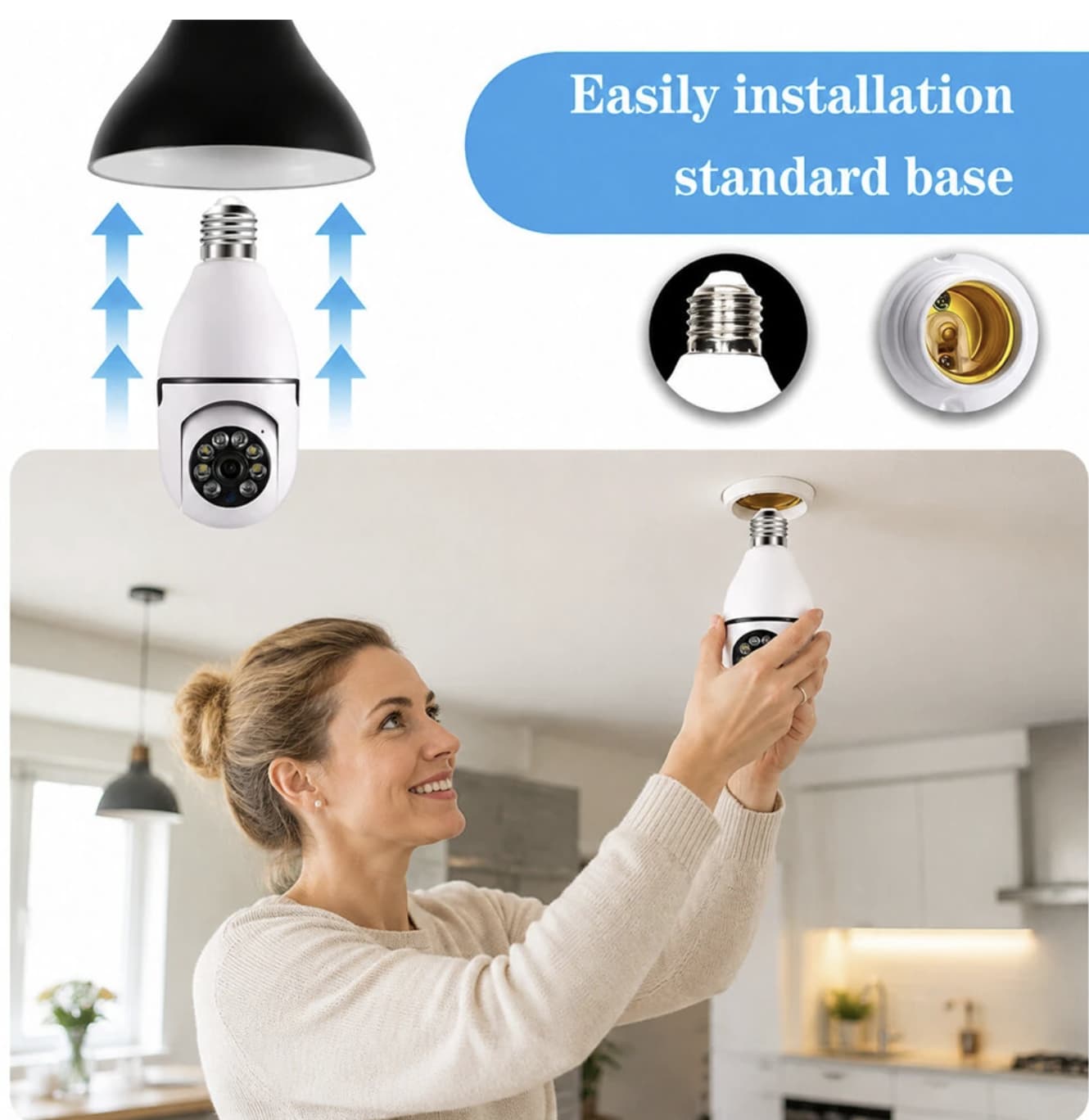
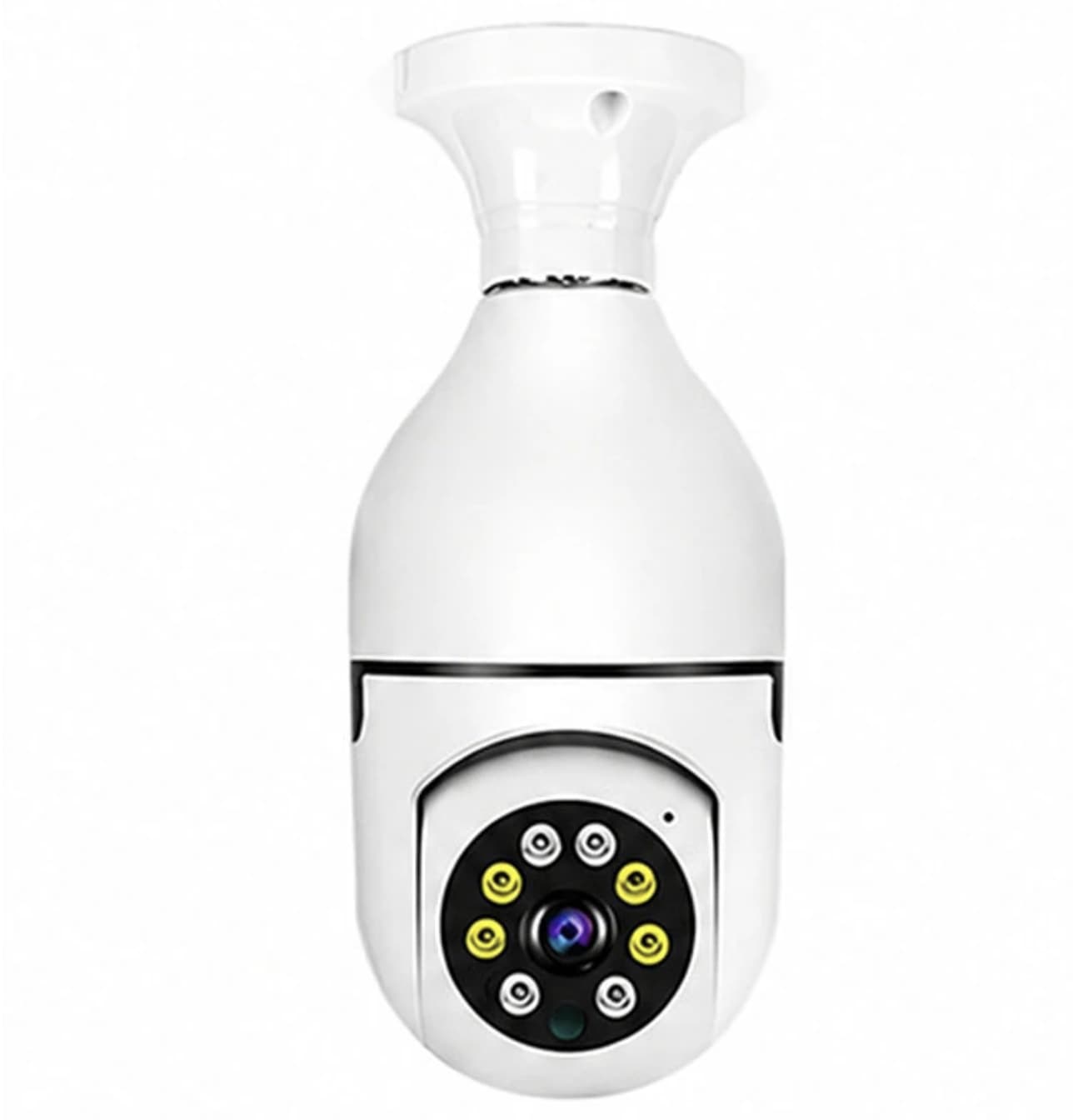
Instead of designing the camera around a conventional wall mount, it puts the surveillance hardware into a bulb-style body with an E27 socket connection. In other words, the same place that would normally hold a light bulb can become the camera’s mounting point.
That simple idea changes more than the installation process.
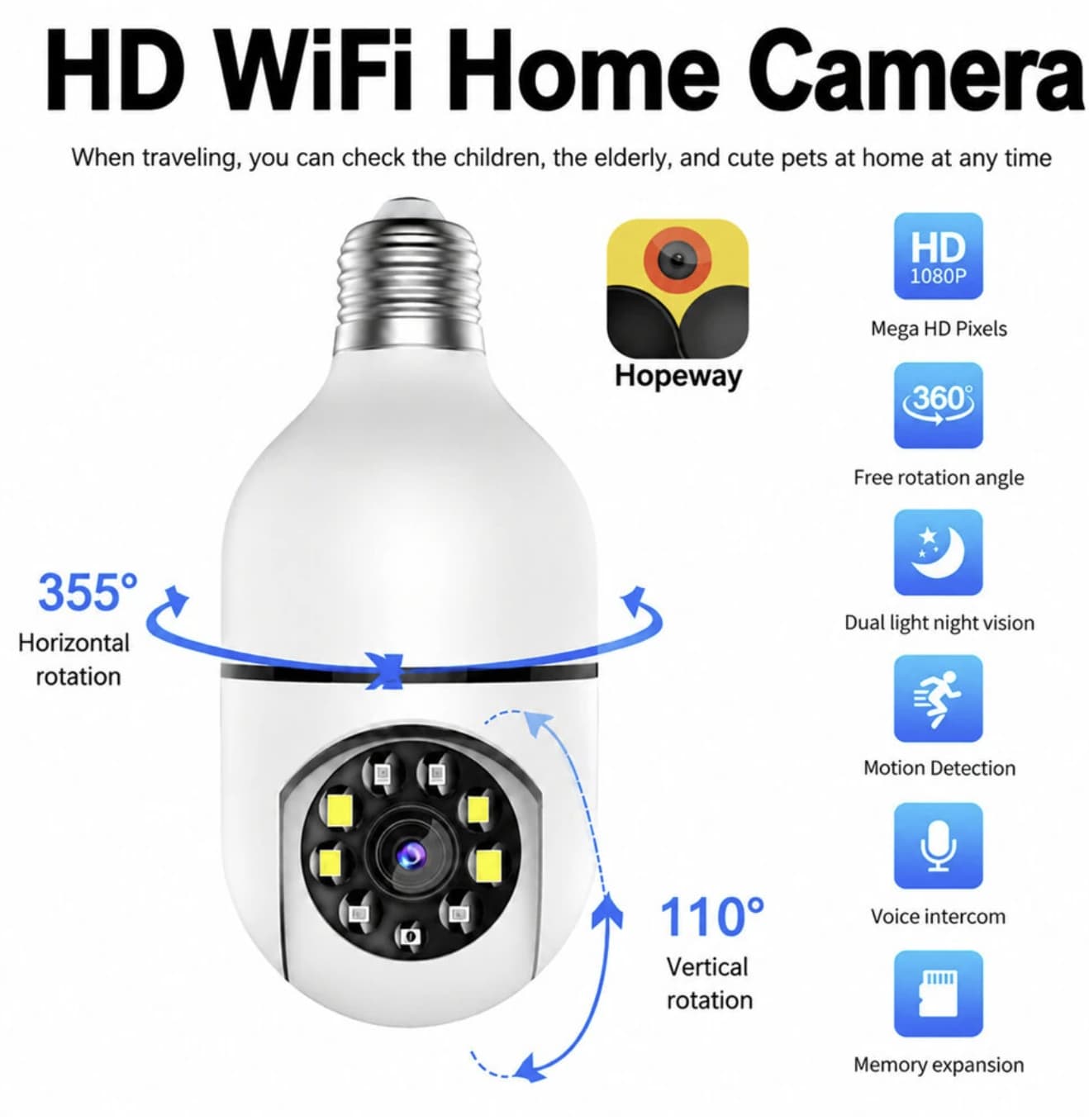
Because the camera can pan horizontally through 355 degrees and tilt vertically through 110 degrees, the A6 is designed to watch a broad area rather than stare permanently in one direction. It also combines 1080P video, 2.4GHz Wi-Fi, motion detection, automatic tracking, color-capable night vision and two-way audio.
The result is less like a miniature CCTV camera and more like a surveillance system disguised as an everyday electrical fixture. If you’re comparing different home-monitoring options, our guide to smart home security cameras explains what to consider beyond resolution.
But does putting a camera where a light bulb normally goes actually make home monitoring better?
The E27 Installation Is the Real Feature
The most interesting thing about the Hopeway A6 isn’t its 1080P resolution.
1080P Wi-Fi cameras are everywhere.
The unusual part is the mounting system.
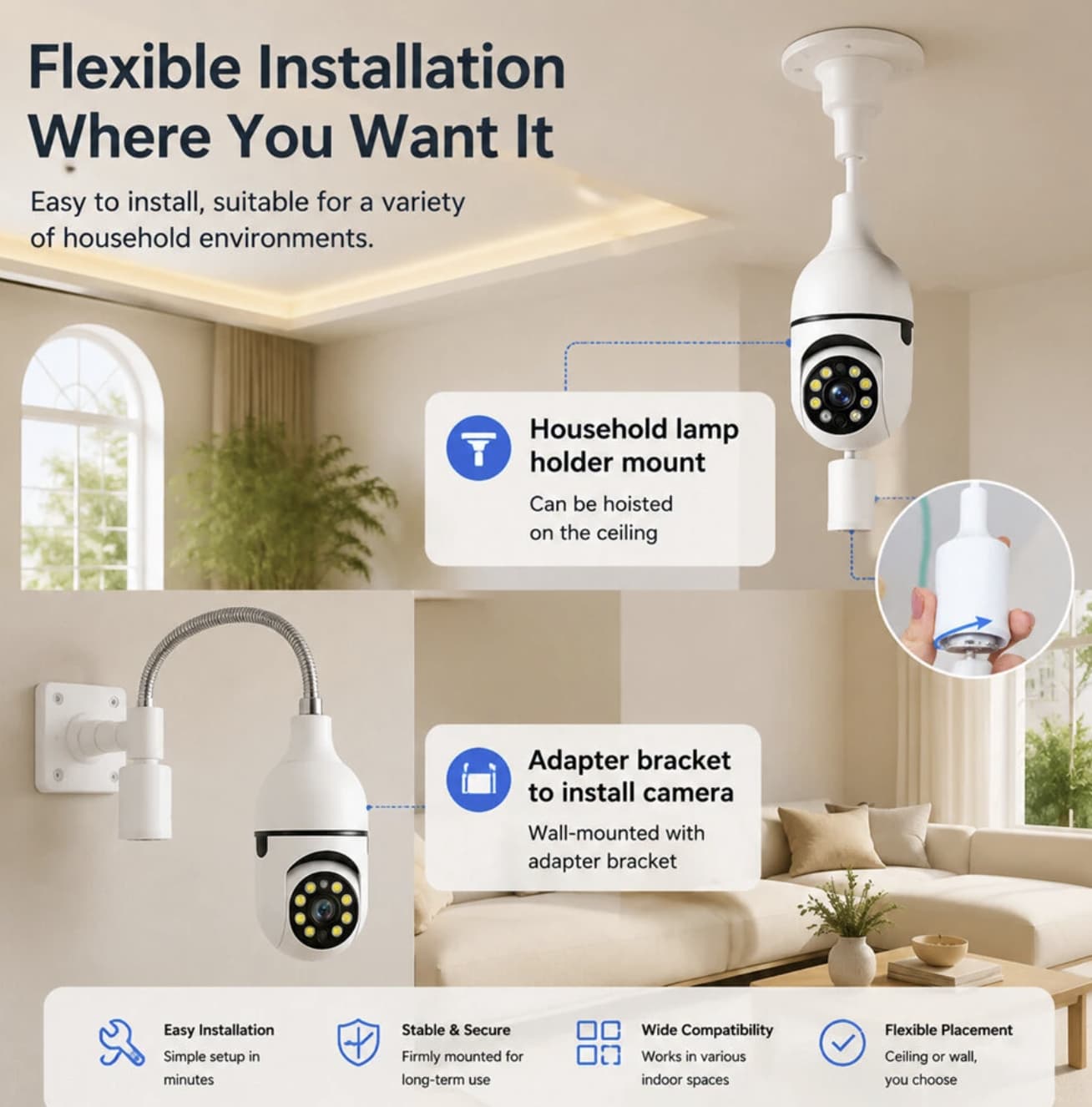
The A6 is designed to screw into a standard E27 socket, meaning the camera can use an existing bulb position for both physical placement and power. The package also includes a mounting bracket, allowing the device to be installed in other positions such as a wall or ceiling.
That gives the A6 an advantage in homes where adding another dedicated power cable would be inconvenient.
Imagine a room that already has a ceiling light positioned near the center.
A conventional camera might need a separate power adapter and cable routed across the ceiling or down a wall. With a bulb-style camera, the existing socket becomes the starting point.
It isn’t necessarily a better solution for every room.
But where the E27 socket is already positioned correctly, it can dramatically simplify installation.
Why Camera Position Matters More Than Resolution
A security camera’s usefulness depends heavily on what it can actually see.
A theoretically sharper camera mounted in the wrong location may be less useful than a lower-resolution camera positioned where it can observe the important areas.
This is where the A6’s PTZ camera system becomes relevant, especially when one camera needs to monitor several areas.
The camera offers 355 degrees of horizontal rotation and 110 degrees of vertical movement.
The horizontal range is particularly useful.
The camera can rotate almost completely around its mounting point, allowing the user to change the viewing direction remotely instead of physically repositioning the camera.
That makes a centrally positioned installation much more practical.
However, “360-degree viewing” should not be interpreted as literally recording every direction simultaneously.
The camera is moving its viewing angle.
It isn’t the same thing as a true panoramic camera that captures an entire 360-degree scene at once.
That’s an important distinction when evaluating the product.
1080P Is Enough for the Intended Job
The A6 uses Full HD 1080P video.
That isn’t a spectacular resolution by 2026 standards, but security cameras aren’t necessarily competing with smartphones.
For general indoor monitoring, 1080P can provide enough detail to recognize people, monitor movement and keep an eye on rooms, entrances or pets.
The more important question is what happens when the image is enlarged.
A 1080P image contains considerably less information than a 2K or 4K recording, so fine details at a distance will eventually become difficult to distinguish.
That means the A6 is better suited to monitoring a defined area at a reasonable distance than trying to identify tiny details across a large property.
This is also why its PTZ capability matters.
If the camera can be positioned closer to the area of interest, the available 1080P detail becomes more useful.
Motion Detection Is More Useful When It Leads Somewhere
Motion detection has become a standard feature on affordable security cameras.
The problem is that a motion notification by itself isn’t particularly intelligent.
If your phone constantly tells you that something moved every time a curtain shifts, a pet walks past or sunlight changes, the alerts quickly become noise.
The A6 combines motion detection with automatic tracking. When movement is detected, the camera can follow the moving object, and the system can also be configured to illuminate the area as a deterrent.
This creates a more useful chain:
movement → detection → camera response → notification
The automatic tracking element is particularly relevant because the camera doesn’t necessarily have to remain fixed on the point where motion was first detected.
A moving person can potentially remain within the camera’s field of view as the PTZ mechanism follows them.
Of course, tracking accuracy depends on the software and environment.
A person walking slowly across a relatively uncluttered room is an easier target than multiple people moving simultaneously in a busy scene.
So automatic tracking should be treated as a convenience feature rather than a guarantee that nothing will leave the frame.
Color Night Vision Is More Than Just a Marketing Term
The A6 uses a dual-source night vision system combining infrared LEDs with white LEDs, an approach that can be useful when monitoring rooms with changing light conditions. The product listing says the infrared lighting supports discreet monitoring while the white LEDs can illuminate the area for color night viewing.
This gives the camera two different approaches to darkness.
Infrared illumination is useful when you want to observe an area without flooding it with visible light.
White illumination takes the opposite approach.
It provides visible light, which can help preserve color information while also potentially acting as a deterrent.
That makes the lighting behavior an important part of the security system rather than simply an accessory to the camera.
There is, however, an obvious trade-off.
A white light can make an intruder more aware that they have been detected.
For some users, that’s exactly what they want.
For others, discreet infrared monitoring may be preferable.
The ability to use different lighting approaches gives the A6 more flexibility than a camera that relies exclusively on one night-vision method.
Two-Way Audio Gives the Camera a Second Job
The A6 includes a microphone and speaker for two-way communication through the smartphone application.
That turns the camera from a passive monitoring device into a communication point.
The obvious example is a delivery.
Instead of opening the door immediately, you can use the camera’s audio function to communicate with someone outside the monitored area.
The same feature can be useful for checking on family members, talking to someone in another room or communicating with a pet sitter.
There is also a security benefit.
If motion is detected and the person is within audible range, the ability to speak through the camera can provide an immediate response without requiring the owner to physically enter the room.
It isn’t a replacement for an alarm system.
But it adds another layer of interaction to the camera.
2.4GHz Wi-Fi Is Deliberate
The A6 uses 2.4GHz Wi-Fi.
Some buyers may see the lack of 5GHz support as a weakness.
For a security camera, however, 2.4GHz has one important advantage: range.
Lower-frequency Wi-Fi signals generally travel farther and penetrate walls more effectively than higher-frequency signals.
That makes 2.4GHz a sensible choice for a camera that may be installed away from the router.
The trade-off is congestion.
The 2.4GHz band is widely used by smart-home devices, routers and other wireless equipment. In a crowded environment, interference can affect connectivity.
So the best installation isn’t necessarily the one physically closest to the router.
It is the one with a stable wireless connection and a clear view of the area that matters.
The A6 Works Best When Installed High
A bulb-shaped camera naturally encourages ceiling installation.
That is actually useful.
A higher mounting position can provide a broader view and make it harder for someone to physically reach the camera.
The central ceiling position also complements the A6’s wide horizontal movement.
Instead of looking across a room from one corner, the camera can potentially observe from a more central position and rotate toward areas where activity occurs.
This is where the bulb concept makes practical sense.
The product isn’t merely using a novelty shape.
Its form factor encourages a mounting position that can be useful for surveillance.
But Don’t Confuse Wide Movement With Complete Coverage
The 355° pan and 110° tilt range are impressive, but no single moving camera can eliminate every blind spot.
Physical objects still matter.
Walls, furniture, cabinets and structural columns can block the lens.
The camera also needs time to move from one viewing direction to another.
If an important event occurs outside the current viewing position, automatic tracking needs to detect it and respond quickly enough to follow the subject.
For this reason, the A6 is best used as a wide-area monitoring camera, not as a guarantee that every square inch of a property will be continuously visible.
For larger homes or outdoor properties, multiple cameras may still make more sense.
Where the Bulb Camera Concept Works Best
The A6’s design makes particular sense in locations where an existing E27 socket is already in a useful position.
Examples include:
Living rooms:
A centrally mounted camera can observe a large portion of the room.
Garages:
The high mounting position can provide a useful view of vehicles, tools and entrances.
Entry areas:
PTZ movement can help monitor more than one approach.
Pet areas:
Two-way audio and remote viewing make it possible to check on animals while away.
Small shops or offices:
A single high-mounted unit can provide broad coverage without taking up shelf or wall space.
The product becomes less attractive when there is no suitable E27 socket or when the camera needs to be positioned outdoors in conditions beyond its specified use.
The listing describes the A6 as an indoor smart-home monitor, so buyers shouldn’t assume that its bulb-shaped construction makes it an outdoor weatherproof camera.
What the A6 Doesn’t Tell You
This is where potential buyers should slow down.
The headline specifications tell us a lot about the hardware, but not everything about the ownership experience.
The Banggood listing doesn’t establish how accurately automatic tracking performs in different lighting conditions, how quickly notifications arrive, how reliable the companion application is over long periods, or how well the camera handles multiple moving subjects.
Those are not small details.
For a security product, software reliability can matter as much as lens resolution.
A camera that produces excellent video but frequently disconnects isn’t particularly useful.
Likewise, an intelligent tracking system is only valuable if it consistently recognizes and follows the intended subject.
These are areas where independent hands-on testing would be necessary before making stronger claims.
Privacy Deserves Attention Too
A connected security camera is fundamentally different from a normal electronic accessory.
It can observe private spaces and transmit information over a network.
That means buyers should pay attention to the camera’s application, account security, storage method and access controls rather than focusing exclusively on image quality.
The Hopeway platform says it supports local SD-card storage as well as optional cloud storage, and its documentation describes remote viewing, recording and PTZ controls through the application.
Before installing any internet-connected camera, it is sensible to use a strong unique account password, keep the camera and application updated, and understand where recordings are stored.
A cheap security camera isn’t a bargain if its privacy configuration is ignored.
Is 1080P Enough for a Smart-Home Camera?
For the A6’s intended role, probably.
The camera isn’t trying to replace a high-end surveillance system with multiple high-resolution sensors.
Its value comes from combining several practical functions:
- 1080P live video
- Nearly full horizontal rotation
- 110° vertical movement
- Motion detection
- Automatic tracking
- Dual-source night vision
- Two-way audio
- 2.4GHz wireless connectivity
- E27 installation
None of those features is revolutionary individually.
Together, they create a fairly complete monitoring package in a surprisingly compact form factor.
That is the more interesting story behind the A6.
The Real Advantage Is Installation Flexibility
Traditional security cameras often force the buyer to think about the camera first and the mounting location second.
The A6 reverses that relationship.
If you already have an E27 socket in the right place, the installation problem becomes much easier.
That can be particularly attractive for renters or homeowners who don’t want to drill several holes, run dedicated power cables or install a large camera bracket.
The included mounting hardware also provides another option when the bulb socket isn’t the best location.
In that sense, the A6 isn’t competing only on camera specifications.
It’s competing on how little effort it takes to put surveillance somewhere useful.
Who Should Consider the Hopeway A6?
The A6 is a good fit for users who prioritize simple installation and broad indoor coverage.
It makes the most sense for:
- Smart-home users with convenient E27 sockets
- People who want remotely controlled PTZ monitoring
- Pet owners who want remote viewing and two-way audio
- Users who want motion tracking without installing a large camera
- Small indoor spaces requiring broad coverage
- Buyers looking for a multifunctional home-monitoring camera
It is less suitable for buyers who need:
- 4K-level image detail
- Guaranteed continuous panoramic coverage
- Professional multi-camera surveillance
- Clearly documented outdoor weather protection
- Advanced enterprise security features
Those users should look at more specialized surveillance hardware.
Final Verdict
The Hopeway A6 isn’t particularly interesting because it is a 1080P camera.
It’s interesting because of where it puts the camera.
By combining surveillance hardware with an E27 bulb-style installation, it turns an existing light socket into a potential monitoring position. From there, the 355° horizontal and 110° vertical movement allow the camera to cover a broad area, while motion detection, automatic tracking, dual-source night vision and two-way audio add layers of functionality beyond basic live video.
The compromises are equally clear.
1080P is adequate rather than cutting-edge, 2.4GHz Wi-Fi prioritizes range over bandwidth, and PTZ movement should not be confused with simultaneous 360-degree recording.
But that’s not really the point.
The A6 is designed for people who want a camera that can disappear into the infrastructure of the room instead of becoming another piece of hardware mounted onto it.
If you have an E27 socket in a useful position and mainly need flexible indoor monitoring, that design could be more valuable than another jump in resolution.
The Hopeway A6’s cleverest feature isn’t the camera—it is the decision to make the camera fit where a light bulb normally goes.