










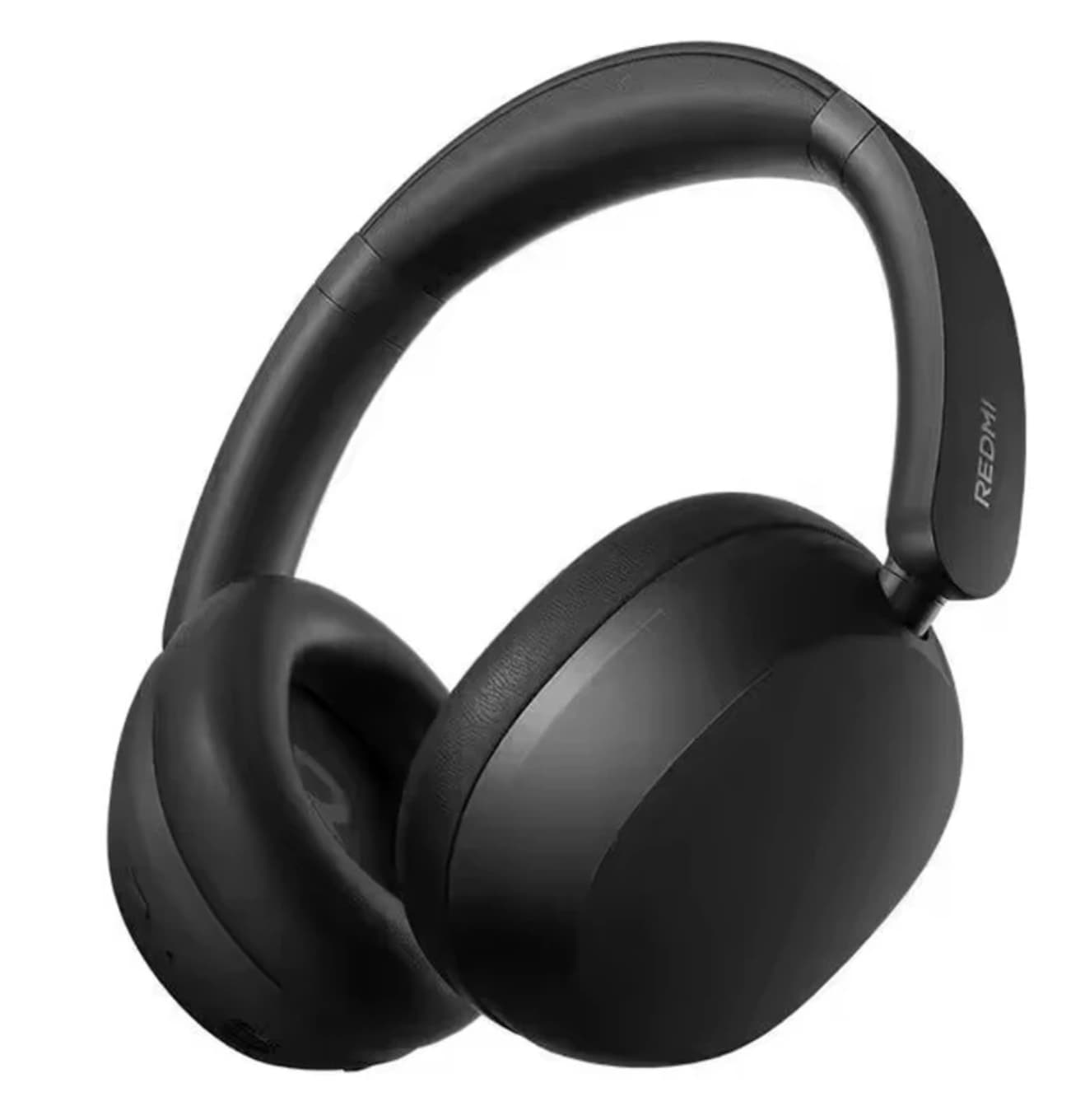
REDMI Headphones Neo headphone take a fairly straightforward approach to wireless over-ear headphones: instead of chasing a single headline feature, they combine active noise cancellation, large dynamic drivers, long battery life, AI-assisted call noise reduction, and Xiaomi ecosystem features in one everyday headset.
On paper, the numbers are competitive. The headphones offer up to 42dB of adaptive ANC, a 40mm dynamic driver, Bluetooth 5.4, and up to 72 hours of playback with ANC turned off. Xiaomi also lists three-microphone AI call noise reduction and support for HyperOS connectivity features.

But those specifications tell only part of the story.
The more interesting question is how the REDMI Headphones Neo’s features fit together. Is the 42dB ANC mainly useful for commuting? Does the 72-hour battery make a meaningful difference for travel? And does the 40mm driver suggest a particular type of listening experience?
This article breaks down those points without treating manufacturer specifications as independent performance measurements.
REDMI Headphones Neo at a Glance
| Feature | REDMI Headphones Neo |
|---|---|
| Design | Over-ear wireless headphones |
| Bluetooth | Bluetooth 5.4 |
| ANC | Up to 42dB adaptive ANC |
| ANC modes | Three levels / adaptive mode |
| Driver | 40mm dynamic driver |
| Microphones | Three-microphone AI call noise reduction |
| Battery | 600mAh |
| Playback | Up to 72 hours, ANC off |
| Playback with ANC | Up to 54 hours |
| Quick charge | 5 hours playback from 10 minutes* |
| Audio codecs | AAC / SBC |
| Frequency response | 20Hz–40kHz |
| Wireless range | Up to 10m listed |
| Weight | About 263g |
| HyperOS | Smart Connect support |
| Colors | Black, white and blue |
*Playback figures are manufacturer/listing claims and can vary depending on volume, connection, ANC usage, temperature, and other conditions.
The Real Focus: Everyday Noise Control
The REDMI Headphones Neo are built around ANC, but the implementation is more flexible than simply having noise cancellation switched on or off.
If you are comparing different noise-cancelling designs, our guide to ANC headphones explains how active noise cancellation differs from passive isolation and what to consider before choosing a pair.
Xiaomi says the headphones provide up to 42dB of adaptive active noise cancellation, with three noise-cancellation levels and an adaptive mode that adjusts according to the surrounding environment.
That matters because different environments produce very different types of background noise.
A train, airplane cabin, busy street, and office do not create the same acoustic conditions. A fixed ANC setting may work well in one environment but feel unnecessary in another. An adaptive approach is intended to make that adjustment automatically.

The 42dB figure should also be interpreted carefully. It is a manufacturer’s maximum noise-reduction specification, not a promise that every sound will be reduced by 42dB. ANC performance varies according to frequency, fit, environmental conditions, and the type of noise being encountered.
For everyday use, the more meaningful feature may therefore be the combination of adaptive ANC and multiple intensity levels, rather than the 42dB number alone.
Three ANC Levels Give the Headphones More Flexibility
Not every situation requires maximum noise cancellation.
For example, someone working in a relatively quiet room may want some environmental awareness while listening to music. A commuter, meanwhile, may prefer stronger noise reduction when dealing with continuous transportation noise.
The REDMI Headphones Neo support three ANC levels as well as an adaptive mode, according to Xiaomi.
That gives the headphones a broader range of use than a simple single-mode ANC system.
It is also worth remembering that ANC works best against certain types of continuous, low-frequency noise. Physical isolation from the earcups still plays an important role in reducing higher-frequency sounds.
In other words, good ANC is not simply about the largest number printed on the specification sheet.
A 40mm Driver Changes the Audio Design
The headphones use a 40mm dynamic driver, giving the REDMI Headphones Neo a relatively large transducer for an everyday wireless headset. Xiaomi describes the driver as being designed to deliver strong bass, while the Banggood listing specifies a titanium dynamic-driver configuration and a 20Hz–40kHz frequency response.

A larger driver does not automatically mean better sound.
What it can provide is greater flexibility in designing the acoustic system, particularly when the manufacturer is trying to balance bass response, vocal clarity, and overall soundstage.
For listeners who prefer music with stronger low-end impact, the 40mm configuration is an interesting part of the package. However, actual sound quality depends on much more than driver diameter, including tuning, enclosure design, DSP processing, fit, and source material.
That is why the 40mm specification should be viewed as part of the overall audio architecture rather than a guarantee of a particular sound signature.
What Does the Titanium Diaphragm Mean?
The Banggood listing identifies the driver as a 40mm titanium dynamic driver and promotes it as a Hi-Res Audio setup.
Titanium is used in driver diaphragms because its combination of stiffness and low mass can help a diaphragm respond quickly.
However, material alone does not determine how headphones sound.
A titanium diaphragm can be implemented in different ways, and the final result still depends on the acoustic chamber, tuning, electronics, equalization, and other components.
For that reason, it is more useful to see the titanium diaphragm as a technical design choice rather than assuming that it automatically produces a superior listening experience.
Bluetooth 5.4 Keeps the Wireless Side Current
The REDMI Headphones Neo use Bluetooth 5.4 and support AAC and SBC audio codecs. The Banggood listing specifies a listed transmission distance of about 10 meters.
For another look at a different wireless audio design, you can also read our Monster AC739 review, which explores an open-ear earclip approach rather than a traditional over-ear headset.
Bluetooth 5.4 is not necessarily a dramatic sound-quality upgrade by itself. The actual wireless experience depends on the connected device, codec, interference, software, and implementation.
The bigger advantage for most users is having a current Bluetooth platform paired with features such as multi-device connectivity and Xiaomi’s ecosystem integration.
For someone using the headphones primarily with a modern phone, tablet, or laptop, the wireless specification is therefore less about a headline improvement in sound and more about maintaining a stable everyday connection.
HyperOS Smart Connect Is More Important for Xiaomi Users
One of the REDMI Headphones Neo’s more ecosystem-specific features is HyperOS Smart Connect.
Xiaomi says the headphones can support functions such as pop-up pairing, device finding, audio transfer between devices, notification broadcasts, and dual-device connectivity within its ecosystem.
This is one area where the value of the headphones depends heavily on what other devices you own.
If you regularly move between a Xiaomi phone and tablet, features such as easier pairing and audio switching can reduce friction. If you use phones and computers from several different brands, those ecosystem-specific advantages may matter less.
That makes HyperOS integration less of a universal selling point and more of a feature aimed at Xiaomi users.
Three-Microphone AI Noise Reduction Targets Calls
The REDMI Headphones Neo also include a three-microphone system with AI-based call noise reduction.
Xiaomi says the microphones and AI processing are designed to separate the user’s voice from background noise, with wind-noise reduction specified for conditions up to 5m/s.
This is a useful distinction from ANC.
ANC is primarily designed to reduce noise that the listener hears. Call noise reduction is designed to make the user’s voice easier for the person on the other end of a call to hear.
The two systems solve different problems.
That makes the microphone system particularly relevant for people who use over-ear headphones for remote work, commuting calls, or voice communication rather than music alone.
As with ANC, however, manufacturer specifications should not be confused with independent microphone testing.
72 Hours of Battery Life Is the Other Big Feature
Battery endurance is arguably the REDMI Headphones Neo’s simplest advantage to understand.
The headphones use a 600mAh battery, and the listing specifies up to 72 hours of playback with ANC disabled and up to 54 hours with ANC enabled.
That is a significant difference between the two operating conditions.
It also illustrates why battery claims need context. A headline figure such as “72 hours” normally represents a specific test configuration. Turning on ANC, increasing volume, making calls, using different codecs, or changing other settings can reduce actual runtime.
For frequent travelers, however, even the lower advertised ANC-on figure means fewer charging sessions.
Quick Charging Helps When You Forget to Charge
The listing also claims approximately five hours of playback from a 10-minute charge.
This is more useful than it might initially sound.
Long battery life reduces the need to charge frequently, but it also creates a common problem: users may simply forget to charge because they rarely need to.
A quick-charge function provides a safety net. If the headphones are nearly empty before leaving home, a short charging session can provide enough listening time for part of a commute or workday.
Actual quick-charge results can vary, so the figure should again be treated as a rated specification rather than a guaranteed real-world result.
The Over-Ear Design Is Better Suited to Long Listening Than Pocket Portability
Unlike compact earbuds, the REDMI Headphones Neo use a full over-ear design.
The listed product weight is approximately 263g, while the dimensions are around 200 × 160 × 40mm.
That physical size gives the headphones room for a larger battery, 40mm drivers, multiple microphones, and active-noise-cancellation hardware.
The trade-off is obvious: they are less pocket-friendly than true wireless earbuds.
For home listening, office work, flights, and longer journeys, the larger format can make sense. For short trips where minimum size is the priority, earbuds remain more convenient.
Is the REDMI Headphones Neo Good for Travel?
The feature combination makes travel one of the more logical use cases.
There are three reasons:
First, ANC. Continuous transportation noise is one of the situations where active noise cancellation can be particularly useful.
Second, battery life. The advertised 54 hours with ANC enabled provides a large amount of claimed endurance between charges.
Third, over-ear construction. The larger earcup design provides passive isolation in addition to electronic noise cancellation.
The headphones are therefore designed around a very practical travel problem: staying connected and listening for long periods without constantly thinking about charging.
REDMI Headphones Neo for Work and Calls
The headphones are not limited to entertainment.
The three-microphone AI call-noise-reduction system gives them a clear productivity angle, particularly for people who regularly switch between music and voice calls. Xiaomi specifically promotes voice separation and wind-noise reduction as part of the call system.
The dual-device connectivity feature listed for HyperOS users can also be useful when moving between a phone and another device.
For example, someone could use the headphones with a computer during working hours and still keep a phone connection available.
The usefulness of this setup depends on the specific devices and software involved, so users should check compatibility rather than assuming every feature works identically across all platforms.
What the REDMI Headphones Neo Are Not
The specification sheet can make the headphones look like a solution for almost everything, but there are clear boundaries.
They are not an ultra-light pair of earbuds.
They are not a professional studio monitoring headset simply because the listing mentions Hi-Res Audio.
They are not guaranteed to eliminate every external sound just because the ANC rating reaches 42dB.
And the 72-hour battery figure should not be interpreted as 72 hours of maximum-performance use with every feature enabled.
Understanding those limitations makes the product easier to evaluate realistically.
Who Should Consider the REDMI Headphones Neo?
The REDMI Headphones Neo are particularly relevant to users who prioritize a combination of:
- Strong advertised ANC performance
- Long battery life
- Full-size over-ear comfort
- 40mm dynamic drivers
- Wireless Bluetooth 5.4 connectivity
- AI-assisted call noise reduction
- Multi-device features
- Xiaomi or REDMI ecosystem integration
They are especially interesting for commuters, travelers, remote workers, and Xiaomi users who want more ecosystem integration than a generic Bluetooth headset typically provides.
On the other hand, users who prioritize minimum weight, pocket portability, or highly specialized audiophile features may want to consider a different type of headphone.
REDMI Headphones Neo vs Typical Budget Bluetooth Headphones
The REDMI Headphones Neo’s differentiation comes from the combination of features rather than one isolated specification.
Many affordable wireless headphones offer Bluetooth and basic noise cancellation. The Neo adds a larger 40mm driver, adaptive ANC, three-microphone AI call processing, long claimed battery life, quick charging, and HyperOS ecosystem functions.
That creates a product aimed at people who want a single headset to cover several parts of daily life.
Music, commuting, video, calls, travel, and multi-device use all fit within the same basic design.
The important consideration is whether those features match your actual usage. More specifications do not automatically translate into a better experience if you never use them.
Final Thoughts
REDMI Headphones Neo are best understood as an all-round wireless over-ear headset built around three priorities: noise control, endurance, and everyday connectivity.
The headline specifications are certainly easy to remember: up to 42dB adaptive ANC, 40mm dynamic drivers, Bluetooth 5.4, three-microphone AI call noise reduction, and up to 72 hours of playback with ANC off. Xiaomi’s official product information confirms the major ANC, driver, battery, and call-focused features.
But the more interesting part is how those features work together.
The ANC targets commuting and noisy environments. The large battery reduces charging frequency. The over-ear design provides a platform for the larger drivers and isolation. The microphone system addresses calls, while HyperOS Smart Connect adds extra value for users already inside Xiaomi’s device ecosystem.
That makes the REDMI Headphones Neo less about chasing one spectacular specification and more about building a practical wireless headphone package for everyday listening, travel, work, and calls.
As always, the advertised battery life, ANC performance, wireless range, and audio characteristics should be treated as manufacturer or retailer specifications rather than independent laboratory results. Actual performance can vary depending on the connected device, environment, volume, fit, and usage conditions.