










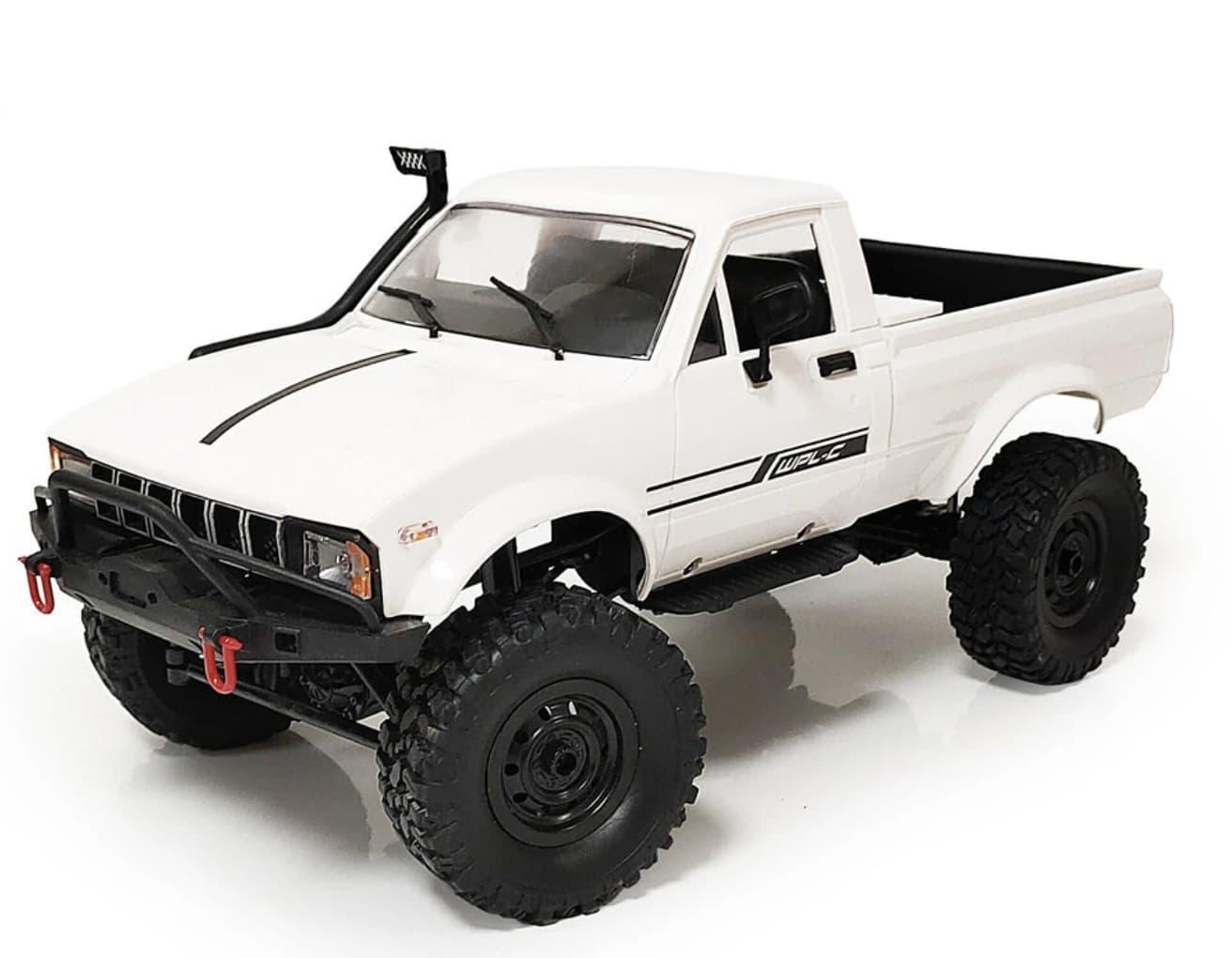
A 1/16 RC car is small enough to be easy to carry but can still deliver surprisingly strong performance. However, there is no single speed that applies to every 1/16-scale RC car. Depending on the motor, battery, gearing, tires, drivetrain, and intended use, a 1/16 model can range from a relatively modest speed to well over 30 km/h.
For many hobby-grade 1/16 RC cars, around 20–35 km/h (12–22 mph) is a reasonable general range. Some performance-focused models can go faster, while inexpensive toy-grade vehicles may be considerably slower.
The important point is that 1/16 describes the vehicle’s scale, not its speed.
What Does 1/16 Scale Mean?
The term 1/16 scale means that the RC vehicle is approximately one-sixteenth the size of the corresponding full-size vehicle in terms of its modeled dimensions.
For example, if a real vehicle is 4.8 meters long, a perfectly scaled 1/16 model would theoretically be around 30 centimeters long.
In practice, RC manufacturers do not always reproduce every dimension proportionally. Wheel size, suspension travel, battery space, motor placement, and other engineering requirements can affect the final dimensions.
Therefore, two RC cars labeled 1/16 can have noticeably different sizes, weights, and performance.
What Is the Typical Speed of a 1/16 RC Car?
There is a wide range, but the following provides a useful general reference:
| 1/16 RC Car Type | Approximate Speed |
|---|---|
| Basic toy-grade model | 8–15 km/h |
| Entry-level hobby model | 15–25 km/h |
| Faster hobby-grade model | 25–35 km/h |
| Performance-oriented model | 35 km/h or more |
These figures are only general ranges. The actual speed of a particular vehicle can be substantially different.
A 1/16 off-road truck with large tires and a powerful brushless motor may reach a higher top speed than a small indoor-oriented model. Conversely, a crawler may intentionally have a very low top speed because it is designed for torque and control rather than racing.
Can a 1/16 RC Car Reach 30 km/h?
Yes. 30 km/h is achievable for many performance-oriented 1/16 RC cars, although it depends heavily on the vehicle’s specifications.
A car with a brushless motor, suitable battery, efficient drivetrain, and appropriate gearing can potentially reach or exceed this speed.
However, a manufacturer’s advertised top speed should not automatically be treated as the speed you will achieve in normal driving. Factors such as battery condition, road surface, temperature, wind, tire condition, and vehicle setup can all affect the result.
For everyday use, acceleration and traction may also matter more than the highest number shown on the product page.
What About a 1/16 RC Car That Reaches 40 km/h?
Some 1/16 RC cars are marketed with speeds around 40 km/h or higher.
At this point, the vehicle is moving quickly relative to its physical size. A car traveling at 40 km/h covers about 11 meters every second, so even a short straight section can disappear surprisingly quickly.
A high-speed 1/16 model therefore needs more than a powerful motor. Good tires, suspension, steering response, drivetrain durability, and braking control become increasingly important.
A vehicle that can theoretically reach 40 km/h but struggles to remain stable at that speed may be less useful than a slightly slower model with better handling.
What Determines the Speed of a 1/16 RC Car?
Scale is only one part of the equation. Several components determine how fast an RC car can actually travel.
Motor Type
The motor is one of the most obvious factors.
Brushed motors are common in entry-level RC cars. They can provide adequate performance at a lower cost and are relatively simple to use.
Brushless motors are commonly found in higher-performance hobby vehicles. They can offer greater efficiency, stronger acceleration, and higher potential speeds when paired with an appropriate electronic speed controller and battery.
However, simply installing a more powerful motor does not guarantee a faster vehicle. The rest of the drivetrain must be capable of handling the additional power.
Battery Voltage
Battery voltage affects the amount of electrical power available to the motor.
For example, a setup designed around a higher-voltage battery can potentially produce greater motor speed than a lower-voltage configuration.
But battery voltage must match the motor, ESC, and manufacturer’s specifications. Using an incompatible battery can damage the electronics and create a safety risk.
Gear Ratio
Gearing determines how motor rotation is converted into wheel speed and torque.
A taller gear ratio can increase potential top speed but may reduce acceleration and place greater demands on the motor.
A shorter gearing setup generally favors acceleration and torque rather than maximum speed.
This is why two otherwise similar 1/16 RC cars can have noticeably different performance.
Tires
Tires have a major influence on real-world speed.
A tire that is too soft, too heavy, or poorly suited to the surface can reduce efficiency. Excessive tire expansion at high motor speeds can also affect stability and control.
For off-road vehicles, aggressive tread can improve traction on dirt or grass, while smoother tires may work better on pavement.
Weight
A lighter vehicle generally requires less energy to accelerate.
However, extremely low weight is not always an advantage. A very light 1/16 RC car can become unstable at high speed, especially on uneven ground or in windy conditions.
Manufacturers therefore have to balance weight, durability, battery capacity, and stability.
Drivetrain
A 4WD 1/16 RC car can often put power to the ground more effectively than a 2WD model, particularly on loose surfaces. If you’re interested in how four-wheel drive affects traction and handling, see our guide on what 4WD means on an RC car.
But 4WD does not automatically make an RC car faster. The drivetrain also adds mechanical components, weight, and potential friction.
The motor, gearing, tires, and surface still determine how effectively the available power becomes forward motion.
Does 4WD Make a 1/16 RC Car Faster?
Not necessarily.
Four-wheel drive primarily improves traction and power delivery rather than directly increasing the motor’s top speed.
On grass, gravel, dirt, or other low-grip surfaces, a 4WD model may accelerate more effectively because all four wheels contribute to moving the vehicle.
On a smooth surface, the advantage may be less obvious.
If maximum speed is your priority, look at the complete power system rather than choosing a vehicle simply because it has 4WD.
Brushless vs Brushed: Which Is Faster?
For high-speed applications, brushless systems generally have greater performance potential. For a closer look at real-world speed, specifications, and driving performance, check out our 1/16 RC car reviews.
A brushless 1/16 RC car can be designed to deliver strong acceleration and higher top speeds, particularly when paired with a suitable battery and ESC.
Brushed systems remain popular because they can be less expensive and are often sufficient for casual driving.
A useful way to think about it is:
Brushed = simpler and often more affordable
Brushless = higher performance potential
Neither system alone determines the final speed. The complete vehicle setup matters.
Does a Bigger Battery Make a 1/16 RC Car Faster?
Not automatically.
Battery capacity, usually measured in mAh, mainly affects how long the vehicle can run. Battery voltage has a more direct relationship with motor speed and available power.
For example, increasing battery capacity may extend runtime without significantly increasing top speed.
A higher-voltage battery can potentially increase performance, but only if the motor and electronics are designed to support it.
Always use the battery specifications recommended for the particular RC car.
How Fast Is a 1/16 RC Car in mph?
For readers who use miles per hour, here are some approximate conversions:
- 10 km/h ≈ 6.2 mph
- 20 km/h ≈ 12.4 mph
- 30 km/h ≈ 18.6 mph
- 35 km/h ≈ 21.7 mph
- 40 km/h ≈ 24.9 mph
- 50 km/h ≈ 31.1 mph
This helps put the advertised numbers into perspective.
A 30 km/h RC car may not sound extremely fast compared with a full-size automobile, but it feels much faster when experienced from the driver’s position of a small RC vehicle.
Where Can You Safely Drive a Fast 1/16 RC Car?
A high-speed RC car should be operated in an appropriate open area where you can maintain control and keep a safe distance from people, animals, traffic, and property.
Smooth pavement is useful for measuring top speed, while grass and dirt provide a more realistic test of off-road capability.
Avoid public roads and crowded areas. Local rules may also apply to where RC vehicles can be operated.
Before a high-speed run, check that the wheels, suspension, steering, battery, and body are securely attached.
Is a 1/16 RC Car Fast Enough for Racing?
That depends on the type of racing.
For casual backyard racing, a 20–30 km/h 1/16 RC car can already provide plenty of excitement.
Competitive racing is different. Lap times depend on acceleration, cornering, braking, traction, suspension setup, and driver control—not simply top speed.
A slightly slower car that maintains traction through corners can outperform a faster vehicle that constantly spins its tires or becomes difficult to control.
How Do You Measure the Real Speed of a 1/16 RC Car?
If you want to know how fast your RC car actually travels, use a GPS speed meter or another reliable speed-measuring device rather than relying solely on the manufacturer’s claim.
For a meaningful test:
- Fully charge the recommended battery.
- Choose a long, flat, open area.
- Make sure the tires and drivetrain are in good condition.
- Make several runs in both directions.
- Record the highest consistent speed rather than a single unusual result.
- Avoid testing around people, traffic, or obstacles.
Testing in both directions can also reduce the influence of wind.
Does a 1/16 RC Car Need to Be Fast?
Not every 1/16 RC car is designed for speed. If you’re comparing different types of RC vehicles before buying, browse our RC car reviews for detailed information on speed, motors, batteries, suspension, and drivetrain configurations
A crawler may have a low top speed but excellent torque and suspension articulation. A drift car may prioritize steering control and predictable slides. An off-road truck may balance speed with ground clearance and durability.
Before buying one, decide what type of driving you actually want:
For speed: look for brushless power, suitable gearing, good tires, and a capable ESC.
For off-road driving: prioritize 4WD, suspension travel, ground clearance, and durable components.
For crawling: focus on torque, low-speed control, suspension articulation, and tire grip.
For drifting: pay attention to drivetrain layout, steering angle, tires, and chassis setup.
Final Answer: How Fast Is a 1/16 RC Car?
There is no universal top speed for a 1/16 RC car. Many models fall somewhere around 20–35 km/h, while performance-focused versions can reach 40 km/h or more. Basic toy-grade models may be considerably slower.
The most important thing to remember is that 1/16 refers to scale, not performance. Two vehicles with the same scale can have completely different motors, batteries, gearing, tires, drivetrains, and intended uses.
If speed is your priority, compare the complete power system and look beyond the advertised top-speed figure. A well-balanced 1/16 RC car with good traction, stable handling, and reliable electronics can be much more enjoyable than a model that simply has the highest number on its specification sheet.