










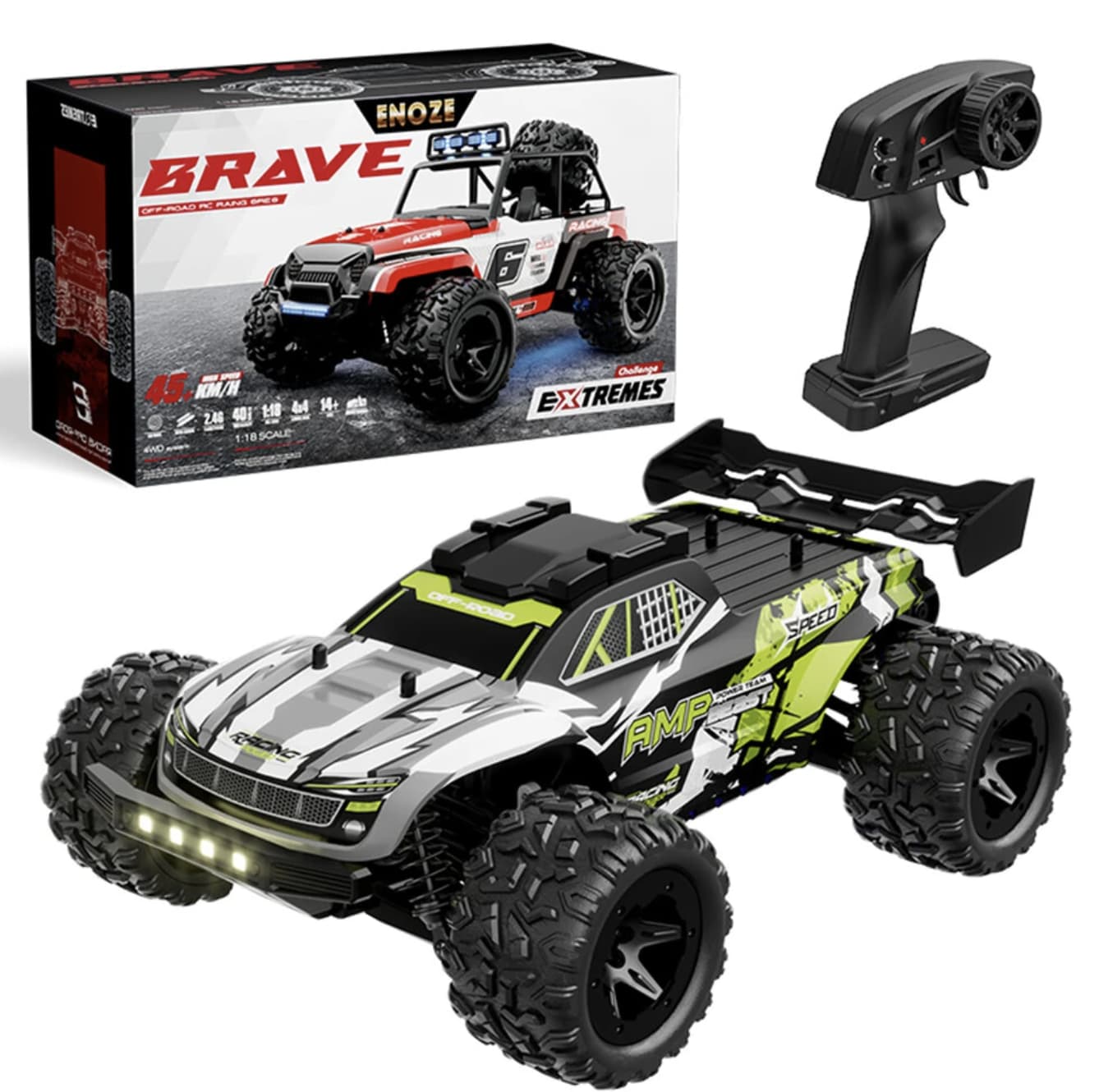
If you are shopping for an RC car, you have probably seen terms such as 2WD, 4WD, AWD, brushed, brushless, and proportional steering. Among them, 4WD is one of the most important specifications because it directly affects how an RC car puts power to the ground.
4WD means four-wheel drive. On an RC car, the drivetrain sends motor power to all four wheels instead of only the front or rear wheels. This can give the vehicle more traction when accelerating and help it maintain control on loose, uneven, or slippery surfaces.
However, 4WD does not automatically mean an RC car will be faster or better in every situation. The motor, tires, suspension, gearing, weight, and terrain all influence how the car performs.
How Does 4WD Work on an RC Car?
A typical 4WD RC car uses a drivetrain that transfers power from the motor to both the front and rear axles.
Depending on the design, the system may use components such as:
- A center driveshaft
- Front and rear differentials
- Gears
- Dogbones or universal driveshafts
- Differential housings
- Separate front and rear axles
When you squeeze the throttle, the motor produces rotational force. The drivetrain distributes that force to all four wheels, allowing the tires at both ends of the vehicle to contribute to acceleration.
This is especially useful when one axle has less available grip. If you want to see how four-wheel drive works in a real vehicle, take a look at our 4WD RC car reviews for examples of different off-road drivetrain designs. Instead of relying entirely on two driven wheels, a 4WD RC car has four contact points that can potentially transfer power to the ground.
4WD vs 2WD: What Is the Difference?
The simplest way to understand the difference is to look at how many wheels receive power.
| Feature | 2WD RC Car | 4WD RC Car |
|---|---|---|
| Powered wheels | Two | Four |
| Traction | Generally lower | Generally higher |
| Loose terrain | More likely to lose grip | Usually better suited |
| Drivetrain complexity | Simpler | More complex |
| Weight | Often lighter | Often heavier |
| Maintenance | Usually easier | More components to maintain |
| Energy losses | Generally lower | Can be higher |
| Driving style | Often more specialized | Generally more versatile |
A 2WD RC car can still be extremely capable. For a practical example of a compact RC vehicle with a different drivetrain approach, check out our 2WD RC car reviews and comparisons. For example, many lightweight racing and drift-oriented RC cars use 2WD because the simpler drivetrain can reduce weight and allow a particular handling style.
A 4WD model, by comparison, is often chosen when traction and predictable power delivery are important.
Does 4WD Make an RC Car Faster?
Not necessarily.
This is one of the most common misconceptions about four-wheel drive.
A 4WD system can help an RC car accelerate more effectively when the available traction is limited, but the drivetrain itself does not determine the vehicle’s top speed.
Top speed depends on several factors, including:
- Motor type and power
- Battery voltage
- Gear ratio
- Vehicle weight
- Tire diameter
- Aerodynamics
- Electronic speed controller
- Surface conditions
For example, a 4WD RC car with a modest motor may be slower on a straight road than a lightweight 2WD car with a more powerful setup.
Where 4WD can make a noticeable difference is putting power down. If the motor produces more torque than two tires can transfer to the surface without slipping, driving all four wheels can help reduce wheelspin.
Why Is 4WD Useful for Off-Road RC Cars?
Four-wheel drive is particularly useful for off-road driving because outdoor surfaces are rarely perfectly consistent.
An RC car may encounter:
- Grass
- Gravel
- Dirt
- Sand
- Mud
- Small rocks
- Uneven ground
- Loose soil
On these surfaces, traction can change from one wheel to another.
With 2WD, the driven wheels may spin when they encounter a low-grip section. A 4WD system gives the vehicle additional driven wheels, which can help it continue moving when the surface becomes difficult.
This is one reason 4WD RC trucks and off-road buggies are common among hobbyists who drive on mixed terrain.
Does 4WD Improve Handling?
It can, but the effect depends on the vehicle’s design.
Because all four wheels receive power, a 4WD RC car can often feel more planted when accelerating out of corners. The additional traction can also make it easier to control wheelspin on loose surfaces.
However, handling is not determined by drivetrain layout alone.
The following factors can be equally important:
Suspension:
Independent suspension can help each wheel maintain contact with uneven ground.
Tires:
The tread pattern and rubber compound determine how effectively the tires grip different surfaces.
Weight distribution:
Where the battery, motor, and electronics are positioned affects balance.
Differentials:
The front, rear, and center differentials influence how power is distributed when the wheels rotate at different speeds.
Steering geometry:
Caster, camber, toe, and steering response can all affect cornering behavior.
So, a well-designed 2WD RC car can handle better than a poorly designed 4WD model in a particular application.
What Are the Disadvantages of 4WD?
The extra traction comes with some trade-offs.
More Mechanical Components
A 4WD drivetrain requires additional gears, shafts, differentials, and moving parts. That means there are more components that can wear or require maintenance.
More Weight
A 4WD system generally adds mechanical hardware compared with a simple 2WD layout. Extra weight can affect acceleration, jumping behavior, battery consumption, and handling.
Higher Mechanical Resistance
More drivetrain components can introduce additional friction and mechanical losses. The exact effect varies considerably between designs.
More Maintenance
After driving on dirt, sand, or mud, a 4WD RC car may require more cleaning and drivetrain inspection. Small stones and debris can also find their way into exposed mechanical areas.
For casual backyard driving, these factors may not matter much. For competitive racing or users who prioritize simplicity, however, drivetrain complexity can become more significant.
Is 4WD Better for Beginners?
For many beginners, 4WD can make outdoor driving easier because the extra traction provides more forgiveness on uneven surfaces.
A 4WD RC car can be particularly useful if you plan to drive on grass, dirt, gravel, or other surfaces where traction varies.
That does not mean every beginner should buy a 4WD model. A lightweight 2WD RC car can be simpler, less expensive, and easier to maintain.
Think about where you will actually drive the car rather than choosing 4WD simply because it sounds more powerful.
If you are comparing models before buying, our RC car reviews cover differences in speed, suspension, battery capacity, drivetrain layout, and outdoor performance.
What Is the Difference Between 4WD and AWD?
The terms 4WD and AWD are sometimes used interchangeably in RC product listings, but they can describe different drivetrain concepts in the automotive world.
In many RC cars, manufacturers simply use 4WD to indicate that all four wheels are driven.
AWD, or all-wheel drive, is also used for systems that deliver power to all four wheels, particularly in on-road RC models.
The exact drivetrain design matters more than the label. If you are buying an RC car, check the manufacturer’s specifications to see how power is actually distributed.
Does 4WD Use More Battery Power?
It can.
Driving additional drivetrain components creates additional mechanical resistance, and a heavier 4WD vehicle may also require more energy to accelerate.
However, battery life cannot be predicted from the 4WD designation alone.
Runtime also depends on:
- Battery capacity
- Battery voltage
- Motor efficiency
- Driving speed
- Terrain
- Vehicle weight
- Tire size
- Driving style
A large-capacity battery paired with an efficient power system may provide longer runtime than a smaller battery in a lightweight 2WD vehicle.
Is 4WD Good for RC Drift Cars?
It depends on the type of drifting you want to do.
Many dedicated RC drift cars use 2WD because rear-wheel drive allows the driver to control the rear tires and maintain a drift with throttle and steering inputs.
Other RC platforms use 4WD and can be configured for different driving styles. Four driven wheels can provide additional traction, but the setup may feel different from a dedicated rear-wheel-drive drift car.
If drifting is your main goal, look beyond the 4WD label and check the car’s drivetrain layout, steering angle, tires, chassis design, and available setup adjustments.
What Should You Look for in a 4WD RC Car?
If you are considering a 4WD RC car, don’t stop at the drivetrain specification.
Motor
Brushless motors generally provide strong performance and are common in higher-performance hobby-grade RC vehicles. Brushed motors are simpler and can be suitable for entry-level models.
Suspension
For off-road use, look for a suspension system that can handle uneven surfaces and maintain tire contact with the ground.
Tires
Tire tread should match the terrain. Aggressive tread can be useful on dirt and grass, while smoother tires may be more appropriate for paved surfaces.
Differential System
The type and configuration of the differentials can have a significant effect on how the car behaves in corners and on uneven terrain.
Battery
Check both voltage and capacity. A higher-capacity battery can potentially provide longer runtime, but compatibility with the vehicle’s electronics is essential.
Spare Parts
This is often overlooked by new buyers. A 4WD RC car has more drivetrain components, so replacement gears, driveshafts, suspension arms, and other parts can be important for long-term ownership.
Is a 4WD RC Car Worth Choosing?
The answer depends on how you plan to use it.
If you mainly drive on grass, dirt, gravel, trails, or uneven outdoor surfaces, four-wheel drive can provide a useful traction advantage.
If you mainly drive on smooth indoor floors or paved surfaces, a 2WD model may already provide everything you need.
The key point is that 4WD is a drivetrain configuration, not a guarantee of speed or overall performance. A good RC car combines its drivetrain with appropriate tires, suspension, motor power, gearing, and weight distribution.
Final Takeaway
4WD on an RC car means that all four wheels receive power from the motor. Compared with 2WD, this can improve traction and power delivery, particularly on loose or uneven terrain.
The trade-off is additional mechanical complexity, weight, and maintenance. For off-road driving, those compromises can make sense, while drivers focused on drifting, lightweight racing, or simple maintenance may prefer a different drivetrain.
When comparing RC cars, treat 4WD as one part of the specification rather than the deciding factor. Looking at the motor, battery, suspension, tires, differential system, scale, and intended terrain will give you a much clearer idea of what the vehicle can actually do.