









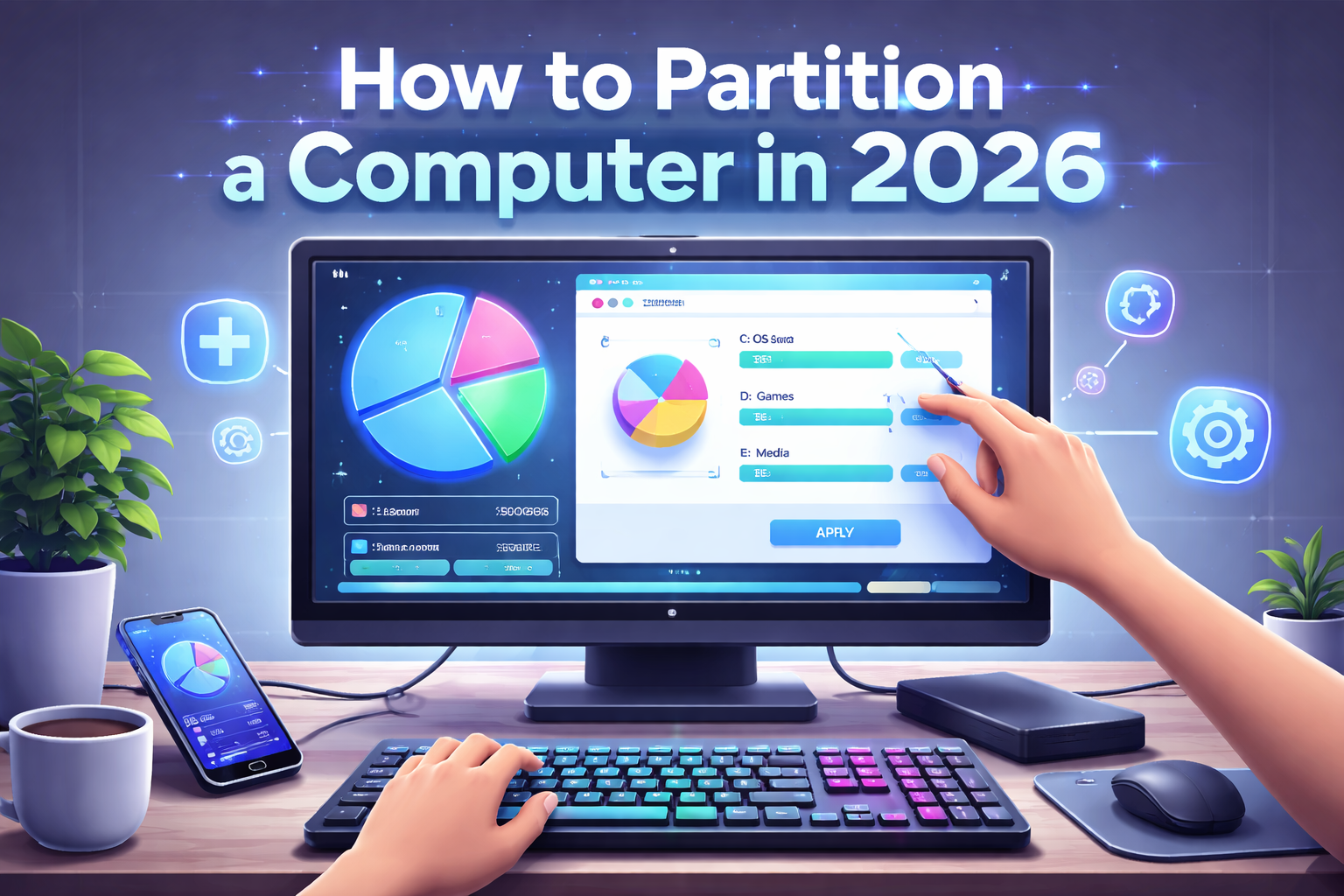
Partitioning a computer’s hard drive (or solid-state drive) is a critical task that allows you to organize your data more efficiently, optimize performance, and improve security. Whether you’re setting up a new machine, dual-booting operating systems, or simply tidying up your storage, partitioning can provide both organizational and performance benefits. In 2026, partitioning a computer is still an essential skill, and with the increasing use of SSDs (solid-state drives) and advanced operating systems, it’s important to understand how partitioning works on modern hardware.
This guide will take you through the process of partitioning a computer in 2026, explaining the steps, tools, and considerations for both Windows and macOS users, with a focus on the latest storage technologies and user needs.
What is Partitioning?
Partitioning refers to the process of dividing a computer’s storage device into distinct sections (or “partitions”) that are treated as separate units by the operating system. Each partition can function as an independent drive, allowing you to:
- Organize data: Keep your files, applications, and operating systems separate.
- Increase performance: Faster read/write speeds by using smaller partitions on SSDs.
- Improve security: Keep system files and personal data isolated, reducing the risk of data corruption or accidental deletion.
- Dual-boot operating systems: Install and run multiple operating systems on the same machine.
Why Partition a Computer in 2026?
- SSD Optimization: SSDs, which are now the standard storage option, benefit from partitioning because smaller partitions help manage the wear leveling and optimize read/write speeds.
- Separate System and Data: Many users prefer separating their operating system and user data into different partitions to improve backup strategies and ease of restoration.
- Dual-Boot Systems: Partitioning is necessary for users who want to install more than one operating system, such as running Windows and Linux side by side.
- Security and Privacy: With multiple partitions, sensitive data can be encrypted or stored on a partition that is isolated from the rest of the system.
- Data Management: It’s easier to organize large datasets, applications, or media on separate partitions, improving overall data management.
Things to Consider Before Partitioning
Before jumping into partitioning your storage, consider the following factors:
- File System: Different operating systems use different file systems (e.g., NTFS for Windows, APFS for macOS, ext4 for Linux). Make sure you choose the right file system for each partition depending on the operating system you plan to install or use.
- Data Backup: Partitioning will likely erase data on the storage drive. Always back up your important files before proceeding.
- Storage Size: Ensure that you allocate enough space for each partition to perform its function, whether it’s for your OS, programs, or personal files.
- Dynamic vs Basic Disks: On Windows, you can use Basic or Dynamic disks. Dynamic disks offer more flexibility but require a different approach to partitioning.
- System Compatibility: Be aware that older BIOS-based systems may require MBR (Master Boot Record) partitions, while newer systems using UEFI will need GPT (GUID Partition Table) partitions.
Step-by-Step Guide for Partitioning Your Computer in 2026
1. Partitioning in Windows 11/12 (2026)
Windows 11 and Windows 12 (expected to roll out around 2026) include an advanced partitioning tool called Disk Management. However, for more advanced options, you might use third-party tools or the Command Prompt. Here’s how to partition using Disk Management:
Step 1: Open Disk Management
- Right-click the Start menu and select Disk Management.
- In Disk Management, you’ll see a graphical representation of all storage drives and their partitions.
Step 2: Shrink an Existing Partition
- Right-click on the drive you wish to partition (e.g., the C: drive), and click Shrink Volume.
- Specify the size for the new partition. This is the space that will be allocated for the new partition.
- Click Shrink and wait for the process to finish. The unallocated space will now appear in Disk Management.
Step 3: Create a New Partition
- Right-click on the unallocated space and select New Simple Volume.
- The wizard will guide you through creating the new partition. Choose the file system (usually NTFS for Windows).
- Assign a drive letter and name your partition.
- Complete the wizard, and Windows will format the partition and make it ready for use.
Step 4: Verify the Partition
You can now check the newly created partition in File Explorer or in Disk Management.
Optional: Using Third-Party Tools
For more complex partitioning tasks (like resizing partitions or converting between GPT and MBR), consider using third-party tools like EaseUS Partition Master or MiniTool Partition Wizard. These tools provide more advanced features and are user-friendly.
2. Partitioning in macOS (2026)
For macOS users, partitioning is managed through Disk Utility, which has evolved with the latest versions of macOS to handle modern file systems like APFS.
Step 1: Open Disk Utility
- Go to Applications > Utilities > Disk Utility.
- Select the drive you want to partition (usually your Macintosh HD).
Step 2: Partition the Drive
- Click the Partition button at the top of the Disk Utility window.
- Choose the partition layout: you can add, delete, or resize partitions.
- Use the + button to add a new partition. Specify the size and name for the new partition.
- Choose the format for the partition (APFS is recommended for most modern macOS devices).
- Click Apply and wait for macOS to complete the partitioning process.
Step 3: Verify the Partition
Once the process is complete, the new partition will show up on your desktop or in Finder, ready for use.
3. Partitioning for Linux (2026)
For Linux systems, partitioning can be done via a live CD (e.g., using GParted) or during installation using a partitioning tool in the OS setup process.
Step 1: Use GParted (GUI Tool)
- Install GParted via your Linux distribution’s package manager or use it from a live CD.
- Launch GParted and select the storage device you wish to partition.
- Resize existing partitions if necessary, and create new partitions using the available unallocated space.
- Select your desired file system (e.g., ext4, NTFS, or Btrfs) and apply the changes.
Step 2: Partition During Installation
When installing Linux, most distributions allow you to partition the drive directly from the installation process. Select the custom partitioning option and define your partitions according to your needs (e.g., /root, /home, /swap).
Conclusion
Partitioning your computer in 2026 remains a crucial task for managing storage efficiently, improving performance, and organizing your data. Whether you’re using Windows, macOS, or Linux, the process has become more streamlined with modern tools and intuitive interfaces. However, it’s important to back up your data before partitioning, especially since the process can erase information on the drive.
By partitioning your storage correctly, you ensure that your system runs smoothly, and you optimize storage for different tasks. Whether you’re creating multiple operating system environments, securing sensitive data, or simply organizing files more efficiently, partitioning remains an essential skill in 2026 and beyond.