









Indiana has begun enforcing a new set of rules that could significantly affect the sale of imported vaping products in the state.
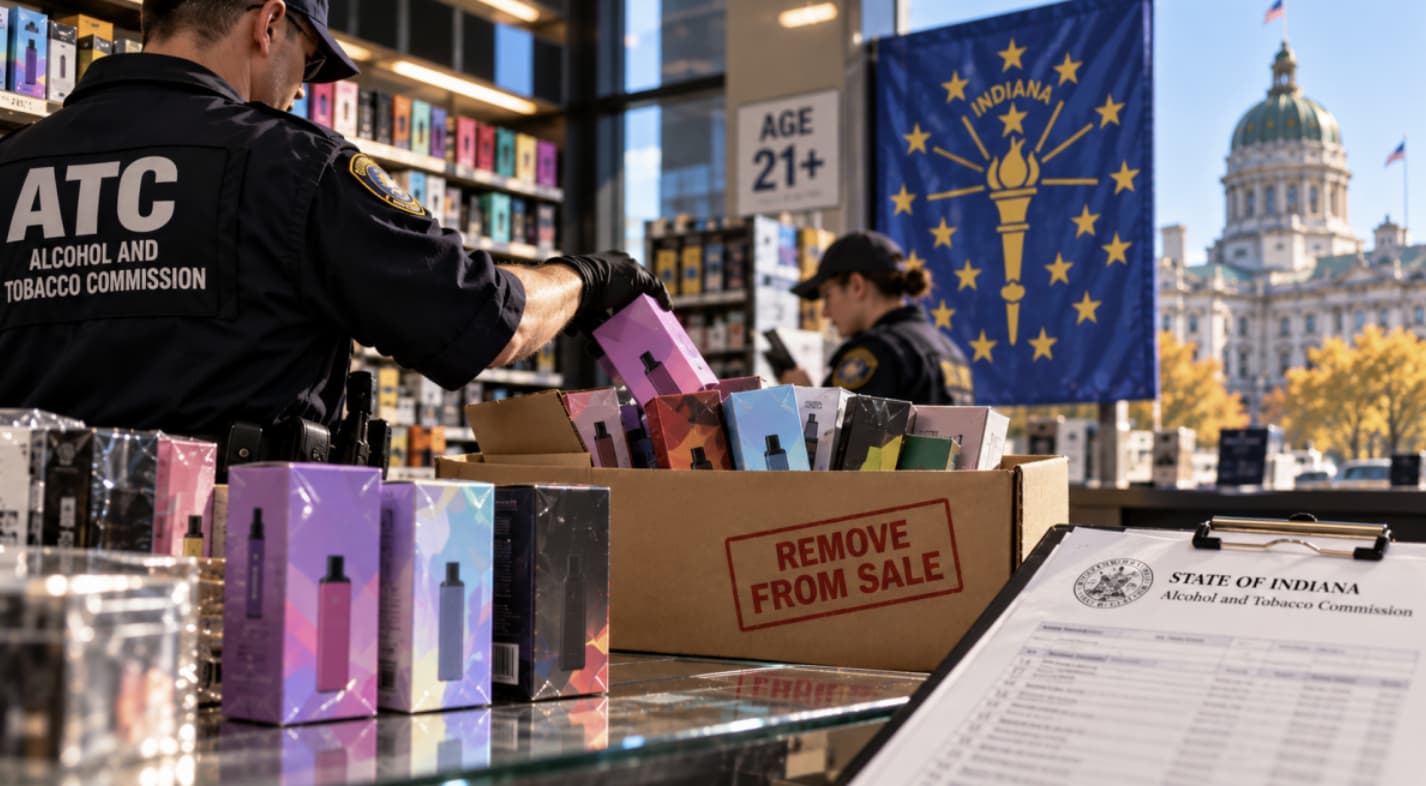
The Indiana Alcohol and Tobacco Commission (ATC) issued foreign-adversary product notices in September covering vaping products associated with brands including Elf Bar, Lost Mary, MR FOG, iJOY and LIO. Retailers and tobacco certificate holders were instructed to remove affected products from inventory and stop selling or distributing them.
However, the situation has since become more complicated. Indiana later revised its determinations for certain MR FOG and Lost Mary products, allowing hundreds of listed products to return to the legal sales list after the agency received or considered compliance information.
The developments show that Indiana’s new rules are not simply a blanket ban on particular vape brands. Instead, product eligibility can depend on factors such as manufacturing and ingredient sourcing, regulatory documentation and whether individual products meet the state’s requirements.
Indiana’s New Rules Put Imported Vape Products Under Scrutiny
The ATC’s September notices were issued under Indiana’s new foreign-adversary product requirements.
The first notice, issued September 9, targeted products manufactured by Shenzhen iJOY Technology Co., Ltd. and marketed under the iJOY and LIO brands. The agency directed tobacco certificate holders to remove the affected products from inventory and halt their sale or distribution.
On September 14, the ATC issued another notice covering products manufactured by Shenzhen iMiracle Technology Co., Ltd., including products marketed under Elf Bar, Lost Mary and Heaven Gifts.
A separate September 14 notice covered products manufactured by Dongguan HT Technology Co., Ltd. and marketed as MR FOG.
This means the initial action involved several manufacturers and brand families rather than one specific vape company.
Lost Mary and MR FOG Later Received Partial Clearance
The most important development came after the initial sales restrictions.
On September 22, the ATC issued a revised MR FOG notice identifying 257 product entries as lawful for sale in Indiana. The list covered several MR FOG product families, including the SWITCH, NOVA, AURA and ELITE ranges.
Lost Mary products followed a similar path.
On September 23, the ATC published a revised notice identifying 57 Lost Mary products as lawful for sale. The following day, the agency said it had received compliance evidence for another 20 products and expanded the list to 77 Lost Mary entries.
Importantly, these numbers represent listed product entries rather than necessarily distinct SKUs. The ATC’s September 24 Lost Mary notice contains repeated product names, so the combined figure should not automatically be interpreted as 334 unique products.
The changes demonstrate that a product’s status can change when manufacturers or other parties provide information showing compliance with Indiana requirements.
Elf Bar Has a Different Position
While some Lost Mary products were later cleared, the situation for other products manufactured by Shenzhen iMiracle Technology remained more restrictive.
The ATC’s revised Lost Mary notice stated that the listed products were lawful for sale, while other relevant e-liquid products manufactured by Shenzhen iMiracle Technology — including products marketed as Elf Bar or Heaven Gifts — remained prohibited from sale or distribution in Indiana.
That distinction is important for retailers.
A brand name alone does not tell the entire regulatory story. Different products from the same manufacturer can potentially have different statuses depending on the evidence submitted and the requirements applicable to each product.
Why E-Liquid Origin Matters
One of the more unusual aspects of Indiana’s rules is the focus on the origin and supply chain of e-liquid and its ingredients.
The state’s foreign-adversary framework addresses specified e-liquids and e-liquid products connected to countries designated as foreign adversaries. China is included in the relevant federal designation. The law also distinguishes between e-liquid-related products and vaping-device hardware.
As a result, determining whether a product can be sold may involve more than asking where the finished vape device was assembled.
Information about where e-liquid was manufactured, where ingredients came from and how the supply chain is structured can become relevant to the compliance assessment.
This creates a more detailed regulatory challenge for manufacturers and distributors that source components or ingredients from multiple countries.
FDA Status Can Also Matter
Indiana’s requirements also interact with the broader U.S. vaping regulations that manufacturers and retailers must follow.
The U.S. Food and Drug Administration has repeatedly warned retailers about the sale of unauthorized e-cigarette products, including Elf Bar and Lost Mary. In 2024, the FDA announced warning letters to 80 retailers selling unauthorized e-cigarettes and said that only products authorized by the agency may legally be marketed and sold in the United States.
Indiana’s foreign-adversary rules add another layer to that already complicated compliance landscape.
For manufacturers and distributors, the question is therefore no longer limited to whether a product has an FDA-related filing or status. State-level requirements can create additional conditions for market access.
What the Changes Mean for Vape Retailers
For Indiana retailers, the recent notices create a practical vape retailer compliance issue, particularly for businesses carrying imported disposable products.
A retailer should not assume that a product is legal to sell simply because the same brand was previously available in the state. The ATC’s notices identify specific products and manufacturers, and those lists can be revised.
The agency’s tobacco information page now provides access to the relevant foreign-adversary product notices, including the iJOY and LIO notice, Elf Bar notice, revised Lost Mary notice and revised MR FOG notice.
Retailers therefore need to pay attention to the latest state-issued product lists rather than relying solely on older inventory information or brand-level assumptions.
Indiana also requires retailers selling tobacco products to hold the appropriate tobacco sales certificate.
The Broader Impact on Vape Manufacturers
Indiana’s approach could have implications beyond the brands named in the September notices.
For manufacturers selling imported vaping products in the United States, maintaining detailed documentation about the supply chain may become increasingly important.
Records concerning e-liquid production, ingredient sourcing, nicotine or nicotine-analog suppliers, manufacturing locations and federal regulatory status could potentially help demonstrate whether individual products satisfy state requirements.
The recent Lost Mary and MR FOG revisions are particularly significant because they show that Indiana’s enforcement process can evolve after additional compliance information becomes available.
This is different from a simple permanent prohibition based solely on a brand name.
Indiana’s Vape Market Is Becoming More Documentation-Driven
The latest developments suggest that Indiana is moving toward a more product-specific approach to vape regulation.
The Indiana case also reflects the growing importance of disposable vape regulations in determining which products can remain on the market.
Instead of looking only at the brand printed on a device, regulators can examine the manufacturer behind the product, the origin of e-liquid and ingredients, federal regulatory considerations and documentation supplied to state authorities.
For retailers, this means inventory management may become increasingly dependent on checking official state lists.
For manufacturers, the lesson is equally clear: maintaining detailed compliance records can be just as important as getting a product onto the market in the first place.
What Happens Next?
The Indiana ATC has already demonstrated that its determinations can change. MR FOG received a revised list containing 257 lawful-for-sale product entries, while Lost Mary’s list expanded from 57 to 77 entries after additional compliance evidence was received.
At the same time, products that are not included on the applicable lawful lists can remain prohibited.
The situation is therefore still developing. Vape retailers, distributors and manufacturers operating in Indiana should monitor the Indiana Alcohol and Tobacco Commission’s official tobacco information and foreign-adversary notices for future updates rather than relying on older lists or third-party summaries.
The Indiana case also highlights a wider trend in U.S. vaping regulation: market access is increasingly shaped not only by the device itself, but by the origin of the e-liquid, the ingredients used, federal authorization status and the documentation companies can provide to regulators.
For brands such as Elf Bar, Lost Mary, MR FOG and iJOY, the next stage may therefore depend as much on compliance documentation as on the products themselves.