










Pennsylvania is about to enter a major new phase of vape regulation.
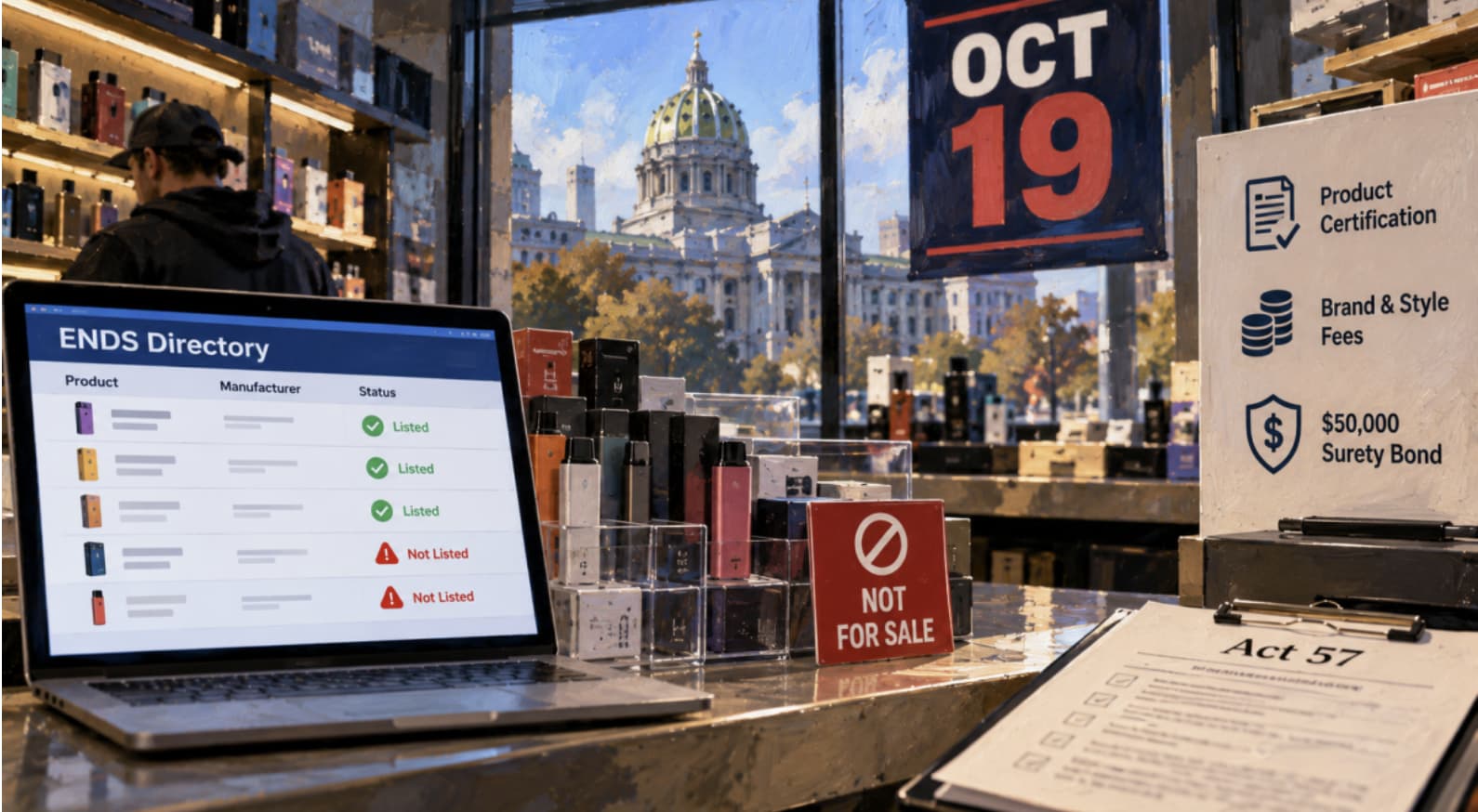
Beginning October 19, 2026, nicotine-containing electronic cigarettes that are not included in Pennsylvania’s official Electronic Nicotine Delivery System (ENDS) directory will no longer be eligible for retail sale in the state. Products that remain outside the directory can be treated as contraband and may face seizure, forfeiture and destruction.
The deadline marks the end of a 120-day transition period created under Act 57 of 2025. During that period, retailers and wholesalers had an opportunity to sell through or remove products that were not yet listed.
For Pennsylvania vape businesses, the change is significant because the state’s product directory is moving from a registration system into a direct retail-enforcement tool.
October 19 Is the Critical Deadline
Pennsylvania’s Attorney General established the ENDS directory to identify nicotine-containing electronic cigarettes that have met the state’s certification requirements.
The directory includes information such as manufacturers, brands, product categories, product names and flavors. The state is also required to update the directory at least monthly.
The important date for retailers is October 19.
Before that date, the state said it would not physically remove off-directory products from the marketplace under the new enforcement provision. Starting October 19, however, an unlisted nicotine-containing e-cigarette that is sold, offered for sale or possessed for sale in Pennsylvania can become subject to seizure.
That gives retailers a relatively simple compliance question:
Is every nicotine vape currently being sold in the store listed in the Pennsylvania ENDS directory?
If the answer is no, the product could create a compliance problem after the deadline.
What Is the Pennsylvania ENDS Directory?
The ENDS directory was created through Act 57 of 2025.
Rather than allowing any nicotine vape to enter the Pennsylvania retail market simply because it is available through a distributor, the law creates a state-level certification system.
Manufacturers must provide information about the products they want included. The Attorney General then maintains a public directory of approved manufacturers and covered products.
This creates another layer of market access on top of federal regulation.
A product therefore cannot be evaluated solely by its brand name or whether it is commonly sold in vape shops. Retailers also need to determine whether the specific product appears on Pennsylvania’s current directory.
Why FDA Status Matters
Pennsylvania’s system adds another layer to the broader U.S. vape regulations that manufacturers and retailers must navigate.
Act 57 establishes eligibility criteria related to the U.S. Food and Drug Administration’s regulatory treatment of electronic cigarettes, including products with FDA marketing authorization and certain products associated with the federal Premarket Tobacco Product Application process.
That means Pennsylvania retailers and manufacturers are dealing with two related questions:
- Does the product meet the applicable federal regulatory conditions?
- Is the product properly included in Pennsylvania’s ENDS directory?
A product that fails the state’s directory requirements can therefore face a Pennsylvania retail restriction even if the brand is familiar to consumers.
Retailers Face Direct Financial Risk
The new system is not simply an administrative registration exercise.
Pennsylvania’s Attorney General says retailers, wholesalers and importers that sell or offer an unlisted nicotine-containing e-cigarette for retail sale can face an initial $500 civil penalty for each product until the product is removed or properly listed.
The consequences become more serious for repeat violations.
A second violation within 12 months can result in a penalty of between $750 and $1,000 per day per product, along with a license suspension of at least 14 days.
A third violation can bring a penalty of $1,000 to $1,500 per day per product and license revocation. Businesses can also be responsible for costs associated with the seizure and destruction of products.
For a retailer carrying hundreds or thousands of unlisted devices, the potential financial exposure can therefore grow quickly.
Manufacturers Face Their Own Compliance Costs
The burden does not fall entirely on retailers.
Manufacturers seeking certification must pay fees under Pennsylvania’s system. Initial certification costs $2,000 per brand family plus $200 for each brand style, while annual renewal costs $1,000 per brand family and $100 per brand style.
Manufacturers must also provide a surety bond of at least $50,000.
The structure creates a meaningful cost for companies with large product portfolios.
A manufacturer selling multiple flavors, devices or product variations may need to account for product-level certification costs in addition to its broader manufacturing, distribution and federal compliance expenses.
The Directory Can Still Change
One important detail is that the October 19 deadline does not necessarily mean the directory is permanently frozen.
The Pennsylvania Attorney General’s office has indicated that manufacturer certifications remain under review, meaning additional products can potentially be added as applications are processed.
This creates an unusual situation for retailers.
A product could be unavailable for legal retail sale today but potentially become eligible later if the manufacturer completes the necessary certification process.
At the same time, retailers cannot simply assume that an application is enough. The product needs to appear on the applicable state directory before it can be treated as compliant for Pennsylvania retail purposes.
Retailers Need Better Inventory Controls
The new rules make inventory management much more important.
In the past, a retailer might have relied primarily on its distributor’s licensing status or a product’s established presence in the market.
Under Pennsylvania’s new system, retailers need to check the actual product against the state’s directory.
That means businesses should consider maintaining records for:
- Manufacturer name
- Brand
- Product name
- Product category
- Flavor
- Directory status
- Supplier and wholesaler information
- Date of directory verification
This information can make it easier to identify products that need to be removed before they become a compliance problem.
Wholesalers Are Also Part of the Chain
Pennsylvania’s rules also affect how products move between businesses.
The state requires licensed retailers to purchase tobacco products from licensed wholesalers, while wholesalers must operate systems designed to prevent unlisted ENDS products from entering the Pennsylvania retail market.
This means compliance is no longer limited to the manufacturer or the final vape shop.
The manufacturer, importer, wholesaler and retailer can all become important points in the product’s regulatory chain.
For businesses, this makes supplier verification increasingly important.
A retailer may need to ask not only whether a product is listed, but also whether it was obtained through an appropriate licensed distribution channel.
What Happens to Products Already in Stores?
The transition period was designed to give businesses time to deal with inventory that was not included in the directory.
According to the Attorney General’s FAQ, products will not be physically removed from the marketplace before October 19 under the new enforcement provision. After that date, an off-directory product that is sold, offered for sale or possessed for sale can become subject to seizure.
Retailers should therefore avoid waiting until the final day to review inventory.
Checking products early gives manufacturers and distributors more time to resolve documentation problems, submit necessary information or determine how remaining inventory should be handled.
What About Products Sold Outside Pennsylvania?
The rules are specifically focused on products entering the Pennsylvania retail market.
The Attorney General’s guidance addresses situations involving wholesalers that maintain inventory in Pennsylvania but intend to sell the products outside the state. However, businesses remain responsible for ensuring that products sold into Pennsylvania comply with the directory requirements.
This distinction could become important for regional distributors serving multiple states.
A warehouse may contain products that are lawful for another state’s market but cannot legally be sold into Pennsylvania.
Why Disposable Vapes Could Be Particularly Affected
The impact could be especially visible in the disposable segment, making disposable vape regulations increasingly important for manufacturers and retailers.
Many disposable products are sold in large numbers of flavors and variations, meaning manufacturers may have substantially more individual product entries to manage than companies selling a smaller number of traditional e-liquid products.
Recent reporting from Pennsylvania indicates that retailers expect a significant portion of their current disposable-vape inventory to become unavailable if products remain outside the directory. One Pittsburgh-area retailer estimated that around 95% of its vape inventory could be affected, although that figure reflects the individual store’s inventory rather than the Pennsylvania market as a whole.
That distinction is important.
The 95% estimate should not be interpreted as evidence that 95% of all Pennsylvania vape products will disappear. The actual impact will depend on which manufacturers and individual products receive certification before and after the enforcement date.
A Smaller Legal Product Pool Could Change Retail Shelves
If the directory remains relatively limited, consumers could see a noticeable change in vape-shop inventories.
Retailers may reduce the number of brands they carry, concentrate on products with confirmed regulatory status, or replace products that cannot remain on the shelves.
This could also affect purchasing decisions.
Consumers accustomed to choosing from a large selection of disposable vapes may encounter fewer options, particularly if popular products are not included in the directory.
For manufacturers, meanwhile, obtaining Pennsylvania certification could become an important competitive consideration.
The Difference Between Brand Approval and Product Listing
One of the most important points for businesses is that brand recognition does not automatically equal product eligibility.
Pennsylvania’s directory contains detailed information about brands, styles, products and flavors. A retailer should therefore avoid assuming that every product from an approved manufacturer is automatically covered.
The safer approach is to verify the specific product against the current directory.
This product-level approach also means retailers should continue checking the directory after October 19. The Attorney General’s office says the directory will be updated at least monthly, and a product’s status can change over time.
Pennsylvania Is Building a State-Level Vape Filter
The significance of Act 57 goes beyond one enforcement deadline.
Pennsylvania is effectively creating a state-level filter for nicotine vaping products. Manufacturers must meet certification requirements, products must satisfy applicable eligibility conditions, wholesalers must follow licensing requirements and retailers must ensure that the products they sell are properly listed.
That makes the state’s vape market more documentation-driven.
For manufacturers, regulatory compliance increasingly becomes part of product distribution strategy. For wholesalers and retailers, checking product status becomes an ongoing operational responsibility.
What Retailers Should Do Before October 19
Pennsylvania vape businesses should treat the October 19 deadline as an inventory-management deadline, not simply a regulatory date.
A product-by-product inventory audit should become part of vape retailer compliance as Pennsylvania moves toward active enforcement.
A practical review could include:
- Audit every nicotine-containing vape product in inventory.
- Compare product names, brands and flavors with the current ENDS directory.
- Separate products that are not currently listed.
- Confirm that suppliers and wholesalers meet Pennsylvania licensing requirements.
- Keep documentation showing where products were purchased.
- Monitor the directory for new certifications and removals.
- Ask manufacturers about pending certification applications where appropriate.
The official Pennsylvania Attorney General directory and guidance should remain the primary reference because the list can change as certifications are processed.
What October 19 Means for Pennsylvania’s Vape Market
October 19 represents a major shift in how Pennsylvania approaches electronic nicotine products.
Once the transition period ends, being physically present in a vape shop will no longer be enough. A nicotine-containing e-cigarette intended for retail sale must satisfy the state’s directory requirements or risk being treated as an illegal product.
The financial consequences can also be substantial, particularly for businesses that continue selling unlisted products after receiving enforcement notice.
For consumers, the most visible result may be a smaller selection of vapes on store shelves. For manufacturers and retailers, however, the bigger change is structural: Pennsylvania is making product-level regulatory verification a routine part of doing business.
With the directory still evolving, manufacturers and retailers will need to monitor the state’s official listings closely even after October 19. The enforcement date is not the end of the process—it is the point at which Pennsylvania’s ENDS directory becomes a much more consequential part of the state’s vape market.