










Igeekphone News August 4, 2026 – Apple is reportedly preparing a major upgrade to its mobile photography system with the upcoming iPhone 18 Pro series, which is expected to debut in September 2026. According to recent leaks, the new flagship will become the first iPhone model to feature a variable aperture camera, marking a significant step forward in Apple’s smartphone imaging technology.
The rumored camera innovation would allow the iPhone 18 Pro to dynamically adjust the amount of light entering the lens, bringing smartphone photography closer to the behavior of traditional cameras.
iPhone 18 Pro May Introduce Variable Aperture Main Camera
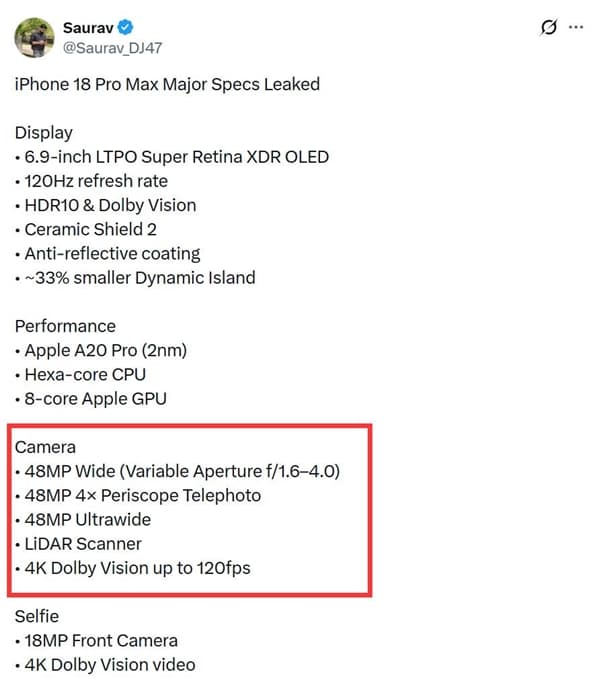
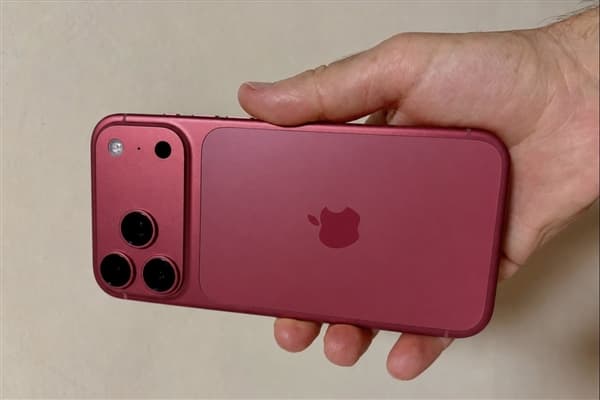
According to leaked information, the iPhone 18 Pro will feature a triple-camera system consisting of three 48MP sensors.
The main camera is expected to support a variable aperture mechanism with the following specifications:
- Aperture range: f/1.6 to f/4.0
- Optical Image Stabilization (OIS) support
- 48MP main sensor
Interestingly, these aperture specifications are reportedly identical to those of the Huawei Pura 80 Pro, which also introduced a variable aperture system with an adjustment range from f/1.6 to f/4.0.
If confirmed, Apple would be adopting a technology that has already appeared in some high-end Android smartphones, while integrating its own computational photography advantages.
How Variable Aperture Improves Smartphone Photography
Traditional smartphone cameras typically use a fixed aperture lens, meaning the amount of incoming light cannot be physically adjusted. Variable aperture technology changes this by allowing the lens opening to expand or contract, similar to how the human eye adjusts its pupil.
This provides several key benefits.
Improved Low-Light Photography
In darker environments, such as nighttime scenes or indoor photography, the aperture can open wider to allow more light to reach the sensor.
The increased light intake can help:
- Reduce image noise
- Improve detail preservation
- Produce cleaner low-light photos
- Enhance overall image quality
This allows the camera to capture brighter and more natural images without relying entirely on software-based processing.
Better Exposure Control in Bright Environments
Under strong lighting conditions, the aperture can narrow to reduce excessive light entering the sensor.
This helps:
- Prevent overexposed highlights
- Improve image balance
- Preserve fine details
- Enhance edge clarity
The ability to adjust aperture gives the camera greater flexibility across different shooting conditions.
More Natural Depth-of-Field Effects
One of the biggest advantages of variable aperture is improved control over depth of field.
Previously, smartphone portrait effects relied heavily on computational photography algorithms to simulate background blur. While modern AI processing has become increasingly advanced, software-generated bokeh can sometimes struggle with complex edges and natural transitions.
With a wider physical aperture, the iPhone 18 Pro could create genuine optical background separation, resulting in:
- More natural blur
- Smoother transitions between foreground and background
- Better portrait photography
- Improved close-up shots
This could bring smartphone photography closer to the look of professional cameras.
Greater Creative Control for Users
Variable aperture could also provide users with more creative flexibility.
Instead of relying on fixed camera settings, photographers may be able to adjust aperture according to their needs, switching between:
- Wide aperture for strong background blur and portrait shots
- Narrow aperture for landscape photography with greater overall sharpness
This would give smartphone users more control over their images and expand the creative possibilities of mobile photography.
Powered by Apple’s A20 Pro Chip
Beyond camera improvements, the iPhone 18 Pro is expected to introduce Apple’s next-generation A20 Pro chipset.
The processor is rumored to be manufactured using TSMC’s 2nm process technology, making it one of Apple’s most advanced mobile chips to date.
The A20 Pro is expected to deliver improvements in:
- Image processing performance
- Artificial intelligence workloads
- Computational photography
- Gaming performance
- Overall system efficiency
The combination of advanced camera hardware and a more powerful AI-focused processor could significantly enhance Apple’s photography pipeline.
A New Era for iPhone Camera Technology
Apple has traditionally focused on improving smartphone photography through sensor upgrades, computational algorithms, and image processing software. The introduction of a variable aperture lens would represent a shift toward more advanced optical hardware.
If the leaks prove accurate, the iPhone 18 Pro could combine:
- Triple 48MP camera system
- Variable aperture main lens
- Advanced OIS stabilization
- A20 Pro 2nm processor
- Next-generation AI image processing
With smartphone camera competition becoming increasingly intense, the iPhone 18 Pro’s rumored variable aperture system could become one of its most important upgrades and a major milestone in Apple’s imaging development.
Apple has not yet officially confirmed the iPhone 18 Pro specifications, so final camera features, pricing, and availability will need to wait until the company’s official launch event.