










OpenAI has reportedly introduced GPT-6 Cyber, a specialized artificial intelligence model designed to strengthen cybersecurity research. The new model focuses on identifying software vulnerabilities, validating security weaknesses, and developing proof-of-concept exploits. Its reported results include the discovery of 81 previously unknown high-severity vulnerabilities in Mozilla Firefox.
According to a report published on November 6, the model has demonstrated significant improvements in vulnerability research and exploit development compared with earlier cybersecurity-focused AI systems.
GPT-6 Cyber Discovers 81 High-Severity Firefox Vulnerabilities
One of the most notable achievements attributed to GPT-6 Cyber is its security research involving the Firefox browser.
During testing, the model reportedly identified 81 previously undiscovered high-severity vulnerabilities. It also generated supporting test evidence and reproduction procedures, giving security researchers a way to investigate and verify the reported issues.
OpenAI subsequently shared the findings with Mozilla and provided recommendations for addressing the vulnerabilities. This development follows other advances in OpenAI’s AI lineup, including the recently introduced GPT-6.1 Terra model and its computer-control capabilities.
Mozilla has already released security patches for several of the reported issues. This demonstrates how AI-assisted vulnerability discovery could help software developers identify weaknesses and improve security response times.
The findings are particularly significant because modern browsers contain complex codebases and handle a wide range of potentially dangerous web content. Discovering vulnerabilities before they are exploited can help reduce security risks for users.
Linux Kernel Testing Shows Major Improvement in Exploit Development
GPT-6 Cyber also reportedly achieved strong results during Linux kernel security research.
In the reported tests, the model successfully reproduced 1,724 vulnerabilities and developed working exploits for 948 of them. These results suggest that the model can do more than identify suspicious code: it can also help researchers investigate whether a vulnerability can be reproduced and exploited in a controlled environment.
The report compared its performance with GPT-5.6 Sol under the same testing conditions. The earlier model successfully exploited 166 vulnerabilities, while GPT-6 Cyber reached 948.

That represents more than a fivefold increase in the number of successful exploits.
This improvement could make AI tools more useful in vulnerability assessment, penetration testing, and security research. However, exploit generation also requires strict safeguards because the same capabilities can potentially be misused against real-world systems.
ExploitGym Score Rises to 48.5%
Beyond practical vulnerability research, GPT-6 Cyber reportedly performed better in specialized cybersecurity evaluations.
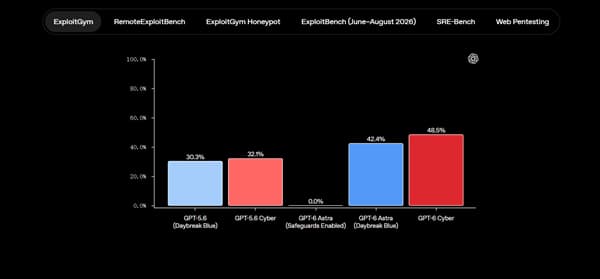
In the ExploitGym benchmark, the model achieved a score of 48.5%, compared with 32.1% for the previous-generation GPT-5.6 Cyber.
Approximately 51% improvement
The difference indicates a substantial increase in performance on this particular benchmark. It also suggests that the latest model may be more capable of handling complex security tasks involving vulnerability analysis and exploit development.
Benchmark scores, however, should be interpreted in context. They measure performance under specific testing conditions and do not necessarily represent how effectively a model will perform across every real-world cybersecurity scenario.
What GPT-6 Cyber Could Mean for the Future of Cybersecurity
The reported results highlight the growing role of artificial intelligence in software security. Traditionally, vulnerability research requires specialists to examine large codebases, reproduce complex bugs, and determine whether identified weaknesses can be exploited.
A capable AI system could accelerate parts of this process by helping researchers: The security implications of increasingly autonomous AI systems have already attracted attention, as discussed in our report on an OpenAI AI model and the Hugging Face cybersecurity incident.
-
Identify potential vulnerabilities in software.
-
Produce evidence and reproduction steps for security issues.
-
Test whether vulnerabilities can be exploited.
-
Assist with security assessments of operating systems and applications.
-
Help developers prioritize weaknesses that need urgent fixes.
At the same time, more powerful exploit-development capabilities introduce additional risks. Responsible deployment, controlled testing environments, coordinated vulnerability disclosure, and effective access restrictions are essential to prevent these tools from being used for malicious attacks.
Final Thoughts
GPT-6 Cyber’s reported achievements point to a potentially important development in AI-powered cybersecurity. Finding 81 previously unknown high-severity Firefox vulnerabilities, reproducing 1,724 Linux kernel vulnerabilities, and generating 948 working exploits would represent substantial progress in automated security research.
Its reported ExploitGym score of 48.5% also suggests a meaningful improvement over the previous generation.
The real measure of success, however, will be how effectively these capabilities help security teams identify and fix vulnerabilities before attackers can take advantage of them. If deployed responsibly, AI-powered security models could become valuable tools for protecting browsers, operating systems, and other widely used software.