










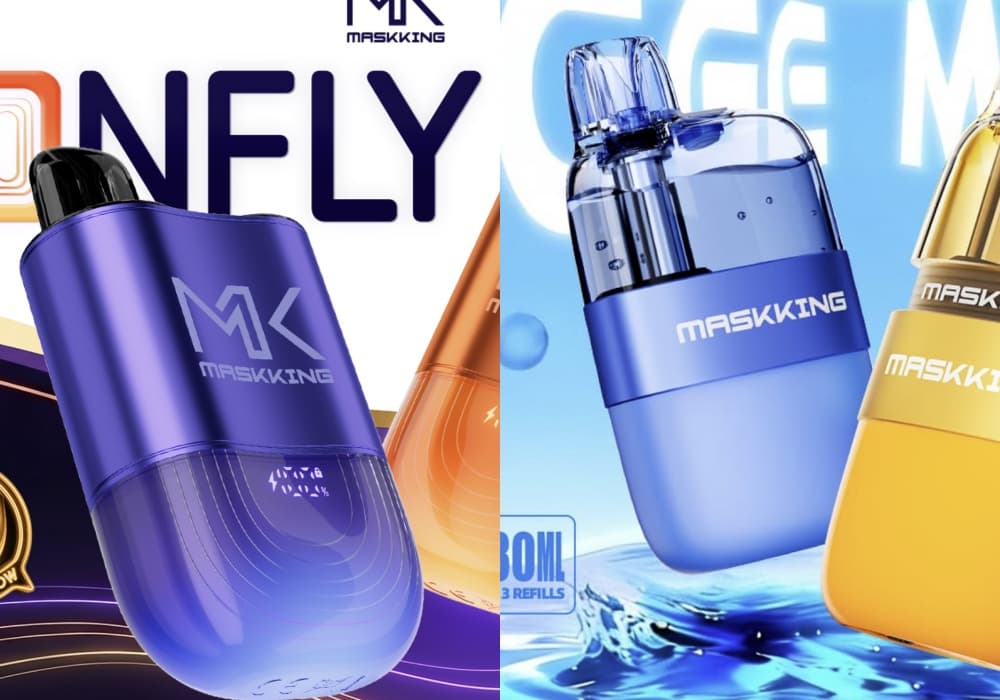
Two products from the same manufacturer can take very different approaches to hardware design. The Maskking Neonfly 6000 and Maskking Ucee Max are a good example: one combines a compact illuminated body with a modular pod arrangement, while the other is built around a larger refillable reservoir, dual-mesh heating and a rotating-seal mechanism.
Their advertised puff figures—up to 6,000 and 60,000 respectively—are eye-catching, but they do not explain the most meaningful differences. A closer look at the pod structure, refill method, electrical specifications and physical dimensions provides a more useful comparison.
This review examines the two devices as pieces of product engineering, separating published specifications from claims that would require independent testing.
At a Glance: What Separates Neonfly from Ucee Max?
| Specification | Maskking Neonfly 6000 | Maskking Ucee Max |
|---|---|---|
| Advertised puff count | Up to 6,000 | Up to 60,000 |
| E-liquid arrangement | 2ml pod + 4ml refill container | 10ml refillable pod |
| Advertised total liquid capacity | 6ml configuration | Up to approximately 30ml across refills |
| Coil | 0.9Ω mesh | 0.6Ω dual mesh |
| Battery | 550mAh | 650mAh |
| Charging | USB Type-C | USB Type-C |
| Power options | Smart power indicator | Normal / Boost modes |
| Main design feature | Firefly-inspired RGB lighting | Rotating-seal refill mechanism |
| Pod visibility | Transparent pod | Visible pod |
| Safety feature | Child lock | Child lock |
1. Two Different Design Philosophies
The most obvious difference appears before looking at the technical specifications.
Neonfly uses a relatively compact body with a firefly-inspired lighting effect. Its high-gloss exterior and dynamic RGB illumination give the device a more visually distinctive appearance. The transparent pod is another practical design element, making the liquid compartment visible rather than completely concealed.
Ucee Max takes a more hardware-focused approach. Its larger body accommodates a 10ml refillable pod and the components associated with its dual-mesh system. Instead of making lighting the central visual feature, its product design emphasizes the refill mechanism, pod visibility and operating modes.
This distinction matters because the devices are not simply two versions of the same platform with different capacities. Their physical layouts reflect different priorities.
2. The Pod Architecture Is the Most Important Difference
Neonfly uses a 2ml pod combined with a separate 4ml refill component. Its published configuration is designed around an interchangeable pod arrangement, with the manufacturer advertising up to 6,000 puffs.
The modular layout is a defining part of the product. Rather than relying on a single large reservoir, the system separates the liquid configuration into components. Its transparent pod also makes it easier to visually check the remaining liquid.
Ucee Max approaches capacity differently.
For a closer look at its individual hardware and refill system, see our detailed Maskking Ucee Max 60K review.
Its main pod has a listed 10ml capacity. Maskking describes a refill arrangement supporting at least three refill cycles, with an advertised cumulative capacity of approximately 30ml.
The distinction is not merely numerical:
-
Neonfly: A smaller, modular 2ml + 4ml configuration.
-
Ucee Max: A larger refillable reservoir with multiple advertised refill cycles.
The refill arrangement also affects how the products should be evaluated in different markets. Liquid-capacity limits and product classification vary by jurisdiction, so the advertised configuration should not automatically be interpreted as proof of regulatory approval in every country.
3. Rotating Seal vs Interchangeable Pods: Two Approaches to Liquid Management
One of Ucee Max’s most distinctive features is its rotating-seal mechanism.
Maskking presents this as a proprietary design intended to help secure the liquid system. It is particularly relevant to a device built around repeated refilling, where the pod’s sealing structure becomes an important part of the overall design.
The NEONFLY also shares some design characteristics with other compact MASKKING pod systems, as explored in our NEONFLY vs SOMO comparison.
Neonfly places more emphasis on its interchangeable pod arrangement. Its modular approach makes the pod itself a central part of the product’s design, rather than relying primarily on a large refillable reservoir.
These are different engineering priorities:
| Design consideration | Neonfly | Ucee Max |
|---|---|---|
| Main approach | Interchangeable pod system | Refillable reservoir |
| Distinctive feature | 2ml + 4ml arrangement | Rotating-seal mechanism |
| Liquid visibility | Transparent pod | Visible pod |
| Main design emphasis | Modular configuration | Refill and sealing structure |
A manufacturer’s leakage-control claim should not be treated as an independently verified result. Actual sealing performance would need to be assessed through testing under consistent conditions.
4. Coil Configuration: 0.9Ω Mesh Compared with 0.6Ω Dual Mesh
The heating systems provide another clear point of comparison.
Neonfly lists a 0.9Ω mesh coil. Mesh heating elements use a structured heating surface rather than a conventional single wire arrangement. The product’s design combines this coil with its smaller pod configuration.
Ucee Max uses a 0.6Ω dual-mesh coil. Its lower listed resistance and dual-mesh structure distinguish it from Neonfly’s single mesh specification.
However, resistance alone cannot establish which device delivers better flavor, longer coil life or greater efficiency. Those outcomes also depend on power delivery, airflow, liquid composition, manufacturing tolerances and operating conditions.
The meaningful technical difference is the architecture: a 0.9Ω mesh arrangement in Neonfly versus a 0.6Ω dual-mesh configuration in Ucee Max. Claims about superior flavor or durability would require controlled independent testing.
5. Power Management: Indicator vs Normal and Boost Modes
The two devices also differ in how their power features are presented.
Neonfly includes a smart power indicator. This provides a visual status feature within its compact design, although the exact information displayed should be checked against the relevant product version and instructions.
Ucee Max lists two operating modes:
-
Normal Mode: The standard operating setting.
-
Boost Mode: An alternative higher-output setting.
The availability of two modes gives Ucee Max a more explicit power-selection system. It also means that comparisons based on the maximum advertised puff count need context: operating mode and draw conditions can affect both liquid consumption and battery use.
Neither the mode labels nor the battery specifications establish an exact runtime or performance advantage without further testing.
6. Battery Capacity and Charging Hardware
The battery specifications show a modest difference:
Ucee Max has a 100mAh higher stated battery capacity. Both models list Type-C charging.
That difference should not be interpreted as a direct measurement of how long either device lasts. Battery consumption is influenced by power settings, coil characteristics, heating duration and usage patterns. In particular, Ucee Max’s Boost mode may change energy consumption compared with Normal mode.
The published specifications do not provide a reliable basis for assigning either device a specific number of hours or days between charges.
7. Physical Size and Portability
Neonfly’s compact dimensions are part of its product identity. Its firefly-inspired lighting and smaller pod arrangement are integrated into a relatively compact body.
Ucee Max has a larger physical format, which is consistent with its 10ml refillable pod and additional hardware features.
Published dimensions are approximately:
| Measurement | Neonfly | Ucee Max |
|---|---|---|
| Height | 76.06mm | 97.3mm |
| Width | 41.56mm | 46.8mm |
| Thickness | 20.77mm | 22.9mm |
These figures illustrate the difference in physical footprint. They do not establish which product is more comfortable to hold, since grip shape, weight distribution and surface finish also matter.
8. What the Advertised Puff Counts Actually Tell Us
The headline figures are 6,000 puffs for Neonfly and 60,000 for Ucee Max. That is a tenfold difference in the manufacturer’s advertised maximum.
However, puff counts are estimates based on specified testing conditions. Real-world results can vary with draw duration, frequency, power mode, coil performance and other factors.
The figures also describe different liquid configurations. Neonfly’s 2ml + 4ml system should not be compared with Ucee Max’s refillable 10ml pod and multiple refill cycles without accounting for the difference in how the liquid is supplied.
For an objective product comparison, pod structure, battery capacity and coil specifications are more useful technical reference points than puff count alone.
9. Product Specifications and Regulatory Considerations
Both product pages list a child-lock feature. This is a device feature, not a guarantee that a product is childproof or risk-free.
The two liquid systems also deserve careful attention in regulated markets. A 2ml + 4ml configuration and a 10ml refillable pod may be treated differently depending on local legislation, product classification and the exact version being sold.
Before evaluating either model for a particular market, the relevant documentation should be checked for:
-
Applicable liquid-capacity restrictions.
-
Nicotine concentration and labeling.
-
Product notification or registration requirements.
-
Packaging and child-resistant requirements.
-
Battery and electrical safety documentation.
-
Rules governing refill containers and replacement pods.
The presence of a product feature or a manufacturer’s compliance statement does not replace verification against the rules of the destination market.
Final Analysis: What Makes Neonfly and Ucee Max Different?
The central difference between these products is their hardware architecture.
Maskking Neonfly combines a compact body, RGB lighting, a 2ml + 4ml pod arrangement and a 0.9Ω mesh coil. Its design places emphasis on modular components and a distinctive exterior.
Maskking Ucee Max uses a larger refillable pod, a rotating-seal mechanism, a 0.6Ω dual-mesh coil and Normal/Boost operating modes. Its published specifications emphasize refill architecture and power options.
The most useful way to distinguish them is to look beyond the advertised puff figures and examine how each device is constructed. The pod arrangement, sealing mechanism, coil design and battery specifications reveal considerably more about the differences between the two product platforms.