











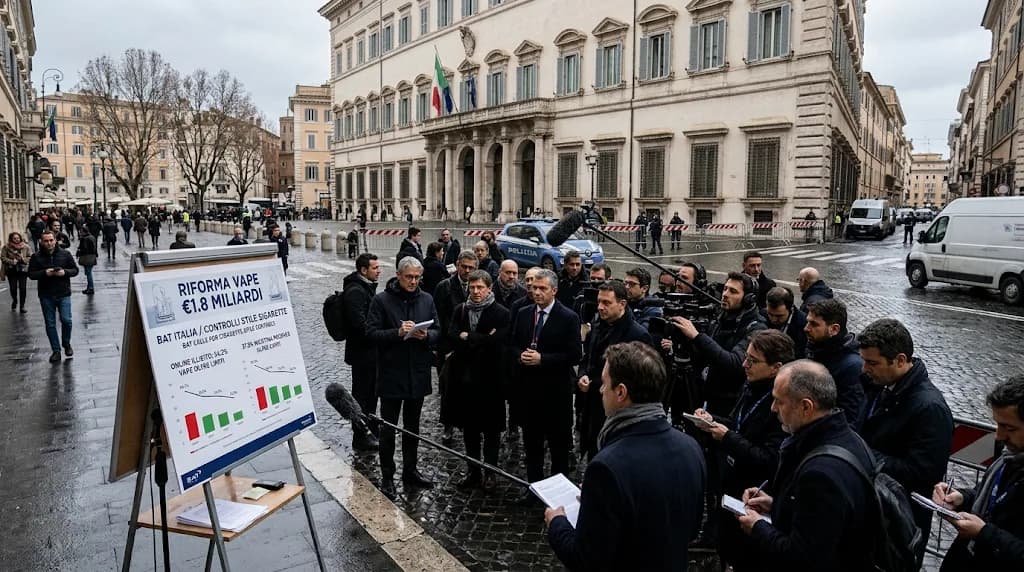
Italy is preparing a significant regulatory shake-up of its vaping and nicotine-product markets. Proposals included in the country’s 2027 Budget Bill could change how e-liquids, nicotine pouches and certain non-tobacco inhalable products are imported, distributed and sold.
The proposed changes would introduce stricter controls on overseas suppliers, require more products to pass through authorized Italian warehouses and establish an official retail pricing system for e-liquids. Online sales and commercial arrangements between manufacturers, distributors and retailers could also face tighter restrictions.
Italy has already been considering changes to e-liquid taxation and authorized distribution, as explained in our earlier report on proposed vape tax increases and retail distribution reforms in Italy.
The proposals are particularly significant because Italy’s legal e-cigarette market was estimated to be worth approximately €1.8 billion in 2025. If approved, the reforms could have a substantial impact on international manufacturers, importers, wholesalers and specialist vape retailers.
However, the measures are not yet final. As of November 24, 2026, the 2027 Budget Bill remains under parliamentary consideration.
Italy’s 2027 Budget Bill Could Reshape the Vaping Supply Chain
Article 34 of the proposed budget legislation focuses on three broad product categories:
-
E-cigarette liquids, including both nicotine-containing and nicotine-free formulations.
-
Non-combustible, non-inhalable nicotine products, including nicotine pouches.
-
Non-tobacco solid products designed for inhalation, with or without nicotine.
One of the most important proposed changes concerns the role of authorized warehouses.
Under the planned framework, e-liquid warehouse operators would face authorization requirements similar to those applied to traditional tobacco tax warehouses. Overseas manufacturers and suppliers would also be expected to distribute their products through authorized warehouse operators established in Italy.
This could make it more difficult for foreign companies to supply Italian retailers through existing cross-border arrangements.
The proposal also targets the tax arrangements used by certain suppliers of nicotine pouches and other non-tobacco products. Some businesses currently rely on tax representatives established in Italy to meet their tax obligations. The proposed legislation would remove parts of this mechanism and transfer responsibility to authorized domestic warehouse operators.
Retailers could also face stricter purchasing requirements. Authorized sellers would generally need to obtain covered products from approved warehouses rather than relying on unrestricted sourcing channels.
In addition, the bill proposes limiting situations in which one business operator holds both certain warehouse and retail authorizations.
Existing businesses affected by these provisions could receive a transition period of up to one year to reorganize their operations. Further implementation rules are expected to be established within 180 days after the new provisions take effect.
Italy has previously adjusted its approach to cross-border online vape purchases, including delivery and age-verification requirements, as discussed in our report on Italy’s rules for online e-cigarette purchases.
Official E-Liquid Pricing Could Replace Greater Retail Price Flexibility
Another major element of the proposed reform is the introduction of an official retail pricing mechanism for e-liquids.
Italy’s Customs and Monopolies Agency, known as ADM, would manage the process of adding products to an official price list. Manufacturers would submit applications containing their proposed retail prices. For manufacturers based outside the European Union, an authorized representative or exclusive importer could submit the application.
The proposed administrative timetable includes:
-
Up to 90 days for approval of a product’s inclusion in the official price list.
-
Up to 40 working days for the determination or adjustment of retail prices.
-
Publication of approved prices through ADM’s official website.
If implemented, this system could reduce the flexibility that retailers currently have when setting prices for different e-liquid products.
The bill also seeks to regulate commercial relationships throughout the supply chain. It proposes restrictions on several practices, including:
-
Product bundles and sales subject to additional purchasing conditions.
-
Exclusive sales agreements.
-
Financial or commercial incentives linked to sales volumes or market-share targets.
These provisions could affect how brands negotiate with distributors, how wholesalers reward retailers and how vape shops organize promotional campaigns.
For international brands, the implications may extend beyond taxation. Companies could need to reconsider their distribution contracts, pricing policies and relationships with Italian retail partners.
Online Vape Sales Face Additional Restrictions
The proposed legislation also addresses online distribution.
One notable measure would remove an existing authorization exception that allows certain qualified warehouse operators to sell nicotine-free e-liquids remotely. If adopted, this change could narrow the circumstances under which these products can be sold through distance-selling channels.
The bill also proposes restrictions on components that could enable e-cigarette cartridges or tanks to exceed the applicable legal capacity limits.
These changes come as Italian authorities continue to focus on online sales and cross-border supply channels. The issue is not limited to nicotine-containing products: nicotine-free e-liquids are also included in parts of the proposed commercial framework.
For online retailers and overseas suppliers, the potential removal of existing exemptions could mean additional compliance checks, changes to fulfillment arrangements and a greater need to verify whether their sales channels meet Italian authorization requirements.
BAT Wants New Nicotine Products Regulated More Like Traditional Cigarettes
The proposed reforms are developing alongside a wider debate about how Italy should regulate next-generation nicotine products.
Andrea Di Paolo, Vice President of BAT Italia and Chairman of BAT Trieste, has called for traditional cigarette regulatory mechanisms to be extended to newer product categories.
His proposals include using tax warehouses to control distribution, strengthening oversight through ADM’s information systems and establishing a nationwide retail pricing framework.
Under the suggested approach, manufacturers would declare their prices, while the regulator would publish the approved prices for use across the national retail market.
Di Paolo has also criticized substantial price differences between sales channels and promotional activities, including Black Friday discounts. He argues that pricing and promotional practices should receive closer regulatory attention.
These are industry policy positions rather than proof that every proposed measure will become law. Nevertheless, BAT’s support for a more centralized framework illustrates the growing importance of distribution controls and pricing policy in Italy’s nicotine-product debate.
Study Finds Compliance Problems Across Online Nicotine Markets
The policy discussion has also been influenced by a study supported by BAT Italia and conducted by research organization Intellegit.
The sixth edition of its research into illicit cigarette and next-generation product markets was presented at the Italian Senate on November 18, 2026. It examined developments between 2021 and 2025 and highlighted potential compliance problems in online sales.
Its findings included:
| Product category | Businesses or channels monitored | Reported findings |
|---|---|---|
| E-cigarettes and e-liquids | 242 online sellers | 34.2% offered e-liquids exceeding the 20 mg/mL nicotine limit |
| E-liquid containers | Same monitored seller group | 28.8% offered bottles exceeding applicable capacity limits |
| Nicotine pouches | 45 online sellers | 37.8% offered products above the nicotine reference limit used in the study |
| Heated tobacco | Illicit online sales channels | Products compatible with IQOS and glo were identified, with sellers mainly located in the UK |
The study also found that approximately one-quarter of monitored online sellers offering non-compliant e-liquids and disposable e-cigarettes were located in Italy.
For context, the EU Tobacco Products Directive sets a maximum nicotine concentration of 20 mg/mL for nicotine-containing e-liquids. It also limits refill containers to 10 mL and the capacity of applicable disposable e-cigarettes, cartridges and tanks to 2 mL.
These figures come from a study supported by BAT, rather than an official census of the entire online market. They should therefore be understood as findings from the monitored businesses, not as a measurement of every seller operating in Italy.
Italy Has Already Tightened Rules on Nicotine Pouches
The proposed 2027 reforms would build on regulatory changes already introduced for nicotine pouches.
Italy’s 2026 Budget Law, adopted on December 30, 2025, introduced additional restrictions that took effect from January 1, 2026.
The framework limits nicotine content to 16.6 mg per pouch and prohibits distance sales to consumers in Italy, including cross-border remote sales.
The reported penalties are also significant:
-
Manufacturers and importers can face administrative fines ranging from €30,000 to €150,000 for violations of the relevant remote-selling rules.
-
Distributors and retailers can face fines ranging from €500 to €5,000.
The new budget proposal would therefore extend an already tightening regulatory approach to a wider range of nicotine products and commercial activities.
Proposed Tax Increases Could Take Effect Earlier in 2027
Alongside distribution and pricing changes, Article 33 of the 2027 Budget Bill proposes bringing forward certain previously scheduled excise-tax increases.
Some adjustments originally planned for January 1, 2028, could instead take effect on July 1, 2027.
The proposed changes include:
| Tax category | First half of 2027 | Proposed from July 1, 2027 |
|---|---|---|
| Fixed cigarette excise duty per 1,000 cigarettes | €35.50 | €38.50 |
| Minimum cigarette tax per 1,000 cigarettes | €221 | €227 |
| Heated tobacco tax coefficient | 41% | 42% |
| Nicotine e-liquid tax coefficient | 20% | 22% |
| Nicotine-free e-liquid tax coefficient | 15% | 17% |
The percentages for heated tobacco and e-liquids are tax coefficients calculated against the equivalent cigarette excise duty. They are not direct tax rates applied to the retail selling price.
According to the budget bill’s technical documentation, the proposed adjustments could generate approximately €112.2 million in additional government revenue in 2027.
The proposal would therefore affect both the commercial framework and the tax costs associated with several tobacco and nicotine product categories.
Italy’s €1.8 Billion Vaping Market Makes the Changes Significant
The potential impact is considerable because Italy has one of Europe’s established vaping markets.
Research published in April 2026 by distributor Logista and market research company Ipsos Doxa estimated that Italy’s legal tobacco and related-product market reached approximately €24.5 billion in 2025.
The estimated breakdown was:
| Market category | 2025 estimated value |
|---|---|
| Traditional tobacco products | €18.3 billion |
| Inhalable products, including heated tobacco | €4.4 billion |
| E-cigarettes | €1.8 billion |
| Total | €24.5 billion |
The same research estimated that Italy had approximately 3.5 million e-cigarette users in 2025. Vaping users represented 27.1% of consumers of tobacco and related products, up from 16% in 2023.
The study also estimated the country’s illicit tobacco and related-product market at approximately €1.2 billion in 2025, associated with around €690 million in lost tax revenue.
Online channels played a major role in illicit e-cigarette transactions: approximately 61% of purchases classified as illicit in the research were completed online.
Italian enforcement activity has also continued. On October 28, the financial police reported seizing approximately 4.3 million e-cigarettes and smoking accessories from an unauthorized warehouse in the province of Latina. A further round of ADM measures targeting non-compliant sales websites took effect on November 19, 2026.
What the Proposed Rules Could Mean for Vape Businesses
If the 2027 Budget Bill is approved in its current form, Italy’s vaping market could become more centralized and more difficult for some overseas businesses to enter.
Foreign manufacturers may need to work more closely with authorized Italian warehouse operators. Importers and distributors could face changes to tax responsibilities, while retailers may have less freedom to choose suppliers and negotiate commercial incentives.
The proposed official pricing system could also change how brands compete. Instead of relying as heavily on retailer-specific discounts or promotional campaigns, companies may need to adapt to a more standardized pricing environment.
Online retailers face another challenge. The proposed removal of certain remote-selling exemptions could make it harder to serve Italian consumers, particularly for nicotine-free e-liquids.
However, the final impact will depend on the legislation’s progress through Parliament, the wording of the approved provisions and the detailed implementation rules issued by Italian authorities.
For companies selling e-cigarettes, e-liquids, nicotine pouches or related products in Italy, the key issue is no longer just product compliance. Distribution authorization, pricing, tax responsibilities and online sales arrangements may all become equally important.