









High-capacity vape devices have changed what users expect from a disposable-style product. Instead of being designed around a short period of use, newer devices are built to last considerably longer, which makes battery endurance, liquid management and consistency increasingly important.
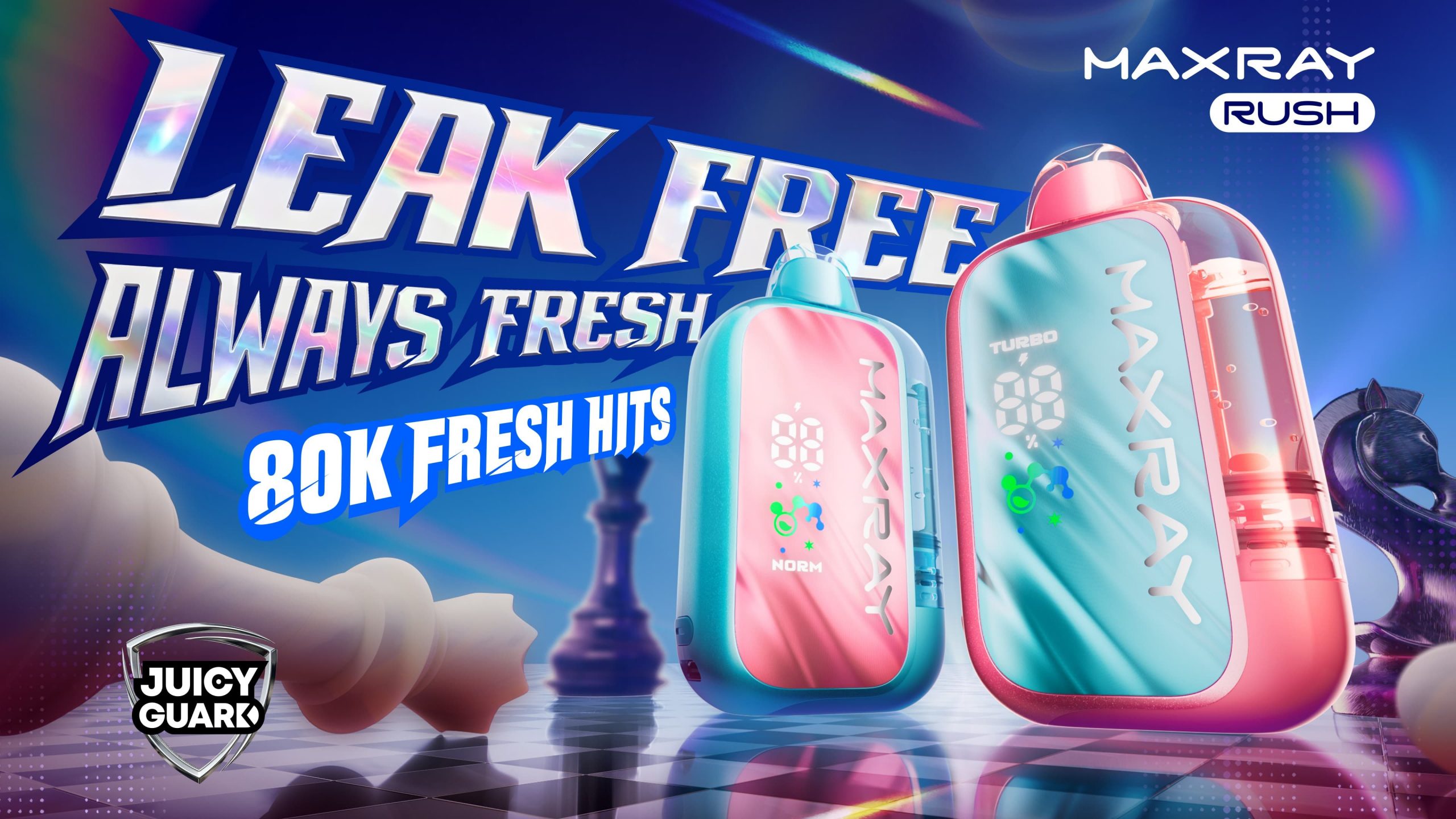
The MAXRAY Rush enters the U.S. market with that longer-use scenario in mind. Rather than making its identity entirely about a large puff-count number, the device emphasizes a more controlled approach to e-liquid management and leak resistance.
That distinction is worth examining because a high-capacity device has a different set of practical challenges from a conventional low-capacity disposable.
Why Leakage Becomes a Bigger Problem as Capacity Increases
Leakage is inconvenient on any vape device, but the problem can become more noticeable when a device contains a larger amount of e-liquid and is intended to remain in use for an extended period.
A small leak in a short-life device may be relatively easy to overlook. With a high-capacity product that users may carry for days or weeks, however, repeated exposure to liquid around the mouthpiece, airflow area or pocket can quickly become a major usability issue.
This is why leak resistance deserves more attention than simply asking how many puffs a device advertises.
A large capacity is useful only if the device can deliver that capacity consistently.
MAXRAY Rush Takes a Different Approach
The MAXRAY Rush is positioned around a design philosophy that puts liquid containment and stable operation closer to the center of the user experience.
That is a more interesting proposition than simply increasing the amount of e-liquid inside a device.
The basic challenge is straightforward: the liquid needs to reach the coil when required, but it should not move freely into areas where it can create condensation, flooding or leakage.
A well-designed high-capacity system therefore needs to balance several factors at once:
- liquid storage
- airflow
- coil saturation
- internal sealing
- temperature changes
- draw consistency
These elements are interconnected. Changing one part of the system can affect the others.
More Capacity Does Not Automatically Mean Better Value
The high-capacity vape market often encourages buyers to compare products by advertised puff counts.
That is an easy number to understand, but it does not tell the entire story.
Actual consumption varies with draw duration, frequency and airflow conditions. A manufacturer’s advertised puff figure is therefore better viewed as an estimate under particular testing conditions rather than a guaranteed number of real-world draws.
For the MAXRAY Rush, the more useful question is whether the device can maintain a consistent experience throughout its intended lifespan.
If a high-capacity device develops inconsistent flavor, airflow problems or leakage before its advertised capacity is exhausted, the larger number becomes much less meaningful.
The Coil and Liquid System Have to Work Together
A high-capacity vape is essentially a small fluid-management system.
The e-liquid has to reach the heating element at an appropriate rate. Too little liquid can contribute to dry or burnt-tasting hits, while too much can contribute to flooding and leakage.
This balance becomes particularly important when a device is expected to remain functional over a long period.
The MAXRAY Rush’s emphasis on leak resistance suggests that the manufacturer is addressing this part of the problem rather than treating capacity as the only selling point.
For users, that can be more meaningful than another incremental increase in the headline puff figure.
Why Temperature and Storage Matter
Even a well-designed vape device is not completely isolated from its environment.
Temperature changes can affect the behavior of e-liquid and the pressure inside a sealed device. Carrying a vape from a cool indoor environment into high outdoor temperatures, for example, can change how the liquid behaves.
Storage position can also matter.
Keeping a device upright may reduce the chance of liquid accumulating around areas that were not designed to hold it. Leaving any e-liquid device exposed to significant heat for extended periods is also generally undesirable.
This means that leak-resistant should not be interpreted as leak-proof.
The MAXRAY Rush’s design may reduce the likelihood of leakage, but no consumer vape should be treated as completely immune to environmental or usage-related issues.
Consistency Is More Important Than a Big Number
One of the most useful ways to evaluate a high-capacity device is to consider how consistent it remains over time.
A new vape can perform well during its first few draws. The more meaningful test is whether the flavor, airflow and vapor production remain reasonably stable later in the device’s life.
This is where a high-capacity design can become complicated.
As the amount of e-liquid decreases, the relationship between the reservoir, coil and airflow can change. A good system needs to maintain predictable liquid delivery throughout that process.
The MAXRAY Rush’s focus on leak control therefore fits into a larger goal: making a high-capacity device feel consistent rather than simply making it last longer on paper.
Rechargeability Changes the Definition of Convenience
Another important factor in modern high-capacity devices is battery management.
A device intended for extended use needs enough battery capacity to make full use of its liquid supply. Otherwise, users may find themselves repeatedly charging the device before reaching the end of the e-liquid supply.
USB-C charging has become common across rechargeable vape hardware because it provides a convenient and widely available charging connection.
For high-capacity products, the relationship between battery and e-liquid capacity is particularly important.
A large reservoir paired with insufficient battery endurance creates an imbalance. Conversely, a rechargeable system can make the hardware more practical when the liquid capacity is designed for extended use.
What MAXRAY Rush Is Trying to Solve
The most interesting aspect of the MAXRAY Rush is therefore not simply its position in the high-capacity segment.
It is the idea that capacity and reliability need to develop together.
Adding more e-liquid can increase the potential lifespan of a device, but it also places greater demands on the internal liquid-management system.
That means the engineering challenge becomes less about asking:
How much e-liquid can fit inside?
and more about:
How can that liquid be delivered consistently without creating unnecessary leakage or flooding problems?
That is a more meaningful way to understand the MAXRAY Rush.
What Users Should Realistically Expect
A leak-resistant design can improve convenience, but users should still maintain realistic expectations.
Performance can be affected by:
- how frequently the device is used
- the length of individual draws
- storage temperature
- storage position
- airflow conditions
- normal condensation
- the remaining liquid level
Consequently, the MAXRAY Rush should not be viewed as a device that can never leak under any circumstances.
Its more reasonable proposition is that its design attempts to reduce common liquid-management problems associated with long-life, high-capacity hardware.
That is a much more useful claim for consumers to evaluate.
Who Is the MAXRAY Rush For?
The MAXRAY Rush is aimed at users who are interested in the convenience of a high-capacity device but don’t want the experience to revolve entirely around an enormous puff-count claim.
It may be more appealing to people who value:
- extended usage
- consistent airflow
- stable flavor delivery
- reduced leakage concerns
- straightforward operation
- less frequent device replacement
It is less relevant to someone who simply wants the largest possible advertised puff number regardless of the underlying design.
Final Thoughts
The high-capacity vape market has reached a point where bigger numbers alone are becoming less informative.
Once a device is designed to remain in use for an extended period, liquid management, coil consistency and leakage control become increasingly important.
That is where the MAXRAY Rush takes a more interesting approach.
Its value proposition is not simply about putting more e-liquid into a compact device. The larger question is whether the internal system can keep that liquid under control while maintaining a consistent experience throughout the product’s useful life.
The MAXRAY Rush therefore represents a broader shift in high-capacity vape design: from competing purely on capacity toward competing on how effectively that capacity can be used.
For consumers evaluating this type of device, that may ultimately be a more useful metric than the biggest number printed on the package.