









On August 8th, Igeekphone reported that OpenAI officially released the GPT-5 model in a live stream early this morning, claiming it to be the company’s most outstanding model with top-notch performance in multiple fields such as programming, mathematics, writing, health, and visual perception.
Sam Altman, the CEO of OpenAI, said that GPT-5 is a “major upgrade” of the company’s previous artificial intelligence models and stated, “Communicating with it is really like having a conversation with an expert in any field.”
GPT-5 will be gradually rolled out to both free and paying users starting today, with paying users having a higher usage limit.
Pro subscribers have unlimited access to GPT-5 and can use GPT-5 Pro. Plus users can use it as the default model for daily problems, and its usage is significantly higher than that of free users.
GPT-5 is a unified system consisting of an intelligent and efficient model + a deep reasoning model (GPT-5 thinking) + a real-time router.
Among them, the intelligent and efficient model can answer most questions; Deep reasoning models are used to solve more complex problems.
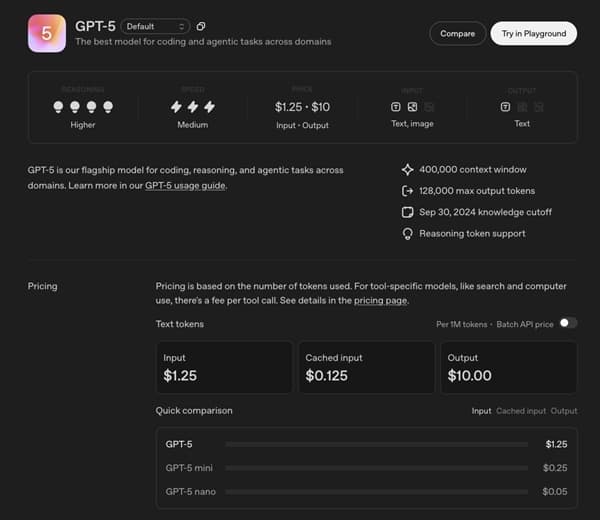
Real-time routers will quickly decide which model to use based on the type of conversation, complexity, tool requirements, and the user’s explicit intentions, and will continuously train and improve based on real signals.
Once the usage limit is reached, the streamlined version of each model will handle the remaining queries. In the future, OpenAI will integrate these functions into a single model.
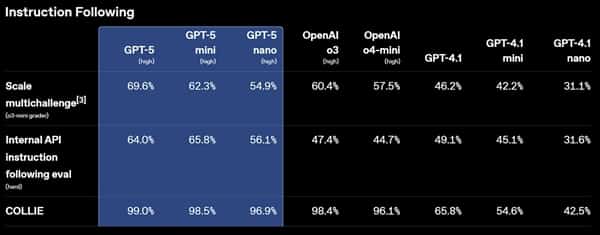
GPT-5 performed better than previous models in benchmark tests, answering questions faster, being more helpful in solving practical problems, reducing hallucinations, improving instruction compliance, and minimizing flattery to the greatest extent.
Especially in the three most common application scenarios of ChatGPT – writing, programming and health consultation – its performance has improved.
Programming: It is the most powerful programming model to date, with significant improvements in complex front-end generation and large code base debugging. It can create beautiful and responsive websites, applications, games, etc. based on a single prompt.
Creative expression and writing: It can transform rough ideas into resonant works with literary depth and rhythm, better handle writing involving ambiguous structures, and is also more helpful in daily writing tasks.
Health: It performs best on health-related issues, scoring significantly higher on HealthBench than any previous model. It can more proactively label potential problems and ask questions to provide more helpful answers. It can also provide more accurate and reliable responses based on the user’s background, knowledge level, and geographical location. However, it cannot replace medical professionals.
In mathematics (94.6% when AIME 2025 is tool-free), real-world programming (SWE-bench Verified 74.9%, Aider Polyglot 88%), multimodal understanding (MMMU 84.2%), and health (HealthBench Hard It has achieved new state-of-the-art levels in aspects such as 46.2%.
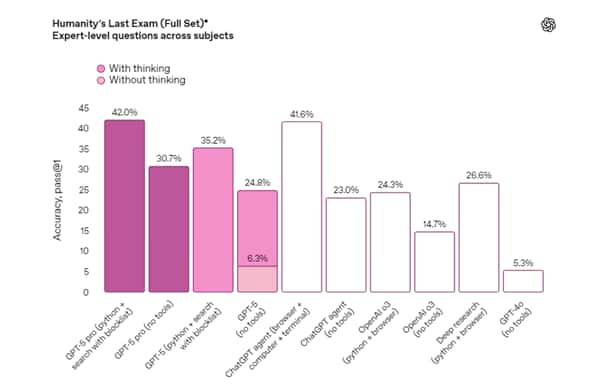
GPT-5 Pro, with its extended reasoning, has also set a new state-of-the-art level in GPQA, scoring 88.4% without tools.
GPT-5 Pro is used for the most challenging and complex tasks, replacing OpenAI o3-Pro. It has a longer thinking time and uses large-scale yet efficient parallel test-time computing to provide the highest quality and most comprehensive answers.
It performed best in multiple challenging intelligence benchmark tests. In the evaluation of over 1,000 economically valuable real-world reasoning prompts, external experts favored GPT-5 Pro in 67.8% of cases. Its major errors were reduced by 22%, and it excelled in health, science, mathematics and programming.