









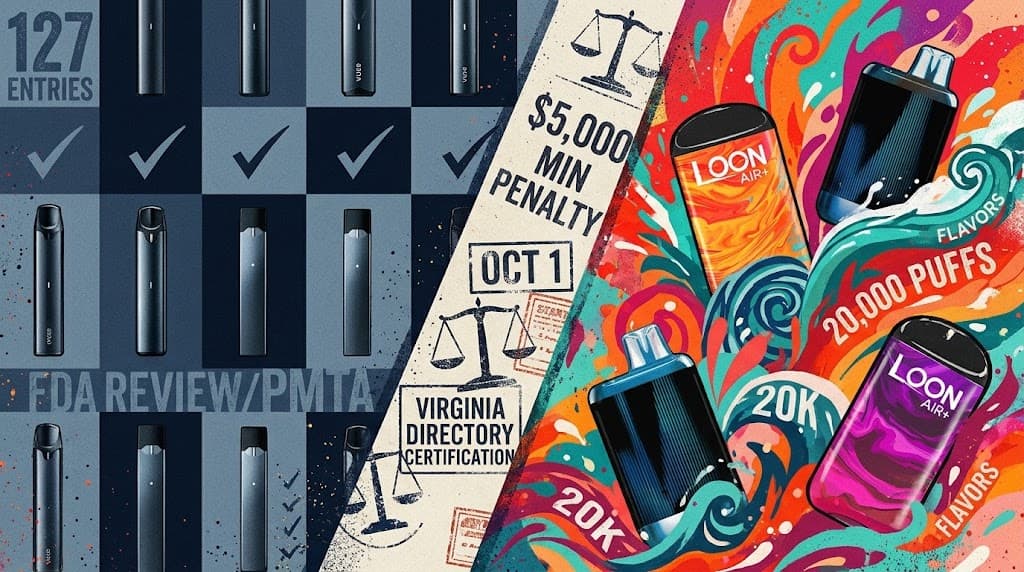
Virginia’s regulation of nicotine vaping products is entering a stricter enforcement phase, with higher financial penalties for businesses selling products that are not included in the state’s official directory. Data compiled by 2Firsts shows that the directory contains 213 product records from 15 manufacturers, covering established brands such as Vuse and JUUL alongside independent names including CrossBar 20K and Loon.
The updated penalties took effect on October 1, 2026. Under the revised Virginia law, the minimum civil penalty starts at $5,000 for a first violation involving each unlisted product, rising to $10,000 for a second violation and $15,000 for a third. The law also permits authorities to seize products sold in violation of the directory requirements.
The changes create additional compliance pressure for vape manufacturers, wholesalers, distributors, and retailers operating in Virginia. Businesses must pay attention not only to whether a product appears in the state directory, but also to its certification status and the separate requirements governing retail operations.
Virginia’s Vape Directory Contains 213 Product Records
According to 2Firsts’ analysis of the Virginia Office of the Attorney General’s published directory, the database includes 213 records associated with 15 manufacturers.
Five groups linked to major tobacco companies and JUUL Labs account for 127 records, or approximately 59.6% of the total. The records cover different products, flavors, nicotine concentrations, packaging configurations, devices, and starter kits. Therefore, the number of records should not be interpreted as the number of unique product models or as a measure of market share.
The directory includes products associated with several well-known brands:
| Company or manufacturer group | Associated brand | Number of records reported by 2Firsts |
|---|---|---|
| R.J. Reynolds Vapor Company | Vuse | 50 |
| JUUL Labs | JUUL | 39 |
| Altria-related products | NJOY | 17 |
| Fontem US LLC | blu | 14 |
| JTI-related manufacturer | Logic | 7 |
| Other manufacturers | CrossBar, Loon, Breeze, and others | 86 |
| Total | 15 manufacturers | 213 |
Source: 2Firsts’ analysis of Virginia’s product directory. The figures represent directory records rather than sales volumes.
The concentration of records among established brands illustrates how the directory documents a mix of major manufacturers and smaller businesses. However, inclusion in the directory should not automatically be treated as proof that every product has received FDA marketing authorization.
Vuse and JUUL Account for a Large Share of Listed Records
Vuse and JUUL represent the two largest brand groups in the directory, with 50 and 39 records respectively. Together, they account for 89 records, or approximately 41.8% of the total.
The Vuse listings include products from the Alto, Solo, and Vibe families, covering devices, prefilled cartridges, and kits. JUUL’s records include devices and JUULpods in different packaging configurations.
Other major brands also appear in the database. NJOY has 17 records covering ACE and DAILY products, while blu has 14 records associated with its devices, cartridges, and disposable products. Logic-related products account for another seven records.
Many of these products are associated with tobacco and menthol categories. The directory nevertheless contains differences in product configurations, concentrations, and packaging, meaning that separate records do not necessarily represent entirely different device platforms.
For businesses, the practical lesson is that checking a brand name alone may not be sufficient. Retailers should verify the relevant product entry and its specific details against the current state directory.
CrossBar 20K and Loon Illustrate the Directory’s Broader Product Mix
The Virginia database also includes independent brands whose products use different formats from the closed-system devices associated with many established manufacturers.
CrossBar 20K
2Firsts identified four CrossBar 20K records in the Virginia directory. The listed categories include tobacco- and menthol-related names, while corresponding commercial product names include descriptions associated with raspberry, confectionery, and mint flavors.
According to information cited in the original report, the CrossBar 20K is a rechargeable, non-refillable disposable vaping device with a stated 13 mL liquid capacity, a 2,000 mAh battery, a nicotine concentration of 50 mg/mL, and an advertised maximum of 20,000 puffs.
These specifications are manufacturer-related claims reported by 2Firsts, rather than independent performance measurements. They should not be confused with a regulatory determination about the product’s authorization status.
The report also notes that the same four products appear in Pennsylvania’s directory under matching UPCs. That overlap makes the products relevant to businesses monitoring state-by-state compliance requirements.
Loon Maxx and Loon Air
The directory contains 18 Loon records, including 16 disposable products and two Refill Shot products associated with tobacco or menthol categories.
The disposable listings include products from the Loon Maxx and Loon Air families. Their commercial flavor descriptions span fruit, mint, ice, and beverage-inspired categories.
Some historical listings and distributor records describe particular Loon variants with different liquid capacities and puff-count estimates. Because specifications vary across versions and distribution channels, those figures should not be applied to every product carrying the Loon name.
The broader point is that the directory covers a diverse product range, and businesses must identify the exact product record rather than relying on general brand information.
More Than Half of the Records Are Marked as Under FDA Review
One of the most important findings in the 2Firsts analysis concerns the FDA status fields associated with the directory records.
Of the 213 records, 120 are marked as having a premarket tobacco product application, or PMTA, under review by the U.S. Food and Drug Administration. That represents approximately 56.3% of the total. The remaining 93 records, or 43.7%, are marked as having received a marketing order.
This distinction matters because Virginia directory listing and FDA marketing authorization are not the same thing.
The state’s certification framework permits eligible products to be included in the directory under specified conditions. These include products with FDA marketing authorization, certain products marketed in the United States by August 8, 2016, and products covered by qualifying PMTA applications submitted by September 9, 2020, that remain under review or have not reached an effective final decision.
Consequently, a directory entry does not necessarily mean that the FDA has authorized the product for marketing.
Manufacturers and retailers should examine the relevant regulatory status instead of assuming that state listing establishes federal authorization. The distinction is especially important when reviewing products whose applications remain under consideration.
For a closer look at how U.S. regulations affect vaping products, read our guide to FDA vape regulations and PMTA requirements.
Virginia Introduces Higher Penalties for Unlisted Products
The revised enforcement framework increases the financial consequences for selling or distributing nicotine products that do not meet the state’s directory requirements.
Under the version of Virginia Code § 59.1-293.20 effective October 1, 2026, the minimum civil penalties are:
| Violation | Minimum civil penalty per product |
|---|---|
| First violation | $5,000 |
| Second violation | $10,000 |
| Third violation | $15,000 |
The penalties apply to violations involving products offered for sale without the required directory listing. The law also allows noncompliant products to be treated as contraband and seized. Where lawful possession cannot be established, seized products may be forfeited and destroyed or otherwise disposed of, with related costs borne by the responsible party.
The revised structure replaces the previous approach of imposing a $1,000-per-day fine for each offending product until it was removed from the market or properly listed.
For retailers carrying multiple unlisted products, the per-product penalty structure could create substantial financial exposure. Manufacturers, meanwhile, need to ensure that the products they supply to Virginia distributors and stores satisfy the applicable certification requirements.
Businesses selling vaping products should also stay informed about U.S. vape laws and retailer compliance requirements, which can differ by state and product category.
Retail Permits and Product Certification Are Separate Requirements
Virginia’s regulatory changes extend beyond the product directory itself.
The state introduced a retail tobacco permit system on October 1, 2026, administered by the Virginia Alcoholic Beverage Control Authority. According to the 2Firsts report, more than 3,000 businesses had submitted applications in September.
The reported application fees are $300 for eligible businesses already holding an ABC alcohol license and $400 for other retailers, with a separate application required for each retail location.
Importantly, a retail permit and product certification serve different purposes. A retailer’s permit does not replace the requirement for products to qualify for inclusion in the state’s directory.
This means businesses need to monitor two separate compliance questions:
- Retail authorization: Does the business have the required permit for its location and operations?
- Product eligibility: Is each relevant nicotine product properly included in the Virginia directory?
Failure to distinguish these obligations could leave a business exposed even if it has completed one part of the process.
Manufacturers Face Annual Recertification Costs
Virginia’s directory framework also creates ongoing administrative responsibilities for manufacturers.
The Attorney General’s official guidance lists an initial certification fee of $5,000 per product SKU and a recertification fee of $2,500 per SKU. Products previously certified before December 31, 2025, remain valid through December 31, 2026, provided they continue to satisfy the applicable requirements.
Manufacturers intending to keep those products on the Virginia market must complete the required recertification process. The state recommends submitting applications by November 1, 2026, to allow time for processing before the end-of-year deadline.
The financial implications increase with the number of products a company maintains. For example, recertifying ten SKUs at $2,500 each would cost $25,000, excluding other compliance and administrative expenses.
For companies with broad product portfolios, annual recertification requires careful planning. Manufacturers need to identify which SKUs they intend to continue selling, prepare the required documentation, and submit applications within the appropriate timeframe.
Retailers should also continue checking the directory as product listings and certification statuses change.
What Virginia’s New Rules Mean for the Vape Industry
Virginia’s directory and enforcement framework shows how state-level product controls can affect the commercial availability of nicotine vaping products.
For retailers, the immediate priority is to check individual products against the official directory and maintain the required retail authorization. A familiar brand name is not enough to establish that a particular product configuration is eligible for sale.
For manufacturers, the process involves product-level certification, supporting documentation, fees, and annual recertification. Companies must also understand the distinction between state directory eligibility and FDA marketing authorization.
Distributors and wholesalers face their own inventory-management responsibilities. Products that cannot legally be sold in Virginia may need to be removed from the relevant supply chain, while businesses must track the rules applicable to the products they handle.
The directory’s mix of major tobacco-company brands and independent manufacturers also demonstrates why compliance checks need to be specific to each product and jurisdiction.
Conclusion
Virginia’s vape directory contains 213 product records across 15 manufacturers, according to 2Firsts’ analysis. Major brands account for a substantial share of the listings, but independent manufacturers and disposable products are also represented.
The more significant development is the enforcement framework that took effect on October 1, 2026. Minimum civil penalties now begin at $5,000 per unlisted product for a first violation and rise for repeat violations. Separate retail-permit requirements and annual manufacturer recertification add further obligations.
For businesses operating in Virginia, the safest approach is to verify each product’s directory entry, confirm its applicable regulatory status, maintain the necessary retail authorization, and follow the official certification and renewal procedures.
The Virginia Office of the Attorney General’s official product directory and certification guidance should be the primary reference for current listing requirements. The statutory text should be consulted for the precise penalties and enforcement provisions.