










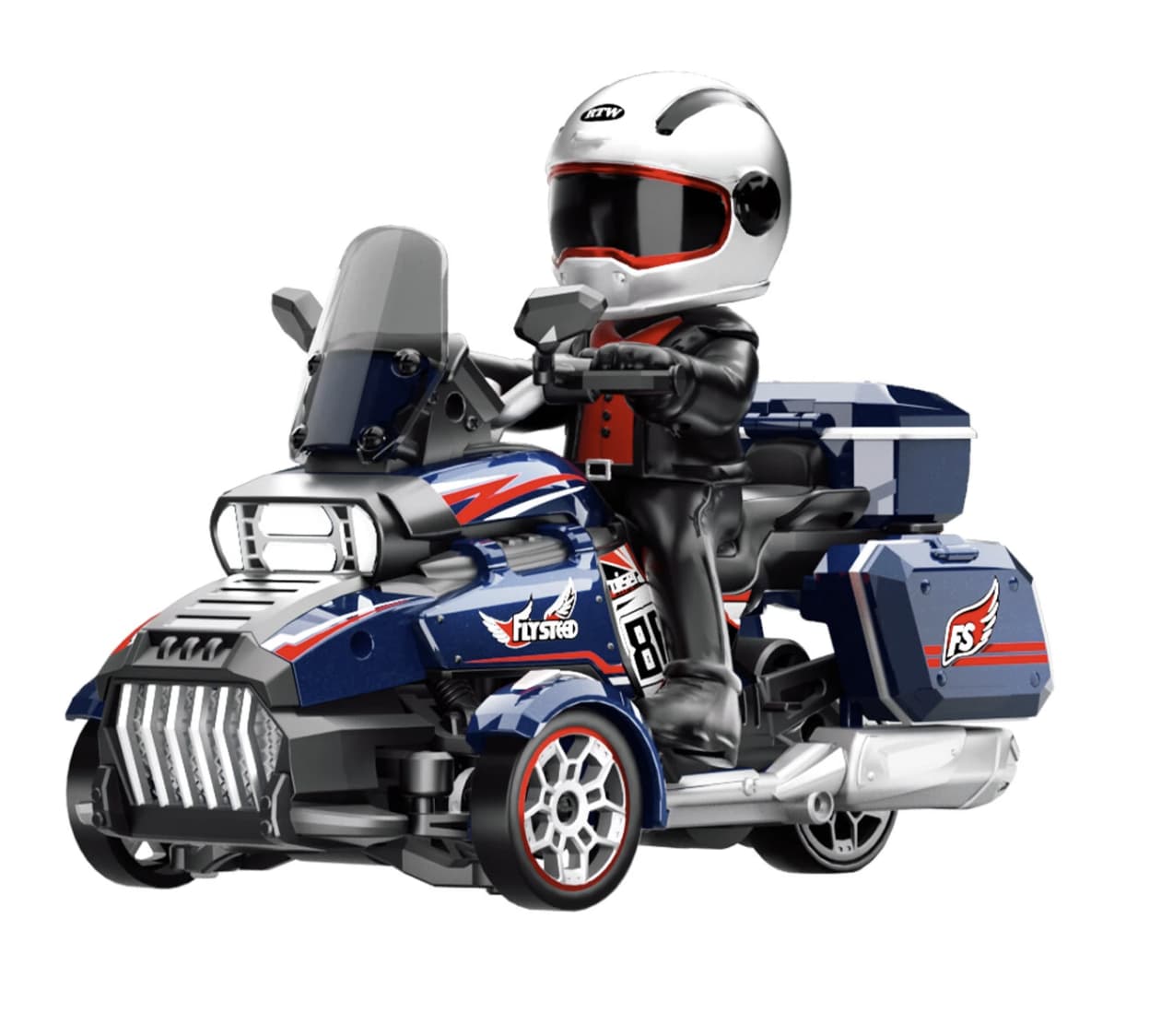
Most small RC vehicles follow the same formula: four wheels, a compact body, and enough power to drive around a table or driveway. The Fayee FQD86 rc motercycle takes a very different approach. Instead of trying to shrink a conventional RC car, it combines a three-wheel drivetrain, motorcycle-inspired styling, a built-in gyro, and proportional controls into a miniature 1:43-scale drift trike.
That difference is important. The FQD86 is not really aimed at people who simply want the fastest mini RC car they can find. Its appeal comes from the way its unusual chassis is designed around controlled sliding and quick directional changes.
According to the current Banggood specification, the FQD86 uses a 3WD system, 2.4GHz radio control, a digital steering servo, an integrated gyro, LED lighting, and a 3.7V 220mAh LiPo battery. The listed vehicle size is just 115 × 65 × 70 mm, making it considerably easier to use in confined spaces than a typical larger RC car.
If you’re interested in other compact RC models, our guide to the best mini RC cars covers the main types, features, and driving styles worth considering.

A Three-Wheel Layout Changes the Driving Experience
The first thing that separates the FQD86 from ordinary RC cars is its three-wheel configuration.
A conventional four-wheel RC car gets much of its stability from having four contact points with the driving surface. A three-wheel drift trike has a different balance, which makes the chassis more closely associated with sideways movement and playful handling than straight-line stability.
For someone who already owns several conventional RC cars, that makes the FQD86 more interesting than another miniature four-wheel model.
The 3WD system is paired with a built-in gyro, which is intended to help manage the vehicle while it is sliding. Rather than simply relying on the driver’s steering input, the gyro can assist with maintaining control during directional changes and drifting.
That combination is particularly relevant for beginners. Small drift vehicles can become difficult to control when the rear end starts moving independently of the direction of travel. A gyro can make the vehicle’s behavior easier to manage, although the actual effectiveness will depend on the surface, gyro settings, driving technique, and available traction.
Full Proportional Control Is More Important Than It Sounds
Another useful feature is full proportional control.
Cheaper toy-grade RC vehicles often use simple on/off inputs. Press the trigger and the motor runs at a predetermined level; move the steering control and the wheels jump toward a fixed position.
The FQD86 instead uses proportional controls for forward and reverse movement, while its 2g digital steering servo provides proportional left/right steering.
That gives the driver more control over speed and direction.
For a drift-oriented vehicle, this matters because precise throttle input can be more useful than simply having a powerful motor. Smooth acceleration makes it easier to approach a corner, initiate a slide, and correct the vehicle without immediately losing control.
In other words, the FQD86’s appeal is less about maximum speed and more about how much control it gives the driver over a very small chassis.
The Gyro Is One of the FQD86’s Most Interesting Features
The integrated gyro deserves particular attention because it changes the character of the vehicle.
If you’re new to RC drifting, our guide to how RC drift cars work explains the role of traction, steering, and chassis setup in controlled sliding.
When a small RC vehicle starts sliding, the direction the body is facing may no longer match the direction in which it is traveling. That is exactly where a gyro-assisted system can become useful.
The FQD86 is designed to use its gyro to help with this type of movement. For casual users, that can make drifting less frustrating. For more experienced RC enthusiasts, it also creates an opportunity to experiment with different steering and throttle inputs.
However, buyers should keep expectations realistic. A built-in gyro does not automatically turn a small RC trike into a competition drift machine. Surface grip, available space, battery condition, and driver technique will all affect how it behaves.
The real advantage is that the electronics are designed to support the vehicle’s unusual three-wheel configuration rather than simply adding a gyro as a marketing feature.
1:43 Scale Makes It a Different Kind of RC Vehicle
The FQD86 is listed at 1:43 scale, with dimensions of approximately 115 × 65 × 70 mm.
That makes it particularly suited to people who do not have a large outdoor area available for RC driving.
A vehicle this small can potentially be used on:
- Smooth indoor floors
- Tables and large desktops
- Short paved areas
- Compact driveways
- Small homemade drift courses
The important word here is smooth.
A 1:43 RC vehicle has very little ground clearance and limited wheel size. It is not designed to deal with grass, loose gravel, deep cracks, or rough off-road terrain in the same way as a larger RC car.
This is therefore much closer to a compact drift toy/hobby vehicle than an off-road RC platform.
LED Lighting Adds More Than Just Appearance
The FQD86 also includes synchronized vehicle lighting.
LEDs are common on RC models, but they make particular sense on a small drift-oriented vehicle because they make its movement easier to follow visually.
The lighting system can also give the miniature trike a more animated appearance when it is being driven indoors or in lower-light conditions. The Banggood specification specifically lists lighting control and synchronized vehicle lighting among the features.
This is not a performance feature, but it contributes to the overall experience.
For a small RC model intended for casual driving, visual feedback can be part of the fun.
Battery Life: Compact, but Not Built for Long Sessions
The FQD86 uses a 3.7V 220mAh LiPo battery, with the Banggood listing claiming approximately 15 minutes of runtime. Charging is specified at roughly 35–40 minutes using a 5V/1A Type-C connection.
For more options designed around compact driving and easy portability, check out our guide to small RC cars for indoor driving.
Those numbers suggest that this is a short-session RC vehicle rather than something intended for continuous driving for an hour.
That is not necessarily a problem.
A mini drift vehicle can be surprisingly entertaining in short sessions because the objective is not simply to drive a long distance. Setting up a small course, practicing controlled turns, and trying to maintain a slide can make 10–15 minutes of driving feel more purposeful.
Still, buyers who prefer extended RC sessions should consider the battery limitation before purchasing.
The charging time is also relatively reasonable compared with the claimed driving time, but users should remember that actual runtime can change depending on driving style, surface resistance, throttle use, and battery condition.
2.4GHz Control and a 20–25m Range
The FQD86 uses a 2.4GHz remote-control system and has a listed control distance of approximately 20–25 meters.
For a vehicle of this size, that range is more than enough for the environments where it makes the most sense.
You are unlikely to need 25 meters of space when driving a 115mm-long RC trike around a room or small paved area.
More importantly, 2.4GHz control is the standard type of radio system buyers will encounter on many modern consumer RC vehicles. It makes the FQD86 much more practical for everyday use than older basic RC systems.
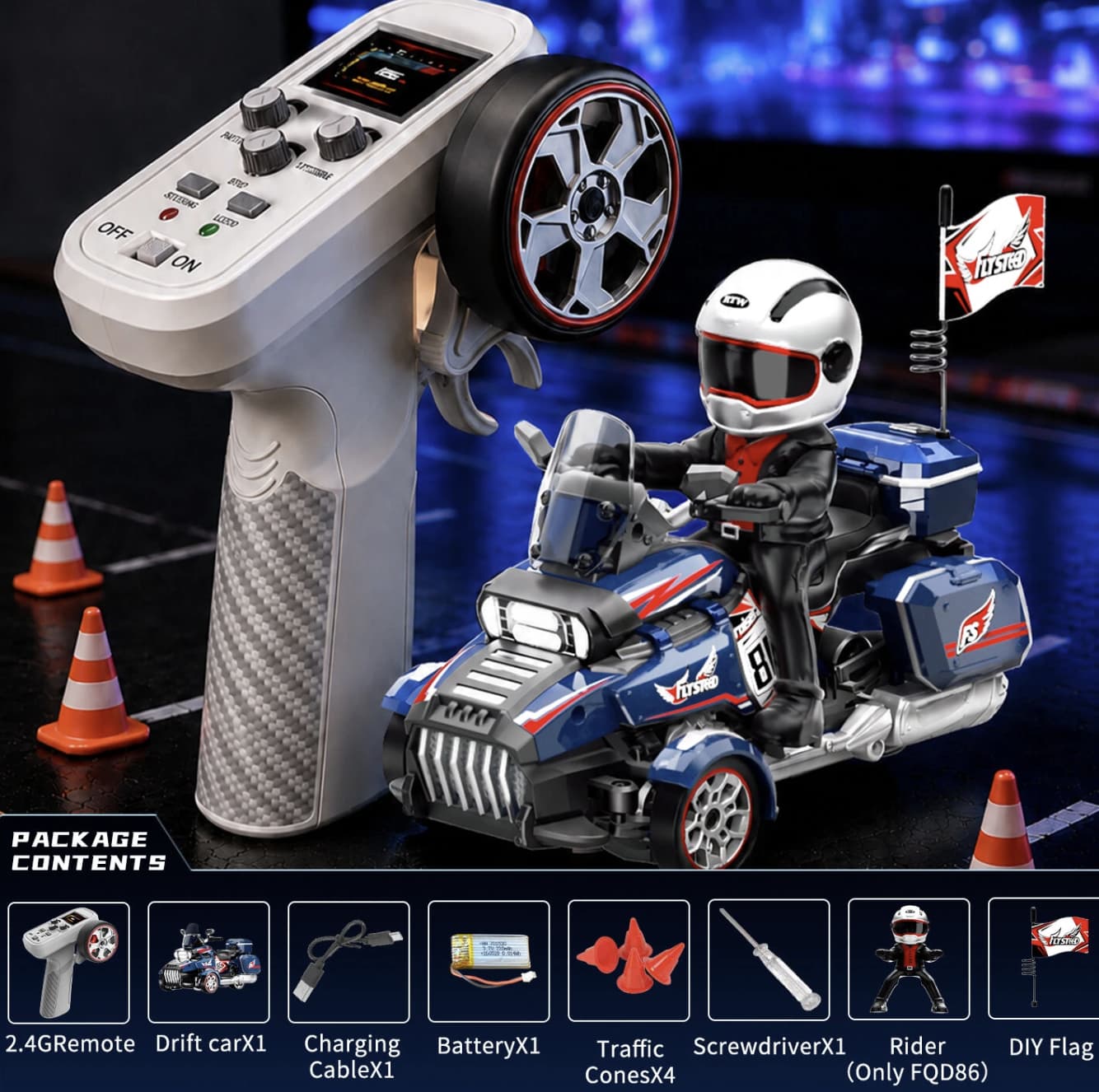
The vehicle also comes with a dedicated remote controller, so it is an RTR package rather than a kit requiring separate electronics.
A Small RC Vehicle With a Distinct Personality
The FQD86’s physical design is arguably just as important as its electronics.
The motorcycle-inspired three-wheel format gives it a very different appearance from the typical miniature sports car or off-road truck. That makes it attractive to buyers who want something unusual rather than another familiar RC body.
Its ABS construction keeps the design compact, while the included electronics provide the control functions needed for proportional driving and gyro-assisted movement.
Because the vehicle is so small, its visual design becomes part of the appeal. It can function as both a remotely controlled toy and a miniature model when it is sitting on a desk.
What You Get in the Box
The current Banggood listing specifies the following package contents:
- Fayee FQD86 RC drift trike
- 2.4GHz remote controller
- USB charging cable
- Road-block/obstacle set
- User manual
The vehicle battery is included, while the remote requires two AA batteries, which are not included.
The included obstacles are particularly useful because they allow the owner to create a small driving course instead of simply driving the vehicle randomly around a room.
That fits the FQD86’s character quite well. Its compact size means a simple collection of cones or barriers can turn a small area into a miniature practice track.
Fayee FQD86 Specifications
| Feature | Fayee FQD86 |
|---|---|
| Scale | 1:43 |
| Drivetrain | 3WD |
| Radio frequency | 2.4GHz |
| Motor | High-speed coreless motor |
| Steering servo | 2g digital servo |
| Gyro | Built-in |
| Battery | 3.7V 220mAh LiPo |
| Claimed runtime | About 15 minutes |
| Charging time | About 35–40 minutes |
| Charging | 5V/1A Type-C |
| Claimed control distance | About 20–25m |
| Vehicle size | 115 × 65 × 70mm |
| Vehicle weight | About 392g |
| Lighting | LED |
| Control | Full proportional |
| Materials | ABS + electronic components |
Specifications are based on the current Banggood product listing rather than independent testing.
Who Should Consider the FQD86?
The FQD86 makes the most sense for a particular type of RC enthusiast.
Good fit for:
People who want something different from a conventional RC car.
The three-wheel motorcycle-style design immediately separates it from the crowded four-wheel mini RC category.
Indoor RC enthusiasts.
Its compact dimensions make it easier to operate in limited spaces, provided the surface is reasonably smooth.
Beginners interested in drifting.
The proportional controls and integrated gyro provide useful electronic assistance while learning how the vehicle reacts to steering and throttle inputs.
Collectors and RC model fans.
The unusual 1:43 trike format gives it display appeal even when it is not being driven.
Less suitable for:
Off-road driving.
The small chassis and drift-oriented design are not intended for rough terrain.
Long-duration RC sessions.
The listed 15-minute runtime is better suited to short driving sessions than extended outdoor use.
High-speed racing.
The FQD86 is designed around compact drifting and maneuverability rather than being a pure speed-focused RC car.
The Real Reason to Buy the FQD86
The FQD86 does not need to compete with larger RC cars on speed, size, or off-road capability.
Its selling point is that it offers a different driving experience in a very small package.
The combination of a three-wheel drivetrain, proportional control, gyro assistance, LED lighting, and motorcycle-inspired styling gives it a character that a conventional 1:43 RC car does not necessarily have.
For someone building a collection of miniature RC vehicles, that difference is meaningful. It is also why the FQD86 is more interesting when viewed as a compact drift trike rather than simply another inexpensive remote-control car.
Final Verdict
Fayee FQD86 is an unusual miniature RC vehicle aimed at drivers who value novelty and controllability over outright speed.
Its 3WD layout and integrated gyro are the defining features, while full proportional control gives the driver more precise input than basic toy-grade RC systems. The 1:43 scale makes it practical for smaller spaces, and the LED lighting and included obstacles add to its play value.
The biggest limitations are equally clear: the small chassis is not suited to rough terrain, and the listed battery runtime of around 15 minutes means driving sessions will be relatively short.
But that is also why the FQD86 should not be judged like a traditional off-road RC car.
It is a compact drift-focused trike with its own personality, designed for quick sessions, small spaces, and experimenting with controlled slides. For RC fans looking for something more distinctive than another four-wheel mini car, that combination is what makes the Fayee FQD86 worth a closer look.
Note: This article is based on the manufacturer’s/Banggood-listed specifications and available product information. It is not a hands-on test, so performance claims such as handling, range, and runtime should be treated as stated specifications rather than independently measured results.