










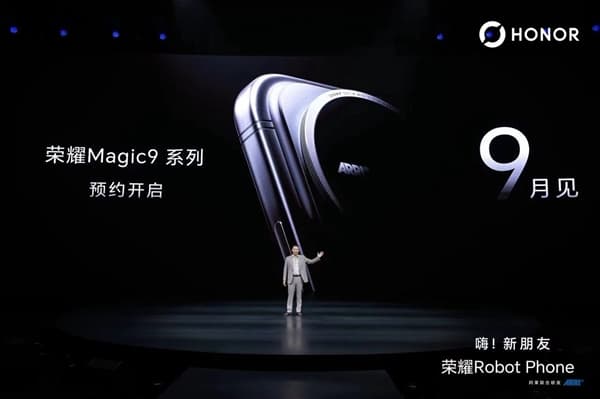
Honor has officially confirmed the launch date for its next-generation flagship smartphone family. The Honor Magic 9 series will be unveiled on September 28, bringing major upgrades in performance, photography and artificial intelligence.
Honor CEO Li Jian announced the launch date during a post-event interview following the company’s recent introduction of the Honor Robot Phone. The Magic 9 series has also reportedly entered the reservation phase through Honor’s official online store in China.
The upcoming lineup is expected to serve as Honor’s flagship smartphone family for the remainder of 2026, with the company positioning it firmly in the premium segment.
Honor Magic 9 Series to Launch on September 28
According to information reported by FastTech on August 13, Honor has confirmed that the Magic 9 series will officially debut on September 28, 2026.
The announcement comes shortly after Honor unveiled its first robot phone, marking an increasingly aggressive expansion of the company’s premium technology portfolio.
Honor has not yet revealed the complete Magic 9 lineup, but the series is expected to include multiple flagship models targeting different segments of the premium smartphone market.
Reservations for the new generation have already begun through the Honor Mall, allowing consumers to register their interest ahead of the official launch.
First Honor Flagship With a 2nm Snapdragon Chip
Performance is expected to be one of the biggest highlights of the Magic 9 series.
Honor says the new lineup will be among the first smartphones to adopt Qualcomm’s next-generation Snapdragon 8 Elite Gen 6 flagship platform.
The processor is reportedly manufactured using TSMC’s N2P 2nm process, representing a major transition toward smaller and more efficient semiconductor technology.
Compared with the previous generation, the new Snapdragon platform is expected to deliver improvements across several areas, including:
- CPU and GPU performance
- Power efficiency
- On-device artificial intelligence
- Sustained flagship performance
- Advanced mobile computing capabilities
For Honor, the move to a 2nm flagship platform is particularly significant. The Magic 9 series will reportedly become the company’s first flagship smartphone generation to enter the 2nm era.
The smaller process node could allow Qualcomm and smartphone manufacturers to achieve greater performance while reducing energy consumption, although real-world improvements will ultimately depend on the final chip design and Honor’s system optimization.
Century-Old German Imaging Brand Collaboration
Photography will be another major focus of the Magic 9 series.
Honor has announced a collaboration with a century-old German professional imaging equipment brand, Ale, with the two companies reportedly working together on imaging technology for the new flagship series.
The collaboration is expected to cover both still photography and video recording, potentially giving the Magic 9 series a stronger position in the increasingly competitive premium smartphone camera market.
Honor has increasingly emphasized professional imaging capabilities across its flagship products, and the new partnership suggests that the company intends to take this strategy further with the Magic 9 generation.
200MP Main Camera With a Large Sensor
According to information shared by digital blogger Digital Daxia Tixiang, the Magic 9 series could feature a high-resolution 200MP primary camera using a 1/1.28-inch sensor.
The main camera is reportedly paired with a large f/1.57 aperture, allowing more light to reach the sensor and potentially improving image quality in low-light environments.
The camera is also said to support 3° OIS optical stabilization.
A large sensor combined with a wide aperture and optical stabilization could give the Magic 9 series significant advantages in areas such as:
- Night photography
- Portrait photography
- Handheld video recording
- High-resolution image capture
- Dynamic-range performance
However, these specifications remain based on current industry leaks and should be confirmed by Honor at the official launch.
200MP Telephoto Camera Could Strengthen Zoom Photography
The Magic 9 series is also rumored to receive a powerful 200MP telephoto camera.
The reported telephoto sensor measures approximately 1/1.4 inches and features an f/2.6 aperture.
If accurate, this would be an unusually large sensor for a smartphone telephoto camera.
The combination of high resolution and a large sensor could allow Honor to improve image quality across multiple focal lengths while giving the computational photography system more data for digital zoom and hybrid zoom processing.
The upgrade could be particularly important as premium smartphones increasingly compete on long-range photography rather than relying solely on improvements to their main cameras.
Imaging Technology From the Honor Robot Phone
Honor is also expected to carry forward some of the imaging technology introduced with its recently unveiled Honor Robot Phone.
The company has indicated that the Magic 9 series will further develop professional imaging technologies used on the Robot Phone while incorporating additional AI capabilities.
This could mean the Magic 9 lineup will use AI more extensively for scene recognition, image processing, portrait photography, video stabilization and computational zoom.
Honor has been increasingly positioning AI as a core component of its premium devices rather than simply an additional software feature.
AI Expected to Become a Major Focus
Beyond camera improvements and processor upgrades, the Magic 9 series is expected to deliver significant advances in AI.
The Snapdragon 8 Elite Gen 6 platform is designed to provide stronger on-device AI processing, while Honor is expected to combine Qualcomm’s hardware capabilities with its own AI software ecosystem.
Potential applications could include intelligent photography, real-time image processing, personalized recommendations, productivity features and more sophisticated AI-assisted interactions.
Honor’s recent Robot Phone launch also demonstrates the company’s interest in agentic and embodied AI, suggesting that AI will likely play an increasingly important role across its future flagship products.
A More Aggressive Premium Strategy
The Magic 9 series arrives at an important time for Honor.
The company has been expanding beyond its traditional smartphone positioning and increasingly competing with established premium manufacturers across global markets.
By adopting a 2nm Snapdragon flagship platform and investing heavily in smartphone imaging, Honor is targeting two of the most important differentiators in the premium segment: performance and camera technology.
The reported 200MP main and telephoto sensors could also give the Magic 9 series a distinctive hardware advantage if the specifications are confirmed.
Honor Magic 9 Series: What to Expect
Based on the information currently available, the Honor Magic 9 series is expected to offer:
- September 28, 2026 official launch
- Snapdragon 8 Elite Gen 6 flagship platform
- TSMC N2P 2nm manufacturing process
- Upgraded on-device AI capabilities
- Collaboration with century-old German imaging brand Ale
- 200MP 1/1.28-inch main camera
- f/1.57 main-camera aperture
- 3° OIS stabilization
- 200MP 1/1.4-inch telephoto camera
- f/2.6 telephoto aperture
- Enhanced professional imaging features
- Further AI integration
Honor has yet to disclose the full specifications, pricing and global availability of the Magic 9 series. The reported camera specifications are also based on leaks and should therefore be treated as unofficial until the company confirms them.
Nevertheless, the September 28 launch date is now official, and the combination of 2nm Snapdragon technology, large camera sensors, professional imaging collaboration and expanded AI capabilities suggests that the Magic 9 series could become one of Honor’s most ambitious flagship smartphone launches of 2026.
As the premium smartphone market becomes increasingly focused on AI and computational photography, Honor’s next-generation Magic series will be closely watched to see whether the company can translate its hardware ambitions into meaningful real-world improvements.