










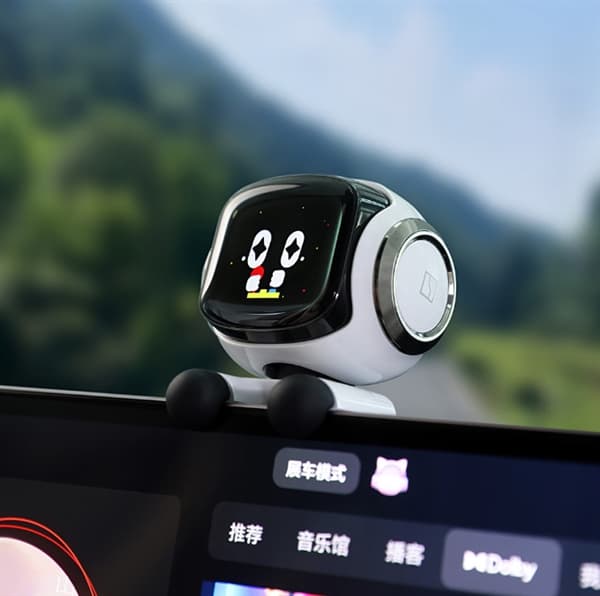
August 14, 2026 — Igeekphone: KQ Auto has officially launched its new KQ Eva in-car robot, an interactive automotive accessory designed to add a more expressive and personalized element to the driving experience.
The robot is now available through JD.com, with final payments beginning at 8:00 a.m. on August 14. Although its official suggested retail price is 1,199 yuan, customers who previously paid a 10-yuan deposit can reportedly receive a 410-yuan discount, bringing the final purchase price down to 799 yuan.
The KQ Eva is compatible with multiple KQ vehicle models, including the KQ 001, KQ 7X, KQ 8X, and KQ 9X, although compatibility depends on the vehicle’s infotainment hardware.
Astronaut-Inspired Design for the Smart Cabin
The KQ Eva robot takes its visual inspiration from an astronaut, giving the device a distinctive appearance designed to fit naturally into the cabin environment.
Rather than functioning as a conventional navigation or control device, Eva is primarily intended to serve as an interactive companion and emotional-atmosphere accessory.
The robot is integrated with the vehicle’s intelligent voice-assistant system, allowing its physical movements and facial expressions to respond to different driving situations.
This gives the cabin a more animated and personalized character, particularly for drivers who enjoy interactive technology.
799 Yuan Launch Price
According to the JD.com listing, the KQ Eva has an official guide price of 1,199 yuan.
However, the launch promotion significantly lowers the effective price:
| Item | Price |
|---|---|
| Official guide price | 1,199 yuan |
| Deposit | 10 yuan |
| Deposit discount | 410 yuan |
| Final promotional price | 799 yuan |
The promotional terms may be subject to JD.com and KQ Auto’s specific sales conditions.
Type-C Power Makes Installation Easier
One of the biggest advantages of the KQ Eva is its universal USB Type-C power connection.
The accessory comes with a power cable and fixing clips, allowing owners to install it themselves rather than requiring a professional installation appointment.
KQ recommends connecting the Type-C power cable to the robot before attaching the adhesive to the rear of the center console.
The company’s suggested cable route runs from the rear of the robot, along the back of the center console, and toward the armrest compartment. Owners can adjust the cable routing according to the layout of their vehicle and their preferred installation style.
This approach makes the Eva more accessible as an aftermarket accessory.
The Trade-Off: One USB-C Port Is Occupied
The Type-C installation method is convenient, but it comes with an obvious compromise.
Unlike the factory-integrated version developed for models such as the 007GT, the aftermarket KQ Eva obtains power directly from the vehicle’s USB-C port.
As a result, installing the robot will occupy one of the vehicle’s available charging ports.
Cable management is also dependent on the owner’s installation. A carefully routed cable can maintain a clean appearance, while a less precise installation may leave visible wiring. Some vehicle configurations may therefore benefit from additional cable-concealment work.
For owners who regularly use the vehicle’s USB-C port for charging smartphones or other accessories, this is an important consideration.
Dual-Axis Movement and 30+ Expressions
The Eva robot isn’t simply a stationary decorative accessory.
Its hardware incorporates a dual-axis mechanical structure, allowing the robot to move up and down while also turning its head.
The built-in display can reportedly show more than 30 different dynamic expressions, giving Eva a range of reactions depending on what’s happening inside the vehicle.
These physical movements and visual expressions are designed to make interactions feel more natural and engaging.
Responds to Different Driving Situations
The KQ Eva is designed to respond to a variety of vehicle events.
When the vehicle is powered on and the driver enters, the robot can provide a welcome greeting. When the vehicle is switched off and the driver leaves, it can respond with a goodbye.
The robot can also react when the vehicle’s voice assistant is activated. When it detects a voice interaction, its head can turn toward the apparent sound source, creating the impression that the robot is listening to the driver.
Other vehicle events can trigger corresponding expressions and movements, including:
- Switching driving modes
- Reversing
- Seat-belt reminders
- Voice-assistant activation
- Vehicle startup
- Vehicle shutdown
This creates a more animated relationship between the vehicle’s software and the physical accessory.
OTA Updates Could Add New Interactions
KQ also plans to expand the Eva’s functionality through OTA software updates.
Future vehicle-system updates could introduce additional expressions, interactive Easter eggs, and other animation content.
This is an important distinction from traditional car accessories. Instead of remaining static after purchase, the robot’s library of expressions and interactions could evolve over time as KQ adds new software content.
Bluetooth and KQ+ App Connectivity
The Eva robot connects to the vehicle’s infotainment system through Bluetooth and the KQ+ application.
According to the current compatibility information, the accessory supports refreshed versions of several KQ models, including:
- KQ 001
- KQ 007
- KQ 009
- KQ 7X
- KQ 8X
- KQ 9X
- Other compatible KQ models equipped with the 8295 platform
The vehicle’s hardware is particularly important here.
The KQ Eva requires a vehicle system based on the Qualcomm 8295 automotive platform. Older KQ vehicles without the 8295-based system are not compatible with the accessory.
Therefore, prospective buyers should verify their vehicle’s hardware configuration before purchasing.
Works With the Vehicle’s Super Eva System
The KQ Eva robot can reportedly connect with the vehicle’s Super Eva intelligent body, enabling more human-like emotional interaction between the car’s software and the physical robot.
For example, the vehicle system can determine the appropriate interaction based on voice commands or driving conditions, while the physical Eva provides a visual and mechanical response.
This creates a bridge between the vehicle’s digital assistant and a physical device that can move, look toward the driver, and display different expressions.
Not an Independent AI Robot
Despite its smart features, the KQ Eva should not be confused with a standalone AI robot.
The accessory does not have independent AI computing capabilities. Instead, its intelligent functions depend on the vehicle’s infotainment system.
In practical terms, the robot acts as a physical extension of the vehicle’s existing intelligent system rather than an independent computer.
This also means that the Eva does not perform core vehicle-control functions independently. Its primary role is to provide emotional interaction, visual feedback, and cabin atmosphere, rather than operate the vehicle.
More of an Emotional Companion Than a Driving Tool
The KQ Eva represents an interesting direction for smart-car accessories.
Most automotive peripherals are designed around practical functions such as charging, navigation, storage, or vehicle control. Eva takes a different approach by focusing on the emotional and entertainment aspects of the cabin.
Its movements, expressions, greetings, and reactions are intended to make the vehicle feel more interactive and personable.
For families and technology enthusiasts, the animated robot could make the interior experience more entertaining, while drivers who prefer a minimalist cabin may see it as an unnecessary accessory.
KQ Eva Key Specifications and Features
| Feature | KQ Eva |
|---|---|
| Product type | In-car interactive robot |
| Design inspiration | Astronaut |
| Launch price | 799 yuan promotional price |
| Official guide price | 1,199 yuan |
| Power | USB Type-C |
| Installation | Self-installation |
| Movement | Dual-axis mechanism |
| Expressions | 30+ dynamic expressions |
| Connectivity | Bluetooth + KQ+ app |
| AI computing | No independent AI computing |
| Vehicle integration | KQ intelligent vehicle system |
| Required platform | Compatible 8295-based vehicle system |
| OTA support | Expression library and interactive content |
| Primary function | Emotional interaction and cabin atmosphere |
Who Is the KQ Eva For?
The KQ Eva is primarily aimed at KQ vehicle owners who want to personalize their cabin and add a more interactive experience.
It may appeal particularly to:
- KQ owners with compatible 8295-based vehicles
- Technology enthusiasts
- Families with children
- Drivers interested in smart-car ecosystems
- Users who enjoy animated accessories
- Owners looking for a more personalized cabin experience
However, buyers should confirm vehicle compatibility before ordering, especially if they own an older KQ model.
Final Thoughts
KQ Eva in-car robot is an unusual automotive accessory that combines physical movement, dynamic expressions, Bluetooth connectivity, and integration with KQ’s intelligent vehicle system.
Its 799-yuan promotional price, Type-C power supply, and self-installation design make it relatively easy for compatible vehicle owners to add the accessory without professional installation. The more than 30 dynamic expressions, dual-axis movement, voice interaction, and driving-event responses give the robot a more engaging presence than a conventional dashboard accessory.
The biggest limitation is compatibility. The Eva requires a compatible KQ vehicle system based on the 8295 platform, meaning owners of older vehicles may not be able to use it. It also occupies a USB-C charging port and does not contain independent AI computing hardware.
Ultimately, the KQ Eva is less about adding another functional control system to the car and more about making the smart cabin feel alive. By turning vehicle-system events into physical movements and animated expressions, KQ is experimenting with a more emotional and character-driven approach to automotive technology.