









In recent years, vaping has increasingly become a focus of public health policy, legal battles, and regulatory scrutiny across the United States and globally. The landscape shifted again with Vape Master Settlement, a landmark agreement that could have far‑reaching consequences for the vaping industry, manufacturers, retailers, and consumers alike. The settlement raises questions about accountability, public health, and the future of vaping as both a smoking‑cessation tool and a consumer market.
What Is the Vape Master Settlement?
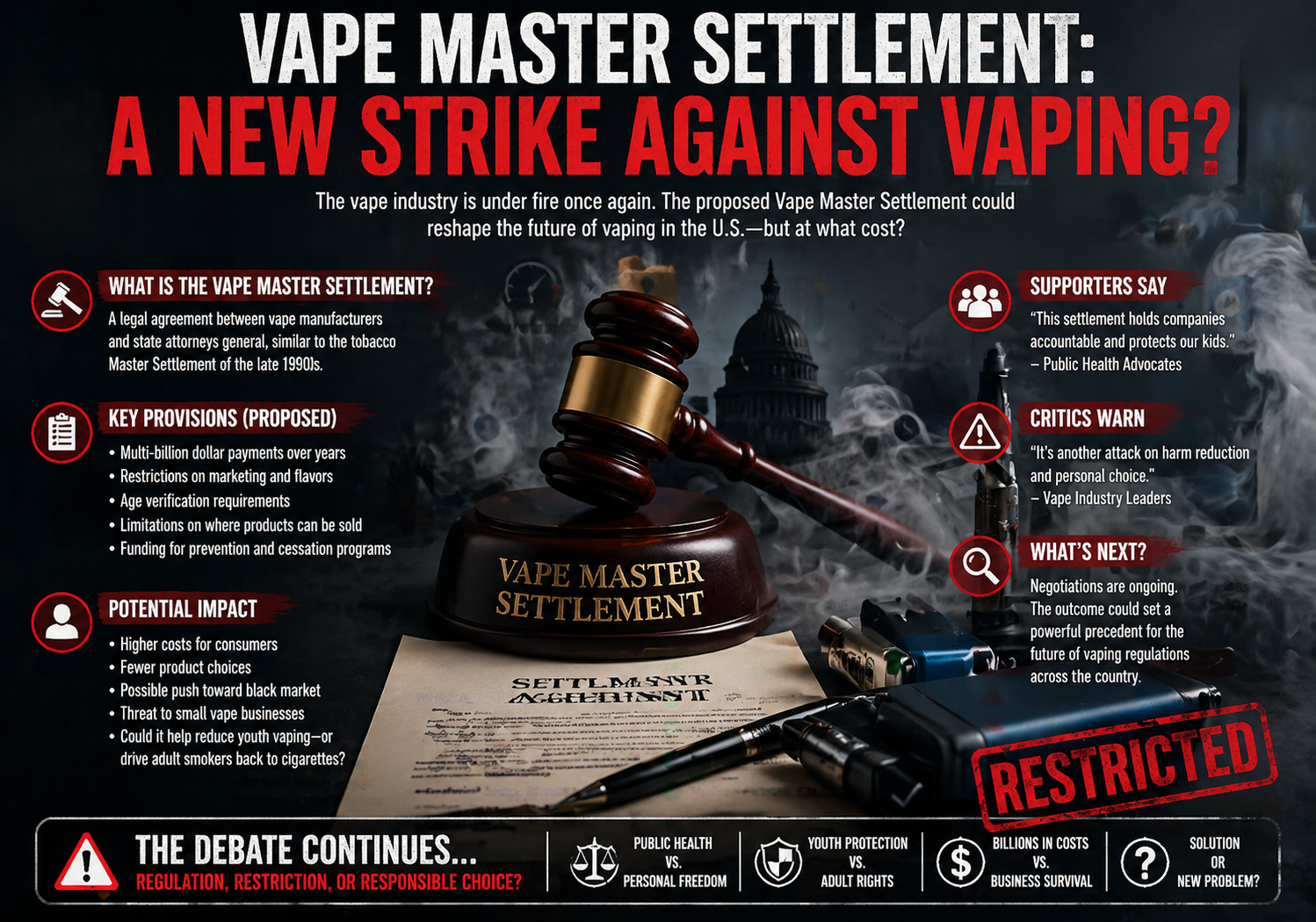
The Vape Master Settlement refers to a comprehensive legal agreement between state attorneys general and several major electronic cigarette and vaping product manufacturers. Modeled in part on the historic 1998 Tobacco Master Settlement Agreement — which imposed sweeping restrictions and financial penalties on traditional cigarette makers — this new settlement targets the emerging vaping sector.
Under the agreement, participating companies are required to:
- Pay billions in settlements and fines to state governments.
- Limit marketing practices that appeal to minors.
- Implement strict age‑verification and product tracking systems.
- Accept enhanced regulatory oversight moving forward.
Although the settlement does not ban vaping outright, it places new constraints on how vaping products can be marketed, sold, and distributed.
Why It Matters: A Public Health Perspective
Proponents of the Vape Master Settlement — including public health advocates, legislators, and some state officials — argue that it is a necessary step to combat youth vaping and protect communities from the potential harms of nicotine addiction.
Reducing Youth Access and Marketing
One of the key drivers behind the settlement is concern over the rapid increase in youth vaping over the last decade. According to national health surveys, millions of middle and high school students have experimented with e‑cigarettes, drawn by sweet flavors, colorful packaging, and aggressive marketing tactics. Critics claim that these tactics mirror the strategies used by tobacco companies decades ago to attract new generations of smokers.
The settlement’s emphasis on:
- Stronger age verification systems
- Restrictions on flavored product distribution
- Prohibition of marketing that targets minors
is designed to curb underage access and discourage youth initiation.
Balancing Harm Reduction with Regulation
Supporters of vaping as a smoking cessation tool argue that adult smokers can benefit from switching to e‑cigarettes, which some studies suggest may reduce exposure to harmful combustion byproducts found in tobacco smoke. The Vape Master Settlement seeks to strike a balance by making products less appealing and accessible to youth while still allowing adult access under regulated conditions.
Industry Impact: Costs, Compliance, and Innovation
For the vaping industry, the settlement represents both a financial burden and a shift in how business must be conducted.
Financial Penalties
Participating companies are now responsible for substantial payments to state governments. These funds are earmarked for healthcare programs, anti‑addiction initiatives, and regulatory enforcement efforts.
New Compliance Framework
The settlement introduces new compliance obligations, such as:
- Enhanced age verification at point‑of‑sale and online
- Detailed product tracking and reporting
- Restrictions on youth‑targeted advertising
Compliance will require investment in technology, staff training, and updated operational processes — particularly for smaller businesses that may struggle with the increased regulatory load.
Product Development and Innovation
The settlement’s restrictions on flavors considered attractive to youth (such as candy‑ or fruit‑based profiles) could limit the product variety available on the market. While some flavor categories — like menthol or tobacco — may remain permissible for adult consumers, other flavors may be subject to phase‑outs or stricter controls.
Manufacturers may need to innovate within these limitations, potentially focusing on:
- Adult‑oriented flavor options
- Reduced‑risk product formats
- Safer delivery technologies
Consumer Response: Confusion or Clarity?
The settlement has triggered mixed reactions among consumers. Some adult vapers welcome stronger regulation, believing it can strengthen the credibility of vaping as a legitimate alternative to smoking. Others see it as an overreach that limits choice and access, particularly in states with strict enforcement mechanisms.
Key concerns voiced by consumers include:
- Higher product costs as companies pass on settlement expenses.
- Reduced availability of preferred flavors.
- Increased barriers for adult users to purchase products.
At the same time, the settlement’s supporters argue that responsible adult consumers benefit from a regulated marketplace that reduces youth uptake and enhances product safety standards.
Legal and Regulatory Context
The Vape Master Settlement is not the only legal effort targeting vaping. Across the United States, individual states and municipalities have enacted their own regulations, including:
- Flavor bans
- Retail licensing requirements
- Restrictions on advertising near schools
Additionally, the U.S. Food and Drug Administration (FDA) continues to enforce premarket review requirements under its regulatory authority, requiring manufacturers to demonstrate that their products are appropriate for public health.
The settlement complements these measures by creating standardized industry obligations at the state level, potentially reducing the patchwork of conflicting local regulations.
Looking Ahead: What Comes Next?
The true impact of the Vape Master Settlement will unfold over the coming years as companies adapt and compliance mechanisms take effect. Key questions remain:
- Will youth vaping rates decrease significantly?
- How will the industry respond with new product strategies?
- Will other countries adopt similar settlement models?
- Will legal challenges arise from manufacturers or trade groups?
Conclusion: A New Era in Vaping Regulation
Vape Master Settlement marks a significant moment in the evolution of vaping policy. Though it stops short of banning e‑cigarettes, it imposes meaningful constraints designed to reduce youth vaping and shift the industry toward more responsible practices.
Whether viewed as a necessary public health safeguard or a blow to consumer freedom and innovation, the settlement signals a new chapter in the regulation of vaping — one that prioritizes accountability, transparency, and measured access.
As with the original tobacco settlement decades ago, the magnitude of its long‑term effects on public health, industry dynamics, and consumer behavior remains to be seen.