











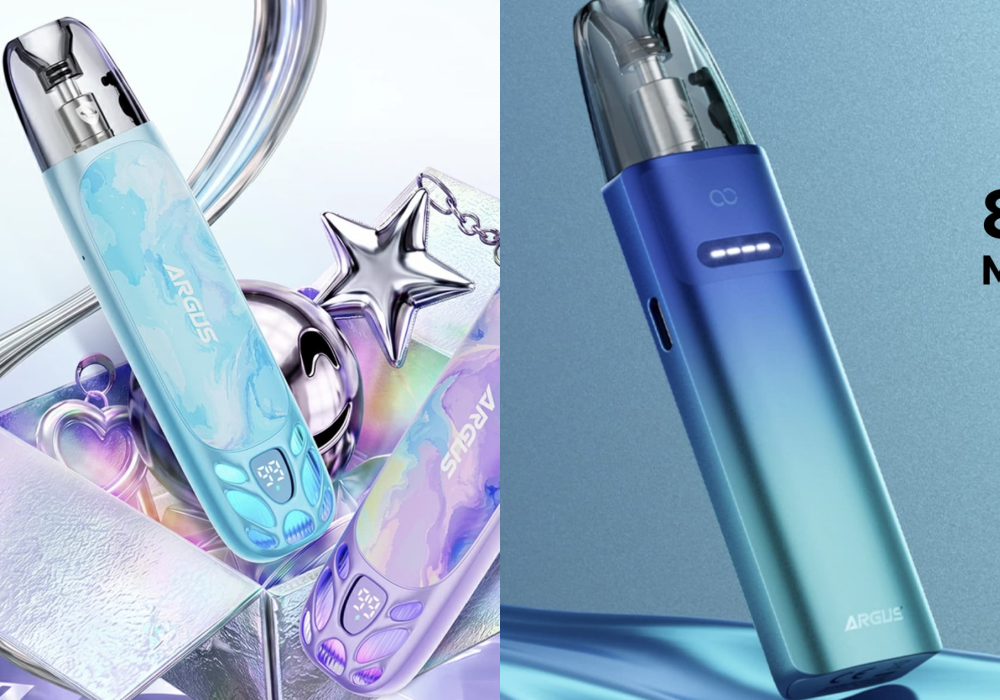
VOOPOO ARGUS LINK and ARGUS G4 mini belong to the same ARGUS pod family, but they take noticeably different approaches to hardware design and everyday operation. The LINK emphasizes a distinctive zinc-alloy body, three lighting modes and a 1,500mAh battery. The G4 mini focuses on a lighter metal construction, a larger 1,650mAh battery and a switchable multi-ohm cartridge.
For a closer look at its construction, lighting modes and cartridge compatibility, read our detailed VOOPOO ARGUS LINK review.
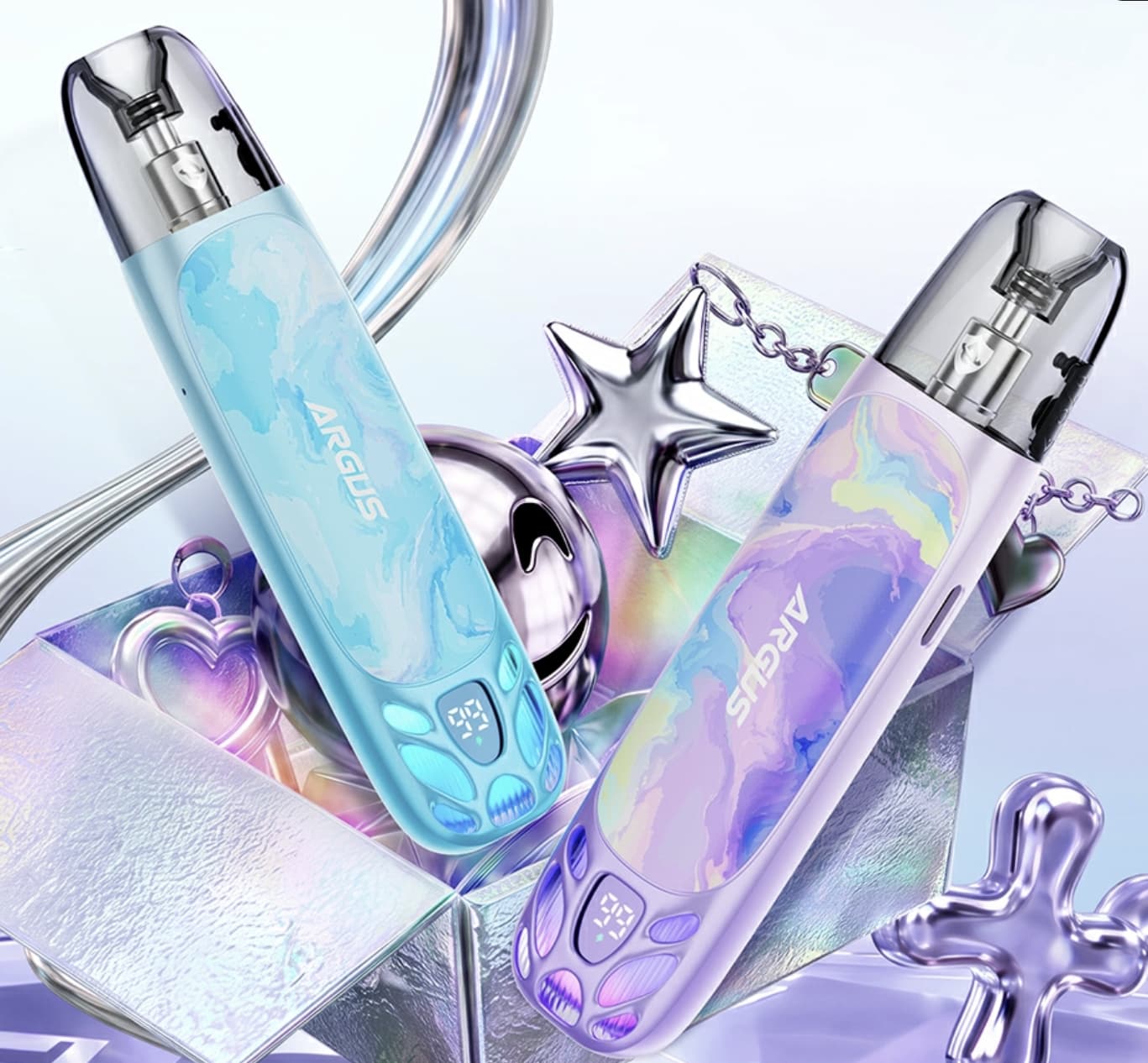
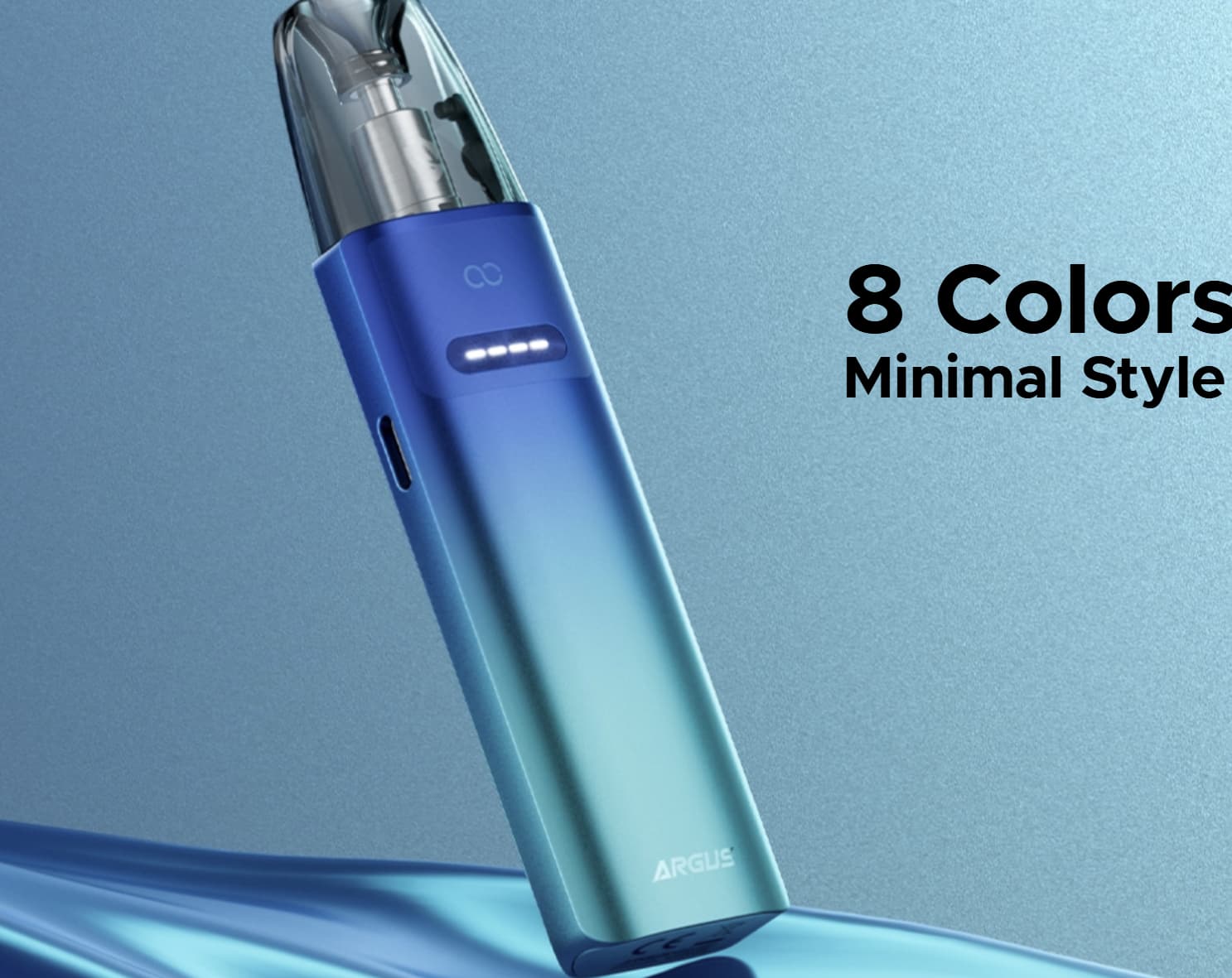
The interesting part of this comparison is not simply which device has the bigger battery. It is how VOOPOO has divided its product design between visual customization and a more configurable cartridge system. Below is a specification-led comparison based on the manufacturer’s published information, rather than claims of hands-on testing.
1. Two devices, two different design priorities
The ARGUS LINK is visually more expressive. Its zinc-alloy body is paired with three lighting modes: Business, Party and Gather. These lighting options give the device a more distinctive appearance than a conventional pod system. VOOPOO also highlights an optional MOODZ protective case, with character designs such as Bear Hug, Dino Boy, Skater Buddy and Panda Dude. Availability is described as limited, so the case should not be assumed to be included with every purchase.
The G4 mini takes a more restrained approach. Its aluminum-alloy unibody construction weighs approximately 56g, with a slimmer 113 × 27.6 × 14.6mm profile. Rather than making lighting the central design feature, it uses an Energy Bar indicator to communicate battery level and cartridge resistance. VOOPOO lists eight color options, giving buyers several appearance choices without the LINK’s character-oriented accessory concept.
The difference is therefore more than cosmetic: the LINK emphasizes external styling, while the G4 mini puts more attention on compact construction and functional status indicators.
2. Battery capacity: 1,500mAh vs 1,650mAh
Battery capacity is one of the clearest specification differences.
| Battery detail | ARGUS LINK | ARGUS G4 mini |
|---|---|---|
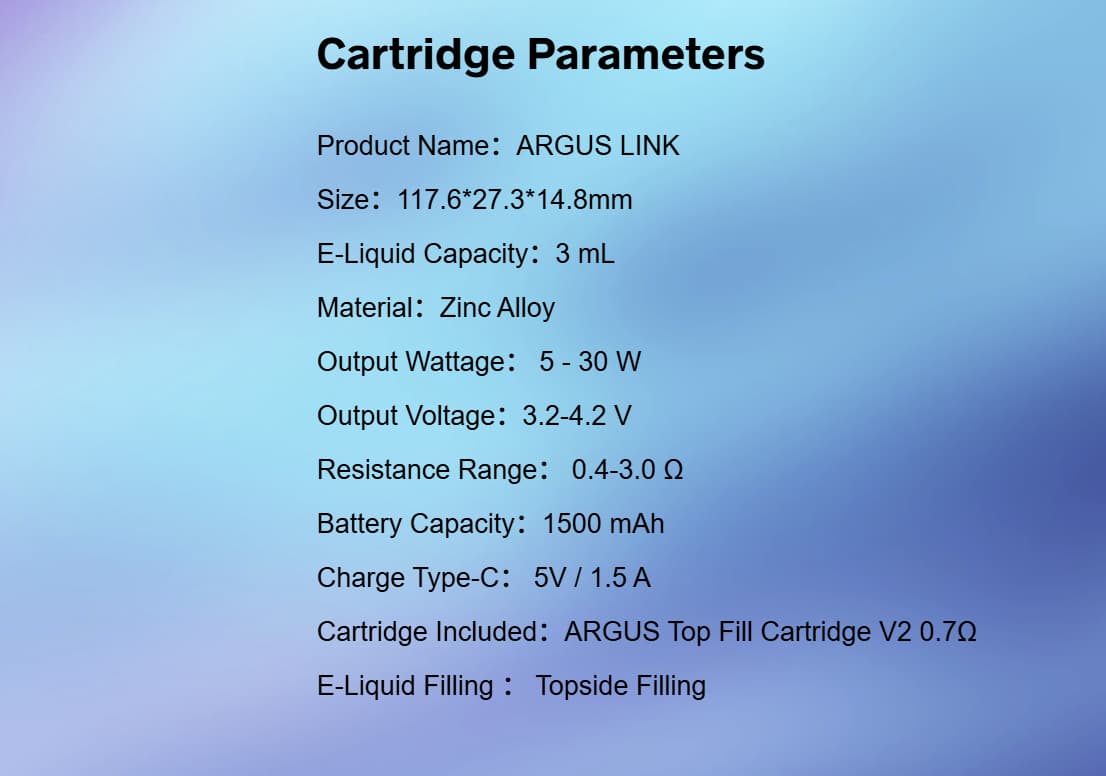
| Built-in battery | 1,500mAh | 1,650mAh |
| Charging port | USB Type-C | USB Type-C |
| Charging input | 5V/1.5A | 5V/1.5A |
| Maximum output | 30W | 30W |
The G4 mini has a 150mAh capacity advantage, equivalent to 10% more nominal battery capacity. That is a measurable difference, although actual operating time also depends on output settings, cartridge resistance, usage patterns and battery condition.
VOOPOO advertises up to five days of use for the G4 mini. This should be treated as a manufacturer estimate rather than a guaranteed runtime for every user. The LINK’s 1,500mAh battery is also substantial on paper, but its official product page does not provide an equivalent five-day claim.
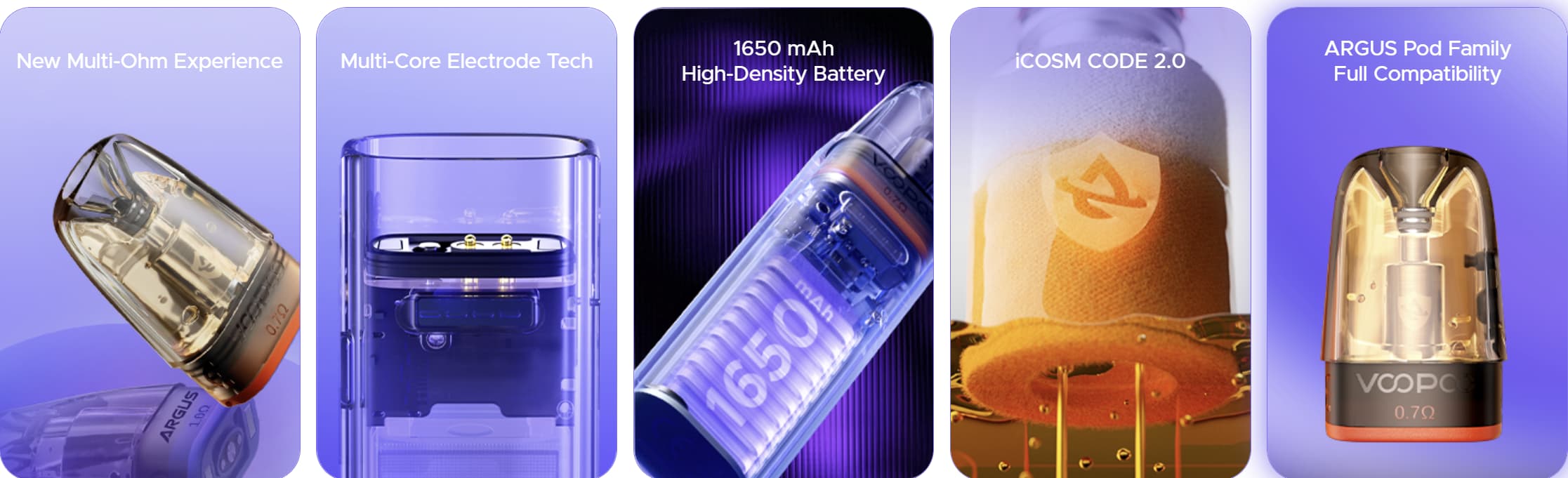
Specification takeaway: The G4 mini has the larger battery, but the difference alone does not establish how much longer it will operate in real-world conditions.
3. Cartridge technology is the biggest functional difference
This is where the comparison becomes more interesting.
The ARGUS LINK comes with an ARGUS Top Fill Cartridge V2 rated at 0.7Ω. Its standard package lists a 3ml cartridge, while the device supports a wider resistance range of 0.4–3.0Ω through compatible cartridges.
The G4 mini is supplied with the ARGUS Multi-Ohm Cartridge. This cartridge integrates two resistance options that can be selected through its design:
-
0.7Ω: One of the two resistance settings supported by the G4 mini’s supplied cartridge.
-
1.0Ω: The alternative resistance setting, selected by flipping the cartridge configuration.
The device communicates the selected setting through its Energy Bar: white light indicates 0.7Ω, while green indicates 1.0Ω. This makes the resistance setting easier to identify without relying on a separate display.
An important distinction: the G4 mini’s supplied Multi-Ohm cartridge offers 0.7Ω and 1.0Ω switching. VOOPOO’s wider ARGUS Multi-Ohm platform also describes a 0.4Ω option, but that should not be confused with the two settings specifically advertised for the G4 mini.
For a technical comparison, this is arguably the G4 mini’s most meaningful feature advantage. The LINK’s included cartridge is a conventional 0.7Ω option, while the G4 mini makes two resistance configurations available in one cartridge.
The technology behind this configuration is explained in our VOOPOO ARGUS Multi-Ohm Cartridge review, which explores how one cartridge supports different resistance configurations.
4. E-liquid capacity and filling design
Both devices use top-fill cartridge designs, but the supplied cartridge specifications differ.
| Cartridge detail | ARGUS LINK | ARGUS G4 mini |
|---|---|---|
| Included cartridge | ARGUS Top Fill Cartridge V2 | ARGUS Multi-Ohm |
| Standard/US capacity | 3ml | 3.5ml |
| TPD capacity | Regional cartridge options | 2ml |
| Filling method | Top-side filling | Top filling |
| Resistance | Included 0.7Ω | Switchable 0.7Ω / 1.0Ω |
The G4 mini has a 3.5ml standard/US cartridge, compared with the LINK’s listed 3ml cartridge. However, regional versions matter: the G4 mini’s TPD cartridge is listed at 2ml, and the LINK also has different compatible cartridge capacities.
This is important when comparing product listings from different countries. A buyer looking at a European version should not assume that it has the same cartridge capacity as the standard or US package.
5. Airflow and user interface
The G4 mini has a documented stepless airflow adjustment system. This gives users a physical way to change airflow rather than relying only on the cartridge’s fixed configuration. Its Energy Bar also combines battery indication and resistance identification in a relatively simple interface.
The LINK’s official product page places more emphasis on its three lighting modes and external design. It lists a 30W maximum output, but does not describe a comparable stepless airflow feature on the product specification section.
That distinction matters when reading product descriptions: a feature not listed on the official page should not automatically be assumed to be present. The G4 mini has a clearer published airflow specification, while the LINK’s main interface feature is its lighting system.
6. Safety protections and compatibility
Both devices belong to VOOPOO’s ARGUS Pod Family and support the manufacturer’s compatible cartridge ecosystem.
The LINK lists seven protection functions:
-
Overtime protection
-
Over-temperature protection
-
Overcharge protection
-
Output over-current protection
-
Low-battery protection
-
Short-circuit protection
-
Maximum-power protection
The G4 mini lists eight, adding poor-connection protection to the functions above.
This is a specification difference, not proof that one device is universally safer. Protection systems are designed to address particular electrical or operating conditions, and neither list should be interpreted as eliminating all product risks.
Compatibility is another shared feature. Both devices support ARGUS Pod Family cartridges, but users should check cartridge resistance, capacity and regional availability before purchasing replacements. Physical compatibility does not mean every cartridge offers identical operating characteristics.
7. Full specification comparison
| Specification | VOOPOO ARGUS LINK | VOOPOO ARGUS G4 mini |
|---|---|---|
| Product type | ARGUS pod system | ARGUS pod system |
| Body material | Zinc alloy | Aluminum alloy |
| Dimensions | 117.6 × 27.3 × 14.8mm | 113 × 27.6 × 14.6mm |
| Weight | Not specified on product page | 56g |
| Battery | 1,500mAh | 1,650mAh |
| Output power | 5–30W | 5–30W |
| Output voltage | 3.2–4.2V | 3.2–4.2V |
| Resistance range | 0.4–3.0Ω | 0.4–3.0Ω |
| Included cartridge | Top Fill V2 0.7Ω | Multi-Ohm 0.7Ω/1.0Ω |
| Standard/US cartridge capacity | 3ml | 3.5ml |
| TPD cartridge capacity | Compatible regional options | 2ml |
| Filling | Top-side filling | Top filling |
| Airflow | Not specified on product page | Stepless adjustment |
| Lighting / indicator | Three light modes | Energy Bar |
| Safety protections | 7 | 8 |
| Charging | Type-C, 5V/1.5A | Type-C, 5V/1.5A |
| Pod compatibility | ARGUS Pod Family | ARGUS Pod Family |
8. What the comparison reveals
The two devices share several core specifications, including a 30W maximum output, Type-C charging, a similar resistance range and compatibility with the ARGUS Pod Family. Their differences are concentrated in the battery, cartridge configuration, body design and interface.
The ARGUS LINK’s identity is built around its zinc-alloy construction and three lighting modes. Its optional MOODZ case adds another layer of external customization, although buyers should verify whether that accessory is included in the package they are considering.
The G4 mini is more focused on compact hardware and cartridge flexibility. Its 1,650mAh battery is larger, its listed weight is 56g, and its included Multi-Ohm cartridge provides 0.7Ω and 1.0Ω settings. It also has documented stepless airflow adjustment and an Energy Bar interface.
One detail worth checking before making a direct price comparison is the package itself. The LINK’s standard package lists a 15ml e-liquid item, while the G4 mini package lists a Type-C cable and cartridge. Regional rules and retailer bundles can change what is supplied.
Final thoughts
The VOOPOO ARGUS LINK and ARGUS G4 mini are not simply two versions of the same device with different shells. Their specifications show two distinct design directions within the ARGUS family.
The LINK is characterized by its zinc-alloy exterior, lighting modes and optional MOODZ case. The G4 mini has a lighter aluminum-alloy body, a slightly larger battery, stepless airflow adjustment and a Multi-Ohm cartridge with two selectable resistance settings.
For readers comparing the hardware, the most useful distinction is the cartridge system: the LINK’s included 0.7Ω Top Fill V2 cartridge is different from the G4 mini’s switchable 0.7Ω/1.0Ω Multi-Ohm cartridge. Battery capacity and body construction are the next most obvious differences.
For exact regional specifications and package contents, consult the manufacturer’s product pages: