










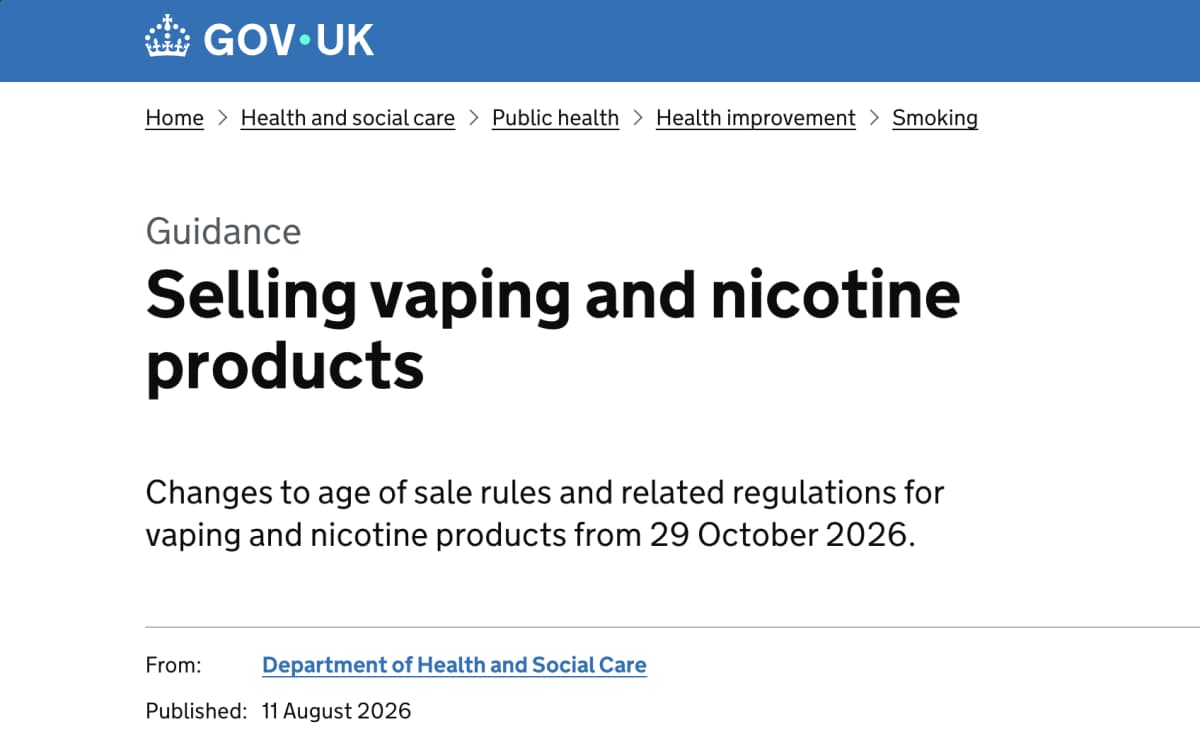
The United Kingdom is preparing to introduce a new phase of retail regulations for e-cigarettes and nicotine products, with stricter requirements covering age verification, proxy purchasing, free promotional products and substantial discounts.
The UK Department of Health and Social Care (DHSC) published new sales guidance on August 11, 2026, outlining requirements scheduled to take effect from October 29, 2026. The measures form part of the implementation of the Tobacco and Vapes Act 2026 and will affect retailers and online sellers across England, Wales, Scotland and Northern Ireland.
While the overall framework applies across the UK, enforcement mechanisms and penalties will differ between jurisdictions.
For retailers and manufacturers, the changes represent a shift from broad age restrictions toward more detailed controls over how e-cigarettes and newer nicotine products are sold and promoted.
New Rules Extend Beyond Nicotine-Containing E-Cigarettes
One of the most significant changes is the expansion of the products covered by the retail rules.
From October 29, retailers and online sellers will be prohibited from selling regulated e-cigarettes and nicotine products to anyone under the age of 18.
The scope includes:
- E-cigarette devices
- E-liquids
- Cartridges and pods
- Coils
- Nicotine pouches
- Nicotine films
- Nicotine beads
- Products containing laboratory-synthesized nicotine
Importantly, the framework also covers zero-nicotine e-cigarettes, broadening the regulatory scope beyond products that contain nicotine.
Medical devices and medicines are excluded from these particular provisions.
The change is especially significant in England, Wales and Northern Ireland, where previous age restrictions primarily focused on nicotine-containing e-cigarettes. Scotland had already applied age restrictions to both nicotine-containing and nicotine-free e-cigarettes, while the new framework extends its coverage to a wider range of consumer nicotine products.
Retailers Must Strengthen Age Verification
The new guidance also places greater emphasis on age verification.
Retailers must take appropriate steps to verify a customer’s age when they cannot reasonably establish that the individual is at least 18 years old.
For businesses operating physical stores, this means staff will need to be prepared to identify customers who may be underage and request appropriate proof of age.
Online retailers will also need to review their existing age-verification systems.
The precise age-verification procedures that will apply in England, Wales and Northern Ireland are expected to be established through additional regulations and parliamentary processes. The government has indicated that the guidance will be updated as the detailed requirements are finalized.
For retailers, the practical implication is clear: existing age-check procedures may need to be reviewed before the October deadline.
Proxy Purchasing Rules Will Also Be Expanded
The regulations go beyond direct sales to minors.
The new framework also addresses proxy purchasing, where an adult attempts to purchase regulated products on behalf of someone under 18.
From October 29, it will be illegal for an adult to purchase or attempt to purchase regulated e-cigarettes or nicotine products for a person under 18.
Retail employees will therefore need to identify situations where proxy purchasing may be taking place and refuse the transaction when there are reasonable grounds for suspicion.
This creates an additional training requirement for retailers because staff must not only verify the age of the person making the purchase but also recognize potentially suspicious purchasing behavior.
Free Gifts and Trial Products Face New Restrictions
Promotional activity will also come under tighter scrutiny.
From October 29, businesses will generally be prohibited from providing free gifts, vouchers or other promotional benefits where the purpose or effect is to promote regulated e-cigarettes or nicotine products.
The rules can apply across different promotional channels, including:
- Physical retail stores
- Online shops
- Promotional campaigns
- Third-party marketing activities
- Free product trials
- Free reusable cartridges
- Branded promotional merchandise
This means businesses will need to reconsider promotional campaigns that rely on free samples or gifts to attract new customers.
Products carrying e-cigarette brand names, as well as other promotional items used to market regulated products, may also fall within the restrictions depending on how they are used.
Symbolic Pricing Could Be Considered an Illegal Promotion
The new framework also addresses attempts to circumvent promotional restrictions through extremely low prices.
Businesses will not be permitted to use substantial discounts or promotional coupons in a way that effectively functions as a promotional giveaway.
The government’s guidance reportedly gives the example of selling e-liquid, e-cigarette devices or nicotine products for a symbolic price such as 10 pence as potentially constituting an illegal promotion.
The purpose is to prevent retailers from technically charging for a product while effectively giving it away as part of a customer-acquisition campaign.
However, the rules do not mean that every price reduction will automatically be illegal.
Normal Clearance Sales Can Still Take Place
Retailers will still be able to reduce prices in certain circumstances.
The guidance allows businesses to discount unsold inventory as part of normal commercial operations, while legitimate trade discounts can also continue.
Whether a discount is considered a prohibited substantial discount will depend on several factors, including:
- The product’s normal selling price
- The size of the reduction
- The circumstances surrounding the price reduction
- The purpose of the promotion
- Whether the activity is designed to encourage purchases
This distinction will be important for retailers managing seasonal inventory, discontinued products and clearance stock.
Businesses will need to distinguish between legitimate inventory management and promotional activity designed to attract customers through unusually low prices.
Exceptions for Smoking Cessation Programs
The regulations include exceptions for certain publicly supported smoking-cessation services.
Programs commissioned or funded by local authorities or the UK’s National Health Service (NHS) may continue to provide e-cigarettes, nicotine products or vouchers free of charge where they form part of an authorized smoking-cessation service.
These programs must comply with the relevant agreements and regulatory requirements.
The exemption recognizes the UK’s broader public-health strategy of using regulated nicotine products as part of smoking-cessation interventions while restricting commercial promotional practices.
Financial Penalties Begin at £200 in Several UK Nations
Businesses that violate the new requirements could face fixed penalties.
From October 29, violations in England, Wales and Scotland involving the sale of regulated e-cigarettes or nicotine products to minors, illegal proxy purchasing, prohibited free distribution or substantial promotional discounts could result in a £200 Fixed Penalty Notice (FPN), equivalent to approximately $270.
In Northern Ireland, the proposed fixed penalty is £250, or approximately $330. The relevant Northern Ireland provisions still require approval by the Northern Ireland Assembly.
More serious cases can proceed through the courts and potentially result in higher penalties.
Repeat Offenders Could Lose Sales Rights
The consequences can become significantly more serious for repeat offenders.
In England and Wales, retailers that commit qualifying violations at least three times within two years could be prohibited from selling designated products for up to 12 months.
In Scotland, similar repeat violations could lead to a sales prohibition of up to two years.
Northern Ireland has a different framework. Retailers that commit qualifying violations three times within a five-year period could face restrictions ranging from 28 days to three years, depending on the applicable enforcement order.
These provisions mean that retailers cannot treat individual fines as isolated compliance costs. Repeated violations could ultimately affect their ability to sell regulated products.
Retailers Are Being Urged to Prepare Early
UK retail organizations and trading standards bodies have begun urging businesses to prepare for the October implementation deadline.
Organizations including the Chartered Trading Standards Institute (CTSI) and Action on Smoking and Health (ASH), along with relevant organizations in Wales and Northern Ireland, have highlighted the importance of retailer awareness and staff preparation.
For businesses, preparation may involve updating:
- Employee training
- Age-verification procedures
- Online age-check systems
- Proxy-purchasing policies
- Promotional campaigns
- Free-sample programs
- Discount strategies
- Store-level compliance procedures
- Record-keeping and internal controls
Online retailers may face particularly complex compliance requirements because age verification needs to be incorporated into the customer journey rather than performed only at the point of physical delivery.
What the New Rules Mean for the UK Vape Industry
The October 29 changes represent an important stage in the UK’s evolving regulation of e-cigarettes and newer nicotine products.
Rather than simply reinforcing the existing minimum-age framework, the new rules extend regulation into areas that directly affect retail operations and marketing strategies.
For manufacturers and brands, free trials and promotional giveaways that were previously used to introduce consumers to new products may require significant reconsideration.
Retailers will likewise need to examine whether discount campaigns, loyalty incentives and extremely low promotional prices could fall within the new restrictions.
The inclusion of nicotine pouches, nicotine films, nicotine beads and synthetic nicotine also demonstrates that the regulatory framework is expanding alongside the broader nicotine market.
A New Compliance Environment From October 29
The UK’s new retail rules mark a further transition from broad principles to more detailed enforcement requirements under the Tobacco and Vapes Act 2026.
From October 29, 2026, businesses selling e-cigarettes and regulated nicotine products will need to pay closer attention not only to who is purchasing, but also how products are promoted and distributed.
Age verification and prevention of proxy purchasing will remain central to enforcement, while free samples, promotional gifts, vouchers and symbolic pricing will face additional restrictions.
At the same time, legitimate clearance discounts and publicly supported smoking-cessation programs remain subject to different treatment under the framework.
For the UK’s vaping and nicotine industry, the message is increasingly clear: retail compliance is becoming broader than age checks alone. Brands and retailers will need to reassess their customer-acquisition, sampling, discounting and in-store promotional strategies well before the October 29 implementation date.