










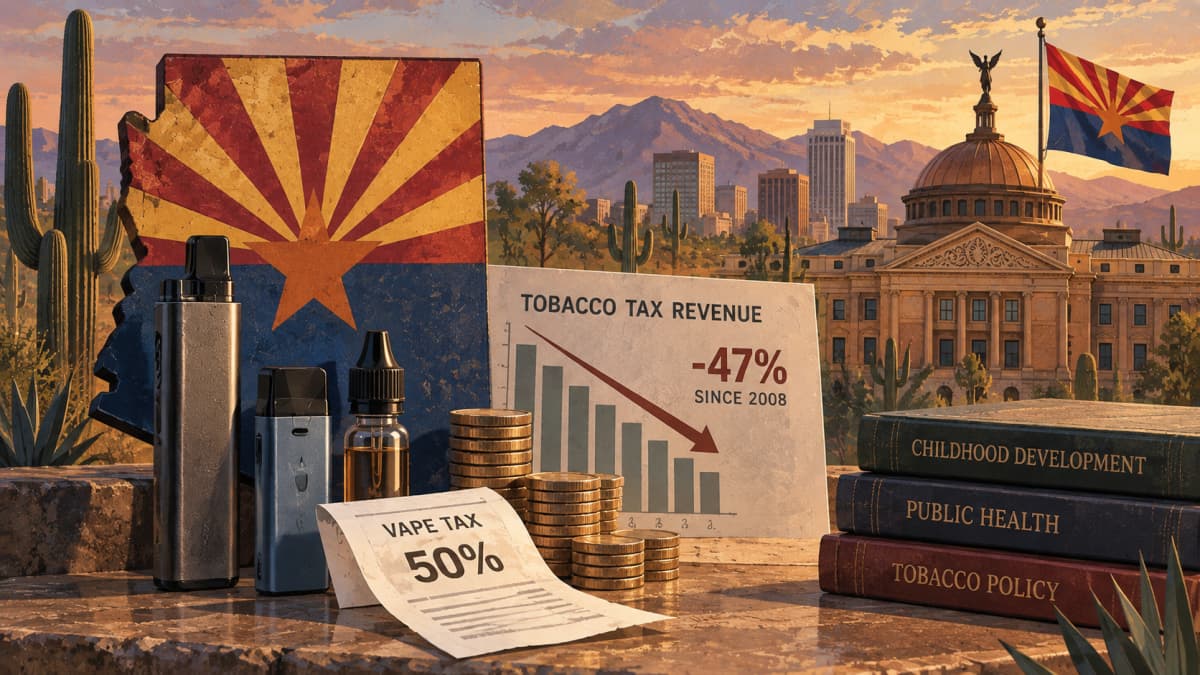
Arizona is considering a new tax on vaping products as declining cigarette use continues to reduce the revenue available for the state’s early childhood programs.
First Things First, the Arizona agency responsible for distributing dedicated funding for early childhood development, is asking state lawmakers to consider a 50% tax on the retail price of vaping products. The proposal is intended to generate roughly $100 million a year, according to KJZZ’s September 15 report.
The proposal has not become law. Any new Arizona tax would require approval by two-thirds of both the state House and Senate, followed by the governor’s approval.
Arizona Wants to Replace Falling Tobacco Tax Revenue
The organization attributes the decline not only to fewer people smoking, but also to consumers switching to products such as vapes, e-cigarettes and nicotine pouches, which are not included in the existing dedicated tobacco-tax structure.
It was created after Arizona voters approved a tobacco tax initiative in 2006. The funding mechanism includes an 80-cent-per-pack tax on cigarettes, with the revenue supporting early childhood programs.
However, cigarette tax collections have declined substantially as smoking rates have fallen and consumers have moved toward newer nicotine products.
It said in its 2026 annual report that tobacco tax revenue has fallen 47% since 2008, reducing the agency’s annual revenue by more than $76 million compared with that period. The agency reported that its tobacco-tax funding was about $88 million in 2025.
The organization attributes the decline not only to fewer people smoking, but also to consumers switching to products such as vapes, e-cigarettes and nicotine pouches, which are not included in the existing dedicated tobacco-tax structure.
Proposed Vape Tax Would Be Based on Retail Price
Under the proposal currently being promoted by First Things First, vaping products would face an excise tax equal to 50% of their retail value.
That would make the proposed tax different from a traditional fixed-rate cigarette tax. For example, if an eligible vaping product has a pre-tax retail price of $10, a 50% retail-value tax would add $5 to the purchase price.
KJZZ reported that First Things First estimates the proposal could raise approximately $100 million annually for early childhood programs. The agency’s CEO, Melinda Morrison Gulick, has been promoting the proposal as a way to address the funding gap created by declining tobacco-tax revenue.
The proposed 50% rate is not necessarily final. First Things First has indicated that the rate could still be discussed with lawmakers.
Arizona Previously Considered a 50% Wholesale Vape Tax
The latest proposal follows earlier attempts to expand Arizona’s nicotine tax base.
Arizona’s proposal is part of a broader shift in how states are approaching vape taxes and nicotine product regulation as traditional cigarette-tax revenue declines.
In 2025, state Rep. Consuelo Hernandez and other lawmakers introduced HB 2778, which proposed a 50% tax on the wholesale price of nicotine and vapor products. That proposal did not complete the legislative process.
In 2026, HB 4032 took a different approach. The bill proposed a 50% excise tax on alternative nicotine products and vapor products based on their retail selling price. The bill defined a vapor product broadly to include devices such as e-cigarettes, vape pens and e-hookahs, along with certain components and substances used with those devices.
HB 4032 also proposed dividing the resulting revenue among several state funds and programs. However, the bill did not advance during the 2026 legislative session.
First Things First’s 2026 annual report specifically identifies HB 4032 as its second attempt to modernize the tax structure by addressing the shift from traditional tobacco products toward vaping and other nicotine products.
New Arizona Nicotine Regulations Are Already Moving Forward
Although the proposed vape tax has not become law, Arizona has separately enacted new regulations covering alternative nicotine products.
Arizona’s approach also reflects the growing focus on regulation of alternative nicotine products across the U.S., including licensing, product definitions and retail requirements.
HB 4001 became Chapter 124 after being signed by the governor. The law establishes licensing requirements for businesses that manufacture or distribute alternative nicotine products in Arizona, along with additional sales and marketing restrictions.
The law defines an alternative nicotine product as a noncombustible product containing nicotine that is intended for human consumption through methods including chewing, absorption, dissolution, ingestion or inhalation. Certain tobacco products and products regulated by the U.S. Food and Drug Administration as drugs or devices are excluded from the definition.
The licensing provisions are scheduled to take effect at the beginning of 2028. Manufacturers and distributors will generally need the appropriate state licenses to supply alternative nicotine products for sale in Arizona, while retailers will be restricted from purchasing such products from unlicensed manufacturers or distributors.
This creates an important distinction in Arizona’s current policy landscape: regulation of alternative nicotine products has been enacted, while the proposed 50% vape tax has not.
Industry Raises Concerns About Consumer Behavior
The proposed tax has also drawn attention from representatives of Arizona’s vaping and nicotine-product industry.
John Paul Willett, president of Arizona Innovates, told KJZZ that the organization is open to discussions about generating additional funding for state programs, but said policymakers should consider how the tax could affect consumers and businesses.
One issue raised by the industry is whether a high retail tax could encourage some consumers to purchase products through out-of-state sellers or informal markets.
Such a shift could affect licensed Arizona retailers and potentially reduce the amount of revenue ultimately collected by the state. These concerns remain part of the broader policy discussion rather than established outcomes of the proposed tax.
What Happens Next?
The proposed 50% Arizona vape tax remains a policy initiative rather than an enacted tax.
The state has moved through several stages over the past two years: a 50% wholesale tax proposal in 2025, a 50% retail-price tax proposal through HB 4032 in 2026, and the enactment of HB 4001 establishing a separate regulatory framework for alternative nicotine products.
For now, the key question is whether First Things First and Arizona lawmakers will turn the latest proposal into a new bill and, if so, which nicotine products would ultimately be covered.
Until formal legislation is introduced and approved, the proposed 50% retail tax on vaping products should not be described as a current Arizona tax. The final tax rate, product definitions, revenue allocation and effective date would depend on any future legislation passed by the Arizona Legislature and signed by the governor.