










A vape coil rarely stops working without warning. More often, its performance gradually changes: flavor becomes muted, vapor production drops, the familiar taste of an e-liquid starts to feel different, or an unpleasant burnt note appears during a puff. These changes are easy to blame on the device or e-liquid, but the coil is often the part responsible.
So, how long should a vape coil actually last? There is no universal replacement schedule. A coil used occasionally with a simple, low-sweetener e-liquid may remain usable much longer than one exposed to frequent high-wattage vaping and heavily sweetened liquids.
Understanding coil lifespan is less about counting days and more about recognizing what happens inside the heating assembly. The wick, heating element, e-liquid formulation, airflow and operating temperature all influence how quickly performance deteriorates.
This guide examines the real factors behind vape coil wear, explains why some coils fail sooner than others, and explores practical ways to recognize when replacement is necessary.
What Is the Typical Lifespan of a Vape Coil?
For many refillable vape systems, a replaceable coil may last approximately one to two weeks under regular use. However, this is only a general estimate, not a guaranteed service interval.
Some coils may need replacement after several days, while others can remain functional for longer depending on usage and maintenance.
| Usage pattern | Possible coil lifespan |
|---|---|
| Light, occasional use | Two weeks or longer |
| Moderate daily use | Around one to two weeks |
| Frequent daily use | Several days to one week |
| High-wattage, intensive use | Potentially only a few days |
These estimates are illustrative. Coil construction, device settings, liquid composition and individual habits can produce substantially different results.
It is also important to distinguish between a coil that still heats and one that performs properly. A coil might continue producing vapor even after its flavor quality has declined considerably.
The practical replacement point is when the coil can no longer deliver consistent performance without burnt or otherwise unpleasant characteristics.
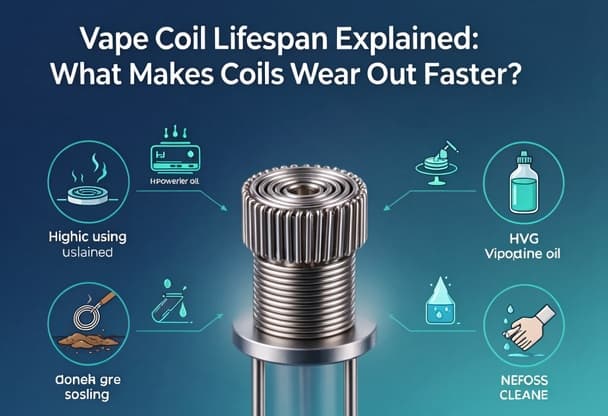
The Hidden Reason Coils Wear Out: Heat and Residue
A vape coil is more than a metal heating element. In a conventional replaceable-coil design, the assembly typically contains a resistive heating element surrounded by an absorbent wick.
When the device operates, the heating element warms the e-liquid held in the wick, producing an aerosol. This process repeatedly exposes the wick and surrounding surfaces to heat and liquid ingredients.
Two processes contribute significantly to deterioration.
First, repeated heating affects the wick. If the wick becomes excessively hot or cannot absorb enough liquid between activations, its material can become damaged. Once this happens, liquid delivery and flavor consistency may suffer.
Second, e-liquid ingredients can leave deposits. Sweeteners, flavoring compounds and other non-volatile ingredients may accumulate on or around the heating surface. Over time, these deposits can interfere with heat transfer and contribute to unpleasant flavors.
This explains why a coil can deteriorate even when the device appears to be functioning normally. The battery may be healthy, the tank may be full, and the display may show no warning, yet the heating assembly may already be losing its original performance.
5 Factors That Determine How Quickly a Vape Coil Wears Out
The same replacement coil can perform very differently in two devices, even when both users choose the same e-liquid. The difference often comes down to operating conditions rather than the coil itself.
1. E-liquid Sweeteners and Flavor Ingredients
E-liquid composition is one of the most important influences on coil condition.
Sweet dessert, candy and bakery-style flavors may contain ingredients that leave more residue on the heating surface. As this material accumulates, it can darken the wick and affect the way heat reaches the liquid.
This is why a coil used with a heavily sweetened dessert flavor may lose its original taste sooner than one used with a less sweet formulation.
Dark-colored liquid is not automatically bad for a coil, and clear liquid is not necessarily residue-free. The actual formulation matters more than appearance.
What to watch: If a coil consistently deteriorates quickly with one particular flavor but lasts longer with another, the e-liquid formulation may be contributing to the difference.
2. Operating Wattage and Heat Output
Power settings have a direct influence on how much heat the coil produces.
Running a coil near the upper end of its recommended wattage range can increase liquid consumption and thermal stress. If the wick cannot replenish the evaporated liquid quickly enough, parts of the heating assembly may become insufficiently saturated.
However, higher wattage does not automatically mean a shorter lifespan in every situation. Coil resistance, mesh design, airflow and liquid delivery capacity all affect how a particular coil handles power.
The safest reference is the wattage range printed on the coil or specified by its manufacturer. A device’s maximum output should never be treated as the ideal setting for every installed coil.
3. Chain Vaping and Insufficient Recovery Time
Taking repeated puffs with almost no pause can prevent the wick from absorbing enough fresh e-liquid between activations.
The wick works through capillary action, drawing liquid from the reservoir toward the heating surface. This process takes time. When liquid evaporates faster than it can be replenished, localized dry areas can develop.
Research into e-cigarette chemistry identifies poor wicking and insufficient cooling between puffs as factors that can contribute to overheating and thermal degradation.
This is particularly relevant to devices designed for frequent use or higher power output. Their liquid consumption may be greater, making adequate liquid delivery and cooling important.
4. E-Liquid Viscosity and PG/VG Ratio
Not every e-liquid flows through every coil equally well.
Propylene glycol (PG) is generally thinner, while vegetable glycerin (VG) is thicker. High-VG liquids can be difficult for some small pod coils or tight wick openings to absorb quickly.
When the liquid is too viscous for a particular coil design, the wick may struggle to keep the heating surface supplied, especially during frequent use.
This does not mean high-VG e-liquid is inherently unsuitable. Some sub-ohm tanks are specifically designed for thicker formulations and higher liquid consumption.
The important point is compatibility: follow the device manufacturer’s recommended e-liquid ratio instead of assuming every refillable system can handle the same liquid.
5. Poor Priming of a New Coil
A replacement coil needs sufficient time for its wick to become saturated before the first activation.
Installing a dry coil and immediately firing the device can scorch the wick before it has absorbed enough liquid. Once cotton has been seriously scorched, normal use will not restore its original condition.
A common mistake is filling a tank, taking a puff immediately and assuming the liquid has already reached the entire wick.
The correct priming process depends on the coil design, but generally involves:
-
Installing the replacement coil correctly.
-
Filling the tank or pod with compatible e-liquid.
-
Allowing the wick to absorb liquid for the period recommended by the manufacturer.
-
Starting within the recommended power range rather than exceeding it.
Priming is not a way to extend an already damaged coil’s life. It is a precaution intended to prevent premature damage when installing a replacement.
6. Letting the E-Liquid Level Get Too Low
A tank or pod does not need to be completely empty before liquid delivery becomes a problem.
Many coil designs have visible liquid-entry openings. If the liquid level falls below these openings, the wick may no longer receive a consistent supply.
The resulting lack of saturation can cause localized overheating. Scientific research has linked insufficient liquid around the wick and heating element with increased temperatures and changes in aerosol composition.
Keeping the reservoir within its recommended filling range is therefore important for normal device operation.
7. Coil Quality and Manufacturing Differences
Two replacement coils carrying the same model number may not always perform identically.
Manufacturing tolerances, wick placement, heating-element contact and material consistency can influence how evenly a coil heats and how efficiently it receives liquid.
A peer-reviewed study examining manufacturing variation in e-cigarette coils found differences in coil resistance and aerosol generation among products that were nominally identical.
If several coils from the same pack fail unusually quickly under otherwise consistent conditions, the problem may involve product quality rather than your vaping habits.
Why Some Coils Burn Out After Only a Few Days
A coil that fails unusually quickly deserves a closer look. Replacing it repeatedly without identifying the cause can become expensive and may leave the underlying problem unresolved.
Consider these common scenarios:
| What happens | Possible explanation |
|---|---|
| Burnt taste immediately after installation | Insufficient priming or incorrect installation |
| Burnt taste after several days | Wick deterioration or residue buildup |
| Flavor becomes weak gradually | Deposits on the heating surface or changing liquid delivery |
| Coil performs poorly at higher power | Wattage may exceed the coil’s practical operating range |
| Several coils fail with one liquid | The formulation may be contributing to residue or poor wicking |
| Coil fails despite careful use | Manufacturing variation or a device-related problem |
One distinction is particularly important: a burnt taste immediately after installing a new coil is different from a flavor that gradually becomes dull over time.
The first may indicate an installation or saturation problem. The second is more consistent with progressive wear.
Do not continue using a coil that produces a persistent burnt or unusually harsh taste. Replace it and check the device’s compatibility and operating instructions.
8 Signs That a Vape Coil Is Reaching the End of Its Life
Rather than relying on a fixed number of days, look for changes in performance.
Other warning signs include unusual gurgling, inconsistent vapor production and a persistent change in device performance.
Not every symptom means the coil is finished. A loose connection, damaged pod seal, blocked airflow or incorrect liquid can create similar problems. Check the device before assuming the heating element is responsible.
Can You Make a Vape Coil Last Longer?
Coil lifespan cannot be extended indefinitely, but understanding the causes of premature wear can help avoid unnecessary replacements.
For more practical advice on coil care, priming and replacement, read our step-by-step guide to maintaining and replacing vape coils.
Here are several practical considerations:
-
Follow the recommended wattage: Avoid treating the maximum power setting as the default operating level.
-
Use compatible e-liquid: Check the recommended PG/VG ratio and avoid liquids that are too thick for the device.
-
Allow proper liquid absorption: Follow the manufacturer’s priming instructions whenever installing a replacement coil.
-
Avoid repeated overheating: Insufficient time between activations can interfere with liquid replenishment.
-
Keep the tank adequately filled: Do not allow the liquid level to fall below the coil’s required feeding openings.
-
Clean the tank when changing flavors: Residual liquid and deposits can affect the taste of a fresh coil.
-
Use compatible replacement parts: An incorrectly matched coil can create performance problems even when it physically fits the device.
These practices help maintain normal operating conditions, but they cannot reverse existing wick damage or guarantee a particular number of days of use.
Do Mesh Coils Last Longer Than Traditional Coils?
Mesh coils and traditional wire coils use different heating-element designs.
A traditional coil generally uses a wound metal wire, while a mesh coil uses a perforated metal sheet or mesh structure. Mesh designs can distribute heat across a broader surface, depending on their construction.
This can contribute to more even heating, but it does not automatically mean every mesh coil lasts longer.
Coil construction also influences heating behavior and liquid distribution. Our guide to mesh, ceramic and cotton vape coil technologies explains the differences between these common designs.
Actual lifespan still depends on:
-
Mesh material and surface area.
-
Wick design and liquid absorption.
-
Operating wattage.
-
E-liquid formulation.
-
Frequency of use.
-
Manufacturing quality.
A well-designed traditional coil may outlast a poorly matched mesh coil. It is therefore more useful to compare the manufacturer’s specifications and real-world replacement requirements than to judge lifespan by coil type alone.
Can You Clean a Used Vape Coil Instead of Replacing It?
Cleaning may remove some surface residue from certain removable tank components, but it cannot reliably restore a damaged wick.
In particular, cotton that has been scorched cannot be returned to its original condition simply by rinsing it with water.
There is also a difference between cleaning the tank and cleaning the coil:
-
Tank: Removable glass, metal and other compatible tank components can generally be cleaned according to the manufacturer’s instructions.
-
Replaceable coil head: Cleaning may remove some residue, but it does not guarantee restored performance.
-
Integrated pod coil: Many sealed pods are designed to be replaced as a complete unit rather than dismantled.
If a coil has a persistent burnt taste, replacing it is the more appropriate option. Avoid attempting to burn off deposits or disassemble sealed pods.
Frequently Asked Questions
How long does a vape coil last on average?
Many replaceable coils last around one to two weeks with moderate use, but this is only a rough estimate. Heavy use, unsuitable liquid, high operating power and poor priming can shorten that period.
Why does my vape coil burn out after three days?
Possible causes include insufficient priming, frequent consecutive puffs, excessive wattage, thick e-liquid that cannot wick efficiently, or residue-producing liquid formulations. Check the coil’s compatibility and recommended operating range before installing another one.
Does sweet e-liquid shorten coil lifespan?
Some heavily sweetened e-liquids can leave more deposits on heating surfaces and wicks. The effect depends on the formulation, coil construction and operating conditions.
Does higher wattage make coils wear out faster?
It can. Higher power generally increases heat output and liquid consumption. If the wick cannot replenish liquid quickly enough, overheating may occur. Always follow the coil manufacturer’s recommended wattage range.
Should I replace my coil when the e-liquid tastes burnt?
A persistent burnt taste is a strong reason to stop using that coil and replace it. If the taste appears immediately after installation, also check whether the new wick was properly saturated.
Do replacement coils expire?
Coils do not necessarily have a universal expiration date, but prolonged storage in unsuitable conditions can affect materials and packaging. Keep replacement coils in their original packaging, away from excessive heat and moisture, and follow the manufacturer’s storage guidance.
Final Thoughts: Coil Lifespan Is About More Than Time
There is no single number that accurately describes the lifespan of every vape coil. Two people using the same device may experience very different replacement intervals because their e-liquids, operating settings and usage patterns are different.
The most important factors are liquid residue, wick saturation, heat exposure, liquid compatibility and manufacturing consistency.
Instead of automatically replacing a coil after a fixed number of days, pay attention to changes in flavor and performance. Persistent burnt tastes, declining flavor quality and recurring wicking problems are more useful warning signs than the calendar.
Understanding these factors also makes it easier to distinguish normal coil wear from problems caused by incorrect settings, incompatible e-liquid or damaged device components.