











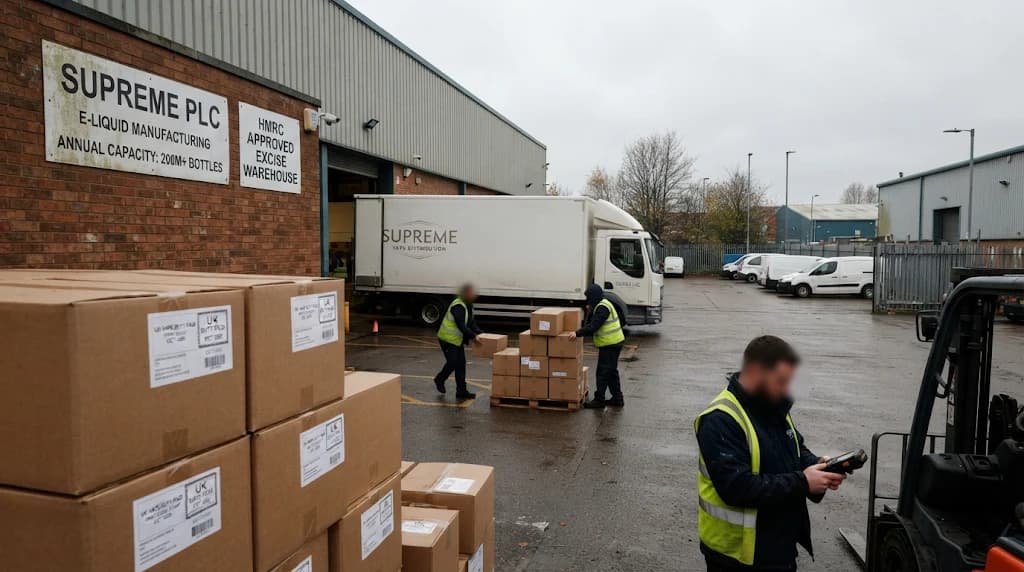
UK-listed consumer products group Supreme plc (AIM: SUP) reported a 7% year-on-year increase in vaping revenue for the first half of its 2027 financial year, even as the industry prepares for a more demanding tax and compliance environment.
In its half-year results released on November 24, 2026, Supreme said vaping revenue reached £82.1 million for the six months ended September 30, accounting for approximately 57% of total group revenue. The company also confirmed that its relationship with vaping brand IVG has expanded beyond distribution to include contract manufacturing.
However, preparations for the UK’s new Vaping Products Duty (VPD) have placed considerable pressure on working capital. Supreme invested £30.2 million in additional vape liquid and pod inventory ahead of the tax’s introduction on October 1. The stock build-up contributed to a £16.2 million operating cash outflow and pushed the group’s adjusted net debt to £17.6 million.
Supreme believes the new regulatory environment could create additional challenges for smaller manufacturers, potentially accelerating consolidation in the UK vaping supply chain. Its Manchester facility, which has annual e-liquid production capacity exceeding 200 million bottles, could be positioned to benefit if more brands seek external manufacturing partners.
For a closer look at the potential impact on consumers and retailers, see our analysis of the UK’s £2.20-per-10ml vaping duty and its effect on e-liquid and pod prices.
Supreme’s Vape Revenue Rises 7%, but Inventory Spending Weighs on Cash Flow
Vaping remains Supreme’s largest business segment, contributing more than half of group revenue.
For the first half of FY2027, group revenue increased 9% year on year to £143.9 million. Gross profit rose 6% to £40.6 million, while adjusted EBITDA edged up 1% to £18.8 million. Profit before tax, however, declined 14% to £10.5 million.
The vaping division generated £82.1 million in revenue, compared with £76.8 million in the same period a year earlier. Its gross profit increased 4% to £24.5 million, although the gross margin slipped from 30.7% to 29.9%.
This suggests that revenue growth has not translated into an equivalent improvement in profitability. The transition toward reusable vaping products, increased operating expenditure, and changes in the product mix have all become important factors in assessing the division’s performance.
Supreme FY2027 First-Half Financial Performance
| Financial metric | H1 FY2026 | H1 FY2027 | Year-on-year change |
|---|---|---|---|
| Group revenue | £132.6m | £143.9m | +9% |
| Vaping revenue | £76.8m | £82.1m | +7% |
| Vaping gross profit | £23.6m | £24.5m | +4% |
| Vaping gross margin | 30.7% | 29.9% | -0.8 percentage points |
| Vaping share of group revenue | 58.0% | 57.1% | -0.9 percentage points |
| Adjusted group EBITDA | £18.5m | £18.8m | +1% |
| Group profit before tax | £12.2m | £10.5m | -14% |
| Operating cash flow | £3.8m | -£16.2m | Down £20m |
| Adjusted net debt | £4.1m | £17.6m | Up £13.5m |
Source: Supreme plc FY2027 half-year results. Adjusted net debt excludes IFRS 16 lease liabilities. Figures and growth rates follow the company’s reporting basis.
One of the biggest financial developments was the inventory investment made ahead of the new vaping duty.
Supreme spent £30.2 million building stocks of vape liquids and pods by September 30, aiming to maintain product availability during the six-month transition period associated with the new tax regime.
This inventory investment significantly changed the group’s cash position. Operating cash flow moved from a £3.8 million inflow in the previous corresponding period to a £16.2 million outflow.
At the end of September, Supreme had shifted from adjusted net cash of £7.5 million at the beginning of the financial year to adjusted net debt of £17.6 million. Bank borrowings reached £19.7 million, although the group still had £20.3 million of undrawn borrowing facilities available.
The regulatory preparations of other major players in the IVG supply chain are also worth examining, including our report on IVG’s parent company obtaining HMRC approval ahead of the UK vaping duty.
During the November 24 results presentation, CFO Suzanne Smith said September vaping sales had increased noticeably ahead of the duty’s introduction, while October trading was comparatively subdued. Management expects monthly sales fluctuations to be greater than usual during the second half, although it currently anticipates broadly stable overall volumes.
Disposable Vape Ban Reshaped Supreme’s Product Mix
Supreme’s latest results also reflect a longer-term transformation in the UK vaping market following the disposable vape ban.
The UK ban on single-use vapes took effect on June 1, 2025, covering both nicotine-containing and nicotine-free disposable products. Before the restriction, disposable devices represented a substantial portion of Supreme’s vaping business.
In FY2025, the company generated £54.1 million from disposable vapes, equivalent to approximately 42% of its £129 million vaping revenue.
Following the regulatory change, Supreme shifted its product offering toward reusable devices and replaceable-pod systems while expanding distribution for third-party brands.
For the financial year ended March 31, 2026, vaping revenue increased 15% to £148.1 million. Supreme said it retained all major retail customers during the transition and did not experience significant inventory write-downs or additional indirect operating costs.
However, the company also acknowledged that reusable alternatives generated lower margins than the disposable products they replaced.
Supreme’s Vaping Business Before and After the UK Disposable Ban
| Metric | FY2025 | FY2026 |
|---|---|---|
| Vaping revenue | £129.0m | £148.1m |
| Year-on-year revenue growth | — | +15% |
| Disposable vape revenue | £54.1m | — |
| Disposable share of vaping revenue | Approximately 42% | — |
| Group gross margin | 32% | 29% |
Source: Supreme FY2026 annual results. FY2026 included the first two months of the UK disposable vape ban. A dash indicates that the corresponding figure was not provided in the cited reporting data.
The shift toward reusable vaping products is also visible in consumer behavior.
According to a July 2026 survey published by Action on Smoking and Health (ASH), approximately 5.5 million adults in Great Britain used e-cigarettes. The proportion primarily using refillable pod devices increased from 15% in 2024 to 42% in 2026.
Over the same period, open-system tank devices accounted for 48% of primary device use, while disposable vapes represented 8%.
For manufacturers and distributors, this shift means that product development, replacement-pod supply, and refillable-device distribution are becoming increasingly important to the UK market.
Supreme Expands IVG Partnership Into Contract Manufacturing
Beyond distribution, Supreme is developing its manufacturing business as another source of growth.
The company operates several vaping brands, including 88Vape and Liberty Flights, while also distributing products from third-party brands such as ELFBAR, LOST MARY, Hayati, and IVG.
Its wider consumer distribution network reaches approximately 55,000 retail outlets and includes more than 3,000 active business customer accounts.
A particularly important development is the expansion of its relationship with IVG.
Supreme began distributing IVG products during FY2026. In its latest half-year report, the company confirmed that it is now also providing manufacturing services for the brand.
This moves the relationship beyond the traditional distributor-retailer model and gives Supreme another opportunity to generate revenue from its production facilities.
The company says its Manchester manufacturing site has annual e-liquid production capacity of more than 200 million bottles, making it one of the largest e-liquid manufacturing operations in the UK.
For comparison, Supreme previously reported actual annual production of approximately 70 million 10ml e-liquid bottles in its FY2026 annual report. The difference between current production and installed capacity suggests there may be room to accommodate additional contract manufacturing demand, although capacity does not necessarily translate into actual output or sales.
Supreme has also reported growth in its third-party 10ml e-liquid manufacturing activities.
Management believes that the new vaping duty and associated compliance requirements could make manufacturing more difficult for smaller operators. Companies without sufficient financial resources, production infrastructure, or regulatory systems may face higher operating costs.
If this happens, more brands could consider outsourcing production to larger manufacturers with established facilities and compliance capabilities.
That could create additional opportunities for Supreme’s contract manufacturing business, although the extent of any future market consolidation remains uncertain.
UK’s £2.20 Vaping Duty Changes Manufacturing and Compliance Requirements
The UK’s Vaping Products Duty officially came into effect on October 1, 2026.
The tax applies to both nicotine-containing and nicotine-free vaping liquids at a uniform rate of £2.20 per 10ml.
The new regime goes beyond simply collecting tax on e-liquid sales. Manufacturers, importers, and other businesses involved in the supply chain must also address approval requirements, duty stamps, product tracking, recordkeeping, and storage arrangements.
Digital functionality is being introduced into the duty-stamp system from January 1, 2027. From April 1, 2027, relevant vaping products outside duty-suspension arrangements must carry a valid duty stamp.
Supreme said it had obtained excise warehouse status and upgraded its production lines and supporting systems to meet the new requirements.
These preparations include packaging changes, duty-stamp application, scanning equipment, and recordkeeping infrastructure. Approved excise warehouse arrangements also allow eligible products to be stored under duty suspension, with the duty becoming payable when the products enter the relevant taxable circulation.
The group reported capital expenditure of £2.6 million during the first half, mainly related to its health food manufacturing facilities and vaping production-line modifications.
The new system could create a competitive divide between manufacturers that can absorb the additional administrative and operational requirements and smaller businesses that need to invest in new infrastructure.
For established manufacturers such as Supreme, compliance investment may become a competitive advantage if customers increasingly prefer suppliers with the necessary production capacity and tax-management systems.
However, the new duty also introduces an additional cost into the UK vaping supply chain, potentially affecting product pricing, consumer demand, and manufacturer margins.
Supreme Has Tested a Scenario in Which Its 10ml E-Liquid Revenue Falls to Zero
Despite its investment in manufacturing capacity, Supreme is also evaluating the potential downside of the new tax regime.
In its FY2026 annual report, the company disclosed that it had modelled an extreme scenario in which revenue from its existing 10ml e-liquid business fell to zero.
Supreme said the group would remain a going concern under that hypothetical situation.
This scenario highlights the uncertainty surrounding the long-term effect of the vaping duty. A uniform £2.20 charge per 10ml could change consumer purchasing behavior and influence the economics of different product formats.
Manufacturers may need to adjust product portfolios, pricing strategies, and distribution arrangements as the market responds to the additional tax burden.
For Supreme, contract manufacturing, reusable-device distribution, and its wider consumer products portfolio provide potential sources of diversification.
Spanish Vape Revenue Falls 26% Following Earlier Tax Changes
Supreme’s experience in Spain provides another indication of how tax changes can affect vaping sales patterns.
Revenue from the Spanish market declined from £6.71 million in the first half of FY2026 to £4.96 million in the first half of FY2027, representing a 26% year-on-year fall.
CFO Suzanne Smith explained during the results presentation that the Spanish revenue came from the vaping business.
She said the market had previously experienced a similar pattern when a comparable vaping tax was introduced: sales increased ahead of implementation before declining afterward. Trading has since returned to more normal levels.
The Spanish experience may offer a useful reference point for understanding the UK market, although differences in regulation, consumer behavior, and product distribution mean the two markets should not be treated as identical.
Supreme is also expanding outside vaping through acquisitions in beverages, health foods, and household consumer products.
During the first half, the newly acquired SlimFast and 1001 brands contributed additional revenue of £11.9 million and £1.5 million, respectively.
There was also pressure within the group’s retail distribution business. After major customer Poundland submitted a notice of intention to appoint administrators, Supreme recognized a £444,000 bad-debt provision.
The potential consequences of Poundland’s financial difficulties and any subsequent restructuring have not yet been fully reflected in the group’s financial outlook.
Supreme Maintains FY2027 Outlook as Management Expects Cash Recovery
Despite lower profit before tax and the temporary increase in borrowing, Supreme maintained its expectation that FY2027 performance would be in line with market expectations.
Management expects the working-capital impact of the pre-tax inventory build-up to ease as the additional stock is sold during the second half.
The company also expects to return to an adjusted net cash position by the end of FY2027, as inventory levels normalize and the six-month transition period for the vaping duty comes to an end.
However, the outlook remains subject to several uncertainties, including changes in monthly vaping sales, the effect of the new tax on consumer demand, the potential impact of Poundland’s financial difficulties, and the pace at which manufacturing customers shift toward outsourced production.
Supreme’s latest results therefore present two contrasting trends.
On one side, its vaping business continues to grow, reusable products are replacing disposable devices, and contract manufacturing opportunities are expanding through relationships such as IVG.
On the other, lower vaping gross margins, significant inventory spending, and new compliance costs are putting pressure on profitability and cash flow.
The longer-term question is whether the UK’s new vaping duty will simply increase operating costs across the industry or accelerate a structural shift toward larger manufacturers with the financial resources, production capacity, and regulatory infrastructure to support the next stage of the market.