










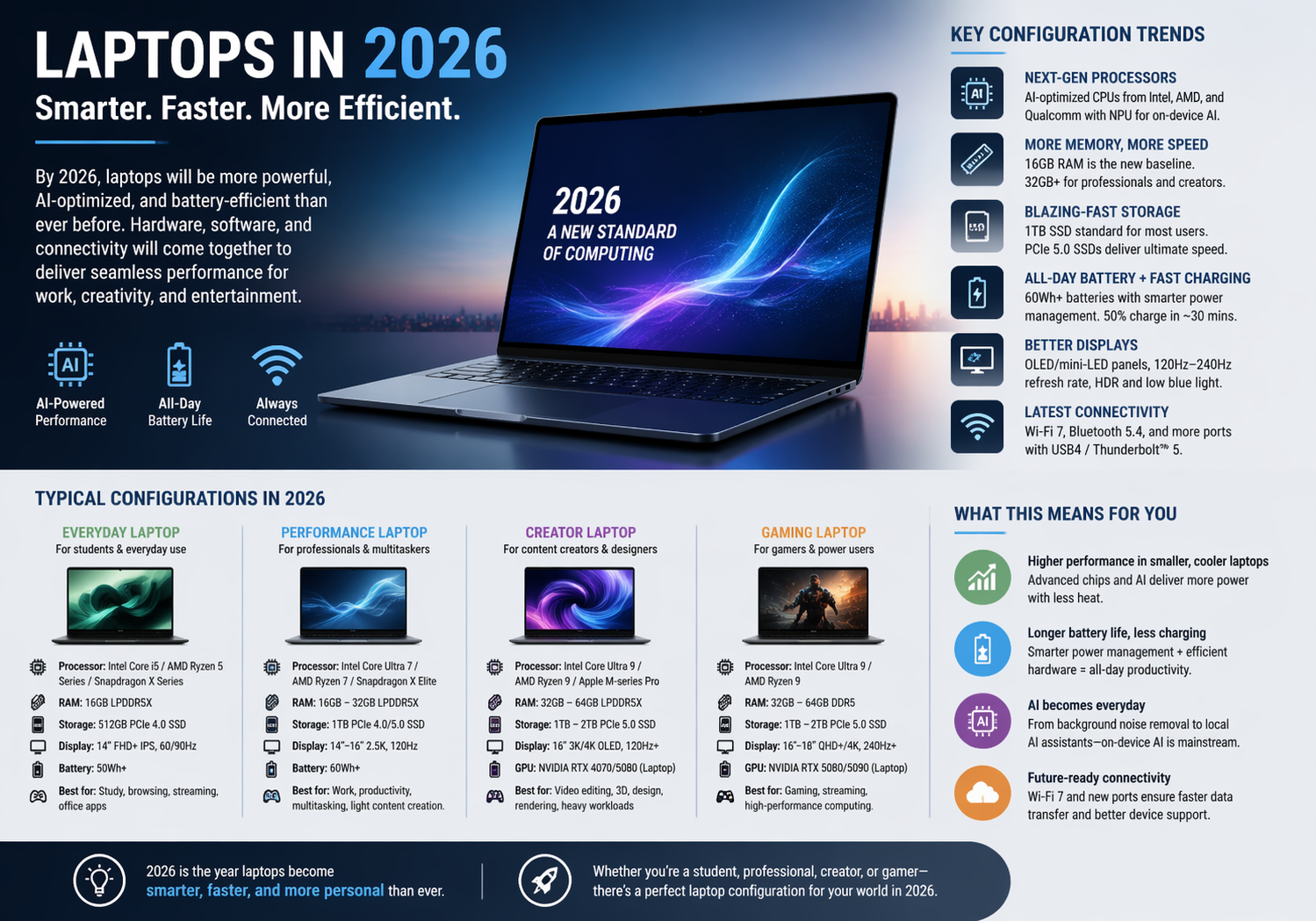
As we approach 2026, the world of laptops is poised for a major transformation. While today’s laptops are already powerful and versatile, the rapid pace of technological advancements suggests that the next generation of laptops will be even more capable, efficient, and integrated with our everyday lives. From ultra-performance components to futuristic designs, let’s take a look at how the configuration of laptops could evolve by 2026.
1. Processor and Performance: The Rise of Quantum and AI-Enhanced Chips
In 2026, the heart of a laptop—the processor—will see groundbreaking improvements. Currently, Intel, AMD, and ARM dominate the market with their respective chips. However, by 2026, we can expect these processors to be more integrated with AI and machine learning capabilities, improving speed and efficiency in real time.
The evolution of quantum computing may also begin to influence the consumer market. While quantum computers today are still far from being mainstream, by 2026, we could see hybrid chips, combining quantum processors with classical ones, offering an unprecedented leap in computational power for both consumer laptops and mobile workstations. These quantum-based processors could be especially useful in fields such as scientific computing, artificial intelligence, and cryptography.
Additionally, custom-designed chips by companies like Apple (e.g., the M-series) will continue to push boundaries. These chips, which already integrate the CPU, GPU, and neural engine, will become more powerful, reducing power consumption while dramatically improving performance in even the most demanding tasks.
2. Display Technology: Immersive, Flexible, and Ultra-High Definition
In 2026, laptop displays will be a major area of innovation. Current 4K and OLED displays will be replaced by even more advanced technologies, such as 8K displays, offering razor-sharp clarity. These high-resolution screens will also be brighter, with improved color accuracy, making them ideal for professional photographers, designers, and content creators.
Foldable and rollable screen technology will likely become a mainstream feature. These flexible displays will allow users to adjust the screen size depending on the task. Imagine having a compact 13-inch screen that can unfold or roll out to a 17-inch display when needed. This flexibility will be especially useful for professionals who need portability but also require larger screens for design, video editing, or multitasking.
Moreover, AR and VR capabilities will start to integrate directly into laptop displays, providing immersive experiences without the need for separate headsets. This will make augmented and virtual reality applications more accessible for both entertainment and professional uses.
3. Battery and Charging: Long-Lasting, Faster, and Wireless
One of the most pressing challenges for laptop manufacturers has always been battery life. However, by 2026, laptops could feature solid-state batteries or graphene-based batteries, both of which promise longer battery life and faster charging times. With these innovations, it’s entirely feasible to see laptops that last for 24+ hours on a single charge, even during intensive use. Quick charging technology will also make it possible to charge your laptop to 50% or more in just a few minutes.
Wireless charging will become more widespread, allowing laptops to charge without being physically plugged into a socket. Wi-Charge or other wireless power transmission technologies may enable laptops to be charged via air, making cables a thing of the past. This will help reduce the number of ports and simplify the design of laptops.
4. Connectivity: 5G and Beyond
By 2026, 5G will be fully integrated into laptops, offering ultra-fast internet speeds and low latency, ideal for cloud-based workflows, video conferencing, and real-time collaboration. With 5G networks expanding worldwide, users will experience seamless internet access wherever they go, transforming how remote work, gaming, and multimedia content are consumed.
Moreover, Wi-Fi 7 or even Wi-Fi 8 might be the standard by 2026, allowing data transfer rates that far exceed today’s Wi-Fi 6 technology, making it easier to handle high-bandwidth tasks like video editing, gaming, or large file transfers over the internet.
5. Design and Build: Minimalism Meets Sustainability
Laptop design will become even more minimalistic in 2026. With thinner bezels, lightweight materials, and more streamlined forms, laptops will become even more portable and aesthetically pleasing. However, the materials used will shift towards more sustainable and recycled components as the tech industry moves toward carbon-neutral manufacturing practices.
The chassis of laptops may be made from bio-plastics, recycled aluminum, and other eco-friendly materials. This trend will cater to growing environmental concerns while maintaining the sleek, premium finishes that consumers demand.
Additionally, modular designs could start to emerge, allowing users to swap out components like RAM, storage, or even the battery, reducing e-waste and prolonging the lifespan of devices. This approach would provide a blend of performance customization and environmental consciousness, offering an attractive proposition for tech enthusiasts and sustainability advocates alike.
6. Security: Biometric and AI-Powered Protection
As cybersecurity becomes an ever-growing concern, the future of laptop security will be deeply intertwined with artificial intelligence and biometric systems. Passwords may be completely phased out in favor of AI-powered facial recognition, fingerprint scanning, or even palm vein recognition for ultra-secure login processes.
Laptops in 2026 will likely incorporate AI-driven security systems that constantly monitor user activity and protect against cyber threats in real time. These systems will be capable of detecting phishing attempts, malware, and even unusual behavior patterns, instantly neutralizing threats without user intervention.
7. AI and Smart Integration: Laptops That Think
Artificial intelligence will be embedded into every aspect of laptops in 2026. From personalized user interfaces to predictive performance optimizations, laptops will become increasingly “smart.” They will learn from your habits and optimize resources automatically, such as switching between energy-saving and performance modes depending on usage.
AI will also enable laptops to provide contextual suggestions, such as recommending files, apps, or reminders based on the time of day or ongoing projects. Integrated AI assistants will be able to perform complex tasks without needing to interact with the user actively, such as automatically arranging meetings, writing reports, or even coding based on voice or text commands.
8. Ports and Peripherals: The Era of USB-C and Wireless Everything
By 2026, USB-C will dominate the port landscape, becoming the universal connection standard for power, data transfer, and peripherals. Legacy ports like HDMI, USB-A, and even Ethernet could be phased out completely, replaced by faster and more efficient wireless technologies.
External peripherals like monitors, keyboards, and mice will be entirely wireless, with Bluetooth 6 or similar technology offering instantaneous connections without any noticeable lag. Users will be able to seamlessly switch between multiple devices with a single set of peripherals, whether they’re on a laptop, tablet, or desktop.
Conclusion: A New Era of Laptops
The configuration of laptops in 2026 will be a harmonious blend of cutting-edge technology, sustainability, and user-centric design. With faster processors, stunning displays, longer battery life, and smarter AI features, laptops will continue to play a pivotal role in both professional and personal life. As technology continues to evolve, we can expect these portable computers to push the boundaries of what is possible, creating new opportunities and reshaping the way we work, create, and connect.