









According to reports by the British media, the British consumer goods group Supreme achieved record revenue for the fiscal year ending on March 31, 2026. The e-cigarette business continued to grow even after the UK’s one-time e-cigarette ban came into effect.
Supreme is headquartered in Manchester, UK. It is a fast-moving consumer goods manufacturing, distribution and brand management group, with its business covering categories such as e-cigarettes, batteries, lighting, beverages, health and nutrition. In recent years, the company has expanded its non-e-cigarette business through mergers and acquisitions in order to reduce its reliance on a single regulatory-sensitive category.
E-cigarette revenue increased by 15%
Supreme stated that as of the fiscal year ending on March 31, 2026, the group’s total revenue increased by 17% to 270.2 million pounds, setting a new record high. During the same period, the revenue from the e-cigarette business rose by 15% to 148.1 million pounds, an increase of nearly 20 million pounds compared to the previous fiscal year.
The ban on disposable electronic cigarettes in the UK will come into effect on June 1, 2025. Sandy Chadha, the CEO of Supreme, said that this ban is one of the most significant regulatory events for the industry in recent years, but the company’s e-cigarette business performance has exceeded expectations.
Chadha stated that Supreme maintained all major retail customers and assisted them in transitioning from disposable e-cigarettes to cartridge systems. The company believes that this demonstrates its channel and execution capabilities in the UK e-cigarette market.
However, the group’s profit margin was affected by investment and acquisition costs. The report indicates that Supreme’s underlying profit remained at 40.6 million pounds, while its pre-tax profit dropped by 14% to 26.7 million pounds. This was mainly due to factory investments as well as the costs associated with the acquisitions of Typhoo and SlimFast.
The one-time ban has driven changes in the product structure.
The UK’s ban on disposable e-cigarettes covers all such products and prohibits businesses from selling or supplying them. The government claims that the ban is aimed at reducing the use among teenagers and the environmental waste issues.
For the UK e-cigarette market, the ban has not led to a disappearance of demand; instead, it has prompted changes in the product structure. Some consumers and retailers have shifted to cartridge systems, reusable devices, and other products that meet the requirements.
Supreme’s performance reflects this shift. The company did not describe the one-time e-cigarette ban as a mere shock, but rather regarded it as a process of adjusting the product portfolio and distribution channels. By retaining major retail customers and promoting alternative products, Supreme still achieved an increase in e-cigarette revenue after the ban was implemented.
This result indicates that, under the backdrop of tightened regulation, the competitive focus of e-cigarette enterprises is shifting from a single best-selling disposable product to product substitution capabilities, retail customer management, inventory switching, and compliance execution.
VPD becomes the next regulatory node
Supreme stated that the UK e-cigarette product tax (Vaping Products Duty, VPD) will be the next major regulatory milestone for the industry. This tax system is expected to be implemented in October and will come with requirements such as packaging tax labels.
Chadha stated that the company has been preparing for the implementation of VPD in the second half of the 2025-26 fiscal year, including adjusting the manufacturing process to accommodate digital tax forms, reviewing packaging requirements, applying for tax deferral arrangements, and reconfiguring some of the warehousing operations.
The company believes that VPD may reduce industry sales volume, but it may also reduce illegal trade and concentrate the market towards mature and reliable distributors. Supreme stated that smaller competitors may face greater compliance burdens, while the company expects to be able to effectively address these issues and expand its market share.
For the UK e-cigarette industry, the impact of VPD may differ from the one-time e-cigarette ban. The one-time ban mainly changed the types of products that could be sold, while VPD will directly affect costs, pricing, packaging, warehousing and supply chain management.
Diversified acquisitions reduce the risk of a single regulatory oversight.
Apart from e-cigarettes, Supreme also operates businesses such as batteries, lighting, beverages, health and nutrition. In recent years, the company has expanded its non-e-cigarette segments through acquisitions in order to reduce the risks associated with the single-category nature caused by changes in e-cigarette regulations.
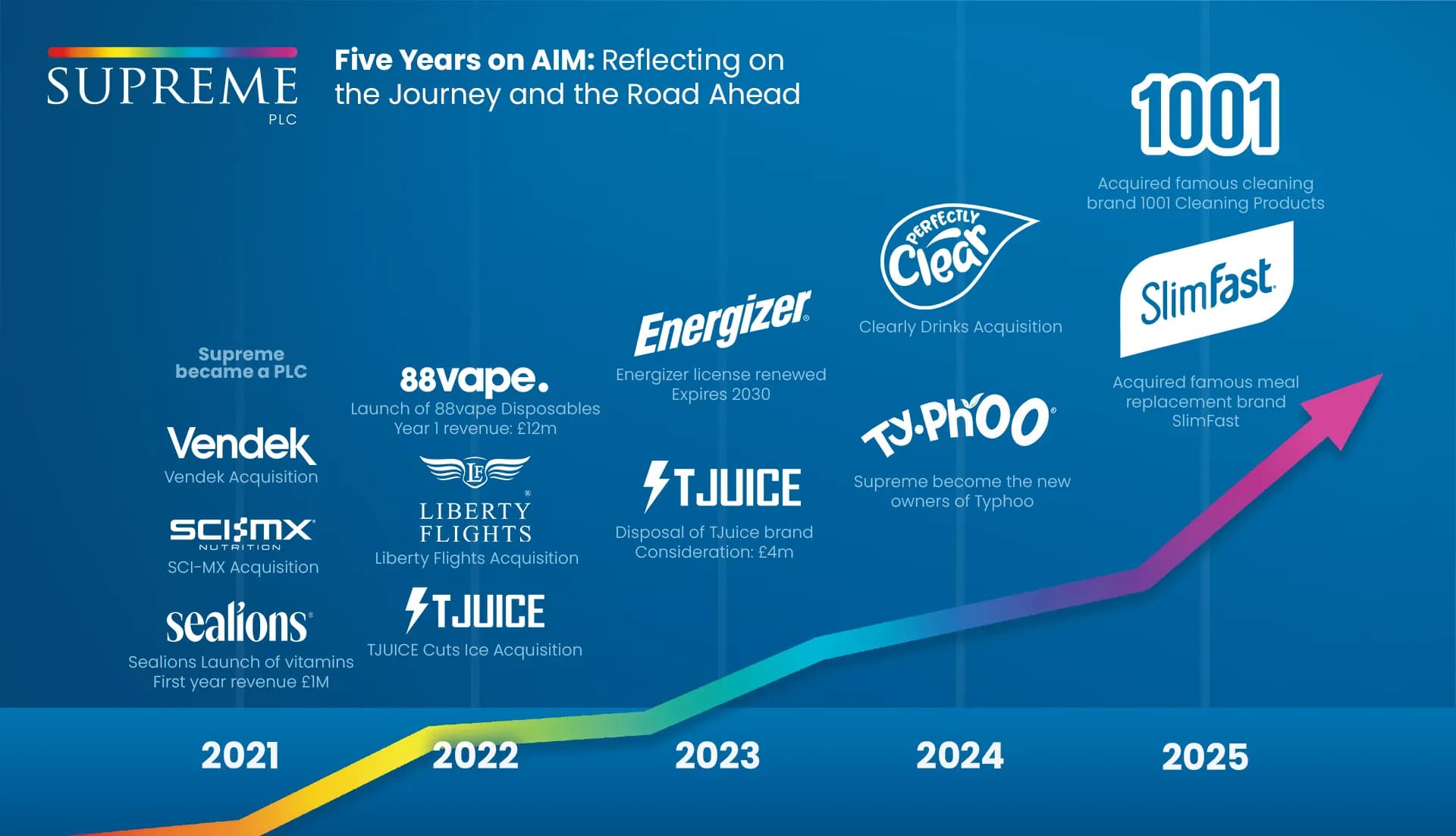
Supreme previously acquired Clearly Drinks to expand its soft drinks and bottled beverage business; subsequently, it acquired the British traditional tea brand Typhoo to enter the broader mass beverage market. In October 2025, Supreme announced the acquisition of SlimFast’s UK and European operations from Glanbia for 20.1 million pounds, further expanding its beverage and health business.
The report indicates that the revenue from the Supreme beverage and health business increased by 60% to 69.3 million pounds, and SlimFast began to contribute to the group just five months after being incorporated.
This diversified strategy holds significant importance in the context of the constantly changing regulations on e-cigarettes. E-cigarettes remain a crucial source of revenue for Supreme, but the growth of non-e-cigarette businesses helps to mitigate the risks posed by the one-time ban, VPD, tax tickets, and potential future regulatory changes.
From an industry perspective, the case of Supreme demonstrates that the UK e-cigarette market did not simply shrink after the one-time ban. Instead, it entered a stage of channel reorganization and compliance competition. Enterprises with capabilities in product switching, retail networks, financial strength, and tax compliance may gain a stronger advantage in the new regulatory environment.
Industry Impact and Subsequent Observations
The Supreme performance conveys three signals.
First, the UK’s ban on disposable e-cigarettes is reshaping the market rather than eliminating demand. Consumers and retailers are shifting towards cartridge systems, reusable devices, and other compliant products.
Secondly, the compliance capabilities of e-cigarette distributors will become even more crucial. The requirements for VPD, tax tickets, packaging, and storage will raise the operational barriers, driving the market towards enterprises with scale and system capabilities.
Thirdly, diversification could become an important strategy for UK e-cigarette-related enterprises to cope with regulatory risks. As the tax system and product regulations for e-cigarettes keep changing, enterprises relying on a single product category will face greater fluctuations.
Subsequently, it is necessary to pay attention to the changes in the price, sales volume and illegal trade of e-cigarettes in the UK after the implementation of VPD, as well as whether Supreme can expand its market share as expected under a higher compliance threshold.
Overall, Supreme’s annual performance indicates that the UK’s one-time ban on electronic cigarettes has not dampened the growth of its e-cigarette revenue, but the logic of industry competition has changed. In the future, product compliance, tax management, retail channel control, and business diversification will become important competitive factors in the UK’s e-cigarette market.